Financial Advisor
Showing posts with label Silver Forecast. Show all posts

Warren Buffett on Gold vs. Hommel on Gold!

Warren Buffet explained why he does not see the value in gold in his annual report from 2011.
http://www.berkshirehathaway.com/letters/2011ltr.pdf

 
http://ivanhoff.com/2013/04/15/warren-buffett-on-gold/
 

It was republished by ivanhoff, and came to my attention last week, which gave me this occasion to respond.   Here I go.

Buffett:
The second major category of investments involves assets that will never produce anything, but that are purchased in the buyer’s hope that someone else – who also knows that the assets will be forever unproductive – will pay more for them in the future. Tulips, of all things, briefly became a favorite of such buyers in the 17th century.


Hommel:
Buffett is claiming that Gold's value exists only because other people will buy it.  True.  True of all assets.  And this is exactly why gold is a good thing, because of all things, gold is most likely to be valuable in more places to more people than nearly any other item that you can consider, precisely because it is money.  But Buffett presents this as a bad thing, calling gold "unproductive".  Well, let's see, how is gold productive?  It can go up in value, just like stocks or bonds or housing, or any other asset.  People recognize that gold has value not because it gains value, but because it does not decay or rot or go bad.  Food makes a horrible form of money, partly because it goes bad.  One of the longest lasting kinds of food is the wheat kernel, which can last up to twenty years.  Gold lasts 6000 years, with no decay.


Buffett:
This type of investment requires an expanding pool of buyers, who, in turn, are enticed because they believe the buying pool will expand still further.  Owners are not inspired by what the asset itself can produce – it will remain lifeless forever – but rather by the belief that others will desire it even more avidly in the future.


Hommel:  True, gold buyers do not buy gold for what gold will produce, but most of my gold buyers are buying gold because they do believe it will go up in value, because they do believe that others will see what they can see, that gold is special, and cannot be printed to excess like paper money is being created to excess these days.  Gold buyers buy gold also because they recognize that gold does not decay, because it has a very high value for the weight and density which makes it portable, and because it can be hidden.

Buffett:  The major asset in this category is gold, currently a huge favorite of investors who fear almost all other assets, especially paper money (of whose value, as noted, they are right to be fearful). Gold, however, has two significant shortcomings, being neither of much use nor procreative. True, gold has some industrial and decorative utility, but the demand for these purposes is both limited and incapable of soaking up new production. Meanwhile, if you own one ounce of gold for an eternity, you will still own one ounce at its end.

Hommel:  True, gold is not procreative.  But this does not mean that gold cannot go up in value.  Gold does have a use.  The use is as a store of value.  The use is to communicate value over time.  Gold has three primary uses: as a store of value, as a unit of account, and as a medium of exchange.  These days, it is not used much as a medium of exchange, because no government on earth is issuing gold as circulating currency, but because all nations issue paper money.  This is making gold an excellent store of value, because gold is increasing in value more than all the paper money being continually printed.  The key use of gold in our times is not only in that it holds value, but gains value.  This is because the new supply of gold is far less than demand.  The world prints nearly $5 to $10 trillion worth of paper money per year, which is $5,000 to $10,000 billion.  In contrast, the world mines about 83 million ounces of new gold, at $1334/oz, is worth only a mere $111 billion.  Clearly, there will be more and more buyers of gold in the near and far future.

Buffett:  What motivates most gold purchasers is their belief that the ranks of the fearful will grow. During the past decade that belief has proved correct. Beyond that, the rising price has on its own generated additional buying enthusiasm, attracting purchasers who see the rise as validating an investment thesis. As “bandwagon” investors join any party, they create their own truth – for a while.

Hommel:  Gold buyers are derided as "fearful" by Buffett.  And he notes this has recently been correct.  But also wise.  He could have written, "The ranks of the wise will grow".  Perhaps more apt.

Buffett:  Over the past 15 years, both Internet stocks and houses have demonstrated the extraordinary excesses that can be created by combining an initially sensible thesis with well-publicized rising prices. In these bubbles, an army of originally skeptical investors succumbed to the “proof” delivered by the market, and the pool of buyers – for a time – expanded sufficiently to keep the bandwagon rolling. But bubbles blown large enough inevitably pop. And then the old proverb is confirmed once again: “What the wise man does in the beginning, the fool does in the end.”

Hommel:  True, bubbles happened in stocks and houses.  And probably still are in a bubble.  Is gold in a bubble?  When less than $100 billion is being mined each year?  I think not.  His buddy Bill Gates could buy half the world's annual gold production, and would probably become a lot more wealthy if he tried.  I say tried, because there is no way he would succeed, because his stock is not liquid enough to sell that much, and the gold market is too tight to buy half the gold market without pushing the gold price up, too.  My point is that the gold market boom is still in the beginning stages. 

Buffett:  Today the world’s gold stock is about 170,000 metric tons. If all of this gold were melded together, it would form a cube of about 68 feet per side. (Picture it fitting comfortably within a baseball infield.) At $1,750 per ounce – gold’s price as I write this – its value would be $9.6 trillion. Call this cube pile A.

Hommel:  Today, one to two years later, gold prices are down to $1335.  Buffet was right for one year out of a thirteen year bull market in gold.  Buffett will likely be wrong next year.  But 170,000 metric tonnes at $1335/oz. is x 32,151 oz/tonne is $7.3 trillion today. 
The tiny size of the cube of gold in pile A also explains why gold is valuable.  It contains a lot of value in a small space, making it very portable.  Some people wonder why gold should be any different than copper or any other metal, asserting that the other metals could be used just as easily as silver and gold.  Really?  Well, I have a 33 kilo block of copper that cost about $300, about the same as a ten oz. bar of silver.  Which would you rather carry to the grocery store?  Also, the copper has a spread on it to buy and sell of over 50%.  Or, would you prefer a quarter oz. of gold for about $330?

Buffett:  Let’s now create a pile B costing an equal amount. For that, we could buy all U.S. cropland (400 million acres with output of about $200 billion annually), plus 16 Exxon Mobils (the world’s most profitable company, one earning more than $40 billion annually). After these purchases, we would have about $1 trillion left over for walking-around money (no sense feeling strapped after this buying binge). Can you imagine an investor with $9.6 trillion selecting pile A over pile B?

Hommel:  Can you imagine an investor with $7.3 trillion to begin with?  There are no investors who are worth so much, are there Mr. Buffett?  Besides, even if there were, there is no evidence that the entire world supply of gold is being all offered at the current asking price for gold.  The vast majority of gold does not trade each year.  World annual mine supply ads only about 1.5% to the pile per year.  Well, let's calculate it.  http://www.goldsheetlinks.com/production2.htm  170,000 tonnes in existing stock.  World annual production about 2600 tonnes.  1.529%.  Yup, still the same after all these years.
But Buffett's point is that he cannot imagine any investor buying the gold instead of the farmland and oil companies.  But let's compare more clearly, $40 billion x 16  Exxon Mobils is $640 billion, plus the $200 billion from crops, which means the oil companies and land produce about $840 billion.  Well, how much does the pile of the world's gold produce?  Gold is likely to exceed $1900 in the next year or two, from $1336 today.  As it does, the pile of gold will go up from $7.3 trillion to $10.4 trillion.  Now let's compare shall we?  $640 billion gain in the oil companies, and $3.1 trillion, or $3100 billion in the gold pile.   I think I've made my point, but let me go further.  In actual fact, 16 Exxon Mobils don't exist.  It's a pure fantasy choice, as in, "not real".  The gold is real.  That makes the gold choice not only several times better, but infinitely better, doesn't it?

Buffett:  Beyond the staggering valuation given the existing stock of gold, current prices make today’s annual production of gold command about $160 billion.  Buyers – whether jewelry and industrial users, frightened individuals, or speculators – must continually absorb this additional supply to merely maintain an equilibrium at present prices.

Hommel:  As we have seen, the existing annual production of gold is now $111 billion, and being purchased not by "frightened individuals, or speculators", but by "wise investors," and even central banks now!  And again, with $5000 to $10,000 billion dollars worth of currency being printed world wide, I think the new gold will have plenty of ready buyers for decades to come.  In fact, Gold is acting not only as a value preserver, but value gainer, for those investors who don't want be robbed by governments.

Buffett:  A century from now the 400 million acres of farmland will have produced staggering amounts of corn, wheat, cotton, and other crops – and will continue to produce that valuable bounty, whatever the currency may be. Exxon Mobil will probably have delivered trillions of dollars in dividends to its owners and will also hold assets worth many more trillions (and, remember, you get 16 Exxons). The 170,000 tons of gold will be unchanged in size and still incapable of producing anything. You can fondle the cube, but it will not respond.

Hommel:  I'd wager that a century from now, none of the world's currencies today will have any value at all, but the gold still will.  Gold is not a choice between oil and gold, it's a choice between paper money and gold.  No investor will ever go out and buy 100 barrels of oil at $103/barrel to store on his lawn, to preserve $10,000 worth of paper money value, because the oil is extraordinarily inconvenient, and expensive to store and ship for the relative value.  But anyone can buy 7 gold eagles that will fit into the palm of your hand for $10,000, which takes up about 1/10th of the space as a stack of 100 of the $100 bills.

Buffett: Admittedly, when people a century from now are fearful, it’s likely many will still rush to gold. I’m confident, however, that the $9.6 trillion current valuation of pile A will compound over the century at a rate far inferior to that achieved by pile B.

Hommel:  In contrast, I'm supremely confident that the world's pile of gold will increase in value far faster than oil.  The reason is that gold has been money for about 6000 years of human history, and mankind has only been using oil for about 160 years or so.  Furthermore, the world's bankers began attacking gold as money about that far back, so the world has never had a good historical gold to oil ratio in place during a time when the world used gold as money!  Therefore, we have to use intuition to determine a proper value for gold as compared to oil, assuming the world returned to using gold as money, and it probably will.  I would supsect that the world's gold production should be valued more than the world's oil production, because the world'd gold production must be spend on more than "just oil".  As it is, oil is no more than 5-10% of the world's economy, but let's assume oil were as much as 50%.  Well, then, the world's gold production would be worth about twice as much as world oil production, because people would need some gold left over to buy everything else.  That would assume a value for gold as follows:
World annual oil production is about 90 million barrels per day.
x 365 days/year x $100/barrel =
That's about $3.3 trillion per year in dollar value, of oil production.
If world gold production of 83.5 million oz. were worth $6.6 trillion per year, that divides out to $79,000 per oz. for gold!
Oh yes, in the last five years, gold and silver have solidly outperformed Birkshire Hathaway stock.
http://finance.yahoo.com/q/bc?t=5y&s=BRK-A&l=on&z=l&q=l&c=slv%2C+gld&ql=1
And I suppose gold and silver have significantly outperformed BRK in the last 13 years.
https://www.google.com/#q=brk.b
Since the year 2000, BRK.B has gone from $40 to $114, an increase of 2.85 times.
Since the year 2000, Gold has gone from $255 to $1314, an increase of 5.1 times.


I strongly advise you to take possession of real gold and silver, at anywhere near today's prices, while you still can.   The fundamentals indicate rising prices for decades to come, and a major price spike can happen at any time.

Please note our new shorter hours, I'm working in each shop every other day.

JH MINT in Grass Valley
Open 11AM to 4PM Pacific Time, Monday, Wednesday, Friday.
Closed Tuesday, Thursday, weekends and bank holidays.  (Also Closed from Dec. 25th to Jan 1st)
13241 Grass Valley Ave
Grass Valley, CA 95945
 (530) 273-8175 
www.jhmint.com

Silver Stock Report : 6 Myths of Inflation

6 Myths of Inflation (Six myths regarding infaltion and hyperinflation in the USA!) by Jason Hommel, August 20th, 2013
1. As the currency goes down, everything else goes up at roughly the same rate. Not true. 2. The law today will be the law tomorrow during hyperinflation. Not true. 3. I'll be able to ride it out here in the back woods of Colorado or Alabama during hyperinflation. Maybe, and maybe not. 4. There is no risk of inflation when the bigger risk is deflation. Not true. 5. The dollar will not go down in value, because everyone who owes dollars has a short position on the dollar that must be covered. Not true. 6. The amount of currency must expand to have an expanding economy. Not true. 1. As the currency goes down, everything else goes up at roughly the same rate. Not true. Or, in other words, if bread goes up ten times in price, and if silver goes up ten times in price, it does not matter what I buy, and does no good to buy silver... Not true. Put $100,000 into bread, try to find the storage place to store it, and watch your investment turn moldy before your very eyes! Or else, keep your money in cash, and watch 90% or more of the value vanish. Silver going up at the same rate of bread is still 100% better than buying bread, and ten times better than cash! In the last twenty years, fruit prices for apples and oranges have been a steady $1-2 per pound. But silver has moved from a low of $5 to a high of $50, and back to $23 today. Silver prices have already dramatically outperformed the price of fruit over the last decade. It has been mostly true that for most hyperinflations, that the price of things as denominated in foreign currency, has been somewhat stable. But the other hyperinflations will be significantly different from the inflation in the US, because of the size of the US economy, and by the education level of the populace, and by the options available. As there was hyperinflation in Zimbabwe, consider... how many coin shops were there in Zimbabwe offering silver to their people? None? There are 4500 coin shops across the USA! And then there is the difference in buying power. The people of the USA have enough money, and enough buying power, to significantly change the world market price of silver, but not the people of Zimbabwe! There is barely $2 billion worth of annual investment demand for silver. When the people of the USA decide they want silver, and can actually buy it, silver demand will actually significantly increase, and it will really move the silver price, and it already has! But consider also. Merchants raise their prices at different rates, such as whenever they feel like it. There is no national governmental council board directing industrialists and capitalists and businessmen on when to raise prices to devalue the currency that government prints! Some express another version of this myth. They say, "it does not matter what asset I buy to protect myself from inflation; housing, stocks and bonds, all are assets, and all will go up at similar enough rates." Not true. Bond values collapse as interest rates rise to match the inflation rate. Housing values collapse if there is capital flight and too many liberal policies in government, such as happened in Detroit. Stock values collapse if tax rates go sky high or during nationalist confiscations or socialization or communism, or even by bankruptcy! And we have seen all of that in this past decade alone during this bull market in silver and gold! The point is that silver and gold will outperform nearly all other things. Monetary demand will not flow into food items. Monetary demand will not flow into bonds that are being sold due to rising interest rates. Monetary demand will flow into silver and gold, the only forms of true money. People will not be buying cowrie shells by the tens of billions of dollars. People will not be buying beaver pelts by the tens of billions of dollars. They will buy silver and gold. Like they always do when they can, and should. 2. The law today will be the law tomorrow during hyperinflation. Not true. Laws will change dramatically as the governments collapse, and can get much worse, or much better, after a change in government or liberty led revolution. This is why I consider education, specifically political education on the topics of freedom, liberty, and libertarian ideals, to be as important, if not more important, than advocating the purchase of silver bullion to protect yourself from inflation. But yes, buy silver bullion too! This way, the owners of the wealth of tomorrow will be more able to form a more free society in the future after the demise of the current forms of government around the world that rely on paper money for the source of their power. 3. I'll be able to ride it out here in the back woods of Colorado or Alabama during hyperinflation. Maybe, and maybe not. Many times, most of the wealthy people are forced to flee the country before or as things are really deteriorating. Many fled communist China and ended up in Hong Kong. Many fled Nazi Germany, even officers in the military, as depicted in the classic movie "The Sound of Music". God's great grand plan might be for most people to flee to Israel. Israel is said to grow rich in gold and silver in the time of the end. Ezekiel 38. Zechariah 14. So, again, buy silver and gold! But remember, that might not be enough. 4. There is no risk of inflation when the bigger risk is deflation. Not true. Deflation is a non existent risk when government prints money to bail out the banks. Deflation only happens when banks fail, and when deposits go "poof" and vanish with the failing bank. Banks may be failing, and are failing, and are often merged into larger banks. But no depositors deposits are going "poof" and vanishing! The entire point of there even being a Federal Reserve is to prevent deflation, and they do. They do more than that, they create inflation. Deflation only happens when there is a gold standard, and when there is not enough gold to back up the deposits. Then, the total amount of "currency" can go down, back down the limited amount of gold. But deflation cannot happen when on demand deposits are not backed by gold, and they are not today. Instead, if people want gold or silver, they have to go to a bullion dealer, and when they buy silver and gold, they cause the value of their dollars to go down and gold and silver go up, which is the exact opposite of deflation, which would happen when they go to the bank and redeem their deposits for gold. 5. The dollar will not go down in value, because everyone who owes dollars has a short position on the dollar that must be covered. Not true. Defaults happen! People actually fail to repay their debts! Can you imagine that?! Yes, the Federal Reserve bails out banks to prevent their failures. But who bails out individuals who must pay down debt? Nobody. When they fail to repay debt, it's the lenders who lose, but when those lenders are the banks who get bailed out, then no deflationary forces take place. Furthermore, look at the nature of this argument. Is debt like a short position on dollars? No, it's not. Consider the differences. The investor who puts on a short position in futures markets must deliver or buy it back, or their brokerage must, or the exchange must. A person or nation who owes dollars does not have two other wealthy and solvent entities who have signed on as co-lenders to securitize the debt. Also, most dollar denominated debt is collateralized, such as by housing. In contrast, a short position in the silver market does not necessarily have the corresponding silver to back it up. Also, consider who is short silver. It's the banks. They will not likely be able to ever buy the ten years worth of annual production of silver to give to people who are content to let the large banks store their non existent silver for them. Since the banks know they will not be able to cover, they never will. They may cover some shorts in the futures market from time to time to create extra volatility, and to earn an extra income from moving the market around, but they will never call up all their silver depositors and say, hey, we are delivering your silver to you for free, and now it's up to you to store it yourself! Never. But the people might wake up, and either demand delivery, or cash out, and buy silver elsewhere. And who is short dollars, or in dollar debt? Many nations around the world? Many cities? Many states? Many of these are sovereign entities who have the right and duty to their people to default and not pay dollars. Many have defaulted already. Many have the legal right to declare bankruptcy, and they will. Did Argentina move heaven and earth to buy dollars? No. They defaulted and devalued their currency. Same thing will happen all over. Debts are not always paid, they are often defaulted, bankrupted, or simply not paid. Dollar denominated debts that are not paid do not prop up the dollar. They devalue the dollar, because they drive up interest rates as bond values crash. 6. The amount of currency must expand to have an expanding economy. Not true. This is a lie! The value of money can go up as the economy expands. In fact, that is exactly what took place in America for over 100 years, from 1776 to 1913. There was consistent deflation at about 2% per year, and America grew from nearly nothing to becoming the powerhouse of the world that won World War I! All on deflation! Deflation is the natural birthright of increased productivity. As productivity goes up, prices go down. This is not a function of money, but rather, something that masks the hidden forces of inflation. I absolutely hate the simple myth in the gold community that an ounce of gold has always been worth about the price of a man's suit. Utter nonsense! By the time machines could make clothes, the value of a man's suit came way down! For over 100 years, gold was $21.66/oz.! Here is evidence online that it was $3-6 for a man's suit in 1903. http://www.gti.net/mocolib1/prices/1903.html Another way this myth is stated, is that if gold itself expands at 2% or less, then businesses, on average, cannot expand more than 2% growth rates, and thus, nobody would ever invest money into the economy and thus, there would be no economic growth. Well, the experience of the United States from 1776 to 1913 is proof that this is not true. Simply because the average returns are 2% does not mean that nobody would ever invest. Some businesses make more, others make less. Some businesses lose money. Yes, losses actually take place, and yes, some businesses go bankrupt! That creates more opportunities for others who can buy things at distressed prices, and other businesses who no longer have to compete against failing businesses! If the 2% investing rule were true, nobody would ever buy bonds that pay less than 2%! Yet many people in today's world do exactly that! And I would wager that everyone who buys bonds that pay less than 2% is not actually even getting 2%, but rather, they are actually losing money, because that's so much lower than the real inflation rate, yet people continue to choose to make decisions that guarantee an economic loss, because that seems safer than earning nothing in cash, and safer to them than "volatile silver" or "mysterious barbaric gold". Read full Article here

Q4 Commodity Outlook: Tricky Road Ahead as Dollar Strengthens

Commodity markets will continue to be driven by worries about the potential impact of a slowing global economy. A solution to the sovereign debt crisis has still not been found and with governments running out of fresh ideas this has caused tremendous stress on the financial system. Cyclical commodities like energy and base metals have suffered as a consequence while safe haven flows and adverse weather have been the main reasons for gains across precious metals and agricultural commodities.

We believe that renewed dollar strength during September will continue into the last quarter and this could potentially have a dampening effect on the performance of commodities, ensuring a relative flat 2011 performance of the major commodity indices.

Energy: The dramatic spike in oil prices earlier this year has been a major reason for the surprise slowdown in economic activity witnessed during the past six months. The price of Brent crude, which has taken on the role as a global benchmark for a majority of global transactions, has so far averaged 111 dollars in 2011, well above the averages for the previous three years. Despite not reaching the record levels seen in 2008 it has nevertheless already spent more days above 100 dollars during 2011, thereby squeezing private consumption.

Increased demand drove prices higher in 2008 while this time supply disruptions and constraints have been the culprit for higher prices. Libyan oil production will be limited for months while supply disruptions from Nigeria, Syria and the North Sea have ensured higher prices compared with WTI crude which has stayed at depressed levels over the summer.

All of the growth in oil demand is now stemming from Emerging Market (EM) economies and in order to determine future price movements the economic well-being of these economies will be the decider. We expect the price of Brent crude to remain range bound for the remainder of the year between 100 and 120 with an end of year target of 105 dollars.
Precious metals: The rally in gold, which has now lasted for more than 10 years and has returned nearly 21 percent annually, is undoubtedly the world’s most powerful trend. Investors and central banks have all been competing for the yellow metal over the past two years as the global financial crisis has triggered an exodus out of other asset classes into “safer assets”, such as gold and silver.

During the third quarter record high prices led to increased volatility which dented some of the lustre for gold as it became increasingly difficult to trade. As a result we saw investors pulling out of long positions, both in ETFs and futures during August and September and we began to see 100 to 200+ dollar corrections. The super trend however remains firmly intact and only a move below 1,500 could spoil the party for investors holding close to 3,000 metric tonnes through various investment vehicles. We believe that gold may have another push to the upside reaching the magical 2,000 dollar level in early 2012 before a period of consolidation sets in.
Continued volatility could trigger additional margin increases on the major futures exchanges and force some investors to scale back positions even further. We see gold trading in a 1,650 to 1,950 range with an end of year target of 1,900. Silver has gone from being a driver to a follower of gold since the April price collapse. Given the weakened outlook for industrial metals we see silver potentially weakening further relative to gold with the value of one ounce of gold going from 50 to 55 ounces of silver.
Agriculture: Despite record planted acreage this crop year poor weather and reduced quality has led to a reduced U.S. production of corn and soybeans. This has caused a strong rally of the two over the summer in order to force demand rationing through higher prices. This rationing now seems to have begun having an impact on both feed demand and export. On this basis we believe that the prices of soybeans and corn have already peaked and could settle into 13 to 14 and 6 to 7 dollar ranges respectively for the remainder, also given our forecast for a stronger dollar which could dampen exports even further.

Real Estate Becoming Bigger Bargain Faster in Terms of Gold

  • Gold's looking an awful lot like money...
  • Especially in real estate!
  • At least to one major real estate mogul...
  • But real estate isn't done falling yet...not by a long shot
  • How you can make the most of the gold and silver bull market...and the real estate collapse
Gary Gibson, Geneva, Florida...
Gold used in a bona fide major real estate transaction?
American Precious Metals Exchange (APMEX) has a new home in one of Donald Trump's buildings. And you won't believe what the Donald accepted as a security deposit...
"Donald Trump, for the first time ever, accepted Gold bullion as a security deposit on the commercial office space that APMEX will occupy in the Trump Building at 40 Wall Street. 'The legacy of gold as a precious commodity has transcended to become a viable currency and an accepted universal monetary standard,' said Trump. 'Central Banks around the world are holding gold as a reserve asset. It is also a terrific, potentially lucrative diversifier in a portfolio, especially with such volatility in the stock market.'"
It's almost as if gold is money...or something...
This reminds us of a theme we've visited frequently in these pages. Silver for houses.
Recall these charts we shared with you a while back:
Years ago we came to the conclusion that a $1000 face value bag of 90% silver pre-1964 U.S. coins--about 715 ounces of silver--would one day buy a nice three-bedroom house in a decent U.S. neighborhood. In 2006 the price of that bag of silver coins and that nice American house started to move aggressively toward each other.
Comparing silver and real estate prices may seem arbitrary, but it's not. The news of Trump accepting gold for a security deposit underscores the point. Gold--and silver--are bound to become mediums of exchange. That is, they are bound to be seen as money again.
You may not even have to convert your gold and silver into other currencies first in order to transact. Folks--like the Donald--will simply accept your metal as money itself.
So hold your silver and wait. Silver probably has quite a bit of upside left while real estate has a bit further down to go...

But how far down are we talking here? Today's featured article answers that question for 10 U.S. markets that are on their way down. And today's Parting Shot has some more ideas to help you make the most of real estate's remaining fall.
Whiskey & Gunpowder
by Michael B. Sauter and Douglas A. McIntyre


10 Housing Markets That Will Collapse This Year
The real estate market is already in the deepest depression in modern U.S. history. If you think it can't get any worse, think again.
In several cities, the real estate market is about to drop even more. Home values in many of those cities, such as Las Vegas, have already collapsed as unemployment has shot higher. And with no hope of quick recovery, housing prices are expected to continue to fall. 24/7 Wall St. identified ten housing markets that are expected to drop by at least another 10 percent by 2012.

Methodology: We used data from the Fiserv Case-Shiller Indexes, which track real estate activity in 380 cities. We selected those that are forecast to have the largest percent price drop between the first quarter of this year and the first quarter of next. We added several other pieces of information to our city-by-city information, including June unemployment levels, median household income, and when home prices are expected to reach their troughs in each market.

Median household income in these cities tended to be near the U.S. median, and in some cases well below. We expected to find high unemployment in these cities. This turned out to be the case. In all but one of the cities we examined, unemployment was well above the national average. The rate was over 18 percent in two of the cities. This link between unemployment and expected future drop in home prices shows again how insidious the housing price problem is.

Home prices fell from all-time highs in 2006. Home equity tapped by second mortgages had been a tremendous source of income then for families who used it for retirement saving, education, and simple consumer purchases. Three years later, many of those homes were worth less than their mortgages. A large population of homeowners still owed a second mortgage. The burden of those two home loans happened to come at a time when national unemployment rose from 4 percent in the mid-2000s to 10 percent. The mix of unemployment and high mortgage payments ripped the home market apart.

The ten markets on the 24/7 Wall St. list of "Housing Markets That Will Collapse This Year," and several other like them, may not see a full recovery in home prices for years. Inventories in these markets tend to be large. Demand tends to be low as the unemployed cannot be buyers.

Finally, fear of further price drops all exacerbate the problem. No person or organization, including the federal government, has been able to help support the housing market, although the administration has tried. Not a single plan has built even a thin net under home values, despite the best efforts of the best economic minds in the world.

10. Fort Lauderdale, Fla.
Expected price drop: -11.1 percent
Median family income: $58,800 (194th highest)
Unemployment rate: 11.8 percent
Median home price: $196,000 (55th highest)
Projected to hit lowest level: Q2 2013

Since 2006, home prices in Fort Lauderdale have dropped by nearly 50 percent. A full 28 percent of that drop occurred in 2009 alone. As was the case throughout most of Florida, the collapse of the housing bubble decimated the construction-based economy. The unemployment rate of nearly 12 percent is evident of the construction sector's disastrous decline. The value of the 686,000 homes in the Fort Lauderdale area is expected to get even worse through at least the second quarter of 2013. Between Q1 2011 and Q1 2012, the median home price is projected to decline an additional 11.1 percent. Between 2012 and 2013, that number will further decrease by 8.7 percent.

9. Bethesda, Md.
Expected price drop: -11.5 percent
Median family income: $114,100 (the highest)
Unemployment rate: 5.1 percent
Median home price: $417,000 (5th highest)
Projected to hit lowest level: Q3 2012
Bethesda, the extremely wealthy D.C. suburb, has the highest median family income in the country — $114,100. It also has the fifth highest median home price, at $417,000. That position may change, however, as Case-Shiller projects home values will drop by more than $60,000 by next year.

8. Salinas, Calif.
Expected price drop: -11.8 percent
Median family income: $62,100 (145th highest)
Unemployment rate: 12.8 percent
Median home price: $240,000 (34th highest)
Projected to hit lowest level: Q2 2012
Salinas is a small coastal city located 25 miles south of San Jose. Since 2006, the median value of the of the 125,000 houses there decreased in value by more than 61 percent. This is the fourth biggest decline from peak home value among all major American cities. More than 40 percent of this drop occurred in 2009, the year after the housing bubble burst. Unemployment in the city is at 12.8 percent, well above the national average of 9.2 percent. Several companies in the area, including food processing company Romco, expect to continue to lay off workers in the coming months, which should serve to further depress home values.

7. El Centro, Calif.
Expected price drop: -12.1 percent
Median family income: $43,300 (10th lowest)
Unemployment rate: 28.6 percent
Median home price: $130,000 (70th lowest)
Projected to hit lowest level: Q1 2012
El Centro is located five miles from the Mexican border, and is one of the poorest cities in the country. Median income is just $43,300 per family, the tenth-lowest in the U.S. Unemployment is at a staggering 28.6 percent. Between 2006 and 2011, home prices decreased by more than 50 percent. According to a report in the Imperial Valley press, one home was sold in the El Centro area before the recession for $390,000. In 2009, that home was listed at $200,000. Prices are expected to drop an additional 12.1 percent by the first quarter of 2012.

6. Miami, Fla.
Expected price drop: -13 percent
Median family income: $47,800 (32nd lowest)
Unemployment rate: 13.4 percent
Median home price: $175,000 (76th highest)
Projected to hit lowest level: Q2 2013
At 13.4 percent, Miami has one of the highest unemployment rates of any major American city. Home values are above average, but are down by more than 50 percent since 2006. Partially as a result of the staggering unemployment rate, the value of the city's homes are projected to decrease by another 13 percent by the first quarter of 2013. What's more disturbing, prices will then likely fall an additional 10.1 percent. If this second drop occurs, it will be by far the greatest depreciation of property values in the country in an area already decimated by current low prices.

5. Merced, Calif.
Expected price drop: -13.2 percent
Median family income: $42,900 (8th lowest)
Unemployment rate: 18.6 percent
Median home price: $112,000 (38th lowest)
Projected to hit lowest level: Q2 2012
Merced has a median family income of just $42,900, placing it among the ten poorest major cities in the country. In 2008, the city's property lost 46.1 percent of its value. This was the second-greatest depreciation in home value for a city since at least 1980. The city's median home prices are expected to drop an additional 13.2 percent by the beginning of next year.

4. Detroit, Mich,
Expected price drop: -13.4 percent
Median family income: $49,000 (47th lowest)
Unemployment rate: 12.7 percent
Median home price: $42,000 (the lowest median home price)
Projected to hit lowest level: Q2 2012
Since the recession began, Detroit has been the horror story for plummeting home values, foreclosures, vacancies, and unemployment. To date, Detroit's median home price of $42,000 is the lowest among all 385 major metropolitan areas. While the motor city has been languishing for some time before the recession, the drop in home value has been more steady, as opposed to the rapid drop-offs seen in cities in Florida, Nevada, and California. Detroit's already record-low values are expected to drop an additional 13.4 percent by the first quarter of 2012.

3. Las Vegas, Nev.
Expected price drop: -13.9 percent
Median family income: $58,900 (196th lowest)
Unemployment rate: 12.4 percent
Median home price: $140,000 (90th lowest)
Projected to hit lowest level: Q4 2012
Las Vegas was one of the center points of the meteoric growth in the first half of the 2000s, only to be followed by a catastrophic fall in the second half. Between 2008 and 2011, home prices in the city dropped by 42.3 percent, the second greatest decline in the country. Although home values in the city are already more than 58 percent off their peak, they are projected by Case-Shiller to drop an additional 13.9 percent by Q1 2012, and then 6.3 percent more by Q1 2013.

2. Riverside-San Bernardino, Calif.
Expected price drop: -15.6 percent
Median family income: $59,700 (190th highest)
Unemployment rate: 13.7 percent
Median home price: $181,000 (70th highest)
Projected to hit lowest level: Q1 2012
Like so many industrial cities in California, Riverside-San Bernadino is being affected by the recession and housing crisis more than most other parts of the U.S. Unemployment has hit 13.7 percent, home vacancy and rental vacancy rates are high, and home values are plummeting. Median home prices are down more than 55 percent from their peak in 2006. By the beginning of next year, prices are expected to drop an additional 15.6 percent, or nearly $30,000.

1. Naples, Fla.
Expected price drop: -16.6 percent
Median family income: $62,800 (137th highest)
Unemployment rate: 10.5 percent
Median home price: $225,000 (40th highest)
Projected to hit lowest level: Q4 2012
Like much of southwest Florida, Naples was one of the fastest-growing communities in the country as it prepared for the millions of baby boomers on the cusp of retirement. When the housing bubble burst, however, the thousands of construction projects for condominiums and retirement communities were halted or lost money, and home values plummeted. From peak home value in 2006, prices dropped by 55 percent. They are expected to keep falling through next year more than any major city in the country. By Q1 2012, home values will drop an additional 16.6 percent, or nearly $40,000.
Regards,
Michael B. Sauter, Douglas A. McIntyre
Michael B. Sauter is research editor of 24/7 Wall Street.

Douglas A. McIntyre is the former Chairman and Chief Executive Officer of On2 Technlologies, a leading video compression company. He was chosen to be one of the members of the inaugural Streaming Media All-Star team, the 25 people who had the most impact on streaming media over the last 10 years. He was also the Publisher of Financial World Magazine from 1983 to 1995. McIntyre has also been President and Chief Executive officer of FutureSource, LLC and President of Switchboard.com, which was, at the time, the 10th most visited website in the US. McIntyre is a magna cum laude graduate from Harvard.
Republished with permission from 24/7 Wall Street.


Gold May Top $6,000, Silver $600: Asset Manager

www.cnbc.com

Gold prices may reach $6,200 per ounce in a bull run which will "end all major bull markets," Urs Gmuer, asset manager at Dolefin, a Swiss investment advice firm, told CNBC.
Gmuer's prediction is based on analysis of the last major gold boom of the 1970s, during which gold prices rose from $35 per ounce to $850 per ounce. Gmuer said that in the current bull run, prices would be pushed upwards by a protracted period of global economic difficulty--potentially lasting years--during which investors would continue to search for so-called safe havens.
"Gold prices have risen over the last few years, as the macroeconomic picture has become worse. The deterioration of the fundamental situation has now gone even further.
"Purchases by investors of gold will be based on fears of systemic risk or banking crashes," Gmuer said.
The investment manager said that as no "safe" currencies remain, cautious investors had no choice but to opt for precious metals.
"The ultimate currency, which has stood the test of time, which has no political support behind it, is gold. Nobody can print gold out of a machine or a PC.
"What the Swiss National Bank did two-and-a-half weeks ago, increasing the supply of the Swiss franc, means the safe currencies are all gone. That is why gold will have a revival," he said.
Gmuer said the precious metal had entered a "super-cycle," which he likened to the 1998-to-2000 boom in technology media and telecommunications.
He added, "This bull trend will end all the other major bull markets," and singled out debt capital as an asset class for which demand and prices would decline.
However, Gmuer denied that high and rising gold prices could be indicative of a bubble. "If everybody is saying a particular asset is a bubble, that reflects the fact that most people have disposed of it," he said.
Other calculations indicate that gold prices could peak at $3,500 or $4,000 per ounce. This is based on historical data regarding the long-term ratio of gold prices to the global money supply.
On Sept. 2, gold peaked at $1884.60.

Silver Set for 14-Fold Price Rise?

In addition, Gmuer said silver is set for an even greater upward run than gold, with the market due to correct a distortion in its pricing of silver in relation to gold.
Gold and silver currently price at a ratio of around 45:1. However, Gmuer said declining silver output over the last 60 years--as a result of inventory depletion and mine closures--meant silver supplies currently outnumber gold by a ratio of less than 10:1, thus indicating a market correction is due.
Once this occurs, Gmuer said silver prices would settle at 6.7 percent to 10 percent of gold prices. This implies that if gold reaches $6,200 per ounce, silver could peak at $620 per ounce.
On Sept. 2, silver peaked at $43.24.
Gmuer added that markets for all precious metals were benefiting from the surge in demand for commodities, food, and energy from developing countries.
"Since World War II, the world population has almost quadrupled. However, most of the increase was in countries that had closed political systems, such as the Soviet Union, China and India," he said. "When these countries started to open up in the 1990s, these people saw they could increase their level of well-being. It is pent-up demand."

August in Review; Energy, Base Metals Struggle, Gold Still Shines

The general market turbulence took its toll on commodities in August with cyclical commodities like energy and base metals struggling while investors ran for cover into gold. The agricultural sector showed solid returns with seven products figuring among the top ten best-performing commodities.

The Reuters Jefferies CRB index ended August almost unchanged, having lost nearly 8 percent during the early part of the month when S&P's downgrade of US debt and a deteriorating economic outlook took hold.  
Coffee on top
A general scarcity of coffee beans among European roasters ahead of the new harvest in October triggered a strong rally in August. Brazil, the world’s largest producer of high quality Arabica coffee, has seen temperatures in the production areas well above levels that could cause frost damage while Vietnam, the world’s largest producer of the Robusta variety, is potentially heading for a record production. On that basis prices should stabilize once fresh supplies begin to reach the roasters. Further upside seems limited.

Gold has stabilized but for how long?
The yellow metal received most of the headlines last month as the year-long rally shifted up a gear with the one month return exceeding 12 percent and, in the process, moving within striking distance of 2,000 dollars per troy ounce. Safe havens from global turmoil were also cut to one from 3 as fear of central bank intervention in Swiss Franc and Japanese yen left gold as the beacon.

In a couple of moves the CME Group raised the margin for trading gold futures from 4,500 to 7,000 dollars. The move came as a response to increased volatility after the unprecedented strong rally, not as an attempt by the exchange to dictate the direction, but mostly in order to keep some integrity in the market. Speculative involvement from hedge funds has been reduced as margin increases make an impact on the position size they are allowed to hold.

The potential for further stimulus signaled last Friday by Ben Bernanke, Chairman of the US Federal Reserve, continues to support gold. The 200+ dollar sell-off recently, however, was a reminder that nothing ever goes in a straight line. After having consolidated earlier this week renewed stock market weakness and squabbles over Greece (again) saw buyers return. Will traders have a strong enough conviction to take it much higher beyond 1,900 remains to be seen? Resistance above the recent high at 1,913 will be 1,965 while support can be found at 1,770 ahead of 1,700.
Grain and soybean complex
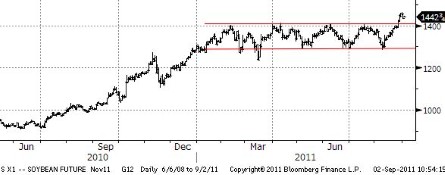
The DJ-UBS grains index rose 10.7 percent in August as wheat, corn and soybeans continued to rally with the outlook for this year’s production deteriorating further. Heat and dought across the main producing regions have played havoc with crop prospects. The price of November soybeans reached a new high of 14.65 per bushel after trading sideways for seven months. Hedge funds added 10 percent to existing long positions as the fundamental outlook favoured the sector over others like energy and base metals.
Wheat prices recovered strongly on a spillover effect from higher corn prices, despite continued strong Russian exports having increased competition in the global market. This resurgence in exports, helped by aggressive undercutting of competitive bidders, has now caused problems on Russia's rail system. The railway authority has banned the transportation of grain to the main shipping port as more than 3,600 railway cars are clogging up the North Caucasus branch of the railway system. This, in return, triggered a rise in domestic prices this week as exporters scrambled to find alternative sources of wheat to cover established contracts.

Brent crude oil firm despite slowdown
Oil markets continued to recover with Brent crude, in particular, moving back up towards the higher end of its month-long trading range. August was a month of serious volatility which impacted the energy sector as a whole. Risk aversion early on triggered a substantial sell-off before signs of physical tightness kicked in. Brent crude recovered back to almost unchanged.

Libyan oil could begin to flow before long, albeit in small quantities,  but so far this has had limited impact on prices as traders have been more concerned about bottlenecks stemming from production problems at the UK’s largest North Sea production field. Meanwhile, the prospects of EU sanctions against Syria could increase an already tricky situation for European refineries who have been struggling to find supplies after the loss of high quality Libyan oil.

While Brent crude is troubled by bottlenecks on the production side, WTI crude continues to have to opposite problem with too much supply at Cushing, the delivery hub for WTI crude. This is causing a complete opposite forward curve shape compared to Brent, as seen below, and also shows why the spread between the two benchmarks are its widest at the front end of the curve.
Brent crude's recent rally ran out of steam above 115 dollars per barrel, some three dollars below trendline resistance from the two previous highs. On that basis we see limited potential for further upside gains with the risk of renewed stock market weakness potentially triggering a move back towards the middle of its established range at 108.

Lower Hog prices
The price of lean hog futures dropped more than 7 percent during the month after a strong run up the previous month. Supplies have been rising steadily on a seasonal basis and continue to outpace demand. At the beginning of August hedge funds held near record long positions which have subsequently been reduced by 25 percent thereby adding to the downside pressure. Further long liquidation is feared should the active contract for delivery in December break out of the established trading range below 81 cents per pound. Support comes from the fact Futures prices are currently trading at a discount to cash with the two eventually needing to converge.

Firm demand for coal and steel
Asian coal and steel demand increased dramatically in August. The number of shipments of iron ore, a key steelmaking ingredient, increased in August with 52% more vessels being hired than in July. The average price for iron ore delivered to China, the world’s largest consumer, rose by 2.5% from July to 177.45 dollars per ton with spot prices now at 180.40 dollars per ton. The average price of Chinese wire rod for August reached $784/ton, the highest level since July 2008 and a 29% increase year-on-year.
Meanwhile in Japan, coal imports are rising as the percentage of coal-fired electricity increases while the nuclear reactors undergo maintenance (coal-fired electricity production increased 36% in July compared to April and 16 nuclear reactors remains idle). Likewise, coal for cement production has also increased as the reconstruction efforts pick up.

Finally – a tricky month ahead
As the timeline below shows financial markets have entered a month with many important political events which will undoubtedly determine direction going into the final quarter and beyond. The global worries which caused all the panic over the summer have not gone away and how politicians meet those challenges will have a major impact on the direction of anything from stocks and bonds to commodities - stay tuned.

Heads up! Gold futures margin could be raised again

In a couple of moves the CME Group recently raised the margin for trading gold futures from 4,500 to 7,000 dollars. The move came as a response to increased volatility after an unprecedented strong rally during the last couple of months. The exchange is not trying to dictate the direction but in order to keep some integrity in the market they had to respond to the increased intraday volatility.
Have they done enough? Probably not, as volatility is still trading at almost twice the level compared with the first six months of 2011 and average daily price swings have continued to rise since the last margin increase  on August 24.
Gold margin as a  percentage of the contract value is still relatively low. Over the last two years margin requirements have hovered between 2.5% and 5.25% with 3.8% currently. 
As an example the equivalent for silver was more than doubled earlier this year 
How much:
Another rise could bring the margin up to somewhere between 8,200 and 9,000 dollars from the current level of 7,000 dollars representing an increase of between 17 and 28 percent.
Impact:
The previous two increases partly help to bring about the 200+ dollar correction and has so far not reduced intraday volatility.  Speculative involvement from hedge funds has been reduced over the last three weeks as margin increases make an impact on the position size they are allowed to hold.
With the increased potential for another round of stimulus from the Federal Reserve gold should be supported at this stage but as the recent correction highlights nothing ever goes in a straight line and discipline remains the key.

Commodities looking for direction from Bernanke

One year ago Ben Bernanke raised the curtain for QE2 in his speech at the gathering of central bankers at Jackson Hole. Once again his speech late Friday CET could set the tone for financial markets in the months ahead as the potential for QE3 has helped trigger some market reversals during the past week.

The Reuters Jefferies CRB index is up just half of one percent at the time of writing bringing its annual return close to flat. Last week’s winners are this week’s losers with gold and silver sitting at the bottom while energy and base metals had a better week. In the agricultural space attention turned to wheat. A deteriorating outlook for U.S. and European production had wheat prices on both sides of the Atlantic performing strongly.

Weak longs washed out of gold
Gold finally succumbed to a sharp correction as weak speculative longs were flushed out sending the price lower by more than 200 dollars in just two days. What triggered the sell-off was probably a combination of a market that had become too overstretched combined with a 55 percent margin increase by the CME which handles the global benchmark gold futures contract.

With daily price swings above three percent the CME felt that the cost of holding a contract worth nearly 200,000 dollars had to be increased. This brought back memories and fears of a collapse similar to the one that hit silver back in May which also occurred after a steep rally was followed by an aggressive margin hike.

Support now at 1,700 dollars
The sell-off however did not go further than 1,705 just short of retracing 50 percent of the recent rally before buyers returned, spurred on by weaker stock markets. The severity of the sell-off has primarily been due to the amount of speculative positions having been built up over the last month and with much of that now out of the way traders felt more comfortable entering the market again. The factors that have been driving gold higher over the last year have not gone away and as such the medium to long term prospect for higher prices hasn’t either.

The Jackson Hole speech by Ben Bernanke of the U.S. Federal Reserve Friday could easily set the tone for the coming months, just like it did last year with the announcement of QE2. High expectations, especially for another round of quantitative easing, have been dwindling over the last couple of days. Given that gold would be the main beneficiary of QE3 a lack hereof could add to the downward pressure. 
Support in the market is now at 1,697 dollars which represents a 50 percent correction of the recent rally followed by moving average supports at 1,570 and 1,480. The uptrend is still firmly in place above 1,450 so even a major drop would not ruin the long-term prospect for gold.

High volatility points towards a bumpy road ahead
Thirty day volatility as measured by the CBOE gold VIX index has been rising steadily over the last month and the current reading of 34.4 percent is some 64 percent above the 2010 average which was another year of strong gold performance. This is telling us that despite the uptrend firm violent corrections like the one experienced this week can easily occur again. Investors who want to benefit from the gold “bubble” therefore need to show discipline in order to avoid being burnt by a market that has become more erratic.

Oil markets driven by Libya and Irene
Early in the week the prospect for high quality Libyan oil returning to the market initially sent oil prices, especially Brent crude, lower. The “relief” sell-off was short lived despite rebel forces entering into Tripoli and thereby bringing forward the potential downfall of Colonel Gaddafi. Traders are fully aware that it could still be many months before oil begins to flow in decent quantities. Many obstacles need to be addressed first, such as establishing security around major fields, pipelines, refineries and ports, a renegotiation of existing contracts and the return of foreign personnel.

The price of Brent crude initially dropped to 105 dollars on the news from Libya but spent the rest of the week recovering back towards 110 as possible sanctions in Syria and force majeure in Nigeria supported prices. Oil demand, especially for diesel, from India and China picked up in July lending support to a Brent crude price above 100 dollars. The spread over WTI crude initially narrowed but has since widened back above 25 dollars as increased U.S. and Canadian production is not easily moved out of the producing regions to the coast from where it can enter into the global market place.

Irene could become the worst in fifty years
Irene, the ninth hurricane of the season is threatening to disrupt gasoline supplies along the U.S. East Coast over the coming days and this helped gasoline putting in a strong performance on the week rising by nearly four percent. It has the potential for becoming the worst hurricane in 50 years and although it is expected to weaken Saturday into Sunday it will probably not happen fast enough to prevent serious problems from wind, rain and ocean water.  

Wheat outperforming corn
The price of December CBOT wheat has risen strongly once again approaching 8 dollars per bushel after touching a low of 6.5 dollars back in July. Record high corn prices are causing livestock farmers to switch to wheat feed. A year-long drought from Texas to Kansas has created the driest conditions on record for farmers who should now be preparing to plant winter wheat. Meanwhile, in Europe the corresponding Milling wheat contract rose the most on the week as Western Europe continues to experiencing tough harvest conditions after a very wet summer. Continued rainfall could result in a higher percentage of wheat being used for livestock feed instead of human consumption thereby adding upside price pressure on high quality wheat. 
 

These 4 things Happen just before a Crash, and ...

CAUTION:
These 4 things happen
just before major
stock market crashes
(and they're happening RIGHT NOW!) by Mike Larson

Stop me if you've heard this one before ...
Bank stocks are leading the entire market lower.
The economy is winding down; politicians and the Fed are scrambling to find a solution.
The Volatility Index — the VIX — is at levels not seen in more than two years.
Gold is setting one new record after another.
Sound familiar? It should:
These are precisely the things that happened
just before America's LAST great stock
market crash in 2008!
And boy, oh boy, was it ever ugly!
The S&P 500 average plunged nearly 60%. Many household name stocks lost 80% ... 90% ... up to 100% of their value. Venerable old companies like Lehman simply ceased to exist. Millions of investors were wiped out.
But this time, things are far worse:
In 2008, investors were worried that consumers had taken on too much debt they couldn't pay.
This time around, investors are panicking because our single largest institution — THE U.S. GOVERNMENT — has taken on too much debt it can't pay.
Back then, investors could only hope that Washington would find a way to end the nightmare with bailouts and stimulus.
This time, investors know that government “rescues” only delay the inevitable collapse.
Plus, they realize that our new, fiscally conservative representatives in Congress are sworn to defeat stimulus and bailout bills.
And they have come to the shocking realization that no institution on Earth has enough money to save the U.S. government now.
This is why gold prices just set
another, new all-time high overnight,
hitting $1,808 per ounce.
And this is also why the Dow fell 519 points yesterday — a whopping 4.9% — while the Nasdaq fell 4.3% and the S&P 500 fell 4.4%.
Just as I've been warning you, U.S. bank stocks were hit particularly hard, giving up a whopping 7% of their value in a single day.
Many big banks fared even worse: Morgan Stanley fell 9.7%. Goldman Sachs fell 10%. Citigroup fell 10.5%. Bank of America crashed almost 11% — all in just a few hours of trading.
And yet, it's clear that the bloodletting has only begun:
The European Union, the world's largest economy, is coming unglued at the seams. The U.S. economy is slowing dramatically. Unemployment is rising. Consumers are snapping their wallets shut. Loan defaults are rising again.
And to add insult to injury, the U.S. Federal Reserve just promised to keep interest rates near zero for two, long years — a decision that will drive inflation higher AND severely limit the interest revenues that are the banks' lifeblood.
This is what
we've been trying to prepare you for ...
This is why we produced our shocking video, American Apocalypse — and it's why we believe that viewing this timely video is the single most crucial thing you could be doing as this crisis unfolds.
BUT BE ADVISED:
American Apocalypse
is NOT for the faint of heart.
It presents disturbing facts about America's economic decline ... how it threatens your very financial survival ... and what you must do immediately to protect your wealth.
We show you why insane government spending, massive debts, out-of-control money printing, and almost unimaginable political cowardice are about to exact a heavy toll from each of us.
We give you three grave warnings that you cannot afford to ignore now — including the scandalous reasons why Washington now believes everything you've ever worked for must now be confiscated from you.
Most importantly, we offer you crucial solutions:
  Simple steps you can take to insulate your money and your family from this great American Apocalypse ...
  The investments that have the power to make you much, much richer — even as the vast majority of American investors lose the shirts off their backs ...
  And we show you why you could now have less than one year left to prepare.
This all-important video is absolutely free — a public service provided by Weiss Research.
Just click this link and it will begin playing immediately.
Best wishes,
Mike Larson

Ratings and Recommendations