Financial Advisor
Showing posts with label Forex Forecast. Show all posts

Japanese Yen Rises as Economic Recovery Continues


The Japanese yen made gains against major rivals on Tuesday, following signs that the Japanese recovery is continuing. At the moment, the U.S. dollar lost 0.15% of its value to trade around ¥80.14, while the euro lost 0.64% to trade around ¥111.88.
The yen found support in better than expected economic activity data. According to the Ministry of Economy, Trade and Industry data, Japan's tertiary industry activity index rose 0.9% in May, from a month earlier, which was above analysts' expectations of a 0.7% increase. The May value is still much below April's 2.5% rise. In April, however, the index rebounded strongly following the earthquake and tsunami that have caused havoc in Japan in March.
The Japanese economy has been hit hard by natural disasters recently, which caused energy shortages and supply disruptions. An inadequate response from the Japanese government has forced Japan's prime minister to announce he will leave his post early. The latest results, however, will come as an encouragement to traders as Japan shows more signs that its economic recovery is gaining speed.
The Bank of Japan is still not convinced that Japan's economic recovery is on firm footing, so it decided to leave its interest rates unchanged at 0.1%. The Japanese interest rates have very low for some time now, as inflation remained low. The latest data, however, points to a rising inflation. In June, Japan's corporate goods price index rose 2.5%, compared to a year earlier. The June value was above 2.2% recorded in May and 2.4% expected by most analysts.
Rising inflation is generally a sign to start worrying about the economy overheating. Japan, however, has been fighting deflationary pressures for over a decade now. Japan's experience has suggested fighting deflation is much more difficult than fighting inflation. As a result, some analysts might see rising inflation as a good sign, since it might signal that the time of deflation is behind the world's third largest economy.
Japan's economic results might not seem spectacular, but when taken into comparison with the news from the Eurozone and the United States, Japan's economic data starts looking much brighter. In Europe, the Eurozone still did not resolve the Greek crisis and it seems the crisis has spread to Italy, the Eurozone's third largest economy. On Friday, the shares of the largest Italian banks fell sharply, and their losses continued in Monday's trading as well. In the United States, President Obama and his Democrats are locked in a battle with the Republicans, which control the House of Representatives, over raising the debt ceiling. If there is no agreement soon, the U.S. government might be forced to shut down, which could send massive shockwaves through the financial markets.
ACTION ITEMS:

Bullish:
Traders who believe that the Japanese recovery will continue gathering speed, which should provide a lot of tailwind for the yen, especially in the light of massive problems in the Eurozone and the United States, might want to consider the following trades:
  • WisdomTree Dreyfus Japanese Yen Fund (NYSE: JYF) is a long play on the yen. JYF will rise if the yen appreciates.
  • ProShares Ultra Yen ETF (NYSE: YCL [FREE Stock Trend Analysis]) is another long play on the yen. YCL will rise more than JYF, however, if the yen appreciates.

EURUSD slide contributes to Italy's pain

Let’s hear it for the Euro zone and all its problems!

Did someone say contagion? Well whether they did or didn’t this is what the world looks like right now. This slide lower in the EURUSD and general risk sentiment is (in my view) wholly contributed to the pain that Italy is currently going through. Overnight we saw everything take a move lower, including US indices, on the back of poorer reporting from Alcoa and of course the EURUSD. Various attempts at jawboning from the emergency meeting yesterday did little (if anything) positive for the markets and, in fact, a more negative cue was then taken as new rumblings about selective defaults and additional rescue packages were whispered by various news providers.

On the day, Tuesday, we have fairly important bond auctions out of some the poorer European nations and while I expect these to be well-supported, the more important auction will be on Thursday in Italy. With spreads currently blowing out with each passing hour, it will be interesting to see how far the ECB can play its liquidity hand. On top of this, of course, we had even more talk yesterday about extending the EFSF and perhaps this time doubling it in size won’t be enough either…

Turning our attention to the day ahead, as a former colleague of mine once put it “buy USD and wear diamonds”… Now, truthfully, I didn’t have much time for this colleague but the sentiment remains the same as I had stated about 2 weeks ago - being bullish USD for the summer and the bulk of Q3 is the way forward. Clearly, I still stand by this view and don’t even attempt to get in the way of the market today; its going to get ugly folks. By way of levels, don’t ask me today as I don’t want to be a participant in this market…

Data-wise we have the US trade balance and just a raft of unreliably timed headlines that will dictate the price action in the majors…
Good luck and helmets on!

Weekly Review and Outlook Euro Broadly Pressured after a Volatile Week, USD/JPY Heading Back to 80

It's been an extremely volatile week with lots of headlines flying around but three developments should be paid more attention to. Firstly, Euro was broadly weak in spite of ECB's rate hike and the signal of maintaining tightening bias. Even though the Greece situation was temporarily resolved, worries on contagion has indeed intensified. Secondly, the sharp reversal in US treasury yields took yen crosses broadly lower on and could be setting the stage for more upside in the Japanese yen ahead. Thirdly, even though the job data from US was deeply disappointing, selloff in risk was relatively brief and shallow. There is no confirmation of reversal in risk sentiments and dollar remains vulnerable to more selling ahead.
ECB raised the main refinancing rate by +25 bps to 1.5%, the highest level since March 2008. The interest rate corridor stayed unchanged at +/-75bps. While there were few changes in the language in the accompanying statement, the central bank noted the momentum of economic recovery has moderated. The ECB continued to describe the monetary stance as 'accommodative'. Concerning inflation, the ECB stated inflation rates will likely stay above +2% in coming months and it pledged to prevent faster inflation to give rise to 'second-round effects'. The central bank did not signal when the next rate hike will be. Yet, the comment that 'it is essential recent price developments do not give rise to broad based inflation pressures over the medium term' indicates further rate hike later this year cannot be ruled out. 

In spite of rate expectation, Euro's upside was limited by intensifying concern on debt crisis contagion. Moody downgraded the credit rating of Portugal to Ba2, or junk, citing there is 'growing risk that Portugal will require a second round of official financing before it can return to the private market'. The downgrade was also affected by the rollover plan for Greek debts. Moody worried that involvement of private investors in a new bailout plan for Greece will later be set as a pre-condition in Portugal's rescue plan. That is 'very significant because not only does it affect current investors, but it is likely to discourage new private sector lending going forward, and therefore reduce the likelihood that a country like Portugal will be able to regain access to the capital markets at a sustainable cost'. The downgrade triggered worries about a 'downgrade contagion' to Ireland. CDS on Portuguese, Irish and Greek sovereign debts rose to record highs last week. Indeed , CDS on Portugal is suggesting more than 50% chance of default in five years.


Technically, EUR/USD is still staying inside a triangle pattern in converging range, suggesting indecisiveness in the market. However, The sharp fall in EUR/CHF last week is opening up the case for another record low below 1.18 in near term. The steep decline in EUR/GBP also suggests that the cross is vulnerable to more selloff back to 0.86 level. EUR/JPY reversed ahead of 117.88 resistance and the technical development indicates that fall from 123.31 is likely resuming in near term to below 113. EUR/AUD's break of 1.3228 support also suggests that recent down trend is resuming for 1.2926 record low. We'd believe that 1.4 in EUR/USD and 1100 in XAU/EUR are important levels for Euro to defend. While Euro is bearish against swissy, yen and aussie, and to a lesser extent sterling, the selloff might not accelerate as long as these two levels holds. However, break will trigger much steeper and broad based selloff in the common currency. 

The benchmark 10 years US yield dropped sharply last week after disappointing US non-farm payroll report and just managed to hold 3.00%. Expectation on the non-farm payroll report was high the impressively strong ADP report. But, investors were hit back to reality after NFP showed merely 18k job growth in June and that's way off market expectation of 89k, not to mention that 150-200k adjusted expectation following the 157k ADP job growth. May's data was also revised down to 25k. April's figure was revised down slightly to 217k. May and June together were the worst two months total since last August and September. Unemployment rate also unexpectedly ticked higher to 9.2%. The poor job data reignited talks on the prospect of QE3. A former BoE policy maker, now a professor at Dartmouth college commented on the US situation and said "QE3 looks increasingly on the table. What are they going to do, let unemployment start rising again?"


Yen crosses were generally lower following US treasury yield on Friday. In particular, USD/JPY seemed to have finished the recovery pattern that started back in June and is possibly heading to below 80 again. Further weakness in USD/JPY, if accompanied by 10 year yield sustaining below 3%, will likely take other yen crosses lower ahead. 
DOW looked like going to have a take on 12876 high after the ADP number on Thursday but the brake was pressured hard after the poor NFP number. Nevertheless, at this moment, we're not seeing a reversal in stock year and that is possibly just a brief retreat. Stocks are indeed supported by the QE3 speculations. And as long as 12539 in DOW and 1330 in S&P 500 hold, we're still expecting more upside in stocks in near term. Similarly, commodities are still near term bullish as long as the CRB index stays above 340 level. And such developments will continue to support Canadian, Aussie and Kiwi. Indeed, AUD/USD and USD/CAD were just staying in tight range in spite of the post NFP pull back. Kiwi even managed to close at new record high against the greenback. Strength in equities, commodities and weakness in treasury yield will limit dollar's rebound attempt.  

 Dollar index continued to stay in triangle pattern from 72.69 last week. More sideway trading would likely be seen in near term. But after all, we'll stay bearish as long as 76.36 resistance holds and expect an eventual downside breakout to extend the down trend from 88.70 to 70.70 historical low. 


Bernanke's testimony at House Financial Services Committee on monetary policy and economy and FOMC minutes will be a main focus of the week. The minutes will likely provided details of the discussion on monetary policy normalization strategy. Bernanke will likely further provide details in the testimony. A main focus is on whether Bernanke would loosen up his guard on further quantitative easing in consideration of the poor job data in Q2. Another focus will remain on the development in Greece's second bailout package. It's reported that no progress was made on the details of private sector involvement in the second bailout after two weeks of negotiation among EU, ECB and IIF. EU finance ministers will also discuss the results of stress tests on 91 European banks that are due to be released on July 15 by the European Banking Authority.
  • Monday: Japan household confidence; Canada housing starts
  • Tuesday: BoJ rate decision; UK RICS house price balance, CPI, trade balance; US trade balance, FOMC minutes; Canada trade balance
  • Wednesday: China GDP; Swiss PPI; UK jobless claims; Eurozone industrial production; US import prices, Bernanke testimony
  • Thursday: New Zealand GDP; Eurozone CPI; US retail sales, PPI, jobless claims
  • Friday: BoJ Minutes; Eurozone trade balance; US CPI, Empire state manufacturing, industrial production, U of Michigan confidence;

USD/JPY Weekly Outlook

USD/JPY edged higher to 81.46 last week but subsequent reversal and break of 80.76 minor support suggests that choppy recovery from 79.69 has completed already. Initial bias remains on the downside this week and break of 80.25 minor support will affirm the case that fall from 82.21 is resuming. Further break of 79.56/69 support zone will also confirm resumption of whole fall from 85.51 and should target 61.8% projection of 85.51 to 79.56 from 82.22 at 78.54 next. On the upside, break of 81.46 is needed to invalidate hits view or we'll stay cautiously bearish.

In the bigger picture, note that USD/JPY's rebound from 76.41 low was held by medium term long term falling trend line as well as the 55 weeks EMA. Thus, down trend from 124.13 could still be in progress. Current fall from 85.51 might now extend through 75.98 for a new record low. In any case, break of 85.51 is needed to revive the case that USD/JPY's down trend has finished. Otherwise, we'll stay cautiously bearish in the pair.
In the long term picture, the minimum target of trend resumption, that is, a break of 79.75 low (1995 low) was met. While the rebound to 85.51 was strong, there is no indication of reversal of the multi-decade down trend yet. We'd look at the structure of the rise, as well as whether USD/JPY could take out 100 psychological level before giving favor to the trend reversal case. Otherwise, we'll treat current price actions as part of a long term consolidation pattern at best.

EURUSD - Bearish below 1.4555

Our cautiously bullish call on EURUSD for yesterday proved correct but gains were limited in both time and price. The subsequent sharp reversal took it to a 2nd consecutive negative daily performance and a move to the lowest levels of the week. Although the lows were not maintained, an overnight rally proved temporary and limited.
In view of this, and negative momentum, our call is Bearish below 1.4555. The immediate objective is 1.4478, yesterday's low, with a move below that point targeting 1.4451, the 3rd June low, then 1.4405, half of the net gains from June 2nd.
The risk to this call is that oversold extremes begin to correct earlier and higher than currently assessed. This would be signalled by a move above 1.4555, the overnight high, with subsequent upside targeting 1.4596, yesterday's European afternoon open, or even Thursday’s high at 1.4652.


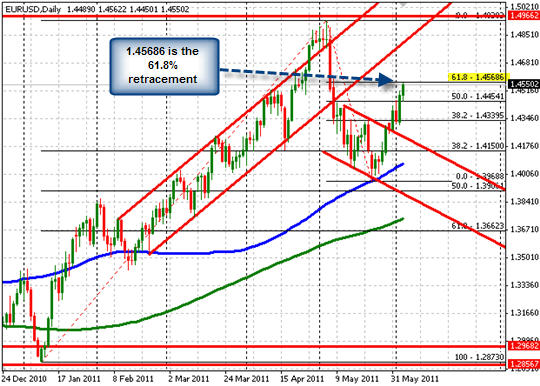
EURUSD targets 1.4568 and then 1.4598 area

The EURUSD move abovet the 1.4516-30 resistance area (see prior posts today), opens the door to the next target at the 1.4568 level. This is the 61.8% retracement off the move down from the May high to the low in May.   There is likely to be some resistance against the area.   However, as long as the price remains above the 1.4530 level (and the correction of the high did just that -see 5 minute chart below) the bias is to the upside. 
A move above the 1.4568 level will next target the 1.4598 level which is the channel trendline off the hourly chart above.  This target is to topside “guard rail” that the market has been using to pace the upside move (see hourly chart above), and I would expect the market to respect that level should it be tested later today.


Daily Report: Euro Recovers Mildly as Greece Will Accelerate Asset Sales, Selling Focus Turning to Sterling

Euro recovers after breaching 1.4 psychological level briefly yesterday. Sentiments stabilized a bit after Greek government endorsed an accelerated asset-sale plan and EUR 6b of budget cuts for getting extra financial aids after it's CDS and 10 year yield both jumped to record high. The sale of assets include stakes in Hellenic Telecommunications Organization SA by the end of next month and Public Power Corp SA, Hellenic Postbank SA, in a total market value of EUR 2.1b. Also, Greece said it would create a fund to accelerate the sales and intend to raise EUR 50b by 2015, including EUR 35b of real estate. The budget cut will worth around 2.8% of GDP for pushing down to 7.5% deficit target.
Selling focus has probably shifted to Sterling on talk that Moody's will considering downgrading debt for 14 UK banks and building societies. The GBP 1T in government bailouts and guarantees would probably account for two to five credit grades for larger UK banks and one to five notches for smaller banks. Government withdrawing support would increase credit risk and triggers downgrades. It would take around three months to carry out the review and gauge the level of state support incorporated in to the credit rating.
New Zealand dollar is broadly higher today as the latest survey from RBNZ showed two year inflation expectation rose in the second quarter to 3%, highest since Q3 2008, up from prior expectation of 2.64%. For 1 year horizon, CPI is expected to reach 3.12%, up from prior expectation of 2.87%. Aussie and Kiwi are also lifted by mild recovery in commodities.
German Q1 GDP was unrevised at 1.5% qoq. Ifo business claim will be a mail focus in European session and is expected to drop slightly to 113.7 but is vulnerable to downside surprise. UK public sector net borrowing will be another focus and is expected to drop to GBP 4.4b in APril. Eurozone industrial orders, UK CBI reported sales and US new home sales will be released.
NZD is comparative stronger against AUD in the past two weeks but it's too early to confirm a change in trend in AUD/NZD. The cross is still staying well inside near term rising channel. Focus will be on the channel support (now at 1.3154). While the current fall might continue lower to extend the consolidation from 1.3792, we'd still expect recent rally to resume sooner or later as long as this channel support holds. Above 1.3700 will bring rally resumption towards 1.4 psychological level. Nevertheless, sustained trading below the channel will bring deeper fall towards 55 weeks EMA (now at 1.3076) instead.

More erratic price action, ugly swings and cleanouts ahead

Well another frantic finish to the Friday session (second week running) with more cleanouts in a thin U.S. market taking place. We saw the EURUSD, Cable, AUDUSD and even USDCHF move as a direct result of some rather interesting USD repositioning coming into the weekend. Suffice it to say it was mainly one way traffic as we saw more buyers of the big dollar emerging. Futures positioning data suggests that EURUSD long contracts were reduced by around 30% last week with more pain to come as USD shorts, on the whole, still remain at hefty levels.
The inference here is that there is likely to be more USD buying ahead this week, and sadly for those trying to trade this market it could well mean more pain as rather than being a relatively smooth one way move, we’re going to be seeing more erratic price action and ugly swings and cleanouts of the kind we have now experienced over the last two Friday evening sessions.
News over the weekend was limited outside of the head of the IMF being arrested on charges of sexual assault, clearly hampering his ability to attend today’s meeting in Brussels to ratify the Portuguese bailout package. The calendar for the day is relatively light as we have the final Eurozone CPI print (no change expected), Empire manufacturing out of the U.S. and rounding out the event risk for the day we have Bernanke speaking in the afternoon.
In regards to levels and/or direction…. Much like Friday, I’m not entirely sure.
As written above, USD purchases are still on the agenda as are, however, headlines that may well disrupt the show.
With that in mind I look for the following over the course of the next day or so;
EURUSD:              1.4030/00 should contain the downside with good sized bids sitting in and around, while the topside will invariably struggle above the 1.4230/50 levels with 1.4180 being the first hurdle.
USDCAD:             Remains a little better bid, however moves above 0.9730/50 can be faded with stops going in above 0.9830, looking for a return to 0.9590 and lower.
GBPUSD:             Still at the broader mercy of the USD, the downside should be contained around the 1.6030/1.5980 levels while the topside might struggle into 1.6250/80.
USDJPY:               I remain long of the 80 Put for expiry this Wednesday and outside of levels mentioned last week there really is little to add, look for 81.35/50 to 81.80 to cap any upside and stop cleanouts while the downside had decent bids sitting around the 80.30 level and then 79.80.
USDCHF:              Should for the time being be contained to 0.9020/30 and 0.8890.
XAUUSD:             Punters long the yellow metal should be wary of 1,477 as a break here opens quite a move with stops sitting below 1475/65.

Stocks in the week ahead: Walking on eggshells!

The coming week may prove to be relatively quiet with the long Easter break dawning upon us.
As the earnings season moves into top gear however, we should get a good idea of developments in the US financial sector: indeed, after JPMorgan and Bank of America reported in the past week (Bank of America this afternoon), we will see a raft of financials reporting their Q1 earnings, including no less than Citigroup, Goldman, Wells Fargo, American Express and Morgan Stanley.
In Europe, we will keep watching developments in the PIIGS sovereign debt as Spain’s cost of debt goes north again and the Finns go to the polls on Sunday! One of the big questions concerning this issue is: what will the impact of an even partial debt rescheduling in Greece, Ireland and Portugal have on the rest of Europe's banks, especially in the U.K., Germany and France?
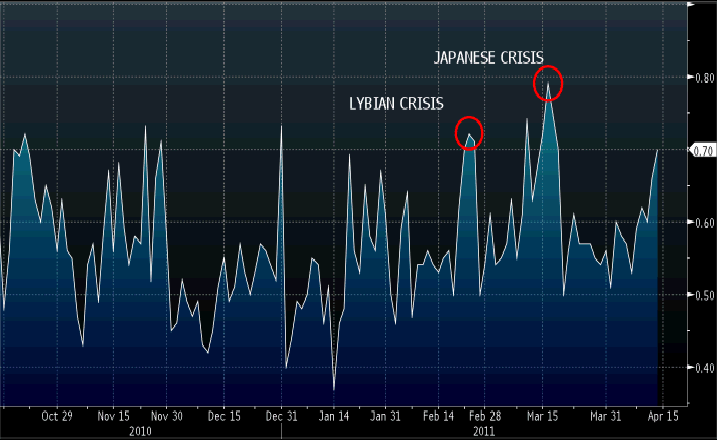
Another area of concern is the current relative underperformance of the Consumer Discretionary sector compared to the Consumer Staples sector in the U.S. The ratio of the two sectors ETFs is shown below from May 2010 to today.
Chart 1: the “Growth” index (XLY:xarc/XLP:xarc) – source Brett Steenbarger/Bloomberg

This relative measure characterises to some extent the strength of the economy: indeed, one can intuitively understand that when growth is expected to be strong, consumer discretionary stocks are in higher demand than consumer staples stocks.
Here, one can see that the discretionary sector has strongly outperformed the Staples sector since summer 2010, thereby confounding the prophets of the U.S. double dip recession at the time. But since peaking in February, the market has taken a much more defensive approach and the outperformance of the Staples sector has in fact accelerated sharply since the beginning of April!
What’s even more interesting is that the “Growth” index and the S&P 500 seem to be highly correlated: over the past year, the S&P 500 index and the growth index have indeed had a correlation of 71%, showing that the relationship between the two series is relatively strong.
 Chart 2: correlation between the “growth” index and the S&P 500 – source Bloomberg

We will therefore closely watch the trend of this “growth” index during the coming weeks.
With light traded volumes expected in the market due to the Easter break, combined with the concerns highlighted above, we go into next week with a rather cautious approach, making sure that we play the current market with the right position sizes and stop levels.
From a technical point of view, we expect a test of the round numbers on both sides of the Atlantic but we still prefer playing the market from the long side for now.
In Europe, we have seen the Euro Stoxx 50 index consolidate towards the bottom of our expected range 2,900 – 3,000. We will be interested in the index on any test of the 2,900 support down to 2,880 with a stop below 2,850. We will target the 2,950 area.
 Chart 3: Euro Stoxx 50 - Daily chart - source Bloomberg

We still see the market meltdown created by the Japanese nuclear crisis as a strong support area to be broken only in case of a serious accident. We are not there yet.
Furthermore, the European benchmark still looks attractive on a fundamental basis as it trades on a 14.1 Graham & Dodd price earnings ratio (10-year CAPE) at current levels.
In the US, we are still looking at the 1,300 support as a major support level. With many stops no doubt positioned just under the round number, we would not be surprised to see the level broken but would look at initiating new longs in the 1,300 – 1,290 zone with stops at 1,274. We will target the 1,320 area.
Here, we are still favouring the reverse head & shoulders formation that we highlighted last week. Interestingly, the 1,300 – 1,290 area would form the second shoulder of the formation. It does also form the support zone for the longer term trend we highlighted last week.
We also look with interest at the build up of protection purchases by investors against a fall in the S&P 500, as crystallised in the Put/Call ratio for the stock index.
 Graph 4: Put/Call ratio for the S&P 500 – source Bloomberg

This is generally a contrarian indicator: as a record protective position gets built, the market gets ready for a move higher. Hence we take some comfort from this development for our bullish stance.
Have a safe trading week!

Wakeup Call: EURGBP – Bullish above 0.8824

The setback from this week's highs on EURGBP, beyond 0.8900, extended yesterday with initial downside of almost ¾-point. And although a second negative daily performance in succession resulted, the market found fresh investor buying interest near 0.8800, similar levels to Monday, and most of the early losses were recaptured by the close.
Trading in Asian lacked clear signals but it is considered likely that yesterday's sharp reversal of the downside will be the dominant factor. In view of this our call is bullish above 0.8824. The immediate objective is 0.8883, yesterday's top, with a move beyond that point targeting 0.8906 and 0.8926, Wednesday’s open and high.
Selling through 0.8824 is the risk to this call as it signals that selling pressure is greater than currently assessed. The market should then decline to 0.8808, yesterday's low, then this week's base at 0.8792.

FX Update: USD plunges on oil rally, potential government shutdown

All eyes are on Washington today to see whether the administration and lawmakers can reach an agreement on the budget as the USD plummets close to its post-financial crisis low. Meanwhile, the JPY is weaker still as EURJPY touches new 11-month high. What’s in store for the week ahead?
US Shutdown? Maybe – but not for long
A potential US government shutdown looms over the market today as the administration and lawmakers have until midnight to strike a deal or risk having to go into “shutdown”, a situation that will have a wide array of consequences, though none of them immediately critical for the likes of air traffic control or entitlement spending.  While tdhese consequences could certainly creep into the real economic growth numbers rather quickly if the shutdown were to continue for more than a week or two (many federal lending programs would be immediately affected), it is hard to imagine the government shutting down for more than a few days. The political risks are enormous here in the first place and we can almost guarantee that the government will open for business before any retiree risks failing to receive a social security check or any Medicare payment risks not being disbursed or treatment refused, etc.
I would suggest better than 50/50 odds that a deal is struck tonight before the midnight deadline. If not, then early next week as the news early next week features coverage of families turned away at the gates of National Parks and Joe Smith unable to get his loan approved by the FHA so he can’t move his family for his new trucking job in Everytown, USA.
Further along, the budget and fiscal fight gets more interesting as the debt ceiling approaches by mid-May. The Tea Party faction of the Republican party will make as much noise as possible around that time as it was voted into office almost precisely for the occasion.
Odds and Ends
After failing to move much yesterday in the wake of the Trichet press conference, the yields at the front end of the yield curve in Europe headed higher today, supporting the tack-on rally we saw in EURUSD overnight. Also possibly supportive of the EURUSD move is the additional spike in crude prices and the idea that petro-states are recycling some portion of their petro-dollars into Euros.
UK PPI levels can’t be particularly comforting for the BoE, which is trying to sweat out this round of inflation like it has already tried to do over the last couple of years of uncomfortably high inflation levels. Note the awful margin compression implications of PPI Input prices at 14.6% YoY vs. PPI Output at 5.4% YoY
Canadian employment data today was more than a bit confusing. The unemployment rate dropped due to a drop in the participation rate (not strong news) and the overall payrolls number was very slightly lower versus the robust growth expected, but the internals of that number were more than a bit confusing, with a whopping 90.6k increase in full-time gains and a -92.1 decrease in part time payrolls (one has to wonder if categories are being shifted around here statistically.) Meanwhile, the never-say-die Canadian housing bubble is percolating along without any firmer signs of a correction, though the strong March Housing Starts numbers may have been affected by pent-up demand from the nasty winter weather.
Japans Eco Watchers Survey of current conditions and the forward outlook dropped by a record amount in March as one might expect, from what were close to multi-year highs to only a couple of points above the lows during the financial crisis of ’08-’09.
Looking ahead
Besides the US government shutdown potential for the weekend, we have an interesting week ahead for the US as next week sees the first batch of major companies reporting their Q1 earnings, where the degree of margin compression from spiking input prices is squarely in focus. At least one major US brokerage house suggested that earnings for Q1 will disappoint and that there have been surprisingly few preannouncements ahead of this earnings season. An ominous sign? Could risk appetite actually focus for once on the fundamentals underlying the prices it has mindless boosted of late even as input prices have been spiking out of control and interest rates head sharply higher?
A paradigm for what is going on here may be as follows (articulated far better in yesterday’s Steen’s Chronicle. It seems that before the Japanese tragedy struck on March 11, the market was getting a bit cautious on the risk appetite side of the equation, but that the new liquidity train that the BoJ has brought to the table might be one of the drivers for the violent turnaround back to the upside in asset prices as the market continues to drive the theme of currency debasement.
Chart: EURJPY
The rally in JPY crosses has continued into today, as the currency debasement theme rages hotly and the market continues to seek out value in hard assets versus the currencies most bent on providing liquidity to their economies. Early today we are seeing a small rally in US treasuries and we have a heavy auction schedule of US treasuries next week (3-, 10-, and 30-year). Will these apply the brakes to the yen’s downhill run or encourage it?
The key point here is that (since the bond market is so manipulated by the world’s central banks, the only adjustment mechanism at present is directly in the currency market. The only chance we will have of knowing the true strength or weakness of the bond market is once the Fed steps away at the end of QE2 and doesn’t come back for a while. Even then, the overhanging fear will be that if things go too far south for the economy or the bond market, the bank is likely to rush to the rescue once more, so why not stick to expressing a view through the currency market instead?
Be careful out there – we’re in near-parabolic mode in a number of markets  - JPY and commodities. While the action could get even more spectacular, it is likely to dramatically increase the risk of volatility both ways as this kind of action continues, as the end usually comes with spectacular reversals.
Economic Data Highlights
  • US Feb. Consumer Credit out at +$7.6B vs. +$4.7B expected and $4.4 in Jan.
  • Japan Feb. Adjusted Current Account Total out at ¥1210B vs. ¥1329B expected and ¥1089B in Jan.
  • China Q1 Business Climate Index out at 133.8 vs. 138 in Q4
  • Japan Mar. Eco Watchers Survey Current/Outlook out at 27.7/26.6 vs. 48.4/47.2 in Feb.
  • Switzerland Mar. Unemployment Rate out at 3.3% as expected and vs. 3.4% in Feb.
  • Germany Feb. Trade Balance out at 12.1B vs. 13.0B expected and 10.1B in Jan.
  • Sweden Feb. Industrial Production out at +1.1% MoM and +16.9% YoY vs. 0.0%/+14.6% expected, respectively and vs. +15.3% YoY in Jan.
  • Sweden Feb. Industrial Orders out at +0.2% MoM and +13.7% YoY vs. +12.2% YoY in Jan.
  • UK Mar. PPI Input out at +3.7% MoM and +14.6% YoY vs. +2.1%/+12.5% expected, respectively and vs. +14.9% YoY in Feb.
  • UK Mar. PPI Output out at +0.9% MoM and +5.4% YoY vs. +0.6%/+5.1% expected, respectively and vs. +5.3% YoY in Feb.
  • UK Mar. PPI Output Core out at +0.4% MoM and +3.0% YoY vs. +0.3%/+2.9% expected, respectively and vs. +3.1% YoY in Feb.
  • Canada Mar. Net Change in Employment out at -1.5K vs. +28k expected and +15.1k in Feb.
  • Canada Mar. Unemployment rate dropped to 7.7% from 7.8% in Feb. as expected
  • Canada Mar. Housing Starts out at 188.8k vs. 181k expected and 183.7k in Fe.
Upcoming Economic Calendar Highlights (all times GMT)
  • US Feb. Wholesale Inventories (1400)
  • US Fed’s Fisher to Speak (1415)
  • UK BoE’s Haldane to Speak (Sat 1800)
  • US Fed’s Yellen to Speak (Sat 1800)
  • China Mar. Trade Balance (Sun 0200)
  • New Zealand Mar. Credit Card Spending (Sun 2245)
  • Japan Feb. Machine Orders (Sun 2350)

FX Update: EUR gets boost from Spanish auctions

The rather successful auction in Spain this morning is giving euro traders something to cheer about after the weak showing by its neighbour, Portugal, earlier this week.
Bid-to-cover up in Spanish auction
The Spanish government auction off EUR 3.22 billion in 10-year bonds at an average yield of 5.162 percent with a bid-to-cover of 1.81 (vs. 1.54 at the latest similar auction), which has put a smile on the faces of euro traders who quickly sent the EURUSD through the 1.40, touching 1.4050 at one point, before giving a bit back. The 1.40 holds for now though. Spain had similar success with a 30-year bond which secured its government EUR 911 million from EUR 1.88 billion tendered at an average yield of 5.875 percent and a bid-to-cover of 2.06. The reaction has been that this indicates that the markets have faith in the new expanded European Financial Stability Fund (EFSF), though we would not go that far just yet (and mind you, the auctions did not draw maximum interest from investors). Elsewhere in Europe this is hurting the CHF, which has given back nearly half of yesterday's gains against the EUR.
Last weekend's agreement amongst EU leaders to increase the scope of the EFSF to EUR 440 billion (it was also nominally at that size before, but several restrictions and buffers were prohibiting the fund from lending all of the EUR 440 billion) is seen as the cause of the appetite for Spanish government bonds, with yields only down slightly from the last auction. So while yields at least did not go up like in the case of Portugal they did not make a forceful move lower either. It is simply too early to celebrate in our view, though Spain has taken some steps to reduce its massive public deficit.
EURUSD intraday chart (last four days)
 Source: Bloomberg.
Stay tuned for a big bout of U.S. data in fifteen minutes with the Consumer Price Index (CPI) the main attraction.

Financial Advisor FX Update: JPY strengthens after earthquake

The devastating Japanese earthquake shows that Japan is no New Zealand, as the JPY strengthened on the earthquake news after an initial weakening. Meanwhile, outside of the USDJPY cross, the greenback remained strong ahead of what proved to be a strong US Retail Sales Report.
Canada Employment Report
Canada’s employment report was the opposite of Australia’s most recent report: it appears not so bad on the surface but looks pretty ugly under the surface (versus Australia’s appearing horrible on the surface, but looking less bad in the details). Overall payrolls came in only 10k below expectations at +15.1k overall, but this wasn’t perhaps a huge surprise after a +69.2k increase in Jan. which would be the per capita equivalent of something like +500k or more on US nonfarm payrolls. The internals showed a strong drop in full time employment, meanwhile, with the month registering a -23.8k vs. +31.1kin Jan., while part-time employment surged 38.9k in Feb. The overall unemployment rate failed to improve, and at 7.8%, is still where it was during the nervous days of the weak economy back in 2002-03, having now only fallen about 1.0% from the peak during the more recent crisis.
Chart: USDCAD
As we write this, it is somewhat remarkable that USDCAD is only a figure off its recent lows despite this news, the sell-off in equities, and oil now off several dollars from its recent highs. The first real reversal for that pair comes with a move back above the 0.9820/50 resistance zone that provided support on the way down.
US Retail Sales Report
The US Retail Sales report was an all-around strong one, with the headline coming in as expected and the ex Auto and Gas figure also beating on a month-over-month basis. Even better, all figures for January received a bump higher in the revisions, suggesting that US consumers still somehow are finding a way to spend beyond their means. How Is the market supposed to react to this data? Perhaps a smidgen of upside in risk appetite, but the bigger focus is on the all-powerful Bernanke and his FOMC and what dastardly plans they are cooking up (or what misguided research they are conducting, if we are to say it in a more mundane way) at the Eccles building in Washington.
Odds and ends
An incredibly powerful earthquake struck Japan in a relatively remote region of the country that often sees powerful earthquakes. There is extensive devastation and tragic loss of life, but there is no real comparison here with the NZ earthquake as this did not strike a major urban area and because there is no “rate angle” from the Bank of Japan. The sell-off in JPY crosses overnight underlines this, as the combined direction of risk and interest rates globally will still dominate. Apparently, there is also a higher risk of JPY repatriation on an event like this as the Japanese government and private entitite sell assets abroad to bring home the funds to pay for the damage.
The mix of Chinese data was rather interesting, assuming it reflects to some degree the relative strength of data, as Industrial Production levels are still running out of control and inflation still high, while retail sales have decelerated markedly. This suggests that the Chinese regime still has a lot to do to get ahead of the curve – the situation in China is likely to be particularly critical for all markets in the coming 3-6 months as many signs point to trouble.
UK PPI data showed continued strong cost pressures on the input side, while the output prices are still markedly lower (a margin squeeze on producers). The core input data was very low relative to expectations, with the MoM at only +0.1% and the YoY lower than expected at +3.1% and generally trendless after peaking in the middle of last year. GBP was weak in response, with GBPUSD dipping below the key 1.6000 level briefly.
The yield on Greek bonds continues to rise to ever more farcical levels, with the 2-year rate hitting above 17% today as default is essentially baked into the cake. Yesterday, Merkel said that the Greeks need to be ready to sell state assets and that the Irish need to raise corporate taxes if they want Germany on board for supporting reduced interest rates on rescue packages.
Looking ahead
We suspect that the University of Michigan confidence number will take a distinct turn for the worse today. Other higher frequency surveys like ones from Gallup and the Bloomberg US Consumer Comfort Survey (the old ABC weekly survey) showed a dramatic swoon in confidence only a week or so after we were registering new highs in Confidence since pre-Lehman days. The market will want to brush this off as a temporary side effect of the Middle East situation and spike in oil prices, so the market impact is questionable. Still, we’ve had a lot of nervousness this week and many are pointing out that there is no POMO today (though there is one for the vast majority of days for the coming month according to the just released schedule of POMO purchases by the US Fed.) and we would point out that the volatility cat is out of the bag.
The next major event risk is next Tuesday’s FOMC meeting. Will we get anything new from the Fed from this one-day meeting? There have been a number of statements suggesting a bit more trepidation about the effects of QE2 and the hawks’ resolve and rhetoric seem to be hardening – so perhaps we see a dissenting voice? Maybe even two?  Or do we get a hint on whether the Fed will consider tapering the QE2 bond buying or let it expire with a bang? We are getting close enough to the end of QE2 soon for the FOMC to need to drop further hints on how it plans to end the program.
Have a great weekend!
Economic Data Highlights
  • China Feb. Producer Price Index rose +7.2% YoY vs. +7.0% in Jan. and +6.6% in Jan.
  • China Feb. Industrial Production rose +14.9% YoY vs. +13.0% Expected
  • China Feb. Consumer Price Index rose +4.9% YoY vs. +4.8% expected and +4.9% in Jan.
  • China Feb. Retail Sales rose +11.6% YoY vs. +19.0% expected
  • New Zealand Feb. Non-resident Bond Holdings out at 63.1% vs. ^3.3% in Jan.
  • Germany Feb. Wholesale Price Index rose +1.1% MoM and +10.8% YoY vs. +9.4% YoY in Jan.
  • UK Feb. PPI Input rose +1.1% MoM and +14.6% YoY vs. +1.5%/+14.4% expected, respectively and vs. +14.1% YoY in Jan.
  • UK Feb. PPI Output rose +0.5% MoM and +5.3% YoY vs. +0.6%/+5.2% expected, respectively and vs. +5.0% YoY in Jan.
  • UK Feb. PPI Output Corse out at +0.1% MoM and +3.1% YoY vs. +0.4%/+3.4% expected, respectively and vs. +3.2% YoY in Jan.
  • Canada Feb. Net Employment Change out ta +15.1K vs. +25k expected and 69.2k in Jan.
  • Canada Feb. Unemployment Rate was steady at 7.8% vs. a drop to 7.7% expected
  • US Feb. Advance Retail Sales rose +1.0% MoM as expected and vs. +0.7% in Jan.
  • US Feb. Advance Retail Sales ex Auto and Gas rose +0.6% MoM vs. +0.5% expected and vs. +0.5% in Jan.
Upcoming Economic Calendar Highlights (all times GMT)
  • US Feb. University of Michigan Confidence (1455)
  • US Jan. Business Inventories (1500)
  • Japan Feb. Consumer Confidence (Mon 0500)

FX Update: How long can USD keep head of steam?

The USD followed through on its smart little technical reversal yesterday with follow-up strength today, but will the currency follow through to the strong side here, or is this simply another modest consolidation that will fade to yield further gains for the greenback like all previous attempts by the currency to make a stand?
UK BRC Sales
The UK Like-for-Like sales number for February were very weak (though overall sales did rise +1.1% YoY) and suggests rather weak end demand from consumer. This makes sense in light of the austerity descending on the British population since the first of the year. The weak demand wasn’t as evident in January due to pent up demand from historically disruptive winter weather that kept people pinned up in their homes in December. Continued weak demand will be an interesting possible theme for the UK in coming months.
Riksbank
The Swedish Krona caught a bit of a bid today despite generally souring risk markets and despite dovish talk from the Riksbank Deputy Governor Svensson. He was out arguing for a “lower repo rate path” and for a focus on employment as well as inflation. Sounds like Mr. Svensson needs to join the Bernanke Fed. Another Riksbank member is out speaking later today.
Chart: EURUSD
EURUSD is reversing after its extensive grind higher all the way from the . So far, we can only speak of an orderly consolidation. The key is whether the sell-off cuts deeply through the 1.3860 area support provided by the previous high, a move that would weaken the uptrend. Note that the recent test above 1.40 just barely took out a falling trendline – a tease that proved a false break. Round numbers have often been important in EURUSD’s history and that 1.40 level remains the key upside resistance for now as we inch close to the EU summit later this month.
 Chart: AUDUSD
The technical situation in AUDUSD is becoming a farce, with an ever-shrinking range between 1.02 and higher and higher lows. The nominal technical formation is an ascending triangle, normally considered a bullish formation, but the longer the pair dallies, ironically, the weaker the formation becomes as an indicator of future direction. Parity is the key downside support beyond the tactical 1.0075 level.
Chart: AUDNZD
A large scale reversal in AUDNZD, which shows the most significant crack in the uptrend in over a month. This may be the beginning of the end of the uptrend – as valuation here is extreme and there is only so much an earthquake can do to a country’s currency. Longer term fair value lies closer to 1.30 if not 1.25 for the pair.
Looking ahead
The USD has followed through a bit stronger today, a development presaged by yesterday’s neat technical reversal in key USD crosses. The question now is whether we follow through and move back through more strategic resistance levels for the greenback. To take three USD pairs, that would be on the order of 1.3860 in EURUSD, parity in AUDUSD and 1.6000 in GBPUSD.  Certainly from a contrarian perspective, there are grounds for further USD strength as USD shorts are out there in record swarms by some measures. Again (as we discussed yesterday), a continued rally in fixed income (which should tend to favor the USD in interest rate spreads), a easing off of crude oil prices and another couple of percent of downside for equities could prove powerful medicine for the greenback in coming days.
For USDJPY, we await today’s 3-year auction with interest. Expectations are relatively low after last month saw a very anemic auction despite relatively high yields (if you can call 1.25% a high yield – but that was higher than the 0.45% the 3-year debt was yielding around the time of Bernanke’s official QE2 announcement). The 3-year debt is yielding about the same now as it was at last month’s auction – so this will be an interesting one to see whether recent events and disruptions in equity markets see a stronger bid coming into the market.
The rest of the week’s calendar is fairly heavy for Australia, with Consumer Confidence and Home loan data tonight, and the employment report tomorrow night. Seems like by this time next week, we are either trading above 1.0200 or below parity.
Economic Data Highlights
  • New Zealand Feb. QV House Prices fell -1.7% YoY vs. -1.5% in Jan.
  • Japan Jan. Adjusted Current Account Total out at ¥1089B vs. ¥1167B expected and ¥1519B in Dec.
  • UK Feb. BRC Like-for-Like Sales out at -0.4% YoY vs. +0.7% expected and +2.3% in Jan.
  • UK Feb. RICS House Price Balance out at -26% as expected and vs. -31% in Jan.
  • Australia Feb. NAB Business Conditions out at -2 vs. -6 in Jan.
  • Australia Feb. NAB Business Confidence out at 14 vs. 4 in Jan.
  • Switzerland Feb. Unemployment Rate fell to 3.4% as expected and vs. 3.5% in Jan.
  • Germany Jan. Factory Orders rose +2.9% vs. +2.5% expected and -3.6% in Dec.
  • US Feb. NFIB Small Business Optimism out at 94.5 vs. 95.0 expected and 94.1 in Jan.
  • Canada Feb.  Housing Starts out at 181.9k vs. 174k expected and 170.6k in Jan.
Upcoming Economic Calendar Highlights (all times GMT)
  • US Fed Nominee Diamond to Testify (1500)
  • Sweden Riksbank’s Ekholm to Speak (1500)
  • US Fed’s Krieger to Speak (1620)
  • US Weekly API Crude Oil and Product Inventories (2130)
  • Australia RBA Assistant Governor Lowe to Speak (2230)
  • Australia Mar. Westpac Consumer Confidence (2330)
  • Japan Jan. Machine Orders (2350)
  • UK Feb.  BRC Shop Price Index (0001)
  • Australia Jan. Home Loans (0030)


Weekly Review and Outlook: Trichet Signaled April Hike, Backed by ECB Chorus, EUR/USD Breached 1.4

Weekly Review and Outlook

Trichet Signaled April Hike, Backed by ECB Chorus, EUR/USD Breached 1.4

EUR/USD surged sharply higher last week and breached 1.4 level as markets' rate speculations was further affirmed by ECB President Trichet's hawkish messages. While the ECB left the main refinancing rate unchanged at 1%, Trichet signaled an 'increase of interest rates in the next meeting is possible' and 'strong vigilance is warranted'. Also, the reference that interest rates are 'appropriate' was taken out from the press statement. The ECB staff revised up forecasts for economic growth and inflation. Annual real GDP will expand in a range between 1.3-2.1% in 2011 and between 0.8%- 2.8% in 2012. The lower ends of the ranges have been lifted when compared with December's estimates. As a result of 'considerable rise in energy and food prices', the ECB also revised up its inflation forecasts. Annual HICP inflation will probably grow in a range between 2-2.6% for 2011 and between 1-2.4% for 2012.

The signal for an April hike was also supported by other ECB officials. France Noyer said that "some question marks start to arise that some pressure for second-round effects develops, that some pass-through is being seen," and "We need to reaffirm very strongly that we will never let that happen." ECB Executive Board member Bini Smaghi warned that failure to lift borrowing costs in response to faster headline inflation would make the monetary policy stance "more accommodative" and "over time fuel core inflation." Gonzalez-Paramo said "the risks to inflation are on the upside and it is the mission of the ECB to prevent those from materializing". Cyprus Orphanides said central banks must be "pre-emptive" in fighting inflation. Meanwhile, German Chancellor Merkel said that "irrespective of the questions of the ECB and interest rates, we know that we have to put a joint package for the euro on the table" to take the debt crisis. Luxembourg Prime Minister Jean- Claude Juncker also said "that has nothing to do with the question of interest rates."
On the other hand, dollar failed to ride on positive economic data and was sold off against European majors. Both ISM manufacturing and non-manufacturing indices rose to 7-year highs in February. US' employment data have improved further. Non –farm payrolls unexpectedly added 192K in February while January's reading was revised up to +63K. Unemployment rate surprisingly slipped to 8.9% in February from 9% in the prior month. Bernanke downplayed the significance of recent jump in oil prices, signaled he would keep QE2 until expiry in June and refused to rule out the possibility of further QE measures. Bernanke said recent recent surge in commodity prices "not yet pose a significant risk" and "oil prices alone would probably not be enough to make us respond."
In additional, the greenback was pressured by the surge in commodity prices as gold made new record high while oil jumped to as high as 104.94, a level not seen since September 2008. Geopolitical tensions in the Middle East and North Africa remained the main driving force in crude oil's rally. Ease in concerns over oil supply disruption was short-lived as Libyan rebels rejected the peace deal offered by Venezuela. It's reported that protesters have moved westward and threatened to damage the central oil port of Ras Lanuf. Oil prices surged on worries that the unrest will spread to other oil-rich countries.

Elsewhere, Sterling's rally against dollar halted on pressured in cross selling against Euro and markets are now expecting ECB to hike earlier than BoE. Swiss franc was helped by risk aversion and comments from SNB Jordan that "low interest rate level is not sustainable in the medium and long term." Canadian dollar managed to ride on strength in oil prices and after BoC delivered a more hawkish tone in March than previously despite no change in the policy rate.
Australia dollar failed to strength in spite of strength in Gold. RBA kept the cash rate unchanged at 4.75% and delivered a neutral tone as policymakers see balanced risks to growth and inflation outlook. Also, for the first time in the current tightening cycle, the RBA stated that the current stance of monetary policy is 'mildly restrictive'. 

New Zealand dollar was the weakest currency as markets are expecting a rate cut from RBNZ this week.  
Technical Highlights
The break of 76.88 support last week indicates that dollar index's down trend has resumed. The index is held well below the falling 55 days EMA, which affirms the bearish outlook. Daily MACD is also stayed below signal line and was falling, which suggests accelerating downside momentum. In any case, near term outlook will remain bearish as long as 76.88 support turned resistance holds and current fall would now be target a test on 75.63 low. 
In the bigger picture, weekly MACD in dollar index is also staying below signal line for a few weeks and is falling, which also suggest increase downside momentum in medium term. Whole decline from 88.70 is possibly resuming too and a break of 75.63 will likely send the index through 74.19 towards 61.8% projection of 88.70 to 75.63 from 81.13 at 73.23. 
The Week Ahead
Two central banks will meet this week. RBNZ is widely expected to cut rates to avoid going back into recession after the worst earthquake in 80 years. BoE on the other hand, is expected to keep rates and the asset purchase program unchanged. On the data front, main focus will be on Australia and Canada employment as well as US retail sales. In addition, EU leaders will meet on Friday to hammer out the highly anticipated comprehensive package of measures to tackle the region's debt crisis, which is expected to be signed off on March 25.
  • Monday: Canada building permits
  • Tuesday: UK RICS house price balance; German factory orders; Canada housing starts
  • Wednesday: Australia home loans; Swiss CPI; UK trade balance; German industrial production; Canada new housing price index; RBNZ rate decision
  • Thursday: Japan GDP final; Australia employment; UK industrial and manufacturing production, BoE rate decision; US jobless claims
  • Friday: China CPI; UK PPI; Canada employment; US retail sales, consumer sentiment.


Today's Call: EURUSD is cautiously bullish above 1.3820

For the fourth consecutive day, direction for investor sentiment changed yet again Wednesday. This time Tuesday’s decline was entirely overturned and EURUSD was bought at the most positive levels for 16-weeks.  Although the highs were not maintained and some consolidation has been seen in Asia, we look for dips/profit taking to be limited and temporary. In view of this, our call is bullish above 1.3820. The immediate objective is 1.3893, yesterday's top, with a move beyond that point targeting 1.3923 or even 1.3967.
Selling through 1.3820, half of yesterday's net gains, is the risk to this call as it signals a stalling, and reversal, of demand. The market should then decline to 1.3778, yesterday's open, or even the day’s low at 1.3743.


FX Update: Market wearing blinders?

Despite the dramatic events unfolding around the world, the markets are exuding remarkable calm. But can that remain the case on possible economic disruption from these events and as we head toward the first big PIGS hurdle in a long time – Irish elections this Friday?
G20 – Early warning system? (Yeah, right.)
The G20 meeting resulted in an agreement in principle on certain measures that are to define when a country is not exercising acceptable flexibility in its currency regime. China managed to strike one of the most important measures, from the agreement, however – namely, measures of a country’s FX reserves. It was almost humorous to see this awkward group of nations calling the new measures an “early warning system” since the measures are extremely basic and are things that we have all known about and discussed for years (budget deficit, savings rates, .  Real change in the international scene on FX issues will only happen, it seems, when one country gets fed up or desperate and makes a dramatic unilateral step – an announcement by the US of unilateral punitive measures or the like or China finally moving more quickly on the yuan when it perceives it is in the country’s own interest.
Chart: GBPUSD
Sterling longs in the US futures exchange vaulted last week (as of Tuesday) to the highest level since the last week of 2007 as expectations for the Bank of England have vaulted higher recently and with GBPUSD pushing at interest levels in the charts. If we look at a weekly chart, we see the upside down head and shoulders formation in play (with a bit of a false break a couple of weeks ago) and we also see the critical flat-line resistance level at 1.6300. The chart looks compelling, but the pair could yet be toppish if risk appetite ever begins to pay attention to events going on around the world (more on this below).

Germany
The German data today showed the German export juggernaut continuing to gain speed, with the preliminary February manufacturing PMI registering a new all time high since measurement began back in 2006. The IFO somehow managed to post yet another all-time as well. Over the weekend, local elections held in the “city-state” of Hamburg saw Merkel’s CDU administered a thorough drubbing, with many seeing this result as an expression of extreme dissatisfaction with the Merkel governments’ support of a PIGS rescue. Three further regional elections will take place in March before and after the key March 24-25 summit. It will be very interesting to see how Merkel walks the tightrope of trying to save the EuroZone project while at the same time appearing not to offer up too much from the pockets of Germany taxpayers and trying to maintain credibility on the domestic popular front.
Looking ahead: Wheels coming off?
A look at the headlines around the world these days is truly remarkable, but perhaps even more remarkable is the market’s lack of reaction to the dramatic events unfolding around the world. Only in precious metals market and to a small extent in oil markets are we seeing any inkling of the market paying attention to anything other than the latest US equity-market pumping POMO or the latest nudge higher and lower in central bank expectations – all of which are driven by cost push inflation rather than the various economies’ strength. In the US, we have hugely important confrontations on the state level between public sector unions and Republican state governments.
In the Middle East, the most important focus at the moment is on Libya, where the situation has become very violent. Libya is significant for oil markets because it exports some 1.6 million barrels of oil per day. There has even been talk of a “Jasmine Revolution” encouraged in China, though this is only noise at present.
Despite all of the uncertainties that such political and geopolitical tensions create, the German equity market was only off a little over a half-percent today. Let’s see how the events around the world unfold in the coming days as we head toward the next big event risk for the EuroZone: the Irish election this Friday.
Economic Data Highlights
  • New Zealand Jan. Performance of Services Index out at 50.8 vs. 52.1 in Dec.
  • UK Feb. Rightmove House Prices out at +3.1% MoM and +0.3% YoY vs. +0.4% YoY in Jan.
  • New Zealand Jan. Credit Card Spending out at +3.8% MoM and +5.6% YoY vs. +2.1% YoY in Dec.
  • Germany Feb. preliminary Manufacturing PMI out at 62.6 vs. 60.3 expected and 60.5 in Jan.
  • Germany Feb. preliminary Services PMI out at 59.5 vs. 60.2 expected and 60.3 in Jan.
  • EuroZone Feb. preliminary Manufacturing PMI out at 59.0 vs. 57.2 expected and 57.3 in Jan.
  • EuroZone Feb. preliminary Services PMI out at 57.2 vs. 55.9 expected and 55.9 in Jan.
  • Germany Feb. IFO Survey out at 111.2 vs. 110.3 expected and 110.3 in Jan.
Upcoming Economic Calendar Highlights (all times GMT)
  • UK BoE’s Bailey to Speak (1930)
  • Japan Bank of Japan Meeting Minutes (2350)

FX Update: A messy market searches for direction

The USD rally of recent days was partially rejected yesterday, but the sell-off is having a hard time finding legs today with ugly US data and a bout of risk aversion thoroughly confusing the picture once again ahead of the NY equity session.
Ugly US data
The data out of the US data is so far not particularly inspiring for the greenback. The CPI was only slightly higher than expected at the core, which suggests less worry on the Fed’s part about inflation. Then, the weekly initial jobless claims came in at 410k – a real disappointment for those looking for the downtrend to continue after last week’s 385k. We do have the issue of weather at play here, so as we have said before, let’s have a look at the numbers perhaps midway through March for a better indication of the status of the US job market. The employment related numbers in the major ISM manufacturing and non manufacturing surveys suggest reasonable strength in hiring, but it’s not showing up convincingly in the claims data nor in the confidence data.
Iran sending ships through the Suez
Just as we are going to press here, we have the announcement over the wires that Iran plans to go ahead and send 2 warships through the Suez Canal after Israel yesterday rattled its saber about responding to any such action. It is tough to separate the market reaction to this news from the market reaction to the US data. We also have the general noise level around the Middle East to consider here. In markets past, this kind of news would have had global equity markets on the floor - and we get the strong feeling that the market is under-appreciating the bigger geopolitical picture here in its maniacal focus on the POMO and The Bernanke Put. But the market always tells its own truth, our protestations notwithstanding.
Also today, we have seen a strong follow through in the Bunds rally from yesterday, and we have the US long treasuries and bonds following suite more convincingly today as well (though as we mention above, how much of this is the Suez Canal situation? We’ll find out within a couple of hourse. The rally has thrown a bone to the Japanese Yen, which is moving stronger across the board ahead of the US equity session.
Odd Aussie
AUDUSD survived ugly developments in copper yesterday and seemed to only want to follow developments in risk appetite instead. It showed remarkable stability during the brief flap over the Iran/Israel news as well. Overnight we’ve had another steep sell-off in copper, and yet hardly a reaction from Aussie, which has indeed even tried higher through the 1.0058 resistance today. This is odd, to say the least. Have no doubt, AUD is more of a commodity currency than it is a risk currency (have a look at 2008 in commodity and equity prices mapped against AUDUSD and see which one was more influential.) While yes, AUDUSD looks resilient here, the interest rate support and the support from certain key commodities is just not there at the moment, so we look on any rally here with a rather jaundiced eye.
Odds and ends
When is the last time you saw a -1.1% reading month-on-month for a core CPI release? That’s what Sweden saw in January, and this is finally seeing the Swedish krona’s furious rally tire somewhat, as new lows in EURSEK today were roundly rejected and the market took a bite of a few bps out of the forward expectations from the Riksbank. By the way, we tend to ignore the Swedish employment data, as the unemployment swings around so wildly that we’ve never taken a crack at understanding why.
Norway’s mainland GDP (basically the attempt to view Norway’s GDP without its oil-related economic activity) saw anemic growth in Q4, but Statistics Norway strongly revised projected growth rates for Norway higher, suggesting that mainland GDP would grow by 3.3% in 2011 and 3.8% in 2012 (vs. 3.0%/3.4% earlier.
Looking ahead
The remaining calendar points ahead of the weekend aren’t particularly noteworthy. Later today we have the Philly Fed, the second of the major US regional manufacturing surveys after the fairly strong, if slightly decelerating Empire survey from earlier this week. In January, the Philly survey was particularly strong in the New Orders and Number of Employees sub-indices, but also showed the kind of margin compression risks that we face in this environment as Prices Paid were a lofty 54.3 vs. Prices Received at 17.1.
Watch out for Bernanke and company testifying on the Dodd-Frank legislation, which was the awkward and lame response to the financial crisis in the US and changed very little about the way in which the TBTF banks are allowed to operate. Later, we have the Dallas Fed’s Fisher – one of the very few Fed governors worth listening to and the one to watch for leading real dissent against Fed policies.
Event risks aside, yesterday’s action looked very odd and was not at all supported by the moves in interest rate spreads. Are we breaking away from spreads determining the currencies’ trajectory? Too early to say yes, but it’s clear that the USD needs a risk sell-off more than it needs marginal improvement in yield spreads to gain a bid.
Elsewhere, we’re picking up signs of decelerating risk willingness in our Carry Trade Index – though the only directly risk averse indicator there has been in Emerging Market bond spreads, which are strongly divergent from most of the other indicators. So we may have leading edge signs that the support for the monolithic equity rally is declining, but not enough divergence to get overly worked up about just yet. It has become painfully clear that any attempt to go against the market juggernaut has had fatal consequences for the bears.
Above all, be careful out there. This market is completely irrational and dangerous.
Economic Data Highlights
  • New Zealand Jan. Business PMI out at 53.7 vs. 53.2 in Dec.
  • New Zealand Q4 Producer Price inputs/outputs out at +0.9%/+0.2% QoQ respectively vs. +0.7%/+1.2% in Q3
  • New Zealand Feb. ANZ Consumer Confidence out at 108.1 vs. 117.1 in Jan.
  • Sweden Jan. CPI out at -0.5% MoM and +2.5% YoY vs. -0.4%/+2.6% expected, respectively, and vs. +2.3% YoY in Dec.
  • Sweden Jan. Core CPI out at -1.1% MoM and +1.4% YoY vs. -0.5%/+2.0% expected, respectively and vs. +2.3% YoY in Dec.
  • Sweden Jan. Unemployment rate rose to 8.2% vs. 8.0% expected and 7.4% in Dec.
  • EuroZone Dec. Current Account out at -13.3B vs. -10.5B  in Nov.
  • Norway Q4 GDP out at +2.4% QoQ and mainland GDP out at +0.3% QoQ vs. +1.7%/+0.9% expected, respectively and vs. -1.5%/+1.1% in Q3
  • EuroZone Dec. Construction Output out at -1.8% MoM and -12.0% YoY vs. -6.3% YoY in Nov.
  • Switzerland Feb. ZEW/Credit Suisse survey out at -17.2 vs. -18.4 in Jan.
  • UK Feb. CBI Total Orders out at -8 vs. -9 expected and -16 in Jan.
  • Canada Dec. Wholesale Sales out at +0.8% MoM vs. +0.9% expected
  • US Jan. Consumer Price Index out at +0.4% MoM and +1.6% YoY vs. +0.3%/+1.6% expected, respectively and vs. +1.5% YoY in Dec.
  • US Jan. CPI ex Food and Energy out at +0.2% MoM and +1.0% YoY vs. +0.1%/+0.9% expected, respectively and vs. +0.8% YoY in Dec.
  • US Weekly Initial Jobless Claims out at 410k vs. 400k expected and 385k last week
  • US Weekly Continuing Claims out at 3911k vs. 3893k expected and vs. 3910k last week
Upcoming Economic Calendar Highlights (all times GMT)
  • US Fed’s Bernanke and others testify on Dodd-Frank (1500)
  • EuroZone Feb. EuroZone Consumer Confidence (1500)
  • US Jan. Leading Indicators (1500)
  • US Feb. Philadelphia Fed Survey (1500)
  • US Fed’s Lockhart to Speak (1700)
  • US Fed’s Evans to Speak (1730)
  • US Fed’s Fisher to Speak (1810)
  • China Dec. Conference Board Leading Index (0200)
  • Japan Jan. Nationwide Department Store Sales (0530)

Ratings and Recommendations