Financial Advisor
Showing posts with label NZD. Show all posts

Q4 FX Outlook: USD Rally to Extend

Waiting for a US dollar rally this year has felt like Waiting for Godot at times as we anticipated one for a long time before the greenback finally rallied sharply in late August and early September after a long period of stagnation over the summer, despite a number of market developments that have normally proven positive for the currency in the past. Those included falling equity markets, rising signs of worry in other risk indicators and in global growth concerns, particularly in Asia and emerging markets.

In our Q3 FX outlook, we discussed the “ugly horse-race” among the G-10 currencies because we felt that few if any of the major or minor developed economies would offer compelling reasons to buy their currencies and that it would be a question of which currencies appeared the least hobbled by fundamentals. The basic outlines of such a development have come to pass, though the USD was very slow to begin rallying as economic data out of the U.S. was terrible as well. But, the relative slowing in other economies and thus a tightening in interest rate spreads was indeed a positive driver for the eventual USD rally. And because U.S. rates were already so low, the tightening has even occurred despite Federal Reserve Chairman Ben Bernanke’s promise to keep the monetary pedal to the metal on low rates until at least mid 2013 – and despite hints that QE3 in some shape or form is on the way. To take the most pronounced example of falling yield spreads, the highest yielding currency among the G-10, the Australian dollar (overnight rate at 4.75 percent as of mid-September) saw its 2-year government bond yields drop from 4.75 percent at the beginning of Q3 to about 3.50 percent by mid-September, a 125-bp drop as compared with a drop in US 2-year rates of a mere 25 bps or so in the same time frame.

We suspect a further tightening in yield spreads between the USD and other currencies will continue to unwind the carry advantage built up against the USD last year and at the beginning of 2011 as economies around the world, particularly in Europe and to some degree in Asia and in developing markets, stumble through a soft patch in growth or worse. At the same time, yet another round of government stimulus and Fed QE could see a few quarters of solid GDP performance as US politicians pull out all the stops to get the economy going and then jostle to take credit for it ahead of the presidential election next November. Efforts in this direction will be aided by the long period of dollar weakness, which has made the U.S. extremely competitive for sourcing production and services and attractive for investment.
Chart: US 2-year yields vs. average G-10 currency yield. In the chart above we have plotted the spread of the 2-year swap rates for the USD vs. an average of the 2-year swap rates for the remainder of the G10 currencies. We’ve then compared this with the USD’s performance vs. an evenly weighted basket of the remainder of the G10 currencies. It is clear that from a yield perspective, owning the USD is far less unattractive than it was just a few months ago. It is also clear from the chart above that the USD has been slow to respond to this development.

There are two further potential sources of USD strength – one is the likely return of the Homeland Investment Act (HIA), the original version of which allowed U.S. companies to repatriate profits tax free back in 2005. Q4 would appear to be the most likely timeframe to discuss and enact an HIA2, which would then go into effect in the New Year. Estimates of the amounts that might be repatriated this time around are far higher than the original HIA and could reach far over half a trillion dollars.

The other potential source of strength for the USD is that there is simply no alternative in a deleveraging world going where participants are unwinding their previous bets on “everything up versus the USD”. The lack of credibility of the Euro as the single currency faces an existential crisis now and in the coming few quarters will also continue to delay the demise of the USD’s status as the world’s reserve currency. Of course, these developments will not boost the U.S. currency forever and we wonder how long it will be until the long run accumulation of the twin U.S. deficits eventually returns to haunt the U.S. debt market and its currency.

Europe - crunch time
As we discuss in our introductory article to this publication, it is crunch time for the European Union, as the efforts of the European Central Bank and EU politicians have failed to outrun the galloping problems caused by the awkward framework of a single currency and 17 finance ministries and 17 sovereign bond markets. As we are leaving Q3, the situation is fast reaching the ultimate crossroads: either the EU makes a strong show of solidarity or a solution will quickly be forced upon it by the markets. 
The Euro could see a relief rally if the EU manages to muddle through with the solidarity enforced by the market’s discipline, but a longer term solution to European debt woes would likely involve some form of QE by the ECB to keep bond markets orderly and dig European banks out of their liquidity pinch. And if the USD has been so punished for the Fed’s various rounds of QE, why shouldn’t a similarly dim view be taken of the Euro for also engaging in money printing? Of course, the immediate relief that sovereign debt investments won’t go immediately bad could offset some of the deleterious effects of a European version of QE (save for Greece, where a severe haircut or Greek exit is a question of time). And a more stable sovereign debt and financial services environment could see the Euro rewarded for its deep liquidity versus higher beta, more pro-cyclical currencies as global growth possibly hits a soft patch over the next couple of quarters.

The Scandies - safe havens?
There was a flurry of talk about the potential for NOK and SEK to become safe haven currencies in the wake of the Swiss National Bank’s frantic and so far successful efforts to put a floor in EURCHF at 1.20. Immediately in the wake of the SNB’s announcement in early September, the market drove both NOK and SEK sharply stronger, completely out of proportion to any other development that could have explained the situation besides the idea of safe haven seeking (or reversals based on positioning?). Afterwards, however, the strengthening in these currencies was erased. So are they potential safe havens or not? There are two important features a currency must have in order to be considered a safe haven in today’s environment – a superior sovereign balance sheet and deep liquidity. CHF used to be the best option until the franc’s incredible strength made the SNB and Swiss government “go nuclear” in their intervention. Sweden has a very solid balance sheet and Norway has an impeccable one, but both SEK and NOK fail the liquidity requirement for a true safe haven. Also, SEK is traditionally a pro-cyclical currency due to its economy’s dependence on export markets. NOK is similarly dependent on oil exports, though it tries to sterilise oil revenues with its pension fund. Of the two, NOK would appear a safer harbour than many of the rest of the G-10 currencies, but it would be surprising to see performance similar to the Swiss franc’s (where the oversized Swiss financial industry was an additional contributor to the franc’s aggravated rise).

The Antipodeans: still waiting for the fall
Last time around we asked whether the strength in the Aussie and Kiwi versus the rest of the market was a bit overdone. Both currencies have begun to trade a bit more sideways in Q3, including one particularly sharp sell-off as equities slid off a cliff in early August. The kiwi has been the stronger of the two due to a few months of perkier economic data and the belief that the Reserve Bank of New Zealand might unwind the emergency rate cut taken in the wake of the earthquake earlier this year. But both rather extremely overvalued – particularly the Aussie, given present market circumstances and our expected scenario for Q4. Because Australia has the highest policy rate among the G10 currencies, it also will likely have the highest beta to risk as the Reserve Bank of Australia has more potential for policy accommodation. The housing bubble appears to be in near full deflation phase now Down Under and could cause a considerable pinch in the Australian banking sector, suggesting that eventually even the RBA has to get in on the Maximum Intervention game in the quarters to come.
Chart: AUD and NZD against the rest of the G-10. Aussie and kiwi rose to new multi-year highs against the rest of the major currencies during 2011 and were remarkably resilient despite the heavy sell-off in risk and weakening emerging market currencies. Just before publishing time, however, they suffered a setback in the wake of the FOMC meeting, which may serve as a catalyst that pushes them lower to a fairer value, given the darkening clouds in the global economic outlook and their normal pro-cyclical correlation.

G-10: the bottom lines

USD:
A lack of alternatives and Maximum Intervention gone global will make the USD continue to look less unattractive in Q4 and the currency has been so weak for so long that the U.S. economy could reap some of the benefit.
EUR: It is crunch time for the Eurozone, which will need to pull together or face a further – and this time more urgent – existential challenge. Will Germany step up to foot the bill for the periphery?
JPY: The government bond rally and declining interest rate spreads (the carry in the carry trade) are the only real supports, as the domestic Japanese economy is relatively moribund. If bond markets pivot some day, so will the JPY, until then, it could remain strong for a while yet.
GBP: Sterling shows us the degree to which the Euro’s woes are driven by its untenable political and central bank framework rather than by the absolute magnitude of its sovereign debt as the UK debt load and deficits are far worse. Yet, GBP has already been endlessly punished, and similar to the USD, could rally “by default” due to dimmer prospects elsewhere relative to previous expectations.
CHF: The Swiss franc has become the latest, most impressive victim of maximum intervention, which makes the world believe that no fiat currency can be a true safe haven forever. We assume that the determination of the SNB and Swiss Government will keep the CHF weaker.
AUD: Aussie did sell-off when risk appetite swooned in early August, but it is far too resilient given risk averse circumstances, prospects for slower growth in Asia, and on the risk of a disorderly unwinding of the domestic housing market. A heady adjustment lower could finally arrive in Q4 for the Aussie.
CAD: It will continue to trade as an “in-betweener” – a lower beta risk currency that may find resilience in its exposure to a less weak than feared U.S. economy. Still, the currency has only so much upside despite the solidity of the sovereign balance sheet and banks, as Canada features the world’s most overleveraged consumer.
NZD: Some of its strength has derived from economic activity from earthquake rebuilding and some of it from Chinese diversification interest (which throws huge weight around in the less liquid kiwi). The rally could falter in Q4 on weaker than expected Asian growth prospects and as the RBNZ stays pat.
SEK: Likely to remain a pro-cyclical currency – the country could face a slowdown that could be multiplied by a European demand slowdown. In addition, Sweden’s housing market is a raging bubble, though the signs of strain have yet to show much. Could they begin to do so in Q4?
NOK: Rate expectations have tumbled as with most other currencies where there is enough rate to cut. NOK may find a safe harbour bid to a degree due to the country’s unmatched sovereign balance sheet, so strength versus the most pro-cyclical currencies might come into play in Q4 and Q1.

Next Downside Levels for NZDUSD

The RBNZ was noncommittal on rates - touting domestic strength but expressing worries about the global economy. NZD dropped as risk appetite soured a bit in Asia. Today we look at possible downside targets for NZDUSD should key support give way.
 
The RBNZ's rate decision saw Bollard bemoaning the international economic risks, including the "real risk that global economic activity slows sharply."  He also expressed worry about the potential for a rising cost of bank funding. On the domestic front, the strength of recent data was noted and Mr. Bollard indicated that New Zealand didn't need rates as low as the current cash rate but that the balance of domestic/international factors demanded a pass for now. Forward rate expectations eased a couple of bps, but the market continues to expect that the RBNZ will be the only bank among the G-10 currency central banks that will raise interest rates in the coming year.
 
While the New Zealand economy has been strong and given the currency a boost, we have to consider a couple of factors here on whether it will remain resilient. First, the tremendously strong weakening impulse of late across Asian currencies versus the US dollar has to be giving the kiwi bulls some pause, as the market seems to be (justifiably) questioning the prospects for near to medium term Asian growth. A continuation of this trend will be difficult for kiwi traders to ignore. Secondly, the kiwi also got a tremendous boost from China's announcement of investments in New Zealand earlier this year. Whether this source of capital flows will continue is an open question, but it has already served to give "artificial support" relative to fundamental inputs like interest rate spreads as we show in the second chart below and further strength from these levels is certainly unwelcome from New Zealand's perspective.
 
Chart: NZDUSD
The technical situation for NZDUSD is very interesting here, as we are facing a somewhat sloppy, but still relatively well defined head and shoulders formation with a neckline fast approaching, or already almost here depending on how the line is drawn between the mismatching points on the chart. Still, we seem to be in a pivot zone just below current levels at 0.8115. The next targets lower are the 200-day moving average currently around 0.7930 and then the bigger area lower is all the way down at 0.7340. Of course, to see this latter level come into play, we would likely either need further turmoil in Asia markets and/or the S&P500, for example to drop out of its current persistent range. 
Chart: NZ vs. US 2-yr rates
The eroding of forward expectations for the RBNZ (NZ 2-yr rates have fallen some 50 basis points since late July and year forward rate expectations, according to a Credit Suisse index, have fallen some 65 bps over the same period. Some of the decoupling here between the NZDUSD's behavior and the rate spread has likely to do with China's interest in buying NZ assets. But looking back to February or so of this year on the chart, we can see that NZDUSD was trading below 0.75 at the current rate spread. 
If we get an upside break in risk appetite in the days ahead (US FOMC meeting will be a critical event risk across global markets next Wednesday and judging from recent action, the market is extremely twitchy on ad hoc Europe-related developments), then we are perhaps more likely to see a scenario in which we first build another "right shoulder" on the NZDUSD chart.

Forex Technical Set-ups for the Week Ahead

Friday's movement should see EURUSD push towards 1.4700
Having moved higher off 1.4322 support on the weekly chart, EURUSD has clearly broken from the corrective channel (blue). An engulfing green candle from Friday should have the follow through to break through the triangle formation (pink), which should push the pair up towards 1.4700; the previous high; and 1.4746; the weekly trend line.
Bullish views of EURUSD could create long opportunities in GBPUSD
GBPUSD has pushed off 1.6289 support on the weekly. A large reversal candle was recorded on Friday, with the pair unable to hold below support. The pair has yet to make a higher low on shorter time frames.
However, the EURGBP chart (analysis to follow below) suggests a corrective pattern (lower), so with a EURUSD bullish view, pullbacks in GBPUSD might be seen as buying opportunities.

A choppy 3 wave corrective pullback could soon follow for EURGBP
On the weekly chart, EURGBP has recorded a bullish candle off support at 0.8691, however the previous area of resistance can be seen at 0.8880-0.8900.
On the daily chart, after producing a double bottom with divergence EURGBP has rallied strongly.
On the four hour chart, the 261.8% projection of the first wave would take the pair to 0.8894; close to the area of resistance, however the top may be in place from Friday’s 4hr engulfing pattern at the high. A corrective pullback is expected soon in a choppy three wave sequence. This might be seen as an opportunity to ‘get long,’ with the prime area being 0.8770 - 0.8750. A larger Bullish pattern is then likely to unfold with the resistance area (0.8900) broken to the upside.
Whilst views are bullish AUDUSD faces strong resistance at 1.0574
AUDUSD appears strongly bullish on the weekly chart. The pair does however face some some strong resistance at 1.0574.
On the daily chart, it looks like a higher correction is due in an ABC pattern. 1.0638; the 61.8% retracement; looks to be the first area of attraction.
A bullish triangle breakout (4hr engulfing candle) would suggest that the rally could extend past 61.8% with 1.0829 (78.6%) looking more likely.
Despite evidence of investor indecision, AUDJPY could move higher
The previous week produced an indecisive ‘Inside Doji’ in AUDJPY. Last week’s price action produced a bullish candle and; although still an inside candle; this gives the cross a slight upside bias.
Having now broken through resistance, AUDJPY looks set to make a larger bullish ABC correction. A perfect formation would see the pair target 83.50.
On the four hour chart, a bullish engulfing pattern should give the cross enough momentum to break and clear the high from the 17th August.
After consolidating, the DOW could move lower following the rally
Since the strong sell-off at the end of August the DOW has been consolidating in a large triangle formation. This consolidating pattern would normally have a slight bias to break to the downside, however Elliott Wave theory may see this as a 4th wave correction with wave C yet to be fully realised. The weekly candle also shows an Inside Harami candle, which illustrates indecision with a slight upward bias. This should only be a temporary rally before the next major sell off.
GBPJPY shows indecision, with Wave C targetting 127.75 to 128.00
For GBPJPY, the last two weekly candles have been inside the range of the week 8th August. This shows investor indecision at these levels.
The Daily chart suggest that a larger ABC formation has yet to complete with wave C targeting 127.75 - 128.00.
NZDUSD could target 0.8509 within an ABC corrective sequence
Price action in NZDUSD produced an engulfing green candle after the previous week's indecisive inside red.
The pair now looks set to produce a larger ABC corrective sequence with 0.8509 – 0.8612 the prime target area.
An ascending triangle breakout to the upside – trading with the bias could see the pair rally beyond the aforementioned area with 8840 the triangle target.
 

Daily Report: Swiss Franc Remains Weak, USD/JPY Heavy

The greenback edged higher across the board except the Japanese currency as the yen rebounded versus most counterparts especially against the Swiss franc, CHF/JPY fell over 600 points yesterday. The franc tumbled everywhere yesterday after comments from SNB officials as they indicated the possibility of a temporary peg of euro and Swiss franc in order to curb the unstoppable rally in franc. EUR/CHF posted the biggest one-day decline in history and USD/CHF also rallied 400 points yesterday from 0.7237 to as high as 0.7689. 

With EUR/CHF fell to historical low of 1.0075 earlier this week followed by series of comments from SNB officials suggesting drastic measures (including EUR/CHF peg and negative interest rates), it looks like the SNB is determined to keep the franc above parity against the euro. Having said that, some investors are skeptical towards the actual implementation of pegging euro and Swiss franc as SNB chairman indicated before the peg will need a change in constitutions. Some analysts also suggested that the SNB will have to accept certain level of decrease in the independence of the SNB if they actually apply the peg and with the debt crisis in eurozone, this may not be healthy for Swiss economy.

Although USD/JPY recovered from yesterday's low of 76.30 to an intra-day high of 77.02 earlier today, the pair then retreated as Nikkei 225 fell back to negative territory (now is down 36 points), Japanese retail and margin traders were seen selling AUDJPY and NZDJPY. Some said they are still worried the Bank of Japan may intervene with some exporters on holiday due to the new power saving scheme, therefore they bought yen against aussie and kiwi in wake of recent weakness in commodity currencies. AUD/USD also slipped over a 100 points from the start of today's trading partly due to risk aversion and Asian fund, European names and real money accounts were seen selling the pair and AUD/JPY. It seemed recent soft economic data from Australia, New Zealand and Canada are still hurting the 3 currencies as traders speculate the central banks will turn to cut rates in the near future. Traders still find the area above 77.00 level quite heavy as the pair quickly retreated from there twice yesterday, some sizeable offers (option-related) are still reported in the area of 77.00-77.30. Familiar comments or warnings from Finance Minister Noda became very much ineffective to the forex market, only real action could lift the pair away from its historical low of 76.25. Meanwhile Japan's cabinet has lowered its growth forecast from 1.5% to 0.5% for the current fiscal year, not much reaction from the market yet as this revision is more or less in line with early forecast by BOJ of 0.4% for 2011/12 fiscal year. Nonetheless, the government kept a relative optimistic forecast of 2.7-2.9% for the next fiscal year which is also very close to the projection of BOJ at 2.9%.

Choppy trading in euro continued since yesterday, after falling briefly below previous support at 1.4122, the single currency found good size option-related bids (around 700 million) right above the 1.4100 (working for 1.4100-1.4700 DNT) and rebounded quite sharply on the back of yesterday's rally in EUR/CHF on speculation of a temporary EUR/CHF peg. However, with the eurozone debt crisis still the focus, traders were unwilling to push euro further higher and investors prefer to wait for the release of eurozone June industrial production data at 09:00GMT.

On the data front, more important data will come in New York time with U.S. retail sales at 12:30GMT, followed by Aug University of Michigan confidence survey at 13:55GMT and June business inventories at 14:00GMT.

AUD/USD Daily Outlook

Daily Pivots: (S1) 1.0187; (P) 1.0273; (R1) 1.0436; 

AUD/USD continues to engage in choppy consolidations above 0.9926 and more sideway trading could still be seen. Note that in case of another recovery, we'd expect upside to be limited by 1.0526 minor resistance. On the downside, break of 0.9926 will resume the fall from 1.1079 towards channel support (now at 0.9664) and below.

In the bigger picture, bearish divergence condition daily MACD suggests that rise from 0.8066 might be finished. And that's possible considering that AUD/USD has just missed a long term projection target at 1.1084. The break of 1.0390 support affirms this case and deeper decline would now be seen towards long term channel (now at 0.9664). But we will treat it as a correction only. And, as long as 0.9404 resistance turned support holds, the whole up trend from 2008 low of 0.6008 should still be in healthy status.

Weekly Review and Outlook : Swiss Franc to Remain Strong in Rough Markets

Risk assets tumbled sharply in panic selling last week. The three major US stocks indices, DOW, S&P 500 and NASDAQ had the worst week since the 2008 financial crisis. DOW lost -5.75% during the week, erasing all gains made since the beginning of 2011. The S&P 500 Index plummeted -7.19% to settle at 1199.38, the lowest level since November 2010. NASDAQ was down -8.12%. More importantly, all three indices broke through key support levels to complete significant medium term head and should top patterns which had very bearish implications. The CRB commodity index dived through key support level at 326 to extend the medium term decline while crude oil was down -9.22%. Safe haven flow boosted US treasures, where 2 year yield made record low, and gold, which made new record high.

In the currency markets, commodity currencies, the Aussie, Kiwi, and Loonie, were the biggest losers, reversing most, if not all of July's gain. The picture of who's the biggest winner was complicated by intervention acts from SNB and BoJ.Dollar managed to gain against most of other major currencies, thanks to the moves from SNB and BoJ to curb gains in Swiss Franc and the Japanese Yen. Meanwhile, dollar was also boosted by strong depend for US treasury yields. Nevertheless, we'd like to emphasized that firstly, Swiss Franc remained the strongest currency in the risk averse markets and managed to make new record highs against Dollar and Euro even after SNB announcement. Secondly, Yen also, pared much of it's loss on Friday and there was no confirmation of reversal in yen's up trend so far. Thirdly, dollar is indeed still bounded in range against Euro and Sterling.

ECB's lack of address to the Spain and Italy problem was taken as the scapegoat for Thursday's selloff. Markets has indeed stabilized on Friday on news that Italy will speed up it's austerity and ECB would buy Spain and Italy bonds. But in any case, investors were getting increasingly inpatient and concerned on the never-ending European debt crisis, which simply won't go away in investors' minds. Austerity measure will also certainly drag down growth in the region and risk bringing the region back into recession. On the other hand, in spite of a better than expected Non-farm payroll figure released on Friday, other economic data from US were mostly, if not all, pointing to deeply slowing growth. Speculation on QE3 from Fed intensified but this time, markets were very doubtful on the effectiveness of further easing.

Volatility will certainly continue for this week considering that firstly, S&P downgraded US' rating to AA+ (from AAA) after the US market closed on Friday. Secondly, European central bankers will hold an emergency conference call on Sunday to discuss latest development in the debt crisis. Thirdly, it's believed that G7 leaders will also hold a conference call on both issues.

Looking further ahead, note firstly that last week's development in risk assets could have marked a major medium term turning point. Some recovery in risks might be seen in near term after last week's panic selling. But there are now tremendous risks on the downside in medium term as global economic outlook deteriorates further. Hence, one should avoid catching rebounds in commodity currencies unless risk outlook does change. Secondly, we're maintaining our view that Dollar, Euro and Sterling are going nowhere against each other, even though Sterling appears to be having a small upper hand against the other two. Thirdly, Yen would have some difficulty in extending its up trend on threat of intervention but we don't believe that unilateral intervention would have much effect. So, we'd indeed try to avoid going long or short on yen crosses. And by the way, Yen is highly correlated to risk and yields, but it's not a safe haven currency. Fourthly, Swiss Franc indeed still the preferred safe haven currency, in particular in consideration of the debt problems in Eurozone. AUD/CHF, NZD/CHF and CAD/CHF offer much downside potential should sentiment worsens.

Technical Highlights
Head and shoulder top patterns were seen in DOW, S&P 500 and Nasdaq last week. S&P 500's pattern was the prettiest among the three (ls: 1344.07, h: 1370.58, rs: 1339.62). From a short term point of view, some support might be seen around 61.8% retracement of 1010.91 to 1370.58 at 11408.30. But rebound attempts should face strong resistance from the neck line, which is around (1260 level). We'll stay bearish as long as 1260 holds. 

In the bigger picture, the long term trend line from 2009 low of 666.79 has clearly been broken by last week's sharp decline. It's at bit early on determining how far the current fall would go but 38.2% retracement of 666.79 to 1370.58 at 1101.73 will likely be breached. The key level should indeed be near term 1010.91 support, which is close to 50% retracement at 1018.68. We'll revisit the possibility of taking out this key level after seeing the structure of the anticipated near term rebound.

Outlook in the CRB commodity index is also bearish as the break of 326.74 support last week confirmed resumption of the whole fall from 370.70. Further decline should be seen ahead. At this point, there is no clear indication of trend reversal yet. Main focus will be on 300 psychological level, which is close to 38.2% retracement of 200.15 to 370.70 at 305.55 and 100% projection of 370.70 to 326.74 from 350.50 at 306.50. Decisive break of this cluster level will pave the way to 250 and below.

Dollar index's rebound last week invalidated the immediate bearish case and turned outlook neutral. The dollar index might stay in range of 74/77 for a while but the current development is still favoring more downside. Break of 74.18 will likely send the index through 72.69 towards 70.70 record low.

The Week Ahead
Markets will certainly be rough considering the uncertainties we're facing. Initial focus will be on market's reaction to US downgrade and any announcements from Eurozone leaders or G7. Focus will then turn to FOMC where markets are expecting a change in the statement's language to reflect the deteriorated outlook and for starting to set the stage for more easing. We're anticipating recovery in risk assets but such recovery shouldn't last long. 12000 in DOW, 1260 in S&P 500 will be the key levels to watch for and as long as these levels hold, selloff in stocks should resume sooner or later. In such case, swiss franc will remain the main beneficiary while commodity currencies will be hardest hit.
  • Monday: Swiss unemployment rate; Eurozone Sentix investor confidence
  • Tuesday: UK BRC retail sales, RICS house price balance, industrial and manufacturing production, trade balance; China CPI; Canada housing starts; FOMC rate decision
  • Wednesday: China trade balance; BoE inflation report;
  • Thursday: Australia employment; Canada trade balance; US trade balance, jobless claims
  • Friday: US retail sales; U of Michigan sentiment

EUR/CHF Weekly Outlook

EUR/CHF extended recent down trend last week and made another record low at 1.0707. It's possibly losing some downside momentum for the moment, but further decline is still expected as long as 1.1148 minor resistance holds. Current down trend should continue to 161.8% projection of 1.2344 to 1.1404 from 1.1891 at 1.0372 next. On the upside, though, note that break of 1.1148 resistance will suggest short term bottoming and will bring lengthier consolidations before resuming the down trend.
In the bigger picture, whole down trend from 1.6827 (2007 high) is still in progress and in any case, medium term outlook will remain bearish as long as 1.2399 support turned resistance holds. Next target is 200% projection of 1.3833 to 1.2399 from 1.3243 at 1.0375. Nevertheless, break of 1.2399 will be the first sign of bottoming and should bring stronger rebound to 1.3243 resistance for confirmation.
In the long term picture, fall from 1.6827 should be resuming whole down trend from 1993 high of 1.8234. The is some sign of re-acceleration as seen in weekly MACD and break of 161.8% projection of 1.8234 to 1.4391 from 1.6827 at 1.0609 and break will target 200% projection at 0.9141. 

Weekly Review and Outlook Underlying Trends in Volatile Markets, Strength in CHF, AUD, NZD and JPY

We had a lot of noises in the markets recently. The US debt ceiling debate remained a major focus as the drama dragged on before the August 2 deadline. Moody's warned earlier in the month of a possible US downgrade. But the rating agency said in a statement on Friday that the triple A rating would likely be kept if the government could continue to pay bond-holders even if a deal can't be reached by the deadline. The Greece situation seems to be solved by markets' focus turned to Spain now as Moody's warned of a Spain downgrade. IMF also said in a report that outlook in Spain is "difficult" with risks "elevated" and the country is still in "danger zone". These noises triggered much volatilities in the markets but under these volatilities, there are trends.

And, the trends that really worth noting are, firstly Dollar, Euro and Sterling are staying in range against each other for the moment. Dollar is a bit weaker against the other two. Sterling also seems to be building momentum against euro. But, they're kept in range as each region has its own problems. Growth in US and UK was dismal. US real GDP grew at 1.3% annualized pace in Q2, substantially below market expectation of 1.7%. Prior quarters figure was also revised down from 1.9% to a very poor 0.4%. UK Q2 GDP grew a mere 0.2% qoq. Outlook in both US and UK reflect fragility in economic recovery and would likely prompt Fed and BoE to add stimulus if situation worsens. Eurozone CPI unexpectedly moderated to 2.5% yoy in July, reducing the need for ECB to continue tightening while the region is still in the middle of the never-ending peripheral debt crisis. The trends between the three currencies are indeed, not too clear.

Secondly, Swiss France and Gold are both strong on safe haven demand. Swiss franc extended the long term up trend and made new record high against Dollar, Euro, and Sterling last week. Gold also jumped to record high against Dollar at 1637. Investors are still in deep concern on the debt problems across the Atlantic. Swiss Franc and gold would likely remain strong in near term ahead.

Thirdly, with all the talk about US downgrade, long term treasuries were still strong. Considering sluggish growth, risk aversion as well as possible reversal in stocks, US treasuries remained one of the preferred place for funds. Yield on 10 year and 30 year bonds both hit fresh low for the year last week. The strength in US bonds, weakness in yields, helped drive USD/JPY lower last week, taking EUR/JPY and GBP/JPY with it. The medium term down trend in yields are confirmed and we'd possibly see 10 year yield heading back to lower side of the range near to 2.35% while 30 year yield would possibly head towards 3.50% level Such development will likely support the Japanese yen further.

Fourthly, Aussie and Kiwi are both strong in spite of risk aversion in the equity markets, both supported by resilience in their economy, strength in the Asia Pacific region as well as commodity prices. The stronger than expected Q2 CPI reading in Australia killed unjustified talk of rate cut from RBA. Instead, markets are back to consensus that the bank would indeed be forced to raise rate again by the end of the year and such expectations boosted Aussie to new record high against dollar. In the post meeting statement, RBNZ delivered clearly the attention to remove the post-earthquake 50 bps insurance cut as 'current global financial risks recede and the economy continues to recover'. It's very likely that the rate hike will place in as soon as September.While also a commodity currency, trend in Canadian dollar is not clear, in particular as weak data cooled speculation of BoC hike in near term.

So in short, we're not too enthusiastic on trades in EUR/USD, GBP/USD and EUR/GBP. Instead, we'd be more interested in going long Swiss Franc and Yen on days of risk-off, and long on Aussie and Kiwi on days of risk-on.

Technical Highlights
GBP/CHF's long term down rend resumed last week and dived to new record low of 1.2880. Current fall should continue in near term and target 161.8% projection of 1.5691 to 1.4168 from 1.5183 at 1.2719 next. 
In the larger picture, we'll stay bearish as long as July's high of 1.3697 holds and expect the down trend to continue to 61.8% projection of 2.4965 to 1.5112 from 1.8113 at 1.2024 in medium term, which is close to 1.2 psychological level. 

NZD/USD's up trend accelerated further last week and made new record high at 0.8797 so far. We're staying bullish in the pair and expect the up trend to extend to 100% projection of 0.4890 to 0.7632 from 0.6560 at 0.9302 in medium term. Key short term support is last week's low of 0.8611 while the medium term key support level is 0.7975. 
Canadian dollar is clearly the weaker one among commodity currencies. AUD/CAD's strong rally last week suggests that pull back from 1.0555 has already finished at 1.0124. Current rise should extend through 1.0555 high in near term to target 61.8% projection of 0.9605 to 1.0555 from 1.0124 at 1.0711. 
In the larger picture, we'll stay bullish in AUD/CAD as long as 1.0124 holds and expect further rise to 100% projection of 0.7168 to 0.9913 from 0.8589 at 1.1333. 
The sharp fall in 10 year yield on Friday took out 2.847 support to close at new yearly low of 2.805. The fall might indeed be reaccelerating based on current structure. 2.688 Fibonacci projection will be a key level to watch in near term and a decisive break there will indeed suggest further downside acceleration ahead for a test on lower side of the medium term range near to 2.334. 
Dollar index attempted for a recovery last week but was limited by near term trend line turned resistance. No change in the outlook that consolidation pattern from 72.69 has finished at 76.71. We'll stay bearish in the index as long as 55 days EMA (now at 74.83) holds and expect an eventual break of 72.69 support to extend the down trend from 88.70. Nevertheless, note again that the outlook in EUR/USD is not cleared yet. And, a break of 55 days EMA in the dollar index will also mix up its outlook too. 

The Week Ahead
US debt ceiling outcome will be one of the major focuses on early part of the week. Four central banks will meet this week, RBA, ECB, BoE and BoJ and all are expected to stand pat. The main market moving one would be RBA and the statement could send Aussie further higher if it delivers a hawkish tone. Meanwhile a number of economic data would be released during the week.
As noted before, firstly Euro, Sterling and Dollar are so far kept in range against each other and the development among these crosses will very much depends on the PMIs and US job data. Also, these data would be important to determine the level of risk aversions and thus determine whether Swiss Franc or Aussie/Kiwi are the preferred currency to go long against dollar, euro and sterling. There are also a number of important data to determine how far the Aussie could go, including Australia retail sales, housing, trade balance and more importantly, China manufacturing PMI. New Zealand dollar bulls will look into New Zealand job data too. Meanwhile, also note that Canadian job data is also featured which could trigger some volatility in CAD crosses even though we don't expect it to change the larger trend.
  • Monday: China Manufacturing PMI; Eurozone manufacturing PMI, unemployment rate; UK manufacturing PMI; US ISM manufacturing
  • Tuesday: RBA rate decision, Australia building approvals, house price index; Swiss retail sales, SVME PMI; UK construction PMI; Eurozone PPI; US personal income and spending
  • Wednesday: Australia retail sales, trade balance; Eurozone services PMI final, retail sales; UK services PMI; US ISM non-manufacturing, factory orders; New Zealand employment
  • Thursday: BoE rate decision; ECB rate decision; US jobless claims
  • Friday: RBA monetary policy statement; BoJ rate decision; Swiss CPI; UK PPI; Canadian employment, building permits, Ivey PMI; US non-farm payroll

AUDUSD at record highs on 2Q Australian CPI data

The biggest mover and news overnight was the much better than expected Australian CPI data and thus in tandem the AUDUSD has hit record highs, roughly where it trades at the time of writing 1.1070 or thereabouts. The data came in much higher than expected not only on the q/q side but more importantly now on a y/r basis pushes the rate of inflation to the upper bounds of the Reserve Bank of Australia comfort zone. This clearly puts pay to any thoughts of rate cuts and for the time being leaves the potential for another hike on the table. If you cast your minds back there have been several instances whereby RBA speakers have intimated that before any move is made they will wait to see this data printed last night and thus react accordingly. While a stronger AUD is in some contributing to the overall inflationary picture, chatter on the news wires this morning has indicated that there will not be any intervention in the market, and quite frankly nor should there be. Fair to say then that a rate cut is off the table and now all eyes will be on the November RBA meeting, where if a move happens, it will likely be at that meeting.
Elsewhere, the AUD was not the only beneficiary of the continued USD weakness, the other cross painting most movement is the USDJPY which is now not far from the extreme reactionary low of 76.25 (March earthquake print). 

We’re set to continue to see more of the same as the suggested vote due to take place today has now been postponed till tomorrow, really cutting a fine line into the deadline set at August 2nd. With such uncertainty come new highs in Gold understandably and even more calls from various quarters for a return to the gold standard, and you know for the first time, I’m loathed to disagree… Bottom line: where is everyone keeping their money right now? Simple really, Gold, CHF and JPY… the other hidden safe haven is the CNY although you won’t hear too many shouting about it…
Other news overnight centered predominantly on political issues and while the U.S. debt ceiling debate remains at the forefront of headlines, people should still focus on the Eurozone, as the proposed package put forward last week, still needs to be ratifies by individual governments etc etc…
With regard to data on the day we have CHF KOF index, U.S. durable goods and later tonight the Reserve Bank of new Zealand rate decision. The last point will be of interest as given the lofty heights to which the NZD has climbed we had an almost incredulous headline last night stating that the NZD is now becoming a safe haven destination… Without resorting to blasphemy , I’m not entirely sure how to express my amazement at the stupidity of this statement and scenario…
On the majors, directionally difficult to play in thin markets, but nonetheless here’s what I’m seeing;
EURUSD: Still looks bid on the back of USD weakness, but will likely struggle above the 1.4550 level (good sized stops above), having said that though a dodgy false break will see us print 1.4570 before we retreat lower again. The downside should be supported with bids at 1.4430, small stops below and more bids into 1.4360/80.
GBPUSD: Still looks bright (again more of a USD play) and 1.6470 should keep us contained for the time being. The downside however begins to look interesting below 1.6330 (stops) and then legitimate support lies in the 1.6270/80 area.
USDJPY: Well you all know how I feel about the JPY, so for now 78.30/80 keeps the topside well capped.
AUDUSD: An initial consolidation should see us test 1.0980, but for now it’s no retreat, no surrender… Other downside levels to watch (although not today) are 1.0830/1.0780.
USDCAD: Looks like a slightly healthier buy into 0.9390/80, but the topside will be seriously limited into 0.9470.
EURGBP: Trapped! That is all… Levels to keep an eye on are 0.8775 and 0.8850, although the latter is unlikely on the day…
EURJPY: As mentioned all along, the failure to close last week above the 114 level, paints the picture for more downside and rallies into 113.30/50 can be faded looking for a return into 111.60 and lower over the coming days.

AUD/NZD Waiting For a Catalyst.

Commodity currencies have been among the best performing Forex instruments of past few months, especially the New ZealandDollar, which continues to get stronger seemingly every day. Not only against the US Dollar, but in relation to its peers as well.
The AUD/NZD has been dropping since early March. It fell from 1.3789 to the recent low 1.2481, which is a large move for this pair. In fact, that is more than the GBP/USD and the EUR/USD moved during this time, making the Aussie/Kiwi cross worth following.
Recently, though, the AUD/NZD settled into a trading pattern, meaning range-bound. For about two weeks now, the price has been locked between 1.2611 and 1.2481, a tight consolidation when compared to preceding velocity. It is an unusually long stretch for the price to remain within such narrow band.
This indicates that market players are clearly waiting for an important catalyst to start a new move. An event, which could deliver a jolt to AUD/NZD, is the RBNZ rate decision on Wednesday. Direction of the price breakout is very likely to determine orientation of the next major move. Breaching of either resistance or support can easily push the price 300-400 pips within days.

To read more click here.

Weekly Review and Outlook: Eurozone Dominated Headlines but Kiwi and Aussie Shone; Important Week ahead, Dollar Vulnerable

Eurozone debt crisis dominated headlines last week and the highly anticipated EU summit delivered new measures to fund Greece and stabilize the situation. The results gave the common currency a strong boost towards the end of the week but Euro is so far limited below near term resistance level against dollar, yen and swissy and thus, there is no confirmation of a return to confidence. Improved risk sentiments, though, helped commodity currencies rally across the board together with strength in equities. New Zealand dollar and Australian dollar were both strong while Canadian dollar pared much of the earlier gains on weak inflation data. The greenback was broadly lower except versus swiss franc and dollar index's breach of 74 level suggested more downside to come ahead. 

The EU summit ended with new measures to fund Greece and stabilize the sovereign crisis in the Eurozone as a whole. he leaders also agreed on an ambitious reform of the EFSF, making it more flexible and effective. However, markets were somewhat disappointed with the lack of details on reform of the EFSF. The new bailout package for Greece by EU/IMF will total EUR 109B. Involvement in private sector will be on a 'voluntary basis' and the total contribution will be around EUR 50B (the net contribution of EUR 37B and EUR 12.6B from a debt buy back program). The document stressed that the private sector involvement arrangement is an 'exceptional and unique solution' for Greece only. Interest rates are lowered to 3.5%. Maturity of the loan, as well as other loans from the EFSF in the future, will be extended 'from the current 7.5 years to a minimum of 15 years and up to 30 years with a grace period of 10 years'. Rate reduction and maturity extension should also benefit Portugal and Ireland on their current debts, too. Greece is required to accelerate implementation of fiscal consolidation measures including privatization of Government assets worth of EUR 50B. The leaders also reached a common position to enhance the importance of ESFS, giving it the ability to buy Eurozone debts in secondary markets. This, however, can only be done upon approval of the ECB and under 'mutual agreement' of the EFSF/ESM member countries. The fund can also give countries 'precautionary' credit lines and recapitalize financial institutions through loans.

In the US, hopes that the White House and the Republicans would reach an agreement soon faded after the news that Obama met with Democratic leaders from the House and Senate at the White House for about two hours as some of them rejected the plan proposed by the 'Gang of Six' on July 19, aiming to cut spending by 3.75 trillion over 10 years. House Speaker John Boehner said after Friday market close that he will instead talk with Senate leaders on a way to avoid a U.S. default. Meanwhile, S&P issued a new warning that it would downgrade US' credit rating if a deal failed to be reached by August 2. The rating agency said there's at least 50% chance that it would cut the country's AAA rating for the first time.

BOC left interest rate unchanged at 1% in July. GDP growth forecast was revised to +2.8% for 2011, down from +2.9% projected in April, while estimates for 2012 and 2013 stayed unchanged at +2.6% and +2.1% respectively. Policymakers saw higher inflationary pressures with core inflation slightly firmer than expected, due to 'temporary factors' and 'more persistent strength in the prices of some services'. Core CPI is expected to 'remain around 2%' through 2013 while total CPI should return to the 2% by the middle of 2012. Concerning monetary policy outlook, the BOC concluded that 'to the extent that the expansion continues and the current material excess supply in the economy is gradually absorbed, some of the considerable monetary policy stimulus currently in place will be withdrawn'. The reference this month, with the term 'eventually' being taken away, sent the market a signal that a rate hike may come earlier than previously anticipated. Canadian dollar surged after the statement but later pared much of the gains on Friday as CPI dropped more than expected to 3.1% yoy in June. while core CPI also unexpectedly moderated to 1.3% yoy. 

Australian dollar and New Zealand dollar were the two biggest winners last week and fear on European debt crisis eased and risk appetites came back. The Aussie lagged behind other commodity currencies in July on talk that RBA might cut rates in the next twelve months. But the idea, as proposed by Westpac, didn't gain many followers and the Aussie jumped as Gold reached new record high above 1600, as well as on strength in global equities. New Zealand dollar was even stronger as Q2 CPI accelerated more than expected to 5.3% yoy, highest number since 1990. Along with the better than expected GDP figure released a week ago, markets are now expecting RBNZ to start tightening again in Q4. 

Technical Highlights

Dollar index's break of 74.13 support suggests that rise from 73.35 has finished at 76.71. Also, the consolidation pattern from 72.69 might be completed with three waves up to 76.71 too. Bias is cautiously bearish this week for a test on 73.50 support. Break there will affirm the case the the down trend in dollar index from 88.70 is resuming for another low below 72.69. Ideally, that should be accompanied by a break of 1.4577 in EUR/USD. 

NZD/USD is one of the strongest pair in July so far and made another record high of 0.8674 last week. There is no sign of topping yet and the pair is indeed accelerating. We're staying bullish and expect further rally ahead. From a medium term angle, NZD/USD should be targeting 100% projection of 0.4890 to 0.7632 from 0.6560 at 0.9302 next. 

The Week Ahead

Talk on US debt ceiling will be a main focus this week. An agreement must be made to raise the current $14.3T borrowing limit by August to avert a default. Meanwhile, a number of key economic data will be released this week. From US and UK, Q2 GDP preliminary reading will be the major focus. Canadian dollar will also need a strong GDP number affirm the expectation of BoC hike in H2 and fuel another rally. Meanwhile, Q2 inflation data from Australia will also be crucial on whether RBA's next move would be a hike or as some said, a cut. RBNZ is expected to leave rates unchanged at 2.50% this week but may start to hint on tightening in H2 and thus, give the New Zealand dollar further boost. 

Meanwhile, a key focus of the week will also be on whether US stocks could extend recent rally. So far, DOW is still limited below May's high of 12876 but it's looking increasingly likely that rise from 11862 is resuming the medium term up trend. We'd expect any retreat to be contained above last week's low of 12296 and DOW should break through 13000 level, maybe after agreement on US debt ceiling and deficit reduction, or after Q2 GDP data. Such development, if happens, will give much pressure on the dollar. 

 AUD/USD Weekly Outlook

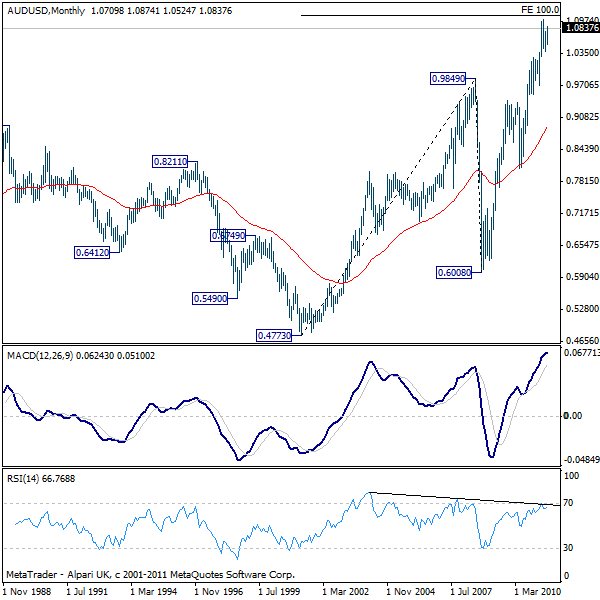
AUD/USD broke out of near term range last week and rose to as high as 1.0874. Rise from 1.0390 has resumed and should be target a test on 1.1011 resistance this week. Overall outlook remain unchanged. we're still favoring the case that correction pattern from 1.1011 is finished with three waves down to 1.0390 already and rise from there is tentatively treated as up trend resumption. Break of 1.1011 will confirm and target 61.8% projection 0.9703 to 1.1011 at 1.0390 at 1.1198 next. On the downside, below 1.0774 minor support will turn bias neutral and bring consolidations first. But downside should be contained well above 1.0524 support and bring another rise.

In the bigger picture, rise from 0.8066 is part of the up trend from 2008 low of 0.6008 and is still in healthy status. Such up trend should target 100% projection of 0.6008 to 0.9404 from 0.8066 at 1.1462 on resumption. On the downside, Break of 1.0182 resistance turned support is needed to be the first signal of medium term reversal. Or we'll stay bullish in AUD/USD.

In the longer term picture, long term up trend from 0.4773 (01 low) is still in progress and would possibly target 100% projection of 0.4773 to 0.9849 from 0.6008 at 1.1084. AUD/USD is staring to show loss of upside momentum with weekly MACD crossed below signal line and there is possibility of bearish divergence condition too. Nevertheless we'd still prefer to see at least sustained trading below 55 weeks EMA (now at 1.0055) before considering long term reversal. 
 

Ratings and Recommendations