Financial Advisor
Showing posts with label Coffee. Show all posts

Hedge Funds Reduced Exposure Ahead of Big Rally

Hedge funds and large investors continued to reduce their long exposure to commodity futures and options last week. The data compiled 3 October showed a  4.2 percent reduction to 920,000 lots, the lowest level since July 2010.

This also helps to explain the strength of the rally that followed as funds scrambled to rebuild positions. The rally that began Wednesday was the biggest three-day rally of the year and was helped by increased efforts in Europe to deal with the debt crisis and signs that the U.S. economy may avoid recession.

The energy sector saw an increase in net longs of 20 percent primarily helped by a sharp reduction in the Natural Gas short position. The WTI crude position meanwhile continued to be scaled back, moving below 200,000 lots just ahead of the rally which began last Wednesday when U.S. inventories showed a much bigger draw than expected.

Exposure to the grains sector was cut by 2 percent to 242,000 lots, the lowest level since July 2010 and much below the 2011 peak of 890,000 lots back in February. The “World agriculture supply and demand estimates” report will be released this Wednesday and any signs of tightening could attract new buying given the sharp reduction of long positions over the last month.

The metal sector was flat on the week with a small increase in gold longs - the first in four weeks - being off-set by another increase in short copper positions.

The soft sector also saw a reduction in speculative longs as positions in sugar and coffee were reduced while the cocoa short position increased further. 
Background information: The Commitments of Traders is a report issued by the Commodity Futures Trading Commission every Friday with data from the previous Tuesday. It comprises the holdings of participants in various U.S. futures markets split into "commercial" and "non commercial" holdings. The non commercial or speculative holding are typically institutional investors such as hedge funds and CTAs. Analysts and investors follow changes in these positions because such transactions can reflect an expectation of a change in prices.

August in Review; Energy, Base Metals Struggle, Gold Still Shines

The general market turbulence took its toll on commodities in August with cyclical commodities like energy and base metals struggling while investors ran for cover into gold. The agricultural sector showed solid returns with seven products figuring among the top ten best-performing commodities.

The Reuters Jefferies CRB index ended August almost unchanged, having lost nearly 8 percent during the early part of the month when S&P's downgrade of US debt and a deteriorating economic outlook took hold.  
Coffee on top
A general scarcity of coffee beans among European roasters ahead of the new harvest in October triggered a strong rally in August. Brazil, the world’s largest producer of high quality Arabica coffee, has seen temperatures in the production areas well above levels that could cause frost damage while Vietnam, the world’s largest producer of the Robusta variety, is potentially heading for a record production. On that basis prices should stabilize once fresh supplies begin to reach the roasters. Further upside seems limited.

Gold has stabilized but for how long?
The yellow metal received most of the headlines last month as the year-long rally shifted up a gear with the one month return exceeding 12 percent and, in the process, moving within striking distance of 2,000 dollars per troy ounce. Safe havens from global turmoil were also cut to one from 3 as fear of central bank intervention in Swiss Franc and Japanese yen left gold as the beacon.

In a couple of moves the CME Group raised the margin for trading gold futures from 4,500 to 7,000 dollars. The move came as a response to increased volatility after the unprecedented strong rally, not as an attempt by the exchange to dictate the direction, but mostly in order to keep some integrity in the market. Speculative involvement from hedge funds has been reduced as margin increases make an impact on the position size they are allowed to hold.

The potential for further stimulus signaled last Friday by Ben Bernanke, Chairman of the US Federal Reserve, continues to support gold. The 200+ dollar sell-off recently, however, was a reminder that nothing ever goes in a straight line. After having consolidated earlier this week renewed stock market weakness and squabbles over Greece (again) saw buyers return. Will traders have a strong enough conviction to take it much higher beyond 1,900 remains to be seen? Resistance above the recent high at 1,913 will be 1,965 while support can be found at 1,770 ahead of 1,700.
Grain and soybean complex
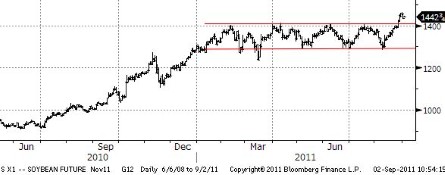
The DJ-UBS grains index rose 10.7 percent in August as wheat, corn and soybeans continued to rally with the outlook for this year’s production deteriorating further. Heat and dought across the main producing regions have played havoc with crop prospects. The price of November soybeans reached a new high of 14.65 per bushel after trading sideways for seven months. Hedge funds added 10 percent to existing long positions as the fundamental outlook favoured the sector over others like energy and base metals.
Wheat prices recovered strongly on a spillover effect from higher corn prices, despite continued strong Russian exports having increased competition in the global market. This resurgence in exports, helped by aggressive undercutting of competitive bidders, has now caused problems on Russia's rail system. The railway authority has banned the transportation of grain to the main shipping port as more than 3,600 railway cars are clogging up the North Caucasus branch of the railway system. This, in return, triggered a rise in domestic prices this week as exporters scrambled to find alternative sources of wheat to cover established contracts.

Brent crude oil firm despite slowdown
Oil markets continued to recover with Brent crude, in particular, moving back up towards the higher end of its month-long trading range. August was a month of serious volatility which impacted the energy sector as a whole. Risk aversion early on triggered a substantial sell-off before signs of physical tightness kicked in. Brent crude recovered back to almost unchanged.

Libyan oil could begin to flow before long, albeit in small quantities,  but so far this has had limited impact on prices as traders have been more concerned about bottlenecks stemming from production problems at the UK’s largest North Sea production field. Meanwhile, the prospects of EU sanctions against Syria could increase an already tricky situation for European refineries who have been struggling to find supplies after the loss of high quality Libyan oil.

While Brent crude is troubled by bottlenecks on the production side, WTI crude continues to have to opposite problem with too much supply at Cushing, the delivery hub for WTI crude. This is causing a complete opposite forward curve shape compared to Brent, as seen below, and also shows why the spread between the two benchmarks are its widest at the front end of the curve.
Brent crude's recent rally ran out of steam above 115 dollars per barrel, some three dollars below trendline resistance from the two previous highs. On that basis we see limited potential for further upside gains with the risk of renewed stock market weakness potentially triggering a move back towards the middle of its established range at 108.

Lower Hog prices
The price of lean hog futures dropped more than 7 percent during the month after a strong run up the previous month. Supplies have been rising steadily on a seasonal basis and continue to outpace demand. At the beginning of August hedge funds held near record long positions which have subsequently been reduced by 25 percent thereby adding to the downside pressure. Further long liquidation is feared should the active contract for delivery in December break out of the established trading range below 81 cents per pound. Support comes from the fact Futures prices are currently trading at a discount to cash with the two eventually needing to converge.

Firm demand for coal and steel
Asian coal and steel demand increased dramatically in August. The number of shipments of iron ore, a key steelmaking ingredient, increased in August with 52% more vessels being hired than in July. The average price for iron ore delivered to China, the world’s largest consumer, rose by 2.5% from July to 177.45 dollars per ton with spot prices now at 180.40 dollars per ton. The average price of Chinese wire rod for August reached $784/ton, the highest level since July 2008 and a 29% increase year-on-year.
Meanwhile in Japan, coal imports are rising as the percentage of coal-fired electricity increases while the nuclear reactors undergo maintenance (coal-fired electricity production increased 36% in July compared to April and 16 nuclear reactors remains idle). Likewise, coal for cement production has also increased as the reconstruction efforts pick up.

Finally – a tricky month ahead
As the timeline below shows financial markets have entered a month with many important political events which will undoubtedly determine direction going into the final quarter and beyond. The global worries which caused all the panic over the summer have not gone away and how politicians meet those challenges will have a major impact on the direction of anything from stocks and bonds to commodities - stay tuned.

Weekly Commodity Update : Commodities nervously awaiting Capitol Hill decision

The standoff continues between President Obama and the Republican led Congress over a deal to raise the debt ceiling. If they, beggaring belief, fail to reach an agreement to raise the government’s borrowing limit, the major ratings agencies have said they could downgrade the AAA credit rating that the U.S. currently holds. Such a move could raise the cost of borrowing and slow an already fragile economic recovery, highlighted by nasty U.S. growth data, and thereby reduce demand for energy by the world’s largest consumers.

A failure would trigger a spike in volatility and disrupt financial markets. These concerns were raised by fourteen of Wall Street’s leading CEO’s on Thursday who wrote to President Obama and Congress warning them of “very grave” consequences of a default and urging them to sort out a deal.

Meanwhile in Europe fiscal worries continue as the market fears that the Greek disease could still spread despite politicians’ best efforts to prevent this. Italy auctioned bonds this week at a very high cost and has seen its spread over German bonds rise above levels seen prior to the agreed Eurozone bail-out plan for Greece. Added to this, ratings agency Moody’s warned about a possible downgrade of Spain’s credit rating.

A month of two halves for commodity performance
Commodities spent the first half of July recovering strongly from the sell off that occurred during May and June. The last half however has been overshadowed by macro-economic concerns with the above mentioned fiscal worries in the U.S. and Europe having caused markets to trade sideways apart from safe haven investments such as gold and silver. As a consequence the Reuters Jefferies CRB index showed the first, but relative small, positive monthly return since April. 
U.S. oil demand reduced
The price of WTI crude briefly traded above 100 dollars before being knocked down with further losses following a surprisingly high increase in U.S. oil inventories. Imports of crude and gasoline into the U.S. appear to have fallen to the lowest levels in years, according to the Lloyd’s list. Whether this is a signal that demand is waning or it is caused by the release of 30 million barrels from its strategic reserves remains to be seen. The Energy Department has just begun delivering this oil with less than one third hitting the market in July and the remainder during expected during August.
WTI crude remains stuck in its July range between 94 and 100 dollars as macro economic developments either side of the Atlantic continues to be the main focal point. In Brent crude the trading remains confided to the 115 to 120 dollar range for now. The spread between the two varieties has moved back above 20 dollars following an injection of 430,000 barrels into Cushing, the delivery hub for WTI crude.

Impacts from hurricane season
The first four tropical storms of this year’s hurricane season so far have highlighted the risk to production and refineries in and along the Mexican Gulf. This week the price of Gulf of Mexico crude called Louisiana Light Sweet rose to a premium of nearly 22 dollars over WTI crude as tropical storm Don entered the Gulf carrying winds that forced companies to evacuate staff from oil rigs and temporarily shut down production.
The US National Oceanic and Atmospheric Administration NOAA have predicted 3-6 major hurricane storms this coming season. In order to cause any disruption they first of all have to come to fruition and secondly have to hit the Gulf leaving enough unknowns for the market to avoid pricing in the potential risk. Natural gas which in previous years use to see increased volatility shrugged off the news about Don and dropped 4% on the week as traders scaled back positions on the back of higher than expected weekly storage data.

Tricky week ahead for precious metals
Gold extended its recent gains and spent the week consolidating above USD 1,600. Silver meanwhile has been struggling to get a foothold above 40 dollars and has underperformed on a relative basis. Being one of the top performers during July investors have been taking some profits as the May sell-off is holding back investors from building up large scale positions similar to ones seen during the first quarter of 2011.
Gold and silver will be facing a tricky week with pressure mounting for some kind of result from the U.S. debt ceiling negotiations. Short term a satisfactory outcome could remove some of the recent support, especially considering the chance of the dollar strengthening as a consequence. Should gold manage to break below USD 1,600 it could trigger a move towards the next support which can be found in a band between USD 1,555 and 1,575.
 
Agricultural markets also had a quiet week continuing a sideways trading pattern while waiting for further clues about the potential size of the upcoming harvest. The adverse weather which had been supporting prices up to now seems to have normalised with rain across dry areas helping crops prosper.  

Investors favour Soybeans and Gold

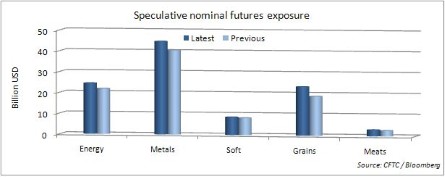
Hedge funds and institutional investors added to long positions by the most in almost a year last week. The leading commodity indicators rose for the fourth straight week as momentum continued to build. The net long futures position rose by 13% to 1.26 million lots or nearly USD 105 billion in nominal value.

Gold and soybeans saw the biggest increases as sovereign debt worries in Europe and the U.S. supported the yellow metal while a severe heat wave in the U.S. kept grains, especially the soybean complex, well supported.

Energy: The sector had a quiet week but with a firm undertone. This attracted additional investors with the futures position in Crude oil rising by 7k to 192,000 lots. Natural gas shorts were reduced as higher heat wave related consumption combined with the upcoming hurricane season led to positions being scaled back.

Grains: Above normal temperatures and dry weather continues to carry the risk of damaging crops in the U.S. Midwest. With upside momentum still in place investors added to existing long positions, especially in the soybean complex and corn while in wheat investors switched from lower (CBOT) to higher (Kansas) quality.

Metals:  Speculative longs in gold rose by 11% last week while holdings in exchange traded products rose to a record 2,122 metric tons. The new record high above USD 1,600 and expectations for additional price gains in the months ahead saw investors adding to existing long positions. Despite Silver outperformance the remembrance of the April sell-off continues to leave professional investors on the sideline with speculative longs only rising by 1.2%.

Softs: investors reacted to the sell-off in coffee and reduced long positions by almost a quarter while cotton began to find buyers after the sell-off combined with reduced U.S. production as large cotton fields in Texas are scorching in the heat.

Background information: The Commitments of Traders is a report issued by the Commodity Futures Trading Commission every Friday with data from the previous Tuesday. It comprises the holdings of participants in various U.S. futures markets split into "commercial" and "non commercial" holdings. The non commercial or speculative holding are typically institutional investors such as hedge funds and CTAs.

From the Wild Wild West to tranquility territory

Clearly most short-term speculative accounts have reduced positions dramatically, as also seen in ETF net-long positions, whilst long-term investors have stayed put, and are possibly first watching Wimbledon and now the Tour de France, with no intention to escalate positions.
Still, they may choose to stay alert like Annie and keep some powder dry for flash crashes, dips and stop related sell-offs as the secular trend for commodities remains intact.
Risk-off in June reduced investor net-length significantly, back below 2008/2009 and 2010 highs despite underlying demand being intact and weather disruption supportive factors.
Source: Morgan Stanley analysis

Oil prices floored
Oil prices found the floor after the International Energy Agency hiccup. Again, as shown in CFTC data, speculative accounts have reduced net longs in WTI and Brent and most major top five banks which were premature in hiking oil price outlooks have now revised outlooks down by $10, still eyeing WTI $110 and Brent $125.
The IEA 60 mln barrel release seems to be oversubscribed, already indicating firm underlying demand clockwise from Sapporo to Vladivostok, so the impact of the emergency stock release on the global balance is likely to be relatively short-lived and long-term bullish.
IEA inventory release showed yet another draw higher than expected and boosted by positive U.S. economic data releases, WTI finished this week at the highs of 98,60 from last Fridays 94,50 whilst underlying fundamentals remain bullish for oil as we are living with no spare capacity.
Source: Bloomberg

Natural Gas traders akin with US weather prophet
You really have to be a U.S. weather prophet to week trade natural gas to determine if air conditioning is on and off with no correlation with Dow Jones. U.S. natural gas futures slid more than four percent lthis week, pressured by weaker cash gas and improved nuclear generation despite some ongoing heat. Inventory data caused another day tumble to lows of $4.13 MMBtu. The IEA storage report showed 95 Bcf injection much higher than expected and with the deficit set to evaporate before summer ends, the outlook for gas is looking increasingly bearish.

Precious metals – Hype is behind us
When my Mum and cab driver do not mention silver and gold for three weeks, then I know the Q1 hype and price rally is behind us. Also ETP silver product flow shows the smallest net long positions in three months and with a clear indication that speculative accounts are not willing to take gold prices higher than1550 - with producer hedging obvious and break-even prices for cost of production putting a firm bottom under the market around 1200 ex profits - then around 1400 seems to be the absolute floor currently from a demand/supply perspective.
However good news from the global auto sales industry is keeping a floor under  platinum prices after the Japanese tsunami earthquake related soft patch trend. Gold wobbled back and forth this week on ratings issues and closed 3% up on the week.
With positions being fairly neutral, the next move will be fierce, so stay alert!

Agriculture – China steps in
Next week is busy again as USDA and WASDE report crop conditions, ending stocks and production and with U.S. weather changing by the minute all grain products are facing volatility going into next week.
This week however was recovery week followed by last week's dramatic limit down sell-offs in wheat and corn on the back of acreage and ending stocks data, with major news that China was stepping in buying corn for storage again.
Russian wheat sales continued to weigh on the market amid seasonal pressure from U.S. winter crop harvests and crop conditions for corn and beans are pretty good because the weather is helping the yields, so the market is currently capped on the upside too.
Corn prices rallied a good 4% after the wash out last week, boosted by sentiment, fresh Asian buying and higher oil and sugar prices, leading corn higher through ethanol demand
U.S. rice futures close solidly higher as India's agricultural minister switches course to say he will not push for grain exports. A continued ban on grain exports from India most likely means increased demand for rice from other countries and with India being the second-largest producer after China, but also consumer, it remains a key driver for rice prices when exports are regulated.
Source: Bloomberg 

No Cocoa please, but hot Coffee and plenty of Sugar
Coffee
Parts of Brazil's Minas Gerais coffee belt were mildly hit by frost this week and supported current prices. Frost can kill coffee trees' leaves and branches, reducing output in the following year's crop. Such freezes are rare but this is the worst since the last major freeze in 2000 occurred last week, but was mostly confined to minor producer Parana. Being the world's largest producer of Arabica coffee, Brazil remains the one and only coffee price factor with Vietnam producing Robusta  instead. All in all it’s all down to weather and frost in Brazil, so risk remains for higher Caffe Latte prices at your corner cafe.

Sweet Sugar up 10%
The queue of ships waiting to load sugar at Brazilian ports rose from 64 to 86 this week, as the world's largest sugarcane crop nears peak harvesting. Waiting times for ships to load were between 8 and 10 days, which would appear to be much shorter than a year ago when ships faced waits of a month or more at some congested ports when rain repeatedly interrupted loading.
UNICA revised down cane crush estimates and sugar took off to the moon and continued production fears in Brazil is keeping front prices firm and squeezed this week, whilst deferred contracts 2012 are still trading 20% lower than spot. Super low inventories, Brazilian harbour congestion and long speculative longs are keeping front prices sweet as well.

Cocoa, O’Boy
The cocoa surplus for the 2010-11 season is likely to affect the market in the third quarter as shipments resume from top producer Ivory Coast, which produces 1/3 of world output.
Rains in the Ivory Coast's key cocoa growing regions last week were ample for the development of the mid-crop until late August and the Ivory Coast is now the end of the 2010/11 season with a bumper crop well ahead of target largely due to good rains. 
Cocoa purchases in the world's number two grower Ghana reached 940,000 tonnes by mid-June, putting output over 50 percent ahead of last year and the bumper harvest had strained storage facilities and led to some congestion at some port and depot facilities. 
Market prices have peaked and market direction looks bumpy with negative bias.
 
Copper, force majeur decouples C from C
Production at Collahuasi copper mine, the second-largest in the world has reportedly fallen to 30-40% of capacity over the past week due to on-going adverse winter weather conditions.
Indeed, current weather conditions were described as a once in "every 50 to 65 years" also as supply-disruption in Chile has come from the separate threat of a 24-hour strike by workers at Codelco, the world's biggest mining company. The final concern on the supply-side has come from Grasberg mine in Indonesia being the third-largest mine globally. The seven day strike at the mine has reportedly reduced the mine site to operating at close to 10% of capacity. So copper rallied for others reason than the Chinese rate hike which would otherwise put pressure on prices. So, Copper has decoupled from China gaining yet another 4 percent this week on top of last week’s rally. The trend is your friend, so be it.

 Source: Bloomberg

By Kjeld Lynggaard, Senior Manager, Trading Advisory on behalf of Ole Hansen.

Funds reduce long positions on lower growth and Greece

Last week Hedge Funds and Money managers cut their net-long positions in 18 U.S. commodities by 13 percent to 1.13 million futures and options contracts in the seven-days ended June 21, data from the Commodity Futures Trading Commission show.

That’s the biggest decline since May 10 and managers reduced bullish bets for the third week in a row.

Funds slashed bets on rising agricultural prices by the most in three months, led by declines in holdings of wheat and coffee, as supply concerns eased amid signs the global economy may slow.

Speculators reduced their net-long position in 11 U.S. farm goods by 12 percent to 674,396 futures and options contracts in the week ended June 21, government data compiled by Bloomberg show. That’s the biggest drop since mid-March. Investors turned net-short, or bet on declines, on wheat for the first time since late November. Coffee holdings tumbled 65 percent.

Wheat prices have tumbled 16 percent in June, heading for the biggest monthly drop since October 2008. Investors held a net-short position of 8,570 contracts as of June 21, compared with net-long holdings of 7,558 contracts the previous week.
 Background information: The Commitments of Traders is a report issued by the Commodity Futures Trading Commission every Friday with data from the previous Tuesday. It comprises the holdings of participants in various U.S. futures markets split into "commercial" and "non commercial" holdings. The non commercial or speculative holding are typically institutional investors such as hedge funds and CTAs. The above chart tracks a total of 27 different commodities split into sectors. 

Energy and Precious Metals Technical Analysis

BULLION

Gold closed higher on Monday as it extends the short covering bounce off last Monday's low. The mid-range close sets the stage for a steady opening on Tuesday. Stochastics and the RSI are bullish signalling that sideways to higher prices are possible near-term. If it renews the rally off May's low, May's high crossing is the next upside target. Closes below last Monday's low crossing would confirm a top and trend change has taken place. 
Silver closed higher due to short covering on Monday. The high-range close set the stage for a steady to higher opening on Tuesday. Stochastics and the RSI are turning neutral to bullish signalling that sideways to higher prices are possible near-term. Closes above last Friday's high crossing would confirm that a short-term low has been posted. If it extends the decline off the late-May high, the reaction low crossing is the next downside target.

U.S. STOCK MARKET INDICES

DJI closed higher due to short covering on Monday as it consolidated some of the decline off May's high. The high-range close sets the stage for a steady to higher opening on Tuesday. Stochastics and the RSI are turning neutral to bullish signalling that sideways to higher prices are possible near-term. SPI closed higher due to short covering on Monday as it consolidates some of this spring's decline. The high-range close sets the stage for a steady to higher opening when Tuesday's night session begins trading. NDI closed higher due to short covering on Monday as it consolidates some of the decline off May's high. The high-range close sets the stage for a steady to higher opening on Tuesday. Stochastics and the RSI remain neutral to bearish signalling that sideways to lower prices are possible near-term. 


ENERGY

Crude Oil closed lower due to short covering on Monday. The high-range close sets the stage for a steady to higher opening on Tuesday. Stochastics and the RSI remain bearish signalling that sideways to lower prices are possible near-term. If it extends this week's decline, the 50% retracement level of the 2010-2011-rally crossing is the next downside target. Closes above the 20-dasy moving average crossing would confirm that a short-term low has been posted. 

Natural Gas

Natural Gas closed lower on Monday as it extends this month's decline. The mid-range close sets the stage for a steady opening on Tuesday. Stochastics and the RSI remain bearish signalling that sideways to lower prices are possible near-term. If it extends the decline off this month's high, the reaction low crossing is the next downside target. Closes above the 10-day moving average crossing are needed to confirm that a short-term low has been posted. 

COFFEE

Coffee closed lower on Monday as it extends the decline off May's high. The low-range close sets the stage for a steady to lower opening on Tuesday. Stochastics and the RSI are bearish signalling that sideways to lower prices are possible near-term. If it extends the decline off May's high, the 38% retracement level of this year's rally crossing is the next downside target. 

Ratings and Recommendations