Financial Advisor
Showing posts with label Real Estate. Show all posts

U.S. Homes: Now the Best Deal in Recorded History

U.S. Homes: Now the Best Deal in Recorded History

Now is literally the best time in recorded history to buy a house in America…

Right now – today – U.S. real estate is the most affordable it's ever been. Ever. 

When I say "affordable," I'm looking at three things: house prices, mortgage rates, and incomes.

With the Affordability Index near 200, the median family has 200% of the income necessary to buy the median home (or more specifically, to qualify for a conventional loan on the median home).

It's easy to see where we are now…

 Right now, as you know, house prices are sitting near new lows for this cycle, down by roughly one-third (depending on who's counting). And right now, mortgage rates – after ticking above 5% earlier this year – are all the way down to 4.5% again, near all-time lows.

So it's simple: With the worst house-price crash in American history, combined with the lowest mortgage rates in history, you can now afford more home than ever.

Meanwhile, hope is gone. Everyone thinks housing is hopeless. That is when a bear market ends and a new bull market begins.

At a conference I attended last month, some speakers spoke woefully of the large supply of houses for sale. That will take care of itself in time. Others bemoaned the certainty of higher interest rates in the future, which would hurt housing. But they shouldn't be so certain…

Twenty years ago, Japan faced a housing bust similar to ours. Japan's government has cut interest rates to near zero and printed money. And long-term interest rates in Japan currently sit around 1%.

Even rising interest rates won't kill housing… In the 1970s, interest rates were rising, and house prices outperformed stock prices.

The story is simple: House prices have fallen more than ever… And mortgage rates are lower than ever. If you can buy a house now (and want one), go for it.

Now is the best time in American history to do it.

Good investing,

Steve

Bank Insider Shares Housing Market Secrets

"Nobody's borrowing right now, Steve," a bank CFO told me over breakfast on Friday.

"You hear that banks aren't lending… But that's not what's going on. What's going on is Main Street America is getting killed. People simply don't have a positive net worth – they don't have assets for banks to lend against."

This banking insider gave me some surprising specifics on real estate today and some intimidating insights on what will happen when the government exits the mortgage market.

Let's hear his take on the real estate market first…

"The math for Main Street is pretty simple… Maybe half of homeowners here in Florida are underwater on their mortgages. They can't borrow money from banks when they're in bad shape like that. Another 20% can't refinance because they don't have enough equity. And another percentage is older folks are in a homesteaded house and don't want to move because their property taxes would soar."

In other words, "The population of capable consumer borrowers is very small." He said the only active market now is "starter" homes under $200,000.

So I asked him, "Who's buying?" I know people are buying… I told him about a home-inspector friend of mine. He says he's busier than he's been in years because of people buying. This home inspector friend said his new clients need the inspections done "right now" and they're doing "all-cash deals."

The bank CFO replied, "You hit the nail on the head… Those are ALL-CASH deals. We are not in that loop. This is that very small percentage of people I was talking about that have the net worth to buy. With prices at these levels, all-cash investors are certainly buying."

The latest talk is about the government exiting the mortgage market… This is a big deal, as something like over 90% of mortgages are government-backed. I asked the banker what he thought. He didn't hesitate…

"Mortgage rates would shoot up," he said. "Nobody in their right mind in my industry would lend at 4% for 30 years. If there was no government subsidy, there would be very few 30-year mortgages."

Here's how he explained it:

"Look, as a bank, I'm trying to make a 4% interest margin. If I lend the money out at 4% in a mortgage, I have to pay zero percent on deposits. I can't do that forever. What happens when I have to pay more on deposits? Four percent mortgages are not reality."

And then he asked me, "Here's an idiot-proof test… Would you lend to someone for 30 years at 4%? How about at 5%? At what rate would you be willing to accept on a loan for 30 years? I don't know about you, but I'm not willing to put 5% on my books for 30 years."

These two conclusions from the banking insider are important:
  • The problem isn't that banks don't want to lend… It's that consumers can't borrow because they don't have the net worth to borrow against. And that situation doesn't look like it will change anytime soon.
  • Thirty-year mortgages could be a thing of the past, and mortgage rates could shoot from their lows around 4% in late 2010 to 7% or more, when the government gets out of the mortgage market (like it's talking about doing now).
I wish I had a prettier picture to report. But that is part of the view from the trenches.

I've written optimistically about real estate recently. I still believe now is an excellent time to buy a house, with near-record low mortgage rates and great prices.

But if my banker friend is right – if you want a 30-year mortgage with a low interest rate – you'd better act soon, while the government is still subsidizing mortgages. If you're not in the market for a house, pass the word along to your kids or someone else who could benefit.

Mortgage rates are still near record lows, and prices are extremely cheap. In a couple years, you probably won't be able to say one of those things… and maybe both.

Good investing,

Steve
.

Billionaire Warren Buffett's Third-Best Investment

"All things considered, the third-best investment I ever made was the purchase of my home."
 
Billionaire Warren Buffett said that in his annual letter to shareholders over the weekend.
 
Buffett is bullish on housing...
 
"Home ownership makes sense for most Americans, particularly at today's lower prices and bargain interest rates," he wrote.
 
Just last week, I wrote the same thing to subscribers of my newsletter, True Wealth:
 
Now is the best time in American history to buy a house.
 
Home prices have crashed more than at any time in our lifetimes. And mortgage rates recently hit all-time lows. Houses are more affordable than ever.
 
Things are getting Less Bad. The recession is over. Housing starts bottomed, and the supply of new homes on the market peaked. Homebuilders like Toll Brothers are "back to growing," and my home inspector friend is "swamped" with business.
 
If you can buy a house, now is the time – the best time in history. While prices may not soar immediately, I believe we're seeing the lows RIGHT NOW.
 
Last week, I thought I was standing alone, saying this. But after Warren Buffett's annual letter came out over the weekend, it appears I have company... The man who is arguably the greatest investor in history agrees with me about housing.
 
One of my main conclusions in True Wealth was:
 
Homebuilding is cyclical. And I believe we've just finished the worst of this down cycle – which is the worst ever seen in our lifetimes, and likely the worst we will ever see. Now comes the upturn. Get in early... get in now.
 
In that issue of True Wealth, I specifically say what to do... which could show you gains of as much as 1,000%. (I know that number sounds crazy, but this strategy returned 1,064% in the late 1970s.)
 
If you're not a subscriber, you can still take action...
 
Last week, I said it's the best time in history to buy a house. And over the weekend, the world's best investor agreed with me.
 
You can listen to your neighbors, the government, or the news media complain about how terrible housing is. Or you can listen to the advice of the best investor in history (Buffett).
 
Who do you think has a better chance of being right?
 
U.S. housing is a fantastic deal right now. If there's any way for you to take advantage of it, you must.
 
Good investing,
 
Steve

P.S. Buffett said buying his home was the third-best investment he ever made... But what did he say were his best two investments? "Wedding rings."

The Best Time in History to Buy a House

The Best Time in History to Buy a House

Right now, is the best time in history to buy a house in America.

Today, I'll show you why… based on a few cold, hard facts.

First off, mortgage rates are lower than they've ever been in American history…

Most investors have only seen a couple decades of mortgages rates on a chart. But my friends at Global Financial Data have databases – including real estate data – that literally go back centuries.

I had dinner with the Global Financial Data team over the weekend. And they told me about their "Winans International" real estate indexes, with housing prices back to the 1800s and mortgage rates going back over a century. I had to share it with you…

Take a look at this chart of mortgage interest rates since 1900:


As you can see, current mortgage rates are the lowest in U.S. history.

When were mortgage rates even close to this low in the past? Just after World War II…

And what happened, just after World War II, when mortgage rates were this low? The greatest postwar boom in housing prices – by far.


Take a look. Mortgage rates bottomed in the mid-1950s, and house prices bottomed about the same time. Then the greatest boom in home prices in our lifetimes started.

Today we have record-low mortgage rates. And we have another thing in our favor…

Homes are more affordable than ever.

Based on the 40-year history of the Housing Affordability Index… houses are more affordable than they've ever been. Take a look…


"Affordability" takes three factors into account: home prices, your income, and mortgage rates.

Home prices have crashed. And mortgage rates are at record lows. But incomes (nationwide) haven't fallen nearly as much… So homes are now more affordable than ever.

"Most people" out there will only tell you the bad news about housing… That's the way it goes in a bear market. People drive looking in the rearview mirror.

Meanwhile, we have some darn compelling facts out there…

Home prices have fallen by a third… and mortgage rates are the lowest in history. Therefore, U.S. homes are more affordable than they've ever been.

You can listen to "most people." Or you can choose to ignore them and stick to these facts.

Based on these facts alone, now may be one of the best times in American history – even the very best time – to buy a house.

Good investing,
Steve

P.S. If you need long-term data like I showed in the charts above, talk to my friends at Global Financial Data. You can find them at www.globalfinancialdata.com

Wealthy Chinese Are Desperate to Buy Your Vacation Home


Real estate insider: Housing crash will surpass the Great Depression

From Pragmatic Capitalism:

More bad news out of the housing market today as Zillow, a leading online real estate marketplace, released its third quarter report and it largely echos what we saw in yesterday's Clear Capital report – the housing market is double dipping. Home values fell an average 4.3% in the third quarter.

Stan Humphries, the Chief Economist at Zillow, says the housing market decline is likely to surpass the Great Depression's decline and that prices are unlikely to recover before...

Read full article...


FX Update: China hikes, risk wilts

Risk appetite is pulling back after a lousy earning report and outlook from Apple Computer late yesterday and a surprise decision to raise rates by the PBOC.  Meanwhile, US banks report great results as mortgage clouds continue to gather.  Risk trades at risk here…
A hike in China
The PBOC’s decision to hike rates has served as a bit of a spanner in the works for the current market paradigm of “Easy money all around – let’s speculate wantonly!”. This is the first move by the PBOC since….2007 and suggests that the Chinese are very concerned about something here since they are willing to rock the boat in this fashion. The speculation can only be that CPI will come in very high when China releases a raft of data on Thursday. Food prices are weighted very heavily in the Chinese CPI, and grain prices are sharply higher from just a couple of months ago. This is a critical political season in China, as it sets about crafting its new 5-year plan for 2011-15 (let’s all remember that this is a command economy…). 8-10% growth forever, anyone? Forever might end within the next 12 months. While the reaction in the Chinese equity market to the PBOC hike suggests no domestic panic in China, any whiff of anything resembling a pulling of the plug on the liquidity-fest is anathema to the competitive devaluation/QE front-running theme and the market shrinking away from risk trades at the moment makes eminent sense and may have longer to run.
RBA Minutes
The RBA minutes were relatively Aussie negative, especially since the currency’s strength was mentioned as a factor in the outlook as a potential aid in easing inflation going forward. This sets up the dynamic  of: too much strength in the Aussie means the RBA is less likely to hike, which means that the AUD uptrend from here on out will be a self-limiting process, meaning downside becomes the side of least resistance in terms of volatility potential. It was also noted in the minutes that the decision was “finely balanced”. This combined with the Chinese rate hike aimed at slowing the Chinese economy has the Aussie in the hot seat for a very good reason today.
Chart: AUDUSD
The news flow today not kind to the Aussie, which could fall across the board on today’s developments. The big focus to the downside here could be the old 0.9400+ high if momentum continues in the short term.
US Housing Surprise?
Interesting to note that despite the new mortgage fiasco in the US, the NAHB survey out yesterday, which measures buyer interest for new homes and is one of the more leading indicators in the US housing market, actually ticked a few points higher in September from its lowest level in a long time in Augus. One might take this as an encouraging sign, but to some measure it is likely also due to the fading effect from the expiration of the homebuying incentive tax that ran out at the end of April and cannibalized forward demand. One might also thing that new homes might sell better in the coming few months than existing homes for those who feel they absolutely must buy a house because they are moving, but don’t want to risk the potential title/ownership hassle of an existing home. At least new homes have a clear title! The other housing related data today was actually less encouraging, as housing starts were about the same as the previous month and building permits dipped sharply. The 539k annualized in the latter figure is the third lowest figure on record.
Bank of Canada
Despite the sharp move weaker in CAD ahead of the BoC decision today, the decision itself failed to throw the currency a rope as USD selling has intensified this morning. The Bank’s statement was cautious as the Bank noted the shift to fiscal consolidation in the developed countries, where it felt growth would be weaker. Canada’s growth potential was also downgraded and the bank also expected household spending to decelerate. All in all, no major surprises, but this is clearly not a bank that is looking to hike any time soon and one would expect the market to reduce forward rate expectations to closer to neutral. Considering the news flow of the day here and the relatively large shock to the AUD uptrend from developments – one has to wonder how long AUDCAD can maintain the parity level here.
Earnings season
Perhaps the US equity market’s most important equity, Apple Computer, fell sharply overnight after earnings somewhat disappointed expectations and as product sales and margins disappointed. A cautious outlook didn’t help. This is important stuff, coming from the market’s poster child of a growth stock and a USD 275 billion company.. This morning’s focus was on Goldman Sachs’ and Bank of America’s earnings – who of course reported great results – but the latter company is at the center of the mortgage furor due to its overtaking of the most reviled mortgage lender (due to their aggressiveness in the sub-prime area and size), Countrywide Financial, in early 2008.
Looking ahead
At what point does he shut down of an entire large nation affect the Euro? Shouldn’t it be soon? And if the USD is doing well here on this consolidation in risk appetite, shouldn’t its fellow traveler the pound also be doing well? For those not wanting to read between the lines, we will simply come right out and say it: why is EURGBP trading at 0.8800 right now – shouldn’t 0.8700 be more appropriate, or even lower at the moment? It appears that the focus is definitely away from GBP at the moment as the USD is the prime mover here.
It appears that this PBOC rate hike, US mortgage situation and the bit taken out of Apple might finally be enough to trigger a reasonable consolidation of this Everything Up/US Dollar Down trade for at least a time. if momentum continues to increase here in the short term on the anti-trend will be the 1.3350 area in EURUSD and the 0.9400 area in AUDUSD. Those levels might appear rather far off, but the April top in risk appetite and subsequent May fall-out showed us what can happen when these persistent moves with virtually no retracements can mean when the downside finally does arrive in a hyper-correlated market.
Interesting to note that the USD strength is unfazed here just after the Fed’s Lockhart is out saying that the Fed needs to get big on QE if it wants to do it at all. 
Economic Data Highlights
  • EuroZone Aug. Current Account out at -7.5B vs. -4.1B in Jul.
  • EuroZone Aug. Construction Output out at -8.5% YoY vs. -6.9% YoY in Jul.
  • Germany  Oct. ZEW Survey out at -7.2 vs. -7.0 expected and -4.3 in Sep.
  • EuroZone Oct. ZEW Survey out at 1.8 vs. -2.0 expected and 4.4 in Sep.
  • UK Oct. CBI Business Optimism out at 2 vs. 8 expected and 10 in Sep.
  • UK Oct. CBI Trends – Total Orders out at -28 vs. -19 expected and -17 in Sep.
  • US Sep. Housing Starts out at 610k vs. 580k expected and 608k in Aug.
  • US Sep. Building Permits  out at 539k vs. 575k expected and 571k in Aug.
  • Canada Bank of Canada left rate unchanged at 1.00% as expected
Upcoming Economic Calendar Highlights
  • US Fed’s Evans to Speak (1340)
  • US Fed’s Dudley to Speak (1400)
  • US Fed’s Lockhart to Speak (1530)
  • US Fed’s Fisher to Speak (1650)
  • US Fed’s Kocherlakota to Speak (1720)
  • UK BoE Governor King to Speak (1850)
  • US Fed’s Bernanke to Speak (20000)
  • US Weekly API Crude Oil and Product Inventories (2030)
  • US Weekly ABC Consumer Confidence (2100)
  • US Fed’s Duke to Speak (2300)
  • Australia Aug. Westpac Leading Index (2330)
  • Japan BoJ Deputy Governor Nishimura to Speak (0130)

Wealthy Chinese Are Desperate to Buy Your Vacation Home


My friend is visiting from Shanghai. Last night, he told us some incredible stories about the crazy rise in real estate prices in China…

Take his parents, for example. They live in Qingdao, a fast-growing city on the east coast between Shanghai and Beijing. His parents bought a house on the beach seven years ago. It's gone up six times in value since they bought it and is now worth over $1 million.

My friend works at a Shanghai mutual fund company. He says his coworkers have all made fortunes buying property in Shanghai. One colleague bought an apartment "way out" in the suburbs where there's no subway. Its value has almost tripled in 18 months.

I asked him why people are so desperate to own property. He says China is gripped by a genuine inflation scare right now. People don't want to hold cash. The rich convert their money into foreign currency and move it offshore. Everyone else buys property.

In April, the Chinese government introduced new laws to prevent property speculation. There's a new sales tax on property held for less than five years, for example. A minimum 40% down payment is another. The idea was to put the brakes on the property market and kill the inflation fears. At the time, people thought these rules would cause buying to dry up and the property market would crash.

"They didn't even slow the market down," said my friend. "My apartment has gained 30% since April."

Here's the thing: While the Chinese property market soars, the U.S. property market is stuck in a bog. Last week, the Commerce Department announced that house prices had fallen to new six-year lows in August. New home sales are at the lowest levels since the government began collecting data in 1963.

The Chinese have noticed how cheap American property is… and instead of plowing their money into expensive properties in China, they're eager to get their money into American real estate. Everyone is afraid the Chinese government will do something stupid to get a handle on inflation, like causing the real estate market to collapse. Cheap U.S. real estate is the perfect solution…

Take my friend's parents… They plan to sell their house in Qingdao and use the proceeds to buy two houses in Fort Lauderdale. They'll live in one house and generate retirement income by renting out the other house. This way, they'll have a great retirement in Florida. And the rental house will keep them busy and provide an income. Most importantly, they'll get their money out of China.

My friend says this trend is going to grow into massive proportions over the next few years. To capitalize on it, he plans to set up a consultancy business helping Chinese invest in South Florida. He'll show them properties, handle the taxes and paperwork, and help them find tenants if they need income. In return, he'll earn commissions and fees.

Florida has beautiful beaches, great golf courses, no state tax, and near-perfect weather. Above all, it's an easy way for foreigners to get capital out of their home countries. It's not just the Chinese who are eager to buy… Rich Venezuelans and Colombians love Miami. So do wealthy Europeans. Snow birds from Canada and the Midwest love Naples. The Brits love Orlando.

This safe-haven status puts a floor under Florida property prices. And the coming Chinese interest is just another reason for buying deeply discounted Florida property.

While I don't expect prices to rise for a few years, there's almost no downside risk to Florida property at current prices.

Consider taking a trip to Miami or Naples and touring a few beachfront houses. If you ever wanted to buy your dream retirement home… or start a new career as a landlord… you can't go wrong in Florida right now.

Good investing,

Tom
 

The 5 Energy Shocks of 2010

The 5 Energy Shocks of 2010
(Part 1 of 3)
(Part 2 of 3)


(Part 3 of 3)


The Oil & Energy Investor
105 West Monument Street
Baltimore, MD 21201

© 2010 The Oil & Energy Investor, All Rights Reserved
105 West Monument Street · Baltimore, MD 21201
North America: 1 888 384 8339 begin_of_the_skype_highlighting              1 888 384 8339      end_of_the_skype_highlighting; Fax: 1 410 223 2650
International: +1 410 230 1200; Fax: +1 410 223 2650
Website: http://www.oilandenergyinvestor.com


Why RIGHT NOW Is Deal Time in Real Estate

By Dr. Steve Sjuggerud

U.S. home prices are down 70% in terms of gold.

Everything else on the planet is up: gold, stocks, bonds, emerging markets, commodities – you name it. But home prices are down... And I'm buying. Here's why:
  • U.S. homes are more affordable than ever. Right here, right now.
  • You can get truly "stupid" deals right now. I'm not sure how long they'll last.
I'll show you affordability first. Then we'll quickly get to the "stupid" deals... 


People buy homes based on their mortgage payments. They ask, "How much can I afford per month?" So housing "affordability" is a matter of three things: 1) home price, 2) mortgage rate, and 3) family income.

Home prices have crashed, and mortgage rates are at record lows. But family incomes have held up... So falling home prices plus ultra-low mortgage rates mean homes are more affordable than ever. Take a look...  


The last time home prices were even close to this affordable was the early 1970s. And you can see, home prices nationwide soared from those cheap levels. But affordability has NEVER been as great as it is right this minute!

Sure it feels bad out there in real estate. But that's the feeling you need to get some truly "stupid" deals...

Let's use the last big bubble as our guide... the dot-com bubble of 2000. Take a look at the chart. The story is simple... 


After the Nasdaq Bust, the biggest gains were made in the Bounce... from October 2002 to January 2004. In just 15 months, the Nasdaq nearly doubled.

Much bigger gains are possible in real estate.

You can make bigger gains because, unlike the stock market, you CAN find absolutely stupid deals in real estate. All real estate is local... and each piece of property is unique. That's not true for, say, shares of Apple. And you would never have the chance to buy shares of Apple way below the market price. But the seller of a unique property may be desperate and ready to sell at a huge discount.

Right now, the same sequence is happening in real estate as in the dot-com days: Bubble, Bust, Bounce, and then the Grind. 


I believe we're in the end of the Bust and the beginning of the Bounce. This is where the deals will happen. Finding a deal now will be your only legitimate shot at making triple-digit gains in residential real estate over the next few years.

But you have to do it right. You're not going to make triple-digit profits buying at market price and selling at market price. You must buy WAY BELOW market price.

I expect the real estate Bounce will be meek. So you CANNOT count on price appreciation to make you your money. Instead, you have to buy at the first red star – cheap, cheap, cheap – and sell at the next red star – which is STILL below market price.

Personally, I have made lots of offers... I was on the courthouse steps just yesterday to bid on a property. I've bought some property at ridiculous prices, so I can personally attest that there are extraordinary opportunities out there. 


What I'm talking about takes a lot of work. And I've done a bunch of homework and still not gotten a property. That's OK. Be stingy... only be willing to pay less than 50% of market price. (You can use your county property appraiser's website to see the tax-assessed value of a property.)

Look, homes are more affordable than ever. But it feels bad out there. This creates your opportunity. It's deal time in real estate. Get started!

Good investing, 

Steve

The Year of the Market Breakouts

Andrew Gordon Reporting: Delray Beach, FL.                           

"Breakout Markets" give you a great chance to make a bundle. And they’re coming your way.
These are markets that surge hard and fast. They go up a lot more than anybody expects. Along the way, many investors get out with modest gains of 20%, 30%, even 50%.
Making 50% in a matter of months is pretty good. But waiting a little longer and making 100% is much better. If there’s an easier way of doubling your money, I don’t know what it is. And today, I’m going to show you just how easy it is.
Many people are afraid of "Breakout Markets" because they eventually peter out and go down. They shouldn’t be.
In a report I’ve just written, I’ve dispelled the following myths...
  • It’s impossible to identify these markets early enough to make serious money.
  • Only “insiders” or professional investors with "connections" know where to look for them.
  • Timing when to get in and when to get out is just too difficult to pull off.
None of these things are true.
As a matter of fact, it’s easy to recognize "Breakout Markets" in plenty of time to jump on board and made HUGE GAINS.
And I’m going to show you exactly how to know when to get out. Not only that, you can exit these investments in such a way as to virtually guarantee that you won’t have a loss. 

So where’s the risk?
The risk is not knowing what to do... getting in too late... and getting out too late. But, as I’ve said, all those things are avoidable.

Breakout Mania

Breakout Markets begin under the radar. And prices start to go up for sound supply-and-demand reasons. Then people begin getting enthusiastic – and before long, "Breakout Mania" sets in.
You’ve heard of the tulip mania in the 1600s. That’s one of the oldest examples of a rising market gone berserk. But have you heard of the nutmeg mania?
Back in the 1600s, nutmeg was the miracle drug. It could cure anything from tuberculosis to insomnia. Or so it was thought. Nutmeg came from the "Spice Islands," now part of Indonesia. More than half the ships that took the treacherous journey to the Spice Islands – halfway around the world from England and the Netherlands (the two countries that traded the spice) – never made it back. Yet sailors begged and clawed to join those expeditions. Just half a pound of nutmeg could buy them an expensive house in the city or a hundred acres of farmland.
But here’s what history has taught us about manias: They come and they go. And you can get rich in the coming. But in the going, you can lose everything. However, as I’ve said before, that’s only if you don’t know what you’re doing.
That’s not going to be the case here. I’m going to show you how to make a great deal of money without risking a loss.
But before I do, I want to show you how easy it was to make money in the last three "Breakout Markets."


This is the oil market. The blue stripes represent getting in at 20% and exiting with a 100% gain.
Here’s another breakout market. This one is China...


 Again, the blue stripes represent getting in at 20% and exiting with a 100% gain.
Now I’m going to show you one more example...


 his shows the U.S. real estate market with the same entry and exit points: getting in at 20% and getting out when the market has doubled.

The Year of the “Market Breakouts”

"Market Breakouts" will begin in Asia where economies are recovering much faster than anywhere else. And Asian central bankers already see them coming.
Hong Kong’s central banker, Norman Chan, gave the San Francisco Fed’s President Janet Yellen an earful last month during her visit there... "We have seen a very massive inflow of funds that is explainable by the very low global interest rates and coupled with this huge amount of quantitative easing," Chan said.
"This question of... asset bubbles forming is a big challenge for us," he said to Yellen.
And Former U.S. Treasury Undersecretary Timothy Adams said that his biggest concern is that "we are simply creating new bubbles... as capital sloshes around the global markets."
In a 2002 report on these markets, the authors (six of them) said that "breakout markets" start with "a decision of a central bank to increase lending or some other similar event. The expansion of credit comes along with an increase in prices...."
The Fed is guilty on both counts: expanding credit and lending more. And so are the central banks in China and most of Europe.
We’re in classic “Market Breakout” territory. 

How to Invest

In the next week issue , I’ll show you three ways to take advantage of these runaway markets with very little risk. And, apart from Asia, I’ll let you in on the most likely places where “Market Breakouts” will take place in 2010 – giving you multiple chances to double your profits.
Invest Safely,

Andrew Gordon

The Skyscraper Curse

 
The "skyscraper curse" has struck again...

Every time a country builds the world's tallest building, it seems their stock market crashes soon afterward.

It happened in America before the Great Depression. Architects unveiled two awesome new skyscrapers – the Chrysler Building and the Empire State Building – just as the worst bear market in America's history was getting started.


There was another bear market in the 1970s. The stock market lost 75% of its purchasing power in a decade. The completion of the Sears Tower in 1973 marked a two-year, 45% decline in the Dow.

In 1997, Malaysia's Petronas Towers took the title of the world's tallest building from the Sears Tower. The same year, the Malaysian stock market fell 50%.

Most recently, the curse struck Dubai. The Burj Dubai became the world's largest building last year. Now Dubai is close to bankruptcy, and its stock market has crashed.

Famous speculator Victor Niederhoffer says mankind has a tendency to build high before a fall. He devotes a chapter to this tendency in his second book, Practical Speculation.

One example Niederhoffer cites is the Nasdaq's MarketSite tower, which featured the world's largest video display on its facade. The building was completed in December 1999, three months before the Nasdaq composite crashed 70%.

Enron is another example he uses. Enron was halfway into construction on a $200 million, 40-story skyscraper, with an eight-story trading floor when the company collapsed into bankruptcy in 2002.

The book's advice is, don't just look at "tallest in the world" when trying to guess where the skyscraper curse could strike next. You should also pay attention whenever you see the tallest in the nation, the state, or the city. These buildings could attract the curse.

Also, skyscrapers make a lot more sense in Hong Kong than they do in Omaha. So watch out for "conspicuously tall buildings" where population density or land values don't justify them.

So where will the curse strike next?

Dubai is still in play. The Burj Dubai isn't yet complete. The official completion day is sometime in 2010. So there could be more trouble to come for Dubai...

There's a gargantuan skyscraper going up in Shanghai right now. The Shanghai Tower will be the world's second-largest building when it's complete in 2014.

South Korea's stock market could be in danger. The Koreans are building the world's tallest twin skyscrapers, the Incheon Towers, scheduled for completion in 2012. And the country will also get a building that's going to be taller than the Shanghai Tower. It's scheduled for 2015.

But my favorite candidate for an attack of the Skyscraper Curse is Saudi Arabia...  


The Saudis are building a complex called the Abraj Al-Bait Towers in Mecca. It'll be the largest building in the world in terms of floor space and the tallest building in Saudi Arabia. The complex will include a prayer room with capacity for 10,000 people and a seven-star hotel.

The project is scheduled for completion in 2010. If the curse strikes, you should expect a stock market collapse in Saudi Arabia to follow shortly thereafter.

Good investing,
Tom Dyson
 

Time to Sell the Banks


Time to sell the Banks

I was golfing with Michael Masterson and his brother-in-law Sunday.

The conversation turned to the markets. Michael and I were surprised when he told us he had made back all his losses from last year. In fact, he said proudly, his portfolio was up 115% since March.

He was very excited. Desperate to make some money back, he got on the Internet and started reading everything he could about the markets.

He loaded up on bank stocks at their lows, and has seen his retirement account go to higher levels than ever before.

We both complimented him on his success. And then, simultaneously, we said, “Sell!”

Your retirement account is not something to gamble with. And while investing in banks early this year was a winning play, the inherent risks are growing, not shrinking.

The banking sector is an exciting market right now. With prices so low, it seems impossible that they won’t eventually go back to where they were. But it’s a sucker’s bet.

Read on to find out why and learn how to make a very selective killing in the future.
Banks are failing at an alarming rate and they want your sympathy.

The New York Times wants you to believe that the bank failures are not because of highly-leveraged bets, toxic mortgages and a gamblers mentality.

“Banks are now losing money and going broke the old-fashioned way: They made loans that will never be repaid,” says Floyd Norris, the author of the article.

“There were no CDOs, or SIVs or AAA-rated ’supersenior tranches’ that turned out to have little value,” he states.

Perhaps not. But the defaults that are happening now (and will probably increase sharply in the future) are still the result of highly-leveraged risk taking. The bulk of the defaults today were caused by a frenzied free-for-all. Insolvent buyers were being given all sorts of stated-income loans, no-income no-asset loans, and loans that would have never been made years before, when bankers were more responsible.

Banks have gotten used to taking money and gambling with it to boost their profits. There is little in the news today that indicates they have changed their ways. And even if they do, it will take a good, long time to clear out the trillions of bad mortgages that are still under cover in the system.

For years banks were lulled into a sense of safety by low default rates.

To satisfy their irresponsible profit goals, banks lowered lending standards to boost their loan portfolio. They were abetted in this Ponzi scheme by real estate appraisers and economists who treated the hyper-inflation of property values as if they were real.

Warren Buffett famously said that when the tide goes out you see who was swimming naked. The tide is receding, my friend, and we haven’t seen the entirety of the banks that were swimming naked. Analysts at the Royal Bank of Canada believe the U.S. still has banking failures “in the thousands” ahead.

Mortgage holders feel cheated now that they are holding loans that are greater than the value of their properties. But they were rushing to the banks for their loans then. They should have been paying attention to their common sense. Or they could have simply listened to our warnings.

Once your money goes to the bank, it’s out of your hands. They can do with it what they wish. So when you borrow money – for a real estate investment or a business or for any other reason – you have to be sure that you will be able to pay it back.

In Automatic Wealth, Michael Masterson said that a smart investor never bets on assets whose maintenance costs are greater than their net worth.

Buying Real Estate only makes sense, he argued, when the rental income is sufficient to pay for all the expenses.

Investing in the later stages of the real estate bubble – when prices were so clearly overvalued – was a fool’s game. Ask an investor who was doing it and he would tell you, “I’m not worried about that. I’ll sell the property when the price goes up and make a fortune.”

This is called the greater fool theory. “Yes, I’m an idiot for overpaying, but I’m sure there will be another idiot that will come along and pay an even more ridiculous price later on.”

Playing that game is like passing a burning match from one person to another. But blindfolded. Somebody is going to get burned. And if you can’t see the match when you take it, it’s likely to be you.

Speaking of banks increasing risk to chase higher returns…

Wall Street has not been chastened by the Great Recession. It is encouraging some banks to start taking bigger risks.

Following a recent Morgan Stanley conference call, two analysts suggested that the company needs to take on more risk.

After the bank reported a 3rd straight quarter of losses, Analyst Steve Delmacha and Amy Debone of FBR Capital Markets wrote, “Absent a more risk tolerant posture, we do not expect Morgan Stanley to sustainably achieve mid teen ROEs”

Translation: Unless they take on more risk, they won’t make more money.

Despite the bad service we’ve received, it’s getting more expensive to be a bank customer lately.

Our Managing Editor Christian Hill learned the lesson recently. He let an old checking account linger. Eventually monthly fees drove the balance to a negative $2.15. This triggered $40 in fees from his bank, Wachovia.

“Instead of just closing the account when it went negative, they charged me $40 for having a delinquent account. Now I have to pay $42.15. to close an un-used account”

Christian’s not the only one getting hit by increased fees. A recent Financial Times article reports that banks are going to collect over $50 billion in fees this year for customer over-drafts. This is almost double the amount collected in 2000.
You want a stimulus plan? How about keeping $50 billion in American’s pockets to spend instead of the coffers of banks that got bailouts.

Banks are clearly trying to find any way they can to make more money. And it’s not just the over-draft fees. All across the board the fees are increasing, from maintaining a checking account, to withdrawing money from another banks’ ATMs. And it’s only going to get worse.

Bernie Madoff has been smoking a pipe…

Another rumor is spreading about Bernie Madoff, America’s most celebrated scam artist.

The rumor is that he has pancreatic cancer. If true, that means he will almost certainly be dead within a year. Pancreatic cancer is the most fatal of all cancers. More than ninety percent of its victims die within months of diagnosis.

And what was the reaction to this news at IDE’s research table yesterday morning?

“It’s proof that there is a Jewish god” says our value investing expert Andrew Gordon.

While the Bureau of Prisons states that the reports are false, Madoff seems to be worried about something. True or not, the story may have started when it was learned that Madoff joined a “Native American religious purification ceremony” that uses prayer, heated rocks, and smoking from a ceremonial pipe.

If he is dying, one has to wonder if he will finally come clean about the scam and tell us where all the hidden money is.

Good Investing,

Bob Irish
Investment Director

The writing is on the wall of these quarterly reports, my friend. Heed it.

Blood in the Streets

Regular readers know I've started buying real estate again. But I'm not doing it because I think the market is about to rebound. On the contrary, I don't think we will see 2004 prices for another 10 years. At least. In the meantime, you can still make plenty of money.

The reason the market will stay weak is because of economic fundamentals. I've mentioned them before: failing businesses, growing unemployment, pent up credit card debt, etc., etc.

By the first quarter of 2011, Deutsche Bank tells us nearly 50 percent of Americans with home mortgages (about 25 million) will be "under water." That is about double the current rate. A third of those (8 million) will owe more than 125 percent of their home's value.

If that proves true, buyers can expect plenty of bargains in the coming years. But, as I said, I'm not waiting around till some big bank tells me what to do. I'm buying now when the numbers are good. If I can put down 20 percent and get positive net cash flow out of a residential property, I'm going for it. The time to make big profits is, and always has been, when blood is running in the streets.

It's Time to Buy a House


By Dr. Steve Sjuggerud

"Hey Steve, how do you feel about the stock market now?"

Fred, my fitness trainer, asked me this yesterday. He told me he had just bought some stock for his son.

"Did you ever buy a house?" I asked.

"No," he said. "My wife and I took your advice. We've been renting."

"Great! You saved yourself a hundred grand! Now's your chance," I told him. "Here's the way to think about it..."

A house that was $250,000 a year ago might be fairly priced today at $200,000. Undoubtedly, one of the thousands of homeowners trying to sell a house for $200,000 these days is desperate... and would take $150,000. Their place has been on the market for six months or more, without a single offer.

Fred is in an ideal situation to take advantage of desperate sellers. He doesn't have much debt... and he doesn't have to worry about selling his house. The hard part is going to be convincing the family to go along with the plan. Because the plan is not to find THE perfect house, but a great deal on a house that's pretty close to what you want.

If you can convince your family it's a good idea to start making a few "lowball" offers, you could do really well... you could get a $200,000 house for $150,000 and sell it for a $50,000 profit in two years.

And, if inflation heats up like it could in the next few years, you could also get some home-price appreciation. I wouldn't bank on that though...

I don't expect residential real estate prices to soar. The "old" way of buying, slapping on a fresh coat of paint, and making $50,000 is over. Instead of planning on selling high, the new plan is to buy really low.

Let's say you're able to buy a $200,000 house at $150,000, move in, and sell at $200,000 in two years. Not counting transaction fees, you could pocket a gain of $50,000, TAX-FREE. (The government lets you keep the profits from your primary residence up to $500,000 if you live there for at least two years.)

If you buy at least 25% below a conservative estimate of the "market" price, and don't take on much debt, then you're in good shape. You're set up for a 33% profit (from 75 cents on the dollar to a sale around a dollar) if the market simply stabilizes.

And we have a "floor" in place... courtesy of guys by the names of Obama and Bernanke. They simply won't let housing prices keep falling. They're "juicing" the system as much as possible, cutting interest rates, pumping money in, and making all kinds of incentives for homebuyers and homeowners.

But today's "unfair deals" – where you can buy at 25% below market price or lower – won't last. As of this week, the home price index is up for the first time since July 2006. So you've got to get those "lowball" bids in.


Your downside is limited, thanks to Obama and Bernanke. Your upside is 33% (not counting fees) if nothing at all happens. If the market goes up at all (which you should NOT include in your return estimates), it's icing on the cake.


The thing is, this window of opportunity will close soon. The distressed sellers willing to give away their house at a 25% discount will be rooted out by other bold investors.

If you're in the position to act, get on it... now!

Good investing,

Steve.

Closing A Real Estate Deal In A Down Market


When the housing market slumps, it's often best to take your home off the market and wait it out - but not everyone has that luxury. Many people are forced to go through with a sale because of a job transfer or a personal liquidity crisis. But even if you're selling in a very bad market, there are things you can do to make the best of a raw deal. Read on for the top tips on how to close a real estate deal in a down market. (For related reading, see Selling Your Home In A Down Market.)

Tip No.1: Sweeten the Deal
In declining markets it is extremely important to be cognizant of comparable properties in the surrounding area and to price your home at a level that will entice potential buyers to view it and ultimately bid on it. In other words, the seller must reject the temptation to hold out for top dollar or to price the home at the upper end of what the market will bear.

There are three easy steps you can take that will give you sense of what similar homes are selling for:

* Attend open houses
* Peruse the newspaper for local listings
* Ask a real estate agent to print up comparable listings on the multiple listing service (MLS)

Tip No. 2: Keep It Simple
In a down market, buyers have a lot to choose from, so it's important that you try not to give them a reason to turn down your property. Therefore, you should eliminate or reduce the number of "contingencies" that you may have otherwise insisted be in the contract. In other words, be flexible and don't make the sale contingent upon any factor that isn't absolutely essential. Make your conditions as simple and straightforward for the buyer as possible and you'll find that they'll be more apt to sign on the dotted line. (To learn what buyers are looking for, read Buying A House In A Down Market.)

Tip No.3: Throw Some Bones
Let's face it - there is a lot of competition out there when it comes to selling a home. In fact, at any one time, there are literally millions of homes for sale throughout the country! In order to make your home stand out from the crowd, you may have to take some extraordinary measures. These extras don't have to cost you a lot of money - you just need to give an interested buyer that extra push toward choosing your house over another.

For example:

* Compensate the buyer for any points he or she might have to pay in order to obtain a mortgage. You can do this by reducing the price. (Read more in Mortgage Points – What's The Point?)
* Offer to pay for any attorney's fees the buyer might incur with the sale. (See The Benefits Of Using A Real Estate Attorney for the advantages of consulting these professionals.)
* Be more flexible with regard to the buyer's requests. More specifically, if the buyer requests that a window be replaced or a room be painted, consider satisfying that request. (Read more about which home improvement projects are the most valuable come resale time in Fix It And Flip It: The Value Of Remodeling.)

Remember, in a down market it's the little things that will help close the deal. Also remember that if you are not accommodating in this type of market, a buyer will simply move on.

Tip No.4: Hire a Professional
Real estate agents often charge commissions that can range up to 6% of the sale price of the home. That's expensive! And it is a major reason why so many individuals decide to place a "For Sale By Owner" (FSBO) sign on their front lawn and try to go it alone. (Read about the advantages of selling your house yourself in Cut Commissions With "For Sale By Owner" Sales.)

The problem with FSBOs is that they often fail to draw traffic. In fact, very few people ever see the sign on the seller's front lawn or the tiny postage-stamp-sized advertisement they've placed in the local paper. Real estate agents, on the other hand, are motivated by a commission, and will aggressively contact potential buyers and direct them to your home. Plus, they offer multiple listing services, which makes your listing accessible to anyone who's looking to buy.

There are no guarantees that a real estate agent will ultimately be successful at selling a home, but hiring a good real estate agent tends to increase the likelihood that a qualified buyer will come out to see your house, making an offer more likely. (Read more in Do You Need A Real Estate Agent?)

Tip No. 5: Get Out of Town
Before an individual buys a car, he or she typically wants to sit in the vehicle and test drive it to see if it "fits". The same is true for a home. In fact, would-be buyers want to walk through a home and take their time exploring every nook and cranny to make sure that they are making a wise choice.

Open houses are designated points in time when potential buyers can walk through a home and ask questions. They can be a very valuable tool when it comes to marketing a home - especially when they are held by a real estate agent. Folks shopping for a home don't feel comfortable opening up closets and drawers and talking with their spouses about what they like and don't like in front of the homeowner - they want adequate time and freedom while doing their due diligence.

The seller should also be prepared to place a key box on the home's front door so that the home will be accessible to real estate agents at all times. The advantage of having a key box is to make sure that would-be buyers will have the ability to walk through the house when you are at work or out running errands. Nobody wants a seller lurking nearby while they peruse the home - it's uncomfortable.

Tip No.6: Raise the Bar
In a buyer's market, the onus is on the seller to make the home as attractive as possible and to make it stand out from the pack. That is why many sellers retain home stagers to help them sell their home. A home stager is a consultant who will recommend cosmetic changes so that the home is more attractive to would-be buyers. Typical recommendations include removing clutter from a room, rearranging furniture, painting or adding more appealing décor. Your home should also be spotlessly clean. (Read more in 12 Worst First-Time Homeseller Mistakes.)

Stagers' fees vary, but they usually range from a couple of hundred dollars to just over $1,000, depending on the services provided. If you think you have a keen eye for detail, you could also take this task on yourself.

Tip No. 7: Don't Be Cheap
In order to make sure that real estate agents pay attention to your property and are eager to show the home to prospective buyers, sellers must provide incentive. That is, they must be willing to pony up the full 6% commission to the broker who sells their home. You can negotiate, of course, but remember that the idea is to give the broker/agent an adequate incentive to market your home ahead of others that he or she maintains in inventory. (For tips on successfully navigating any negotiation, read Getting What You Want.)

If you want to negotiate your agent's commission, consider establishing "breakpoints" in the listing agreement. In other words, establish terms so that the agent of record will receive 6% if, for example, the home sells within the first 60 days. If the home sells within 60-90 days, a 5% commission might be agreed upon, and so forth. Again, the idea is to persuade the agent and the listing firm to give your property as much attention as possible.

Bottom Line
Sellers looking to unload their homes in a down market must be flexible with regard to both price and contingencies. They should also be prepared to enlist the help of an agent or broker to help them better market the home. For those who follow the above tips, it is possible to sell your house successfully, even in a faltering real estate market.

source:
http://investopedia.com/

How to Get 20% a Year Out of Your Property


By Tom Dyson

"Of all of our travels, the Seven Sisters Inn is by far the best we have seen," says a guest.
The Seven Sisters Inn was built in 1888, using Victorian architecture...
Bonnie Morehardt and her husband Ken Oden restored the inn in 1986. They did such a fine job, the Florida Trust Historic Preservation Society judged the Seven Sisters the "Best Restoration Project" and listed it on the National Register of Historic Places.

The Seven Sisters Inn is in Ocala, Florida. It has eight guest rooms and an office. The rooms have different themes... There's an Argentina room, an Egypt room, and a China room, for example. Bonnie Morehardt and her husband were pilots. For 20 years, they traveled the world collecting Egyptian-themed art, custom armoires, and Oriental rugs to decorate each of their rooms.

"I hand-picked everything for each room," Morehardt said. The rooms rent for around $200 a night.

Today, the Seven Sisters Inn is famous across the country as one of the finest bed and breakfasts in America. Here's the thing: The owners weren't able to cover their mortgage costs... and this week, the bank will sell the Seven Sisters Inn in an online auction.

The auction started two weeks ago. It ends in two days. As I write, the current bid for the Seven Sisters is $117,500. You can also bid on the contents of the inn. For example, the current bid on an antique desk is $55. There's an oil painting going for $25.

You can follow the auction of the Seven Sisters Inn and its contents here.

Right now, as a result of the housing collapse and recession, banks are selling thousands of properties through auction all around the country. I noticed three new auction announcements for property in my town last week. And a local hotel held an estate auction yesterday.

These auctions are loaded with bargain properties. One of the properties up for auction where I live is only nine years old, in great condition, and in a very desirable location. I asked the owner of a property-management company about it... He told me it would generate $30,000 a year in rental income. The current bid for this property is $152,500. That's a 20% rental yield at current prices.

To earn a 20% yield from the Seven Sisters Inn, at $200 per room, you'd only have to host 118 guests a year.

If you're interested in property investment... or even if you're thinking about moving house, I suggest you check out your local property auctions. With a quick search online, you'll find thousands of property auctions taking place each month all around the country. You'll find some absolute bargains. Check your local newspaper. Or check these sites. They are the largest property auctioneers in America: www.marknetalliance.com, www.hudsonandmarshall.com, www.williamsauction.com, www.auction.com.

When homeowners default on Fannie Mae and Freddie Mac mortgages, the government assumes ownership of the house. The government does not want to be a landlord, so it sells these houses at big discounts to market prices. You can search Fannie Mae properties for sale by going to www.fanniemae.com and then clicking on "Homes for Sale." You can browse property for sale from Freddie Mac at www.homesteps.com.

The United States Department of Housing and Urban Development (HUD) also makes loans to homeowners. If these homeowners default on their loans, HUD assumes ownership and auctions them on its website. Prices average two-thirds of appraised value. You can browse HUD homes for sale at www.hud.gov/homes.

Finally, many federal agencies auction confiscated and surplus property. You can find residential, commercial, and raw land here. Check out propertydisposal.gsa.gov for the full listings in your state.

As the year progresses, my town will likely see more and more property auctions... Yours probably will, too. Property prices may stay low for awhile, but right now, there are incredible bargains to be had.

Good investing,

Tom.

You Won't Believe This Bear Market Is Almost Over

By Dr. Steve Sjuggerud

You might not admit it yourself. But it's probably true...

Three years ago, you probably believed "you can't lose money in real estate."

It's OK... just about everyone believed that. But once everyone believes that about an investment, it's time to sell!

Today, just about everyone believes bad times for real estate will never end. Once everyone believes that, it's time to buy... or close to it.

My friend, you might not believe it... But the terrible market in housing is almost over. It really is almost time to buy residential real estate. Let me show you why...

I track three main indicators to tell me the "health" of the residential housing market. They're all pretty simple to understand... and two out of three are incredibly good in their timing (the third is a good judge of value). Let's look at 'em, one by one...

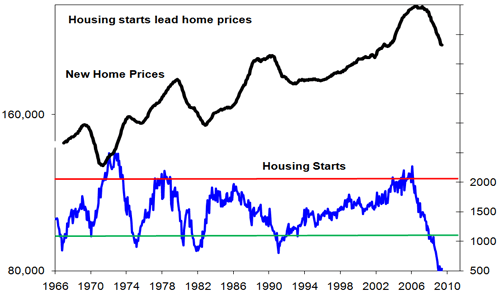
First up: The number of new homes started by builders. After "housing starts" hit a bottom, home prices tend to bottom six months to a year later. Importantly... Housing starts are at a record low right now.


Builders start too many homes (when the blue line goes above 2,000) in good times. Prices peak soon after. In bad times, builders start too few homes (when the blue line goes below 1,000). A bottom in home prices follows.

Based on this chart, housing prices could bottom soon... possibly in the next 12 months.

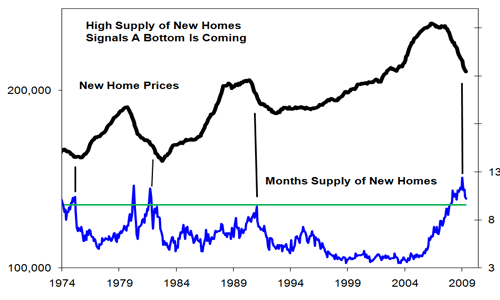
Second: The supply of homes available for sale. This indicator is typically called "months supply." But it's really a ratio of the number of houses available for sale divided by the current rate of sales per month.


A high supply of new homes on the market causes prices to fall. (It's simple supply and demand.) Once the supply of new homes peaks and starts to come down, home prices bottom and start to rise.

Today, the supply of new homes is near a record peak, and it's coming down. So a bottom should come within the next 12 months.

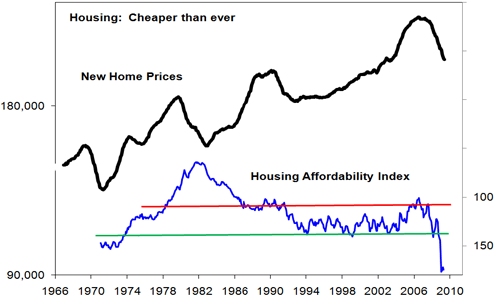
Lastly: Housing "affordability." People buy homes when they're affordable. In technical terms, homes are "affordable" when the median family's income can afford the mortgage payment on the median home at current mortgage rates.

Right now, homes are more affordable than ever, based on this ratio.


Since houses have fallen so quickly in price and mortgage rates have fallen to record lows, housing affordability is at record levels. This is a great "value" indicator for housing... and value is great now.

Housing is not like the stock market. Cycles in housing move slowly. So we can wait on an uptrend to "confirm" the housing market is back before we move in.

We're lucky here... we have a few good "leading" indicators, with good track records. Of course, my indicators could deteriorate from here. But right now, they're at record levels and showing signs of improving.

It's not time to buy residential real estate... yet. But the time is darn close.

Good investing,

Steve.

5 Key Reasons To Invest In Pakistan


5 Key Reasons To Invest In Pakistan
Reason - 1: Geo-strategic Location

Located in the heart of Asia , Pakistan is the gateway to the energy rich Central Asian States, the financially liquid Gulf States and the economically advanced Far Eastern tigers. This strategic advantage alone makes Pakistan a marketplace teeming with possibilities.

Reason - 2: Trained Workforce

Here the people are mostly English proficient, hardworking and intelligent. They have ….lesser costs.

Reason - 3: Economic Outlook

Pakistan is one of the fastest growing economies of the world having touched a GDP growth rate of 8.4% in 2005. Today Pakistan has 160 million consumers with an ever growing middle class. Foreign investment has risen sharply from an average of $400 million in the 1990s to over $ 3.5 billion in 2005-06. Fiscal deficit has declined from an average 7% of GDP in the 1990s to around 3% in recent years. And FOREX reserves have increased from $3.22 billion in 2000-1 to $13.14 billion in 2005-6.

Reason - 4: Investment Policies

Current investment policies have been tailor made to suit investor needs. Pakistan 's policy trends have been consistent, with liberalization, de-regulation, Privatization, and facilitation being its foremost cornerstones.


Reason - 5: Financial Markets

The capital markets are being modernized, and reforms have resulted in development of infrastructure in the stock exchanges of the country. The Securities and Exchange Commission has improved the regulatory environment of the stock exchanges, corporate bond market and the leasing sector. Whilst the Central Board of Revenue has facilitated structural reform in tax and tariffs and the State Bank of Pakistan has invigorated the banking sector into high returns on investment.

Ratings and Recommendations