Financial Advisor
Showing posts with label Commodities. Show all posts

Q4 Commodity Outlook: Tricky Road Ahead as Dollar Strengthens

Commodity markets will continue to be driven by worries about the potential impact of a slowing global economy. A solution to the sovereign debt crisis has still not been found and with governments running out of fresh ideas this has caused tremendous stress on the financial system. Cyclical commodities like energy and base metals have suffered as a consequence while safe haven flows and adverse weather have been the main reasons for gains across precious metals and agricultural commodities.

We believe that renewed dollar strength during September will continue into the last quarter and this could potentially have a dampening effect on the performance of commodities, ensuring a relative flat 2011 performance of the major commodity indices.

Energy: The dramatic spike in oil prices earlier this year has been a major reason for the surprise slowdown in economic activity witnessed during the past six months. The price of Brent crude, which has taken on the role as a global benchmark for a majority of global transactions, has so far averaged 111 dollars in 2011, well above the averages for the previous three years. Despite not reaching the record levels seen in 2008 it has nevertheless already spent more days above 100 dollars during 2011, thereby squeezing private consumption.

Increased demand drove prices higher in 2008 while this time supply disruptions and constraints have been the culprit for higher prices. Libyan oil production will be limited for months while supply disruptions from Nigeria, Syria and the North Sea have ensured higher prices compared with WTI crude which has stayed at depressed levels over the summer.

All of the growth in oil demand is now stemming from Emerging Market (EM) economies and in order to determine future price movements the economic well-being of these economies will be the decider. We expect the price of Brent crude to remain range bound for the remainder of the year between 100 and 120 with an end of year target of 105 dollars.
Precious metals: The rally in gold, which has now lasted for more than 10 years and has returned nearly 21 percent annually, is undoubtedly the world’s most powerful trend. Investors and central banks have all been competing for the yellow metal over the past two years as the global financial crisis has triggered an exodus out of other asset classes into “safer assets”, such as gold and silver.

During the third quarter record high prices led to increased volatility which dented some of the lustre for gold as it became increasingly difficult to trade. As a result we saw investors pulling out of long positions, both in ETFs and futures during August and September and we began to see 100 to 200+ dollar corrections. The super trend however remains firmly intact and only a move below 1,500 could spoil the party for investors holding close to 3,000 metric tonnes through various investment vehicles. We believe that gold may have another push to the upside reaching the magical 2,000 dollar level in early 2012 before a period of consolidation sets in.
Continued volatility could trigger additional margin increases on the major futures exchanges and force some investors to scale back positions even further. We see gold trading in a 1,650 to 1,950 range with an end of year target of 1,900. Silver has gone from being a driver to a follower of gold since the April price collapse. Given the weakened outlook for industrial metals we see silver potentially weakening further relative to gold with the value of one ounce of gold going from 50 to 55 ounces of silver.
Agriculture: Despite record planted acreage this crop year poor weather and reduced quality has led to a reduced U.S. production of corn and soybeans. This has caused a strong rally of the two over the summer in order to force demand rationing through higher prices. This rationing now seems to have begun having an impact on both feed demand and export. On this basis we believe that the prices of soybeans and corn have already peaked and could settle into 13 to 14 and 6 to 7 dollar ranges respectively for the remainder, also given our forecast for a stronger dollar which could dampen exports even further.
Grain Prices Advance Most in a Year Ahead of Today's WASDE Report

Corn increased, extending the largest advance in 16 months, on signs last month’s 23 percent slump may have attracted buyers seeking to build stockpiles.

December delivery corn added as much as 1.2 percent to $6.525 a bushel on the Chicago Board of Trade, after jumping 6.6 percent yesterday, the biggest closing gain for a most-active contract since June 30, 2010. It traded at 6.495 a bushel at 2:43 p.m. Singapore time, narrowing the decline from this year’s high of $7.93 on June 9 to 18 percent.

Mexico, the second-largest corn importer, bought 261,200 metric tons of corn from U.S. exporters, the U.S. Department of Agriculture said yesterday. Separately, the USDA reported that the grain inspected for export rose 8.7 percent to 31.8 million bushels in the week ended Oct. 6 from a week earlier.

“Export business is forecast to return with values at these levels,” Luke Mathews, a commodity strategist at Commonwealth Bank of Australia, wrote in a report today. That outlook “was vindicated by the big purchase of 261,000 tons of U.S. corn by the Mexicans,” he said.

The corn inspected included 4.7 million bushels bound for China, the second-largest user of the grain, the USDA said.

The agency will release today its latest World Agricultural Supply and Demand Estimates report on corn and other crops, which may show higher inventories than earlier forecast, according to a Bloomberg News survey.

Global Inventories

World corn stockpiles will probably reach 120.5 million tons at the end of this season, higher than last month’s 117.4 million-ton projected by the USDA, according to the average estimate of analysts surveyed by Bloomberg. That will still be the lowest level for reserves in five years, according to Bloomberg data.

Hedge Funds Reduced Exposure Ahead of Big Rally

Hedge funds and large investors continued to reduce their long exposure to commodity futures and options last week. The data compiled 3 October showed a  4.2 percent reduction to 920,000 lots, the lowest level since July 2010.

This also helps to explain the strength of the rally that followed as funds scrambled to rebuild positions. The rally that began Wednesday was the biggest three-day rally of the year and was helped by increased efforts in Europe to deal with the debt crisis and signs that the U.S. economy may avoid recession.

The energy sector saw an increase in net longs of 20 percent primarily helped by a sharp reduction in the Natural Gas short position. The WTI crude position meanwhile continued to be scaled back, moving below 200,000 lots just ahead of the rally which began last Wednesday when U.S. inventories showed a much bigger draw than expected.

Exposure to the grains sector was cut by 2 percent to 242,000 lots, the lowest level since July 2010 and much below the 2011 peak of 890,000 lots back in February. The “World agriculture supply and demand estimates” report will be released this Wednesday and any signs of tightening could attract new buying given the sharp reduction of long positions over the last month.

The metal sector was flat on the week with a small increase in gold longs - the first in four weeks - being off-set by another increase in short copper positions.

The soft sector also saw a reduction in speculative longs as positions in sugar and coffee were reduced while the cocoa short position increased further. 
Background information: The Commitments of Traders is a report issued by the Commodity Futures Trading Commission every Friday with data from the previous Tuesday. It comprises the holdings of participants in various U.S. futures markets split into "commercial" and "non commercial" holdings. The non commercial or speculative holding are typically institutional investors such as hedge funds and CTAs. Analysts and investors follow changes in these positions because such transactions can reflect an expectation of a change in prices.

Weekly Commodities Update : Has Gold Left its Safe Haven Status Behind?

Over the past week sentiment towards riskier assets improved ahead of the monthly U.S. jobs report. In Europe two central banks provided further stimulus while officials showed increased willingness to support the banking sector after one bank in particular came very close to the edge.

Despite the somewhat improved sentiment commodity markets continue to be driven by risk aversion stemming from the financial crisis and the focus on a global economic slowdown. The market seems to be caught between two chairs for the time being as fundamentals have not supported parts of the recent sell-off while a recession, if it materialises, will trigger an even bigger sell-off just like 2008-09. The dollar has stabilised after its recent rally and it has helped commodities to recover, also taking into account how Hedge Funds have halved their long exposure over the last few weeks.

The Reuters Jeffries CRB index rose for the first week in a month as the energy sector especially staged a strong comeback on hopes that further stimulus will reduce the risk of a U.S. recession. Industrial metals also received a welcomed boost with copper staging a strong rally after having fallen by one third since early August.
 
Drop in U.S. stockpiles supportive for oil
The dramatic sell-off in crude oil over the last couple of months seems to be at odds with fundamentals as tightness in especially Brent crude is not yet being off-set by the expected slowdown in demand and increased Libyan production. The price of WTI crude reached a one-year low at 75 dollars per barrel before a surprisingly large weekly drop in stockpiles triggered a sharp recovery signalling the emergence of a new 10 dollar trading range with resistance now located at 85. U.S. crude stockpiles compared with the five-year benchmark average dropped to the lowest level since November 2008 while inventories at Cushing, the delivery hub for NYMEX WTI crude dropped to the lowest level in 18 months. This supports the narrowing spread between WTI and Brent in the months ahead as the graph below shows.
The Brent crude forward curve is still pricing in reduced demand as the economic slowdown takes hold and this will continue to be the main focus in the weeks ahead giving us a limited upside potential. Further price falls below 100 dollars on Brent crude, which is currently being priced in, will create problems for some OPEC members and Russia which requires high prices to balance its budget and this will increase the likelihood of Saudi Arabia removing excess production to balance prices.

Gold just another commodity – for now
The price of gold has settled into a range between 1,685 and 1,585 as it tries to recover from the recent sell-off. What has been interesting to observe is how the trading behaviour has changed from a safe haven play, more towards a commodity that moves in line with other riskier assets such as oil and stocks. The presence of physical buying at the lower end of the established range should help cushion any attacks on the downside.

This return, at least for now, to “just another asset” has helped other metals such as platinum and especially silver to outperform gold. Platinum at one stage traded at a discount of 10 percent to gold compared with an average premium of 30 percent over the last five years. Given this massive underperformance we could see a relatively large recovery bounce once the perception of the global economy improves.  
Financial flows are holding the key as investment demand for gold through ETFs and especially futures has been reduced by 500 to 2,700 metric tonnes during the last couple of months. Before this demand and safe haven interest returns further upside above 1,700 dollars seems limited unless we see an unexpected sharp sell-off in the value of the dollar. 

Food inflation easing further in September
The dramatic declines seen across different agricultural commodities in September have filtered through to the United Nations Food and Agriculture Food Price Index. In total 55 commodities are included in the Index which averaged 225 points in September, a two percent decline from August and a 5.5 percent decline from the peak reached in February but still higher than the value of 195 points during September 2010. The decline was lead by sugar (-3.8%), cereals (-3.0%) and oils (-2.3%).  

Grain prices stabilising after rout
The price of CBOT December corn rallied strongly after finding demand below 6 dollars per bushel which coincided with the July low. This followed a 26.5 percent correction during September where focus dramatically switched from supply worries to signs of demand destruction triggered by a stronger dollar and lower domestic demand. Speculative long positions have now been much reduced and talk that China may be falling short of a record 5 to 10 million tonnes also helped stabilise the price.
On 12 October the United States Department of Agriculture (USDA) will release its latest World Supply and Demand report for corn, wheat, soybeans and cotton. This will be viewed with much interest given the scale of the sell-off during September.

Weekly Commodities Update : Commodities in September - What a Mess

Global markets suffered serious setbacks during September as investors’ nerves were tested on numerous occasions. Hopes are now pinned on the fourth quarter which historically tends to support prices but continued uncertainty about the Eurozone debt crisis and the economic slowdown that is impacting the global economy will not go away anytime soon. The commodity area has seen elevated one-sided bets being reduced which leaves individual commodities in a much better position to react to price supportive news.


The three major commodity indices are currently down between seven and ten percent year to date after individual markets suffered heavy losses across the board over the last month, as seen below. Hardest hit has been the base metals sector with the LMEX London Metals Index down 21 percent year to date with copper and nickel particularly suffering heavy losses. The near six percent rise in the value of the dollar during September also hurt the sector, given its inverse relation to commodity prices.
Hedge fund redemptions receiving some attention
 
Many hedge funds have been struggling with their performance this year. The HFRX Global Hedge Fund Index is currently down 7.5 percent year to date and this has lead to increased risk of investors pulling their money out. An example of this was Man Group, the world’s largest listed hedge fund manager, whose share price dropped 25 percent this week as it said clients pulled 2.6 billion dollars during the third quarter. Similar redemptions from others could have an adverse impact on commodities as positions would need to be scaled down in order to reflect reduced levels of assets under management.


Metals stabilising after a week of records
 
Gold is heading for its best quarterly run in at least four decades despite the experience in August, the worst monthly performance since October 2008. Overall the past week in metals has been one for the record books. Silver dropped by 34 percent in a matter of days, its sharpest drop in 30 years. Gold meanwhile corrected by 20 percent from its peak, which has only happened twice before during the last decade.

Copper entered into a bear market having corrected by one third from the February high as hedge funds reversed their positions into shorts for the first time in more than two years. This resulted in the largest quarterly loss since Q4 2008 as concerns over Chinese demand, the world’s largest consumer of industrial metals, had investors changing their perceptions of industrial metals.


What triggered the sell-off?
 
The reasons behind the sell-off are numerous: risk adversity, a scramble to realise cash to cover loss-making positions elsewhere, economic slowdown reducing demand for industrial metals, hedge fund redemptions and not least another margin hike by CME, the world’s largest futures exchange. Added to this there has been market talk about heavy selling by Chinese investors. They have been focusing on the strength of their domestic economies and have been caught out by the slowdown elsewhere.

Since early August gold volatility has been stubbornly high indicating increased uncertainty about its future direction. A new record high at 1,921 was reached on September 6, but already before then (and after) professional investors have been reducing their exposure despite global stock markets going into reverse. Several 100 dollar corrections during the last month added to the unease among investors who had viewed gold as the ultimate safe haven asset.


Risks ahead?
 
It took 18 months to reclaim a new high during the previous two major corrections in 2006 and 2008; investor redemptions from exchange traded funds (ETF) have so far been very limited and as such carry the risk of further selling should that type of investor decide to scale back as well. Lastly and probably most importantly we need to see volatility reduced as excessive volatility poses the biggest risk to gold’s safe haven appeal.
Technically gold held and bounced strongly off its 200-day moving average, currently at 1,532 dollar, and this has returned some of the confidence that was lost during the rout. However, as long as we stay below 1,700 dollars per ounce there will be a risk of testing the support once again. The arguments for holding gold have, if anything strengthened during August so once this nervousness subsides gold could shine once again. Physical demand from a number of central banks has moved up a gear during the sell-off and that should also help cushion any further setbacks.


Oil declines on outlook for reduced demand
 
Oil prices saw the biggest quarterly drop since the 2008 financial crisis as attention shifted from tight supply issues towards slowing demand. Growth across the main oil consuming nations has been slowing and even China has not been able to avoid a slowdown. Most of the major oil trading houses have as a result been slashing their 2012 price forecasts in quite a dramatic fashion. 
So far support levels in Brent crude at 100 dollars have been holding but further signs of weakening economic activity could put this level under some near-term pressure, especially if the dollar continues its recent surge higher. For now though the sector continues its very nervous trading pattern as it tends to react to every little piece of news that hits the wire as traders search for clues about the future direction.


U.S. grain stocks higher than expected
 
Grain markets which have been anything but immune to the carnage over the last month fell further on Friday as a Grain Stocks report from the United States Department clearly showed the impact from reduced demand as both wheat and especially corn stocks were higher than expected while soybean stocks was as expected. The price of corn for December delivery having broken below the 200 day moving average also broke below the uptrend from July 2010 signalling near-term risk of further long liquidation.


Commodities Weekly Update : Commodities Sink into Red as Confidence Saps

Riskier assets such as commodities and stocks were seriously shaken this week as the U.S. Federal Reserve failed to lift investor confidence. At its long awaited meeting it delivered the now famous “Operation Twist” whereby it will be supporting the long end of the yield curve thereby attempting to keep borrowing costs low. What spooked the market however was the comment that the U.S. economy was facing “significant downside risks”.

As my colleague wrote after the announcement: “With the Fed launching Operation Twist Bernanke furthermore runs the risk of arriving too late at the party with a solution for the second time in 10 months as his QE2 programme last November came so late that the economy had long rebounded and the programme fuelled a massive commodity rally instead, which ultimately weighed on U.S. consumers in the first half of this year and forced the economy into a halt yet again.” Full text here.

By avoiding a new QE2 style liquidity injection Bernanke at least removed the fear that another round of galloping commodity prices could be on the cards. This could help consumers and manufacturers who have been struggling amid higher prices of anything from copper to gasoline but at the same time confidence is being hit by the ongoing sell-off in equities.

Changing investor attitude towards dollars
The European debt crisis helped the dollar climb to a seven-month high thereby weighing down the whole commodity complex as it became more expensive for buyers using other currencies. Last week the speculative dollar position held by hedge funds through IMM currency futures moved into positive territory for the first time in 14 months showing how the attitude towards dollars has changed dramatically over the last few weeks.
Commodities suffered the worst setback in more than four months on worries that a global recession could hurt demand for metals, energy and food. The Reuters Jeffries commodity index lost 8 percent in the week as every single commodity moved into the red. Interestingly gold, which has otherwise been viewed as a safe harbour amid stormy seas, also took a beating.
Gold falling victim to excessive volatility
Over the last month gold has made a new record high twice but has also been exposed to three 100+ dollar corrections. This has at least near-term reduced the safe haven flows as the increased volatility has made it increasingly difficult to trade and has prompted some gold bulls moving to the sideline to wait for lower prices and hopefully calmer trading conditions. During the same time investors in ETFs and futures have reduced exposure to gold by nearly 300 tonnes to 2,935 tonnes as cash and/or bonds have met increased demand.
LBMA expects gold at 2,019 next November
This week bankers, traders and investors at the gold industry’s largest annual gathering in Montreal predicted that the decade long Bull Run would continue into 2012. The 500 people attending the conference of the London Bullion Market Association predicted that gold would be trading at 2,019 dollars per troy ounce in November 2012. Last year when gold traded at 1,298 they predicted a price of 1,450 at this meeting, a 25 percent undershot from the 1,805 traded this Tuesday when the poll was made.

Having dropped more than 10 percent from the record high support is again being sought with 1,650 followed by 1,600 being the next major levels to look out for. Further dollar appreciation could trigger such a move but the positive long term projections for gold should help cushion any further setbacks.

Industrial metals suffer the most
Metals related to industrial use however have been the main losers with copper, silver and palladium suffering deeper setbacks. Silver lost an unprecedented 20 percent in just two trading days while copper, a gauge for global economic activity, fell into a technical bear market having lost more than 20 percent from the February high. Platinum is trading at the widest discount to gold in almost two decades as recession fears has removed some of the demand from industrial users which normally caters for more than 50 percent of platinum consumption. Investors looking for an economic recovery should watch this ratio closely as platinum has traded at an average premium to gold of nearly 40 percent over the last decade.
Oil markets confined to wide range
Crude oil, having failed to break higher last week, was caught up in the torrent of negative macro-economic news and dropped the most in two months. The surging dollar and the U.S. Federal Reserve’s failure to pull another rabbit out of the hat left traders focusing on reducing exposure. The moves go somewhat against the fundamental background as continued tightness especially in Brent crude, combined with a continued fall in inventories at Cushing, the delivery hub for NYMEX WTI crude, failed to receive much attention.

The overall worry is that demand for energy in the U.S. and China, the world’s two largest consumers, may fall as their economies slow down. These two nations, according to BP Plc, were responsible for 32 percent of global oil demand in 2010 and if adding the 17 countries using the euro this percentage rose to a total of 44 percent.

The civil war in Libya, which removed high quality crude from the market, has now almost ended. Experts on the ground are now predicting that oil could begin to flow in decent quantities much sooner than originally expected. These additional barrels will hit the market at a time where demand is softening and could force OPEC to address their current output levels. They do not want to see a repeat of the price collapse from 2008 to 2009 given the much higher need for revenues to balance their budgets.  
For now the most likely outcome of the market action is one of continued range trading. Brent Crude having been rejected at 117 went looking for support and should find some at 100. Meanwhile WTI crude having revisited the 80 dollar mark will now find resistance at 85 and support at 75.70, the August low.

Grain speculators suffer blowout
Hedge funds and large investors, who up until recently increased their long exposure to soybeans and corn, suffered heavy losses this week as the commodity deleveraging also hurt the grain sector. The price of new crop soybeans which only recently traded at 14.65 dollars per bushel suffered its biggest weekly loss in more than two years touching 12.50, as the surging dollar combined with signs of demand destruction took its toll.

The stronger dollar has led U.S. growers to face stiff competition on the international grain market with Russia still winning the big wheat tenders while Brazil, having seen its currency drop 16 percent, has stepped up its export of soybeans at very competitive prices.

Weekly Commodities Update : Stronger Dollar Eroding Support for Commodities

Stock markets finished stronger after another volatile weak with especially banks suffering early on before policymakers’ attempts to address the Eurozone fiscal crisis succeeded in reducing some of the stress in the system. The dollar broke higher after having range traded against the Euro for months and the near-term outlook now points towards a stronger dollar which could dampen the demand for commodities as an investment class, especially while the global economic outlook continues to be clouded.

The Reuters Jefferies CRB Index traded lower on the week and is still stuck around a flat performance for 2011. The energy complex had a good week with Brent and WTI crude on top while the majority of commodities saw negative performances with profit taking being the main focus in particularly the agricultural and precious metals sectors after strong rallies in previous weeks. 
Gold Down but Not Out
Investors in gold took some money off the table as the stronger dollar and signs of political will to help the European debt crisis triggered the third 100+ dollar correction within a month. No sign of panic however has been detected and once again the sell-off met new buyers which helped stabilise prices. A continued rise in the dollar could call into question the chance of higher gold prices near term and traders could as a consequence be inclined to book profits faster than previously and ensure that a prolonged period of range trading could be on the cards. The biggest danger near-term however is the size of long positions held through Exchange Traded Funds and futures. Although it has come down by 220 metric tonnes from the August peak above 3,100 tonnes, a move below 1,700 on gold carries the risk of further long liquidation as fund managers look to book profits to offset losses elsewhere.
Spot gold, source Bloomberg

WTI crude rise as release of strategic reserves ceases
The price of West Texas Intermediate rose for the fourth week running and is once again testing the 90 dollar level. The final 1 million barrels from a total of 30.6 million released from U.S. strategic reserves over the last eight weeks has now reached the market. During the same time we have seen inventories at Cushing draw for the seventh week in a row, thereby easing some of the supply overhang at the delivery point for NYMEX WTI crude, which in turn has seen the discount to Brent crude contract. Further upside on both crudes seems limited after the recent run higher as the potential for a stronger dollar and continued nervousness in stock markets should limit any further progress. We anticipate the two varieties to remain within a 10 to 15 dollar range with resistance at 91 on WTI and 117 on Brent. 
Brent crude (front month), source Bloomberg

High corn and soybeans prices trigger demand destruction
The grain and soybean sector posted steep losses this week as focus shifted from the already known tight supply situation to concerns about weakening demand. The monthly “World Supply and Demand” report from the U.S. Department of Agriculture last Monday confirmed the tight supply situation but also highlighted the beginning of a slowdown in demand from exporters, ethanol producers and livestock feed. The liquidation of speculative long futures and options bets on corn and soybeans, which have increased by 50 percent since early August, also played a role in the sell-off this week. The sector had been viewed as immune to the risk adversity which hit other commodities over the summer. The stronger dollar combined with the shift in focus from supply to demand has changed that, at least for now, and could potentially mean that the highest price of the year for new crop corn and soybeans has already been seen.  
Russia, which is expected to harvest 90 million tonnes of grains, continues to undercut prices for large wheat tenders while forecasters made an unexpectedly large increase to their estimate of global inventories due to increased production estimates for Canada, Europe and the FSU. All in all this added downside pressure to wheat prices on both sides of the Atlantic with Chicago wheat trading back down to 7 dollars per bushel.

Dollar and Weak Growth Prospects Dent Commodities

Stock and commodity markets continue to focus on the impact of weak global growth conditions and the EU debt crisis. The dollar moved back to its strongest levels in months benefitting from the Swiss currency peg, worries ahead of the 9/11 ten year anniversary and an European Central Bank more concerned about weak growth than inflation.

Swiss currency floor
Foreign exchange markets lit up this week with news that the Swiss National Bank all but made good on persistent rumours that it would peg the Swiss Franc to the Euro in order to halt the dramatic appreciation of the currency which had begun to hurt the Swiss economy. The line is now drawn at 1.20 versus the Euro at which level the SNB will buy Euros at whatever quantity required to hold the CHF.
..and the potential dollar/commodity impact
 
This move could strengthen the dollar with the SNB likely wanting to buy other currencies than Euros, of which it currently holds 55 percent, in order to maintain a diversified mix of currencies in its reserves. With the dollar being the most liquid of the pack it could now have found a friendly central bank. Asian Central Banks have been selling dollars against Euros for months. All eyes will be on EUR/USD as a break of key levels would open the way for a substantial move higher. It will be interesting to follow from a commodity perspective as a stronger dollar removes some support for the asset class.
The Reuters Jefferies CRB index lost one percent over the week with most commodities bar a few being in the red.  

Oil focus on supply disruptions, Obama job plan and hurricane Nate
Crude oil markets quickly found support this week after another sell off. The recovery was driven by a bounce in equity markets and hopes that President Obama’s job creation plan could stimulate growth. But more importantly near-term is the tightness in the spot market with the loss of Libyan oil continuing. We also have outages in Nigeria, Syria and the North Sea adding up to lower-than-expected production which so far has helped offset reduced demand caused by the economic slowdown. Further, producers in the Gulf of Mexico have had to evacuate workers once again ahead of Tropical Storm Nate which is expected to become the third hurricane this season. Cushing not spilling over
 
During the week the spread between WTI and Brent crude reached a new record high of 27 dollars with most of the above supply issues impacting Brent more than WTI. One of the major reasons for this dislocation has been the belief that increasing storage levels at Cushing, the delivery hub for NYMEX WTI crude, would put downside pressure on prices. The chart below shows, however, that storage levels have been falling since May and currently stands at levels last seen in November 2010 - at which time the spread was trading below one dollar.  
What is the correct price of Oil?
One must conclude that the current spread is more related to the supply issues currently affecting Brent crude. This can also be seen by the Brent oil curve moving into a very steep backwardation with spot price trading more than two dollars higher than Brent for delivery in 3 months time. Should the bottlenecks begin to disappear we can expect prices to adjust lower within the established $118 to $108 range. The price of WTI is arguably cheep on the basis that Cushing is not overflowing, but until we see a pick-up in economic activity investors’ negative views will be expressed through WTI crude.

Gold sold off and found buyers again
Gold reached a new nominal record at $1,921 a barrel but, again, the immediate response was a $100+ sell off highlighting the increased level of volatility seen recently. The drop below $1,800, however, triggered new buying, especially out of the Far East, and a quick bounce followed. This two way battle will continue over the coming weeks but the overall direction still points higher towards 1,970 and potentially the magical 2,000 level. Hedge funds and ETF investors have continued to reduce long exposure over the last four weeks and it could be a sign of rally fatigue but, as mentioned above, the demand on setbacks looks solid for now.

Over the last five years gold has tended to correct aggressively each time it moved further than 20 percent away from its 200 day moving average. This could be the reason why gold has been struggling to hold onto gains above 1,900 recently indicating that further upside progress will be slower than during the previous couple of months. 

UN FAO food price index stable in August
The monthly Food Price Index from the Food and Agriculture Organization of the United Nations averaged 231 points in August and was nearly unchanged from July, but 26 percent higher than a year ago. The index of 55 food commodities hit an all time high of 238 points back in February on the back of steep price rises in sugar. Over the last few months prices have stabilised but world food prices are expected to remain elevated this year as stockpiles will be running low after a difficult growing season. The cereal index which includes wheat, corn and rice, rose 2.2 percent in August, primarily on the back of the rise in international prices of rice and corn. The FAO said: “A policy change in Thailand, the world’s largest rice exporter, which is set to increase the purchasing price from farmers to above market levels, served to further support this increase. Corn prices also rose sharply in August, reflecting further deterioration in this year’s crop prospects in the United States”
 
The price of U.S. rough rice has risen by one third over the last two months, still some 26 percent below the peak in 2008 which caused food riots across Asia. Meanwhile corn prices remain elevated with a highly anticipated U.S. crop report on Monday expected to confirm worries that the crop size and quality of the upcoming harvest have suffered due to a hot and dry summer.
 

August in Review; Energy, Base Metals Struggle, Gold Still Shines

The general market turbulence took its toll on commodities in August with cyclical commodities like energy and base metals struggling while investors ran for cover into gold. The agricultural sector showed solid returns with seven products figuring among the top ten best-performing commodities.

The Reuters Jefferies CRB index ended August almost unchanged, having lost nearly 8 percent during the early part of the month when S&P's downgrade of US debt and a deteriorating economic outlook took hold.  
Coffee on top
A general scarcity of coffee beans among European roasters ahead of the new harvest in October triggered a strong rally in August. Brazil, the world’s largest producer of high quality Arabica coffee, has seen temperatures in the production areas well above levels that could cause frost damage while Vietnam, the world’s largest producer of the Robusta variety, is potentially heading for a record production. On that basis prices should stabilize once fresh supplies begin to reach the roasters. Further upside seems limited.

Gold has stabilized but for how long?
The yellow metal received most of the headlines last month as the year-long rally shifted up a gear with the one month return exceeding 12 percent and, in the process, moving within striking distance of 2,000 dollars per troy ounce. Safe havens from global turmoil were also cut to one from 3 as fear of central bank intervention in Swiss Franc and Japanese yen left gold as the beacon.

In a couple of moves the CME Group raised the margin for trading gold futures from 4,500 to 7,000 dollars. The move came as a response to increased volatility after the unprecedented strong rally, not as an attempt by the exchange to dictate the direction, but mostly in order to keep some integrity in the market. Speculative involvement from hedge funds has been reduced as margin increases make an impact on the position size they are allowed to hold.

The potential for further stimulus signaled last Friday by Ben Bernanke, Chairman of the US Federal Reserve, continues to support gold. The 200+ dollar sell-off recently, however, was a reminder that nothing ever goes in a straight line. After having consolidated earlier this week renewed stock market weakness and squabbles over Greece (again) saw buyers return. Will traders have a strong enough conviction to take it much higher beyond 1,900 remains to be seen? Resistance above the recent high at 1,913 will be 1,965 while support can be found at 1,770 ahead of 1,700.
Grain and soybean complex
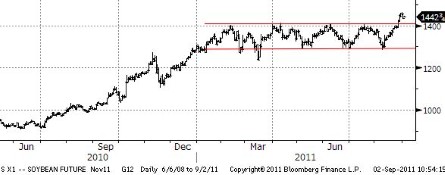
The DJ-UBS grains index rose 10.7 percent in August as wheat, corn and soybeans continued to rally with the outlook for this year’s production deteriorating further. Heat and dought across the main producing regions have played havoc with crop prospects. The price of November soybeans reached a new high of 14.65 per bushel after trading sideways for seven months. Hedge funds added 10 percent to existing long positions as the fundamental outlook favoured the sector over others like energy and base metals.
Wheat prices recovered strongly on a spillover effect from higher corn prices, despite continued strong Russian exports having increased competition in the global market. This resurgence in exports, helped by aggressive undercutting of competitive bidders, has now caused problems on Russia's rail system. The railway authority has banned the transportation of grain to the main shipping port as more than 3,600 railway cars are clogging up the North Caucasus branch of the railway system. This, in return, triggered a rise in domestic prices this week as exporters scrambled to find alternative sources of wheat to cover established contracts.

Brent crude oil firm despite slowdown
Oil markets continued to recover with Brent crude, in particular, moving back up towards the higher end of its month-long trading range. August was a month of serious volatility which impacted the energy sector as a whole. Risk aversion early on triggered a substantial sell-off before signs of physical tightness kicked in. Brent crude recovered back to almost unchanged.

Libyan oil could begin to flow before long, albeit in small quantities,  but so far this has had limited impact on prices as traders have been more concerned about bottlenecks stemming from production problems at the UK’s largest North Sea production field. Meanwhile, the prospects of EU sanctions against Syria could increase an already tricky situation for European refineries who have been struggling to find supplies after the loss of high quality Libyan oil.

While Brent crude is troubled by bottlenecks on the production side, WTI crude continues to have to opposite problem with too much supply at Cushing, the delivery hub for WTI crude. This is causing a complete opposite forward curve shape compared to Brent, as seen below, and also shows why the spread between the two benchmarks are its widest at the front end of the curve.
Brent crude's recent rally ran out of steam above 115 dollars per barrel, some three dollars below trendline resistance from the two previous highs. On that basis we see limited potential for further upside gains with the risk of renewed stock market weakness potentially triggering a move back towards the middle of its established range at 108.

Lower Hog prices
The price of lean hog futures dropped more than 7 percent during the month after a strong run up the previous month. Supplies have been rising steadily on a seasonal basis and continue to outpace demand. At the beginning of August hedge funds held near record long positions which have subsequently been reduced by 25 percent thereby adding to the downside pressure. Further long liquidation is feared should the active contract for delivery in December break out of the established trading range below 81 cents per pound. Support comes from the fact Futures prices are currently trading at a discount to cash with the two eventually needing to converge.

Firm demand for coal and steel
Asian coal and steel demand increased dramatically in August. The number of shipments of iron ore, a key steelmaking ingredient, increased in August with 52% more vessels being hired than in July. The average price for iron ore delivered to China, the world’s largest consumer, rose by 2.5% from July to 177.45 dollars per ton with spot prices now at 180.40 dollars per ton. The average price of Chinese wire rod for August reached $784/ton, the highest level since July 2008 and a 29% increase year-on-year.
Meanwhile in Japan, coal imports are rising as the percentage of coal-fired electricity increases while the nuclear reactors undergo maintenance (coal-fired electricity production increased 36% in July compared to April and 16 nuclear reactors remains idle). Likewise, coal for cement production has also increased as the reconstruction efforts pick up.

Finally – a tricky month ahead
As the timeline below shows financial markets have entered a month with many important political events which will undoubtedly determine direction going into the final quarter and beyond. The global worries which caused all the panic over the summer have not gone away and how politicians meet those challenges will have a major impact on the direction of anything from stocks and bonds to commodities - stay tuned.

Heads up! Gold futures margin could be raised again

In a couple of moves the CME Group recently raised the margin for trading gold futures from 4,500 to 7,000 dollars. The move came as a response to increased volatility after an unprecedented strong rally during the last couple of months. The exchange is not trying to dictate the direction but in order to keep some integrity in the market they had to respond to the increased intraday volatility.
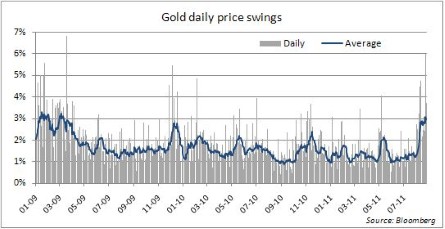
Have they done enough? Probably not, as volatility is still trading at almost twice the level compared with the first six months of 2011 and average daily price swings have continued to rise since the last margin increase  on August 24.
Gold margin as a  percentage of the contract value is still relatively low. Over the last two years margin requirements have hovered between 2.5% and 5.25% with 3.8% currently. 
As an example the equivalent for silver was more than doubled earlier this year 
How much:
Another rise could bring the margin up to somewhere between 8,200 and 9,000 dollars from the current level of 7,000 dollars representing an increase of between 17 and 28 percent.
Impact:
The previous two increases partly help to bring about the 200+ dollar correction and has so far not reduced intraday volatility.  Speculative involvement from hedge funds has been reduced over the last three weeks as margin increases make an impact on the position size they are allowed to hold.
With the increased potential for another round of stimulus from the Federal Reserve gold should be supported at this stage but as the recent correction highlights nothing ever goes in a straight line and discipline remains the key.

Commodities looking for direction from Bernanke

One year ago Ben Bernanke raised the curtain for QE2 in his speech at the gathering of central bankers at Jackson Hole. Once again his speech late Friday CET could set the tone for financial markets in the months ahead as the potential for QE3 has helped trigger some market reversals during the past week.

The Reuters Jefferies CRB index is up just half of one percent at the time of writing bringing its annual return close to flat. Last week’s winners are this week’s losers with gold and silver sitting at the bottom while energy and base metals had a better week. In the agricultural space attention turned to wheat. A deteriorating outlook for U.S. and European production had wheat prices on both sides of the Atlantic performing strongly.

Weak longs washed out of gold
Gold finally succumbed to a sharp correction as weak speculative longs were flushed out sending the price lower by more than 200 dollars in just two days. What triggered the sell-off was probably a combination of a market that had become too overstretched combined with a 55 percent margin increase by the CME which handles the global benchmark gold futures contract.

With daily price swings above three percent the CME felt that the cost of holding a contract worth nearly 200,000 dollars had to be increased. This brought back memories and fears of a collapse similar to the one that hit silver back in May which also occurred after a steep rally was followed by an aggressive margin hike.

Support now at 1,700 dollars
The sell-off however did not go further than 1,705 just short of retracing 50 percent of the recent rally before buyers returned, spurred on by weaker stock markets. The severity of the sell-off has primarily been due to the amount of speculative positions having been built up over the last month and with much of that now out of the way traders felt more comfortable entering the market again. The factors that have been driving gold higher over the last year have not gone away and as such the medium to long term prospect for higher prices hasn’t either.

The Jackson Hole speech by Ben Bernanke of the U.S. Federal Reserve Friday could easily set the tone for the coming months, just like it did last year with the announcement of QE2. High expectations, especially for another round of quantitative easing, have been dwindling over the last couple of days. Given that gold would be the main beneficiary of QE3 a lack hereof could add to the downward pressure. 
Support in the market is now at 1,697 dollars which represents a 50 percent correction of the recent rally followed by moving average supports at 1,570 and 1,480. The uptrend is still firmly in place above 1,450 so even a major drop would not ruin the long-term prospect for gold.

High volatility points towards a bumpy road ahead
Thirty day volatility as measured by the CBOE gold VIX index has been rising steadily over the last month and the current reading of 34.4 percent is some 64 percent above the 2010 average which was another year of strong gold performance. This is telling us that despite the uptrend firm violent corrections like the one experienced this week can easily occur again. Investors who want to benefit from the gold “bubble” therefore need to show discipline in order to avoid being burnt by a market that has become more erratic.

Oil markets driven by Libya and Irene
Early in the week the prospect for high quality Libyan oil returning to the market initially sent oil prices, especially Brent crude, lower. The “relief” sell-off was short lived despite rebel forces entering into Tripoli and thereby bringing forward the potential downfall of Colonel Gaddafi. Traders are fully aware that it could still be many months before oil begins to flow in decent quantities. Many obstacles need to be addressed first, such as establishing security around major fields, pipelines, refineries and ports, a renegotiation of existing contracts and the return of foreign personnel.

The price of Brent crude initially dropped to 105 dollars on the news from Libya but spent the rest of the week recovering back towards 110 as possible sanctions in Syria and force majeure in Nigeria supported prices. Oil demand, especially for diesel, from India and China picked up in July lending support to a Brent crude price above 100 dollars. The spread over WTI crude initially narrowed but has since widened back above 25 dollars as increased U.S. and Canadian production is not easily moved out of the producing regions to the coast from where it can enter into the global market place.

Irene could become the worst in fifty years
Irene, the ninth hurricane of the season is threatening to disrupt gasoline supplies along the U.S. East Coast over the coming days and this helped gasoline putting in a strong performance on the week rising by nearly four percent. It has the potential for becoming the worst hurricane in 50 years and although it is expected to weaken Saturday into Sunday it will probably not happen fast enough to prevent serious problems from wind, rain and ocean water.  

Wheat outperforming corn
The price of December CBOT wheat has risen strongly once again approaching 8 dollars per bushel after touching a low of 6.5 dollars back in July. Record high corn prices are causing livestock farmers to switch to wheat feed. A year-long drought from Texas to Kansas has created the driest conditions on record for farmers who should now be preparing to plant winter wheat. Meanwhile, in Europe the corresponding Milling wheat contract rose the most on the week as Western Europe continues to experiencing tough harvest conditions after a very wet summer. Continued rainfall could result in a higher percentage of wheat being used for livestock feed instead of human consumption thereby adding upside price pressure on high quality wheat. 
 

Has the Gold Bubble Burst?

During the past two months gold has rallied by a mind blowing 30 percent as an increased number of investors have been seeking refuge in the yellow metal as worries about the health of banks, government debt and slowing global activity have taken their toll on other asset classes. A 400 dollar rally in such a short period of time became increasingly unsustainable but was spurred on by some forecasts of 3,500 dollars or even 5,000 within a foreseeable future had short term speculators piling in.

Over the last two weeks however we have begun to see hedge funds and large investors reducing their exposure. The weekly data from the U.S. Commodity Futures and Trade Commission shows that since 2 August they reduced long futures exposure by 20 percent to 622 metric tonnes. During the same time however exposure to exchange traded products continued to rise with investors adding 40 tonnes to a total of 2,200 tonnes before the sell-off began Tuesday.

What triggered the sell-off was probably a combination of a market that had become over-extended combined with a 55 percent margin increase by the CME which handles the global benchmark gold futures contract. With daily price swings above three percent CME felt that the cost of holding a contract worth 170,000 dollars had to increase. This has brought back memories and fears of a collapse similar to the one that hit silver back in May which also occurred after a steep rally was followed by an aggressive margin hike.
The question everyone asks today is whether the gold bubble has finally burst after a 200 dollar tumble from the 1,913.50 high reached on Tuesday. The severity of the sell-off has primarily been due to the amount of speculative positions having been built up over the last month and with much of that now out of the way many will have a look at the fundamental picture once again. The factors that have been driving gold higher over the last year have not gone away but after having over extended to the upside the near-term risk is one of an overextension to the downside. The Jackson Hole speech by Ben Bernanke of the U.S. Federal Reserve tomorrow at 16:00 CET could easily set the tone for the coming months, just like it did last year with the announcement of QE2. High expectations, especially for another round of quantitative easing, have been dwindling over the last couple of days. Given that gold would be the main beneficiary of QE3 the lack hereof could add to the downward pressure. 


Support in the market is now centered on 1,697 dollars which represents a 50 percent correction of the recent rally followed by moving average supports at 1,570 and 1,480. The uptrend is still firmly in place above 1,450 so even a major drop would not ruin the long-term prospect for gold.

Investors who want to benefit from the gold “bubble” need to show discipline and use trailing stops in order to avoid being burnt by corrections similar to the one we have just experienced. 


Weekly Fundamentals - Macroeconomic Turmoil Sent Gold to New All Time Highs

Financial markets had another volatile week as economic data in the US and renewed sovereign debt concerns in the Eurozone continued to shake confidence. Earlier in the week, risk appetite was boosted by better-than-expected US retail sales and Japan's GDP data. M&A news (Google's purchase of Motorola Mobility) sent stock prices higher and in turns boosted risky assets. Sentiment turned sour again in the middle of the week and deteriorated further on Thursday with stocks, commodities (except for gold) and higher-yield currencies facing another big selloff amid disappointing US data. While weaker-than-expected initial jobless claims, housing data and manufacturing index gave further signals that the country may have a double-dip recession, rising inflation pressures indicated it's getting more difficult for the Fed to implement measures to stimulate growth.
The Franco-German meeting failed to come up with solutions to settle the debt crisis. Leaders of biggest economies in the 17-nation region proposed to create a 'true European economic government' which will eventually lead to a common tax and fiscal policies within the Eurozone. Concerning fiscal issues, Germany and France will create a common corporate tax base and tax rate between the 2 countries from the start of 2013. Moreover, they will propose in September the imposition of a new financial transaction tax across all Eurozone members. While the details of the types of taxes were not provided, investors were obviously irritated by the financial transactions tax as the euro and equities plunged after the announcement.

The ECB said that it has recently lent US$ 500M in its 7-day liquidity-providing operation to a bank at above market rates. This was the first time since February that the facility was used. Fears that more banks will seek ECB's funding because of their heavy exposure to debts of Greece and other debt-ridden countries increased and would make the market outlook negative. Concerns over contagion of Eurozone's sovereign crisis have spread to the US. The WSJ said that US regulators are taking a closer look at the US units of Europe's biggest amid concerns that the region's debt problems will spread to the US banking system. The report said that the New York Fed is 'very concerned' about the issue and has been seeking information about the banks' ability to access funds to maintain their US operations. New York Fed President Dudley denied the officials are watching a particular group of banks closely and reiterated that the central bank treats US and European banks 'exactly the same' and is 'always scrutinizing banks'.

Tremendous uncertainties in the economic outlook and banking system in both sides of the Atlantic will persist for some time. Investment banks such as Citigroup and JP Morgan downgraded their forecasts on US growth while Morgan Stanley trimmed its global growth outlook, warning the US and Europe are 'dangerously close to recession'. We expect financial markets will remain fragile in coming weeks.

Crude Oil: The front-month contract for WTI crude oil erased gains made earlier in the week amid worries over US recession. The selloff was exacerbated by the unexpected stock-build. Crude stockpile surprisingly rose +4.23 mmb, to 353.98 mmb as stocks in Gulf Coast surged a huge +6.26 mmb in the week ended August 12. Brent crude was strong despite a similar trend as disruption in the North Sea, Nigeria and Libya supported price. The front-month contract ended the day gaining +0.55%.

Nymex natural gas slipped with price plunging to a 5-month low of 3.843 Thursday before settling at 3.94 Friday. The benchmark contract lost -2.96% on weekly basis. According to the DOE/EIA, gas storage climbed +50 bcf (consensus: +48 bcf) to 2833 bcf in the week ended August 12. Stocks were -175 bcf below the same period last year and -73 bcf, -2.5%, below the 5-year average of 2906 bcf. As far as rig count is concerned, Bake Hughes reported that the number of gas rigs rose +4 units to 900 in the week ended August 19. Oil rigs added +11 units to 1066 and miscellaneous rigs remained unchanged at 8 units, sending the total number of rigs to 1974 units during the week. Directionally oriented combined oil, gas, and miscellaneous rigs fell -13 units to 227, while horizontal increased +15 units to 1138 and vertical increased 13 units to 609.

Precious Metals: With the exception of palladium, all commodities under our coverage jumped during the week. Silver was the best performer, followed by gold and platinum. The strength of these precious metals was attributed to the slowdown in global growth outlook, large fiscal deficits, low interest rate-environment in developed countries, heightening inflationary pressures and political and economic uncertainties. The issues, despite governments' resolutions, will persist (low interest rate-environment will persist for several years) and will continued to support the precious metal complex for some time.

Gold price surpassed platinum price earlier in the month for the first time since December 2008 as demand for safe-haven assets drove investors to the yellow metal from risk assets. In 2008, gold price exceeded that of platinum four times (December 12, 15, 17, 18) and we would not be surprised to see gold trade above platinum more sustainably this time.

While both metals are categorized as precious metals, industrial demand makes up over 80% of total platinum demand (with autocatalytic demand taking up more than one-third of total demand) but it only accounts for around 10% of total gold demand. The 'industrial' characteristic in platinum makes its price movement more synchronized with stocks, oil and other 'higher risk assets'. Therefore, it tends to lose its glitter to gold during economic turmoil and uncertainty. On the contrary, gold is often considered as a store of value and a hedge against inflation. It's especially attractive when global central bankers are competing to devalue their countries' currencies so as to stimulate growth.


World Gold Council released its latest gold demand trend last week. According to the council, total global demand fell in 2Q11 fell -17% y/y in volume terms but increased +5% in value terms. Strong growth in jewelry was offset by a drop in investment demand, especially from ETF and similar products. We believe the apparently underperformance in ETF investment was due to high base effect as ETF demand in 2Q10 was the second large one on record.
Geographically, Indian and Chinese demand grew +38% and +25% respectively in 2Q11 from the same period last year. World Gold Council expects the growth to continue in the second half of the year, thanks to 'increasing levels of economic prosperity, high levels of inflation and forthcoming key gold purchasing festivals'. Other factors supporting gold demand in 2H11 include sovereign debt problem in the Eurozone, downgrading of US debts, inflationary pressures and the for economic growth outlook in developed countries. These factors will continue to support official sectors in remaining net purchasers of gold and are all likely to 'drive high levels of investment demand for the foreseeable future'. 

Ratings and Recommendations