Financial Advisor
Showing posts with label Oil N Gold Focus. Show all posts

Violence during Nigerian Election Season an Upside Risk for Oil Prices

Commodities strengthened in European session as no further bad news released so far. Eurozone's PPI grew less than expected in February with the annual reading rising +6.6%, compared with consensus of +6.7%. January's reading was revised lowed to +5.9%. However, this is not likely to shake ECB policymakers' determination curb inflation by curbing interest rates.
While fighting in Libya and tensions in other Arab countries continue, general elections in Nigeria may be a threat to oil supplies. On March 16, the Movement for the Emancipation of the Niger Delta (MENA) bombed an oil facility run by the subsidiary of Italian energy major Eni SpA. The rebel group pledged further action. We believe the market has not yet priced in attacks of oil facilities in Africa's third largest oil producer during election periods. If these really happen, 10% of US' oil imports will be affected and oil prices should set to rise from recent highs.
A new round of bombings indeed began during Christmas Eve when 7 explosions went off in Jos and killed 80 people. The area has been a center of social and political unrests with 600 people killed last year. 2 bombs exploded in capital Abuja on New Year's Eve, killing 4 people and injuring 26. Violence is common during election seasons. In both the 2003 and 2007 elections, attacks and fighting were seen, especially in the Niger Delta and the Middle Belt. In the 2007 election, destruction to oil facilities in the country suspended supplies of as much as 1M bpd.
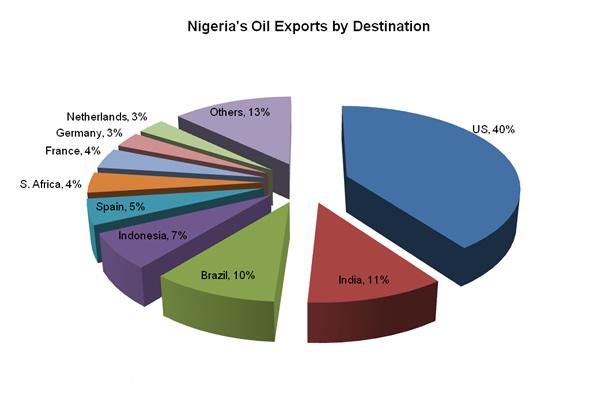
Let's take a look as Nigeria's oil market. The country has been an OPEC member since 1971. It has the second largest oil reserves in Africa and is the continent's primary oil producer. Nigeria exports almost 90% of oil produced every year. In 2009, it exported 1.9M bpd out of total production of 2.2M bpd. Around 40% of oil exports were delivered to the US, making it the 5th largest oil supplier to the US. Apart from the US, Nigeria exports around 20% of oil to each of Europe and Asia, 10% to Brazil and 4% to South Africa. While disruption in Libyan oil production has bolstered Brent crude oil more than WTI crude, stoppage of Nigerian oil infrastructure may affect the latter more due to the export profiles.

China's Stance in Libyan Issue and Impacts on Oil Supplies

Fighting in Libya continued with the NATO taking command of allied military operations. While it appears that no quick resolution is in place for the issue, consolidation of oil prices suggests that the impacts of the turmoil in Libya have more or less been priced in. While it is not a top priority focus for oil investors, market player may find it interesting to understand China's attitude towards the issue and how it will affect her oil investments in Africa in the future.
Despite the tradition of 'noninterference' of international affairs, especially matters related to human/civil rights, China, in the UNSC meeting, voted on February 25 for sanctioning against Qaddafi and the Libya authority who harmed civilians. People believe that China's decision was for the safety of over 30K Chinese workers and citizens in Libya. However, in less than a month, the permanent member of the UNSC abstained from the vote on the resolution to allow 'all necessary measures' to stop Qaddafi. There have been rigorous debates on China's 'contradicting' stances regarding Libya's issue. According to China, it has 'serious reservations' about imposition of a no-fly zone in Libya but it gave up the veto power amid requests from the Arab League and the African Union.
While the Chinese ministry reiterated the non-interference principle remains 'one of the pillars of China's foreign policy' and 'will not change', it also noted the country has 'actively and constructively taken part in Security Council activities'. In our opinion, China may need to modify the 'non-interference' stance somehow as it's playing an increasingly active role in the political and economic stages as it clout grows in recent years. 'Acting against' its western counterparts may not be favorable for China in other foreign affairs.
As the world's second largest oil importers, China concerns very much about oil prices and oil supplies. China's largest oil fields are mature and production has peaked, leading companies to focus on developing largely untapped reserves in foreign countries. According to Stephanie Hanson in her article titled 'China, Africa, and Oil', China adopts a 2-fold strategy on oil investments in Africa. First, it secures deals with smaller countries such as Gabon, Equatorial Guinea, and the Republic of Congo as large oil producers such as Nigeria and Angola have built closed relationship with western countries. Second, it approaches these large producers by offering 'integrated packages of aid'. Recently, the Chinese ambassador to Angola, Zhang Bolun unveiled that China has loaned a total of $14.5B to Angola for national developments of the country. China receives a secured stake of oil supply in return. In 2009, Angola exported 644K bpd of oil to China, surpassing Iran to be the second largest source of Chinese imports after Saudi Arabia. While some market participants find it 'unusual' when China favored sanctioning Libya despite the country's heavy oil demand, the fact is that oil from Libya take up only 3% of China's total imports. The benefits to China are far more than the costs if the UN successfully contains the unrest and stabilizes global oil prices. 
 
Major macroeconomic data are concentrated in the US today. Growth in personal income probably eased to +0.4% in February from +1% in the prior month. Personal spending might have gained +0.6% in February after climbing +0.2% in January. Core PCE inflation is likely to increase 0.2% in February, matching the gain in core CPI. Pending home sales are expected to have climbed +0.9% in February, following a drop of -2.8% a month ago.

Can Saudi Effectively Replace Libya's Oil?

Oil prices recovered modestly in European session after the sharp selloff yesterday. While Saudi Arabia, the US and the IEA pledged to replace Libya's oil supplies, the risk remains there as the grades of oil produced by the countries differ. The spread between WTI and Brent has stayed above 14 as European oil markets are more affected by oil output disruption. In our opinion, while a risk premium should be attached to Brent crude for some time, the price should stay below 120 if the unrest in the MENA region does not spread to other oil producers, especially Saudi Arabia.
Oil supply disruption may be supportive for oil fundamentals in a sense that the ample spare capacity held by the OPEC can be utilized. Libya's oil output takes up around 25% of OPEC's spare capacity of 4.65M bpd and if production in Algeria, another African country thought to be at risk, is also affected, more than half of the cartel's total spare capacity will be in use.

Oil Prices Extend Weakness amid Fuel Demand Concerns

Correction in oil prices continues in European session with the front-month WTI crude oil contract falling to 88.40/45. Heating oil and gasoline prices also slumped. MasterCard's survey showed that gasoline demand in the US tumbled -12.5% to 8.41M bpd in the week ended December 31 from a week ago. This was the lowest level since September 2005. The report, together with API's estimate of huge gasoline stock-builds last week, spurred worries about oil fundamentals once again. Gold, on the other hand, recovered modestly as some investors believed yesterday's selloff was overdone.

Shale Gas Initiative Brings Morocco to My Doorstep

Shale Gas Initiative Brings
Morocco to My Doorstep

by Dr. Kent Moors

Dear Oil & Energy Investor,

On Friday morning, I met with a delegation from Morocco. The five officials were from ONHYM (Office National des Hydrocarbures et des Mines), the national agency overseeing oil, gas, and mining. They're here in the U.S. under the provisions of a Department of State (DOS) initiative on the major new energy source - shale.

And they gathered in my conference room in Pittsburgh to discuss how to best manage this significant new source of fuel.

The DOS project is the Global Shale Gas Initiative (GSGI), launched in April to help make the U.S.' extensive experience in shale production available to countries around the world. The emphasis so far has been on the shale gas side - although North Africa in general, and Morocco in particular, may also have significant deposits of oil shale.

GSGI recognizes two very important developments.

First, shale is going to change the energy sourcing mix significantly. (As game-changers go, this one is huge.) Second, it may just be the most significant opportunity for the export of American hydrocarbon technology and knowhow to come along in generations.

Both of these developments are going to provide major advantages for rest of the world... and major profits for us.

Read on to see why Morocco needs the U.S. to help tap its 37-billion-barrel potential...


Crude Retreats amid Demand Concerns. Gold Firm Despite Temporarily Ease in Default Concerns

Trading remained thin in European session as investors await the FOMC meeting. WTI crude oil price fell to 74.3 after yesterday's rally amid expectations that a weak US recovery would dampen demand outlook. Gold stayed firm at around 1280 despite rally in peripheral European bonds after auctions, suggesting underlying strength in the precious metal.
Releases of Switzerland trade balance and UK's net borrowing data failed to move the market much. Trade surplus in Switzerland narrowed to CHF 0.57B in August from a downwardly revised CHF 2.84B in the prior month. The market had anticipated a milder contraction of CHF 1.97B. The Swiss franc was, however, lifted after the KOF Research Institute raised the country's growth forecasts. The KOF raised its GDP growth forecasts to +2.7% for 2010 and +1.8% for 2011, from +1.8% and +1.6% respectively. Unemployment rate is anticipated to fall to 3.2% in the coming year. In the UK, budget deficits surprisingly widened to the highest level since the record began in 1993. Net borrowing soared to 15.3B pound from 13.5B pound a year ago.

Oil N' Gold Focus Reports

Gold's Rally may not have Ended as Suggested by US Yields

Gold changes little in European session. While price has recovered in tandem with broad-based strength in the commodity market, liquidation from previous long positions and re-allocation of capitals to stock markets capped gold's upside. While investment demand for gold recedes as risk appetite improves, physical demand has picked up as price declines from its peak. Despite a small number compared with that in 2008 (full year imports in 2008: 165.9 metric tons), Turkey, the world's third-largest gold consumer, is reported to have imported 19.93 metric tons of gold bullion in July, up +39% from 14.32 metric tons the same period in 2009. Apart from the lucrative double-digit growth, July's imports marked a significant improvement of gold demand from the first half of the year. Monthly imports from January to June averaged less than 1 metric ton a month!
Read the rest here ......

Crude Jumped to a 3-month High as Eco Data Beat Expectations, Equities Surged

Crude oil's rally accelerated after breaking above the resistance level at 80. The front-month WTI contract rallied +3.02% to a 3-month high of 81.34. Better-than-expected PMIs in the US and Europe, weakness in USD and news of a tropical depression forming in the Atlantic were forces driving price higher. Risk appetite improved as earning results from banks were generally strong. Wall Street and European bourses jumped as led by banking and commodity sectors.
Read the rest here ......

How to Double Your Money in the Next Great Texas Oil Field


 How to Double Your Money in the Next Great Texas Oil Field  
By Matt Badiali.

"When this is all over, I think I'll buy myself an airplane…"

Last month, I spent several days driving along the coastal plains of south Texas… much of it with one of the most successful independent oilmen in the country.

Like most Texans, my guide on the trip was a natural risk-taker… and an eternal optimist. And while a lifetime of hard work and drilling success has brought him considerable wealth, it's this region of south Texas that has him contemplating "personal airplane" levels of wealth.

I spent about two weeks in the area… inspecting drill sites, looking at wells, and reviewing data from drill logs. My other tour guides were a bunch of genuine Texas wildcatters. Collectively, these guys probably have 100 years of experience scouring the Texas plains for oil and pumping out what they find. They've gone through plenty of booms and busts. It takes a lot to turn their heads.

And in this region – the Eagle Ford shale field – they all think they've found the greatest payday they'll ever hit.

As you've probably read in these pages, the Eagle Ford is a huge shale formation that begins near the Mexican border and sweeps 400 miles northeast almost to Houston. It's best known as Texas' "oil kitchen." Buried more than 12,000 feet underground, oil from the Eagle Ford leached out over the centuries into the more porous limestone above it, creating some of the most prolific oil reservoirs in the Gulf of Mexico basin.

Drilling shale formations like the Eagle Ford for the natural gas trapped inside has been the most important trend in the U.S. energy sector over the last decade. Developing the tools to extract shale gas is singularly responsible for an explosion of U.S. natural gas reserves. Now, oil and gas explorers are applying those tools to the biggest shale formation in Texas.

This play is new enough that it's difficult to offer a reliable estimate on how much oil and gas it holds. But consider independent explorer Petrohawk, which kicked off the discovery. It had no production here in 2008. Today, it's producing more than 63 million cubic feet of natural gas and 1,000 barrels of liquids (like butane and gasoline) per day.

Also… two of the early drillers in the region, Pioneer National Resources and EOG Resources, believe their assets hold 1.2 billion and 1 billion barrels, respectively. If Pioneer and EOG are correct in their assessments, this field could produce 5 billion to 10 billion barrels through its lifetime. That would make Eagle Ford the third-largest oil field in the U.S. today.

At one point during my visit, an oncoming semi was so big it forced us up on the side of the dirt road. We had to drive into the sunflowers to avoid a collision. The truck was moving a huge new drill rig, one of the many flooding into southeast Texas.

In March, 43 rigs drilled wells in Eagle Ford. That's up to 61 drilling there today. Nearly the entire fleet (91%) is in use. There just isn't any spare capacity. More rigs need to come into the region, and they will. In the Haynesville shale up in Louisiana, one in four rigs sits idle. In the Barnett, just up the highway in Fort Worth, one in five rigs is out of work. I expect some of those rigs to make the trip to south Texas over the next few months.

The land rush is on. Men and equipment are flooding into the area. Big operators have hundreds of thousands of leased acres. India-based Reliance Energy just spent $1.3 billion (roughly $10,000 per acre) to partner with Pioneer National. Giant oil companies like Shell and ConocoPhillips are working side by side with big independents like Petrohawk and EOG. Nearly all own hundreds of thousands of acres here.

My favorite way to invest in this idea is through companies with lots of unexplored, undeveloped acreages under ownership or lease. Petrohawk, EOG, and Pioneer all own or lease substantial portions of the Eagle Ford. I also recently told my S&A Resource Report subscribers about two companies that throw off huge dividends, yet could skyrocket in price because of their Eagle Ford land positions.

I told my readers to get in soon. One of the oilmen I rode with said the Eagle Ford will easily be the biggest discovery of his more than 30-year career… and maybe the largest in the history of the U.S. oil industry.

Good investing,

Matt Badiali

Gold Recovers while Oil Dips ahead of FOMC, Housing Data

Written by Oil N' Gold 
Gold price edges higher while crude oil trades a tad lower amid renewed worries over European deficits problems and the impacts on economic growth.
At the FOMC later today, the Fed will leave the policy rate unchanged at 0-0.25% and reiterate current economic conditions warrant to keep interest rates at 'exceptionally low' levels for 'an extended period'. As the previous meeting was held before sovereign crisis in the Eurozone elevated, the market will watch closely the Fed's comments on the issue and its impacts on the US and the world economy. In fact, US exports to the Eurozone account for just 1% of US GDP. Therefore, slowdown in Eurozon economy will have mild impact on the US. However, we expect Fed Chairman Ben Bernanke will deliver a slightly more dovish statement as domestic economic data (housing, jobless claims, retail sales and CPI) released recently have been somehow disappointing.
In our opinion, a dovish statement may delay market expectations of a Fed rate hike. This would be positive for gold price as low rate environment reduces opportunity cost of owning gold. However, slowdown in growth and inflation should weigh on prices of energies and base metals as demands will be affected.
The BOC minutes unveiled that Andrew Sentence, an MPC member, favored to raise the policy rate, by +25 bps, to 0.75% as inflation would be resilient after recession. The MPC voted 7-1 to keep the policy rate unchanged at 0.5% and unanimously for maintaining the asset purchase program at 200B pounds. The pound extends rally after the minutes
Although the 6-month moratorium that US President Obama put in place on May 27 was lifted, oil companies with operation in the deep waters of the Gulf of Mexico have no plans to resume drilling until the issue has been clear. The While House will certainly appeal. Interior Secretary Kenneth Salazar said he will issue 'a new order in the coming days that eliminates any doubt that a moratorium is needed, appropriate, and within [their] authorities'. The lift does not change our view that the overall impact of the moratorium on production is limited IF the drilling ban ends 6 months later, given the high inventory level and huge spare capacity in the country. However, the overhang is if the government will extend the moratorium beyond 6 months.
Economic data that worth attention includes US new home sales which probably plunged to 430K in May from 504K a month ago. Canada's retail sales are expected to have contracted -0.4% m/m in April, after gaining +2.1% a month ago.

Crude/Stock Correlation Slips


Risk appetite remains robust in European session. Although the euro, equities and commodities were down modestly amid concerns over Spanish banking systems, prices recovered as the central bank of Spain said it might publish results of the stress test to the public. Currently trading at 77.3, the front-month WTI contract is down -0.35% from yesterday's close. Price slid to as low as 76.78 earlier in the day.
Latest development regarding Gulf of Mexico (GOM) oil spill is that BP and the US government reached a preliminary agreement that the oil company will set aside $20B to cover the economic damages of the GOM oil spill. BP has also started a new containment cap system to increase overall collection capacity to 28K bpd from around 15K bpd. BP shares, however, rebounded almost +10%, the biggest increase since November, yesterday after the agreement and the company decided to halt dividend and sell assets to meet the liability. Jump in BP shares also boosted stock markets.

We Just Got a Buy Signal from My Favorite Oil Indicator

We Just Got a Buy Signal from My Favorite Oil Indicator

It's time to lean over and pick up the cash… again.

The last time this happened, I gave my readers three trades. We earned 25%, 27%, and 30% in just one week.

It was March 16, 2009. Stocks were suffering from a vicious selloff. Every sector was getting hammered. And the oil stocks were especially weak.

Investors were stampeding away from the market. They were leaving a trail of crumpled value stocks in their wake. And they were willing to pay huge premiums to gain any sort of protection from further downside risk.
Profiting from selling options at that time was as easy as leaning over and picking up a pile of cash. So that's what we did.

We took advantage of the fear in the market and a "buy signal" from one of my favorite technical indicators. We sold expensive options on three stocks in the oil sector, immediately generating high income. And we closed out the trades one week later for large gains.

Get ready for these same kinds of gains today.

Stocks are getting crushed right now. Investors are stampeding away from the market. Option premiums are enormous. And we just got a buy signal from my favorite oil-sector trading indicator.

A bullish percent index (BPI) measures the percentage of stocks in a sector trading with bullish patterns. It works best to define overbought and oversold conditions, and to indicate when a sector is vulnerable to a reversal.

For example, in the oil sector, the bullish percent index is overbought when it rallies above 80 (meaning 80% of the stocks in the sector are in a bullish formation). The sector is oversold when the BPI drops below 30 (meaning only 30% of the stocks in the sector are in a bullish formation). Take a look at the chart…
Sell signals, highlighted by the red circles, occur when the energy sector's BPI rallies above 80 and then turns down and crosses below its eight-day exponential moving average (the "EMA" is the blue line on the chart above). Buy signals (green circles) occur when the BPI drops below 30 and then turns up and crosses over the eight-day EMA.

Now here's a chart of the AMEX Oil Index (XOI) with circles indicating the timing of the BPI trading signals…
Not a bad track record. Selling or shorting oil stocks on the red circles and buying them on the green circles was profitable for each of the past five signals.

The oil sector BPI just flashed another buy signal. It's time to buy some oil stocks.

I know what you're thinking… The stock market looks horrible. Europe is on the verge of an economic collapse. Oil is spewing into the Gulf of Mexico. And everybody else is telling you to run for cover.

That's not too different than what we were facing in March 2009. Back then, we took advantage of the situation by putting on a few trades in the oil sector. All of them generated big profits, fast.

There's nothing like a quick market decline to turn a speculative stock into a value play. Stocks that were too expensive and too risky to recommend a couple months ago are downright cheap today. And the premiums we can get from selling covered calls are large enough to offset most, if not all, of any remaining downside risk.

Even though the market is in turmoil and it feels like the risk is high, buying beaten-down oil stocks and selling covered calls against them today is far safer than it has been for most of the past year.

These setups don't come along every day. Take advantage of this one while you can. All you have to do is lean over and pick up the cash.

Good investing,

Jeff Clark

Gold Rallies to Record High as UK Faces Massive Fiscal Challenge

Gold surges to a new record high in USD-terms amid fresh concerns over debt-ridden countries. Comex gold futures rise to as high as 1254.5 as Fitch Ratings' warned that the UK's deficit challenge is 'formidable'. The pound slides and European equities lose grounds. Crude oil prices also reverse earlier gains.
While maintaining Britain's AAA rating with 'stable' outlook, Fitch said 'the scale of the UK's fiscal challenge is formidable and warrants a strong medium-term consolidation strategy, including a faster pace of deficit reduction than set out in the April 2010 budget'. The agency said while the UK's AAA rating is supported by its 'strong policy institutions, advanced, diversified and flexible economy, exceptional financing flexibility and historical track record of fiscal consolidation', the government needs to adopt 'a strong and credible medium-term adjustment plan' to store market confidence in fiscal sustainability. In fact, UK has fastest rise in public debt ratios since 2008 among the 'AAA' rated economies. Treasury estimated government debt-interest costs will reach 70B pound in 5 years, compared with 31B pound in the last fiscal year.

Slowdown in Loan Growth may Dampen China's Oil Demand

Financial markets strengthen in European sessions with bourses gaining almost +1% and WTI and Brent crude oil prices surging above 75 and 76 respectively. Investors anticipate encouraging US payroll addition in May. Concerning precious metals, gold price remains weak with front-month futures approaching 1200. Silver and PGMs change little and prices consolidate.
World Bank chief economist Justin Lin said that China's GDP growth will slow to 9-10% in 2010 after being overheated in 1Q10. China's economy recovered swiftly after global financial crisis with the government's stimulus package of RMB 4 trillion. In 1Q10, the country recorded annual growth of +11.9%, the strongest in 3 years. Coming with robust growth was inflationary pressure and property price bubbles. Headline CPI rose +2.8% y/y in April, up from +2.4% and +2.7% gains in March and February, respectively. Consensus forecast CPI soared further in May.
The Chinese government has been definitely aware of the problem and has implemented cooling measures such as increasing required reserve ratio in commercial banks and imposing lending restrictions. Concerns that the government will introduce a property tax to curb home prices triggered a sharp decline in property price in recent months. In fact, the State Administration of Taxation has just announced minimum rates for pre-paid land taxes. The minimum rates for eastern, western and central China were set at 2%, 1% and 1.5%, respectively.
Given its uncertain impacts on global economic growth, sovereign crisis in the Eurozone may delay further tightening measures in China. Yet, we believe it's a matter of time and impacts of tightening on commodity prices worth attention. Different monetary measures will have different impacts on commodities. For instance, revaluation in RMB will eventually trigger higher commodity demand but measures that curb lending may diminish oil demand.
A curb on lending should diminish oil demand. As the chart suggests, China's loan and money growths are leading indicators of growth in oil imports. As both loan and money growths appeared to have peaked late last year, we doubt the highest point of oil imports growth has also been reached.
Indeed, consumption from China is material to global oil demand. According to the US Energy Department, China contributed 9.8% of the world oil consumption and the shares will rise above 10% in 2010 and 2011. Concerning growth, China is the locomotive and is expected to represent one-third of global demand growth. Impressively, Chinese consumption rose in the face of contraction in world oil demand in 2008 and 2009.

Positive Catalysts Limit PGMs' Downsides

PGMs rise in European session after Wednesday's sluggish performance. Comex platinum futures grind higher to 1564 after closing flat at 1550.4 yesterday while palladium futures rebound to 464 after plunging -1.92% to 453.3. PGMs were under pressure as Eskom's comment that the state electricity provider has sufficient power-generating capacity for the additional demands of the World Cup dimmed hopes of mining disruptions. Yet, positive news elsewhere contained PGMs' downsides.
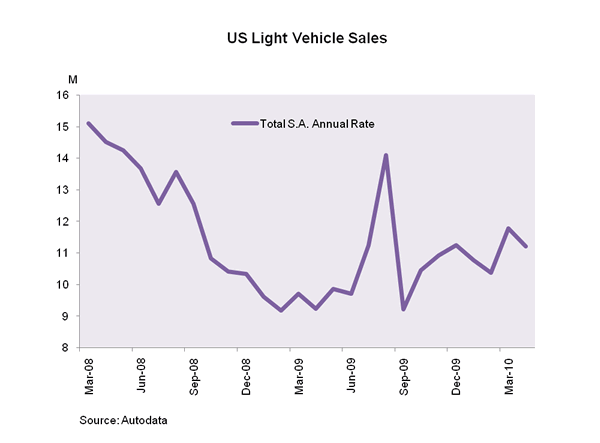
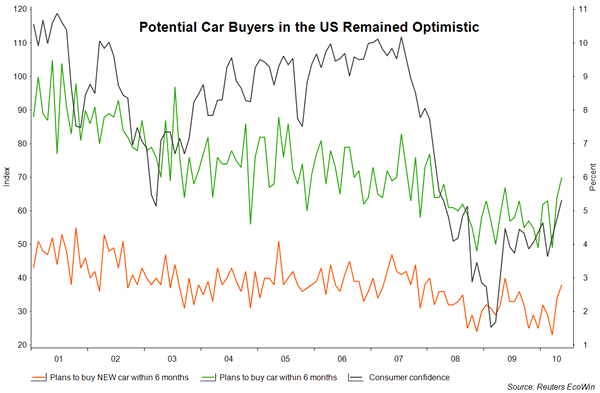
May US light vehicle sales beat market expectations and surged +17.9%, saar, to 11.63M units. The reading was encouraging as it was the second highest reading in 9 months as well as a result in the absence of aggressive discount. Auto market in the US has performed better than previously expected. Survey shows that consumers' intention to buy cars in coming 6 months has risen in recent months despite renewed worries over global economic slowdown. This should help boost PGM prices.
The US SEC approved ETF Securities last week to increase the number of shares offered in its platinum- and palladium- based ETFs. According to the company, share offering of platinum ETF soared +6.44M to 11.22M shares while that for palladium ETF increased +5.92M to 18.8M. The 2 ETFs were well-received after trading started in January. As of May 28, holdings in the US-listed ETFS Physical Platinum Shares reached 334.2K oz, around 30% of all platinum ETFs, while that ETFS Physical Palladium Shares reached 788.4K oz, around 40% of the palladium ETF universe. Increase in new shares indicates robustness of PGM investment demand among US investors. 
Currently trading at 1223, Comex gold futures change little after pulling back yesterday. Some updates on official gold holdings: The IMF reported sale of 14.4 tons of gold in April, following sales of 5.6 tons and 18.5 tons in February March respectively. Gold sales totaled 38.5 tons over the past 3 months and left 152.8 tons gold available for sale. At the same time, Russia's holdings added +5 tons to 668.7 tons during the month. SPDR Gold Trust recorded total holdings of 40.8M oz, or 1268.54 tons, as of June. Holdings in SPDR have been making record highs as sovereign crisis in the Eurozone spurred demand for safe-haven assets. In fact, SPDR ranks 6th in total world gold holdings, just below France and higher than China and the ECB.
Crude oil slides below 74 after soaring to as high as 74.4 after government report showed disappointing retail sales in the Eurozone. The 16-nation region surprisingly showed contraction of -1.2% m/m in April while the market had anticipated a mild growth of +0.1% from a flat month in March. On annual basis, the decline widened to -1.5% from -0.1% in March. European stocks, however, remain firm and should help alleviate weakness in crude price.
In US session, investors should pay attention to ADP employment change, which may give a clue on tomorrow's employment, is expected to show +55K addition in payrolls. The weekly initial jobless claims reading is volatile in nature but can still move the market. The US government will also report ISM services index and factory orders. Both are expected to have improved.

Gold Strengthens amid Fresh Sovereign Concerns

Precious metals rebounded strongly yesterday but only gold managed to maintain the strength in Asian session today. Renewed selling pressure in the euro and tensions on the Korean Peninsula have been supportive for price. The benchmark contract for gold soared to as high as 1197.3 before settling at 1194, up +1.52%, yesterday. The yellow metal remains firm in Asia today. Silver rose +1.98% to 18 yesterday. However, price retreated to 17.8 Tuesday amid fresh concerns about economic recovery. PGM also surged with platinum and palladium adding +2.22% and +3.21% respectively. However, most of the gains were erased as prices retreat today.
WTI crude oil edged higher but ended Monday only slightly at 70.21, up +0.24%. Price drops towards 69 in Asian session today. Brent crude closed +0.72% lower yesterday with price continues drifting low towards 70 in Asian session today.
The market was dominated by weakness in Spanish banking system and EU leaders' diverse opinions on revising the European Union treaty. The euro was badly hurt while US bourses tumbled.
After the Bank of Spain's takeover of Cordoba-based CajaSur, 4 Spanish savings banks plan to combine to form the nation's fifth-largest banking group with more than 135 billion euro in assets. The move deepened worries about the health of banking system in the country as the it's considered as the government's bailout effort help the 'weakest' of Spain's mutually owned banks that account for about half the country's loans.
In a report, the IMF said Spain's banking sector 'remains under pressure' as 'Consolidation needs to accelerate to reduce overcapacity and produce more robust institutions' has been 'too slow'. Concerning the economy, Spain is faces severe challenges including 'a dysfunctional labor market, the deflating property bubble, a large fiscal deficit, heavy private sector and external indebtedness, anemic productivity growth, weak competitiveness, and a banking sector with pockets of weakness'. The IMF advised the country to have 'far-reaching and comprehensive reforms'.
The euro tumbled further as European Commission President Jose Manuel Barroso commented Germany's aim to modify the European Union treaty as 'naive'. At an interview with a German newspaper, Barroso said that 'we will not propose treaty modifications even though we are open to good ideas…It would also be naive to think one can reform the treaty only in areas Germany considers important'. The comments were in response to German Chancellor Angela Merkel's urge for a modification of the treaty.
Catching up with US' fall, Asian stock market tumble with the MSCI Asia Pacific Index sliding -2.3% to a 10-month low. Major regional indices decline with Japan's Nikkei 225 Stock Average, Australia's S&P/ASX 200 Index and South Korea's Kospi losing -3%, -25 and -4% respectively. Apart from Eurozone's sovereign crisis woes, the market is hurt as Korean tensions intensified.
Yonhap News Agency reported that North Korean leader Kim Jong Il last week ordered its military to get ready for combat after the country was accused of firing a torpedo to split apart the 1200-ton Cheonan. Yesterday, South Korea announced that it will push for UN's censure against North Korea for the torpedoing a naval ship, which killed 46 sailors on March 26. At the same time, the news agency said South Korea plans to define North Korea as its 'main enemy'. The tension on the Korean Peninsula adds uncertainty to the market.

Weekly Fundamental Outlook for Energies and Metals - Oil Weakens when Demand Starts to Pick Up

The week started calmly until Germany's Bafin announced Tuesday to temporarily (until March 31, 2011) ban naked short sales of debt securities of Eurozone countries admitted on a domestic exchange to trading on the regulated market. It also temporarily prohibited CDS in which the reference liability is at least also a liability of a euro zone country and is not used to hedge default risks (naked CDS). In addition, Bafin banned short sales on 10 largest German financial institutions (including banks and insurance companies.
The aim of the bans was to reduce the 'extraordinary volatility of debt securities of countries from the Eurozone' as 'excessive price movements' could result in 'serious disadvantages for the financial market and could jeopardize the stability of the financial system as a whole'.
While some interpreted the new rule as part of German Chancellor Angela Merkel's political agenda, the financial market could not escape from turbulent move as sentiment, which has been badly hurt by sovereign-debt crisis in the Eurozone, deteriorated further.
Immediate market reactions were euro's slued to a 4-year low against the dollar, surges in CDS in peripheral European bonds and widening in yield spreads between German bund and peripheral European bonds. Stock and commodity market also got hammered. Although prices stabilized later in the week, most assets recorded severe losses.
While we believe many commodities have fallen below their 'fair values', risk aversion suggests further weakness cannot be ruled out.

Crude Oil

Wall Street rebounded on Friday after recording the steepest decline in more than a year on the prior day. Bargain-hunting was seen as some investors thought the selloffs have overextended. Rebound in stock market helped commodity prices (especially petroleum and base metals) as their positive correlations have been rising in recent years. WTI crude oil for July delivery rebounded to 71.23 after plunging to as low as 69. On Thursday, WTI crude tumbled to a 10-month low at 64.24. On weekly basis, the benchmark contract closed at 70.05, down -7.15%. Note that the June contract expired Thursday.
Positive correlation between crude oil and stock markets has developed since September 2008. This was due to the role stock performance as a proxy for world economic growth. May's correlation between crude and S&P 500 index has reached 78%, compared with 63% and 47% in April and March respectively. Heightened worries about deficit problems and potential global economic slowdown as debt-ridden countries accelerate fiscal consolidation measures triggered risk aversion which has weighed on stock markets. This has also resulted on huge decline in oil prices.
The US Energy Department reported less-than-expected increase in crude stockpile and decline in both gasoline and distillate stockpiles. However, the report did not catch much attention.
Crude oil inventory edged higher, by +0.162 mmb, to 362.7 mmb in the week ended May 14. The increase was lower than market expectations. However, Cushing stockpile also rose by almost +1 mmb.
Gasoline stocks fell -0.29 mmb as rise in production was offset by decline in imports, Demand fell slightly but should improve in coming weeks as we enter the driving season. Distillate stockpile drew as imports and production dropped -5.18% and -1.89% respectively. At the same time, demand soared +5.04% to 4.086M bpd during the week.
It's interesting to see that recent oil price slumps have been accompanied signs of demand recovery in the US. In particular, growth in distillate demand has accelerated in recent weeks with 4-week average reaching +4.18% on May 14 from +1.79% on April 30. The 3 consecutive weekly increases (4-week average data) also reversed the downtrend since the beginning of the year.

Natural Gas

Gas price plummeted in tandem with others in the energy complex and recorded losses for 4 out of 5 days last weeks. Despite less-than-expected increase in gas storage, investors worried about ample supply as driven by huge rise in gas rig counts. Nymex natural gas price surged to a 2-month high of 4.494 Tuesday before sliding. The benchmark contract ended the week at 4.035, down -6.42% on weekly basis.
The US Energy Department reported that gas storage rose +76 bcf to 2165 bcf in the week ended May 14, compared with 5-year average of +93 bcf increase. The 'mild' increase was driven by higher heating demand in the Northeast but the situation will not last for long. Gas bulls may be looking for to hot weather in the US. Weather Derivatives of Belton said cooling requirements in the US will be +36% higher than normal in the coming week. Weather forecasts show that temperatures will be above average in the Midwest in the next 10 days while the temperature in Chicago will be 18 degrees above average on May 24.
The number of gas rigs surged +18 units to 969 units, the highest level since April 16. We remain worried about long-term demand/supply balance in US gas market.

Precious Metals

Correction from recent rally was seen in gold last week. After surging to a record high of 1249.7 on May 14, the benchmark contract for the yellow metal declined and settled at 1176.1 Friday, losing -4.21% over the week. The fall was mainly due to profit-taking and liquidation of long positions to meet margin calls in other investments.
Gold's movement has decoupled from other commodities as well as the euro in recent months. We remain bullish in gold in the medium- to long-term as low-interest rate environment and huge budget deficits in the Eurozone, the UK and even the US should be positive for gold.
Late last week, the World Gold Council said the metal will attract demand as a means of inflation-hedge. The market inevitably worries about inflation as the ECB pledged to buy government and private bonds so as to restore financial market stability. Although the central bank said all purchases will be sterilized, analysts doubt the purchases may not be full sterilized. Investors are increasingly looking to gold for wealth protection. Moreover, investors are increasingly looking to gold for 'wealth protection' and 'the ETF market has been explosive and the intermediate market is on the cusp of growing very rapidly as major pension funds and institutional investors begin to hold gold long-term'.
PGMs were under heavy pressure last week with palladium the worst performer in the commodity sector last week. Settling at 439.5, Comex palladium plunged -16.8% during the week. The benchmark contract dipped below 400 on Friday before recovering. While investors dumped palladium amid concerns of demand for autocatalytic converter as global recovery slows down. Indeed, there was positive news from the market. Norilsk Nickel, the world's largest palladium producer, said that Russia is almost out of palladium stockpile. According to Viktor Sprogis, the Deputy CEO of the company, the government stockpiles of palladium are gone, as judge by indirect indicators. Therefore, 'we, as well as other major platinum-group metal producers, think this factor will no longer affect the market'. Russian supply of state stocks has kept the palladium market in surplus over the past 9 years. Johnson Matthey also estimated in its Platinum 2010 Review that supply from state stocks has been between 0.76M oz and 1.49Moz over the past 5 years.
Platinum fell -12.5% last week. The panic selling was driven by fears that a double dip in economy would cause slowdown in PGM demand. Moreover, potential moderation in Chinese economic growth as driven by government's tightening measure also hurt sentiment. However, we believe last week's decline was excessive and investors may accumulate on pullbacks.

Base Metals

Base metals remained under pressure but buying interest emerged again later in the week as prices reached oversold territories. The LMEX Index, a normalized average of future prices for the six metals (Aluminium, Copper, Nickel, Zinc, Tin and Lead) over 3 maturities, plunged to a 3-month low at 3025.5 on Monday before settling at 3152.1, down -2.04%.
Chinese government's efforts to cool down the property market have weighed on base metals. Although rate hike and RMB appreciation may be delayed to the third quarter as European crisis threatens global economic growth, measures implemented since the beginning of the year, including increase in banks' required reserves ratio and restrictions in new lending, have damped sentiment and property transactions have significantly slowed down. Economists have turned more cautious on the property sector.
Goldman Sachs forecasts transaction volumes will fall -40% between May and December from the same period last year, while home prices will slid -30% from current levels. Credit Suisse expects property transaction volumes will decline -15% y/y in 2010 while prices will slump -30% y/y.


source

Investors Continue Dumping Commodities...

The market remains under pressure as Germany's ban on short-selling activities triggered a new round of panic selling in risky assets. WTI crude oil price extends the 7th-day decline to as low as 67.9, the lowest level since September 30, 2009. The contract has plummeted more than -20% so far in May. Despite a plunge below the OPEC's preferred range of 70-80, Saudi Arabia's financial minister stress that he's not worried about the decline and the country will commit to the planned projects.
Selloff in oil price has been spurred by slumps in stock markets, given the strong correlation the 2 have been trading recently. In Asia, the MSCI Asia Pacific Index dipped -1.5% to a 3-month low. Individual stock indices also weakened with Japan's Nikkei 225 Stock Average sliding -0.54% while Singapore's Straits Times and Hong Kong's Hang Seng Index losing -2.40% and -1.83% respectively. In Europe, all major indices tumble more than -2%. It's ironic that while the Bafin tries to reduce the extraordinary volatility in financial markets by imposing trading restrictions, it actually increases volatility in the market.
While we expect today's US oil inventory will have limited impact of price movement, recent stock builds, especially from Cushing, Oklahoma, have not only widened spread between WTI and Brent crude oil price, but also exacerbated the contango condition in the Nymex contract. The chart below shows that the time spread between WTI June and July contract widened to 4.59/bbl last Thursday after a report on the previous day showed that Cushing stocks soared to a new record high of 37 mmb.

Gold slips but buying interest is seen above 1200. Liquidation of long positions will continue for some time and further weakness in the yellow metal cannot be ruled out. At the same time, gold's decline may also be driven by cashing-out activities as traders need to pay margin calls in investments elsewhere!
Falls in platinum and palladium were more serious. After a brief rebound yesterday, platinum heads lower towards 1600 in European session. Worries over economic slowdown weigh on metals will strong industrial uses. Palladium slides to 464.5, the lowest level since late-March 2009, despite OAO GMK Norilsk Nickel's, a producer of nickel and palladium, comment that Russia is almost out of palladium stockpile. According to Viktor Sprogis, the Deputy CEO of the company, the government stockpiles of palladium are gone, as judge by indirect indicators. Therefore, 'we, as well as other major platinum-group metal producers, think this factor will no longer affect the market'.

Crude Rebounds after Sliding Below OPEC's Preferred Range

Crude oil recovers after breaking below 70, the lower boundary of OPEC's preferred price range. Current level of 71.8 is +2.8% higher that the new 3-month low, at 69.82, made earlier in Asian session. However, the rebound is mild when compared with the -17% selloff recorded since the beginning of the month.
While debt-laden countries such as Spain, Portugal and Italy proposed additional measures to reduce deficits, the market begin to worry about the negative impacts of these measures on economic growth. Tighter fiscal policy will inevitably damped domestic demand while further weakness in the euro will boost exports. The net impact is uncertain but we expect economic forecasters will downgrade growth outlook in the 16-nation Eurozone for 2010 and 2011.
$70/bbl is a psychological support for WTI crude oil as various OPEC oil ministers expressed they were content with a price above that level. Qatari Energy Minister Abdullah bin Hamad al-Attiyah said today that price below 70 would discourage investment in deepwater production. Last week, Kuwaiti Minister Ahmad Al-Abdullah Al-Ahmad Al-Sabah said the organization may call for an emergency meeting before the general meeting on October 14 should oil price drops below 65. Saudi Arabia's Oil Minister Ali al-Naimi said in April that oil price in a range of 70-80 is 'as close to perfect as possible'. King Abdullah also mentioned 75 is a fair price for consumers and producers.
Gasoline and distillate cracks have reached 15-month highs despite fuel inventories remain at historical highs. The phenomenon has been driven by severe weakness in crude oil price. Gasoline crack surged for 7 consecutive days to 17.88/bbl while distillate crack rose to 15.14/bbl last Thursday below pulling back to 14.94 Friday. The rally may continue, especially for gasoline as the US driving season begins in the last week of May. There's possibility that gasoline crack will rise above 20 but it will eventually revert to 12-13.
Gold changes little from Friday's close of 1227.8. Profit-taking is seen but investment demand remains high. In the near-term price is vulnerable to correction on long liquidation and increase in scrap supply. In the medium- to long-term, however, we stay bullish in gold's outlook and believe flight to safe-haven asset should support price as long as worries over sovereign crisis linger.

Commodities Extend Weakness with Crude Oil Tumbling to 3-Month Low

A new wave of selloff in risky assets emerges again after stabilization for 1-2 days. While the market worries about slowdown in European growth as many countries step up their fiscal consolidation plans, corporate earnings and macroeconomic data fail to ignite hopes.
Decline in WTI crude oil accelerates in European session with the benchmark contract sliding for a 4th consecutive day to a 3-month low at 72.72. On weekly basis, WTI crude should fall around -3%, after slumping -12.8% in the prior week.
Gold resumes recent rally after yesterday's pullback as concerns over sovereign crisis and resultant slowdown in global economic growth spurs demand for safe-haven assets. Currently trading at 1249.7, the benchmark contract has made a new record high. At this point, risk of profit-taking is high and scrap supply will likely emerge to drag down price.
PGMs fall for a second day. While the market talks about impacts of escalated sovereign crisis on Eurozone's economy, it raises concerns about auto demand. Analysts had anticipated European car sales to be flat from the previous year as the government's cash-for-clunker scheme ends. However, such forecast may need to be revised down as economy in Europe may weaken. Should slowdown in auto demand have impacts on PGM consumption, platinum should be hit harder than palladium as European auto market is dominated by diesel-fuelled vehicles.
Base metals also plunge, paring gains of 1-3% on Thursday, amid growth concerns. However, new Chinese policy may boost light-weight metals in the future. The National Development and Reform Commission, the government ends discounted power rates to higher-usage companies with immediate effect. Moreover, it will impose financial penalties on companies whose power consumption is higher than limits set by the state. Aluminum smelters will be greatly affected given the heavy power consumption. The policy may force some small smelters to shut down, hence tightening supply.

Crude Recovers as Strong Eco Data Rekindle Hopes on Growth. Gold Grinds Higher

After sliding to as low as 75.42 earlier in the day, crude oil recovers in European session as stronger-than-expected economic data distract investors from sovereign crisis concerns. IEA's downgrade of global oil demand in 2010, in contrast with upgrades by both OPEC and EIA, has however, complicated the oil market outlook. Gold price extends strength after making a record-high yesterday and is currently trading at 1240.
Eurozone's GDP surprisingly expanded +0.2% q/q in 1Q10, compared with consensus of +0.1%, following a flat reading in the previous quarter. Growths in Germany, France and Italy were +0.2%, +0.1% and +0.5% respectively. Peripheral economy was mixed with Greek GDP shrinking +0.8% while Spain and Portugal GDP rising +0.15 and +1% respectively. On annual basis, economy in the 16-nation region expanded +0.5%, after a contraction of -2.2% in 4Q09. Industrial production grew +1.3% m/m in March (consensus: +1%) from +0.7% in February. From a year- ago basis, the reading surged +6.9%.
In the UK, claimant count rate slipped to 4.7% from 4.8% and the number of people claiming jobless benefits dropped -27.1K to 1.52M. ILO unemployment rate in the 3 months to March however rose to 8% (previous: 7.8%). The pound reverses earlier gains as BOE governor Mervyn King said risks of economic growth has increased and the central bank may expand the 200B-pound asset purchase plan when needed. Sterling rose against the dollar and the euro earlier in the day as the Conservative Party and the Liberal Democrats Party formed a coalition government, resolving uncertainties cast by a hung parliament.
International Energy Agency revised down its oil demand forecasts to 86.4M bpd in 2010. While it represents a +1.89% increase from 2009, the demand is lower than April's projection of 86.63M bpd. According to IEA, the downgrade was mainly driven by 'changes to non-OECD historical baseline data, as slightly higher GDP prognoses from the IMF are counterbalanced by a higher price assumption'. IEA also revised up non-OPEC supply to 52.3M bpd, thus lowering 'call on OPEC' to 28.7M bpd from 28.8M bpd as projected in April.
Gold remains strong in European session as we see further flight for safety. The benchmark contract soared to a new high of 1245.4 earlier in the day. Inflows are seen in all areas including ETFs, futures as well as gold coins and bars. Further upside is likely as long as worries over sovereign crisis remain. Risks are profit-taking and increase in scrap supply which is inevitable at current price level. In India, news said that record gold price may hinder physical gold buying during this year's Akshaya Tritiya festival. Analysts forecast the reduction may be as much as -50% from a year ago.

Ratings and Recommendations