Financial Advisor
Showing posts with label Economic Updates. Show all posts

Why “Energy Rebalancing” Means Huge Profits This Year


Marina and I have a little less than a week left on the island before we head back to the mainland. I hope our pipes haven’t frozen back in Pittsburgh!
As we head home to begin the New Year, there are several new wrinkles in the energy market that I have my eye on.
And as always, I’m looking for new ways to profit from them.
These new wrinkles revolve around what I call the “energy balance” – and its changing fast.
It involves big shifts in sourcing and systems that will combine with some major revisions in finance that will alter the landscape for investors.
It’s not about new energy breakthroughs or big oil discoveries. And it’s certainly not about entirely new structures.
Rather, it’s about the accelerating changes in elements you’re familiar with.
Think of it, if you will, as a “rebalancing” of what already exists.
It’s an unstoppable trend that promises to hand us huge profits…

The 2014 Plan: Leveraging a Gigantic Advantage

For us, of course, this “rebalancing” gives us a gigantic advantage: we identified this trend a long time ago. In fact, I’ve discussed it in these pages before.
At present, there are three overarching dimensions to these changes: the energy network itself, the geographical considerations, and the financial arrangements.
As as the market rebalances, it will require we change our investment strategy to profit from it -especially the with first two.
As for the third, we have just about single-handedly revised the approach to finance all by ourselves.
Today, however, I want to talk about the networking dimension.

Networking involves the entire sequence of energy (oil, natural gas, electricity) transmission from production, through gathering and transit, to refining, distribution and retail. This remains the upstream-midstream-downstream sequence that has become a mainstay of the energy sector.
In the case of operating companies, our target interests will consider the basins worked, the company’s focus, market cap and field size, along with the more or less traditional considerations of management style, balance sheet, and market position.
We will also see some interesting rebalancing in the refinery space, as those processors able to bridge the domestic market and rising oil product exports, as well as the conventional/unconventional sourcing mix, will have a substantial advantage.
And then there are the huge transport revisions that are on the way. We have talked about two of these primary developments before, but will be watching their progress with added interest this year.

Fundamental Changes = Big Opportunities

The first is the fundamental change in the worldwide balance occasioned by the rapid expansion of the liquefied natural gas (LNG) market.
This remains the single most significant revision globally to take place over the next decade. The rise of LNG exports from the U.S., fueled by the largess of shale and other unconventional gas sources, will be fundamental to this revolution.
On the other hand, there is another revision that may be just as significant in generating investor profits from the export trade.
I’m referring to crude oil, but with some new elements contributing to another change in the balance. I’m talking about oil exports.
In the future, we will see a concerted move to export oil in new directions – starting with transit from the U.S. For some time, exporting oil from the states has been considered a national security issue, making the trade very difficult.
In this case, two exceptions have been allowed: one permitting the export of heavy, lower quality crude from California (for which the argument can be made of an insufficient domestic demand); the other allowing certain tolling contracts.
Tolling is a process whereby raw materials are exported to be processed abroad with the finished product then imported back in. The justification for this allowance has been the concern over maintaining sufficient domestic stock of oil products, especially diesel. That concern has now abated with the advent of significant reserves of tight oil (“shale” oil actually being only one category of such unconventional sourcing).
None of this would have been considered possible only a few years ago. Being dependent on imported oil, American policy makers were understandably dismissive about allowing the export of finished products from U.S. refineries.
But not any longer…
As is the case with natural gas and LNG, there is now ample local supply. That opens up the market for rising oil product exports.
As a result, I suspect that tolling will rise again – owing to the limitations on overall U.S. refinery capacity – but will increasingly service a jump in the exports of those products. The cost differential in utilizing foreign processing facilities makes this approach quite profitable.

The Big (And Profitable) Global Changes Ahead

Then there is the expanded use of the completed East Siberia-Pacific Ocean (ESPO) pipeline in Russia.
An earlier spur from ESPO has for several years moved oil south to China. But the new impact of the pipeline on wider Asian demand will become far more pronounced.
ESPO export oil will become a new benchmark crude rate, a major development for all of Asia. As this develops, the ESPO benchmark will replace London’s Brent as the standard for trade in wide portions of that market.
This is what makes this so significant. End users in Asia have paid a premium over what it costs to buy the same quality oil for delivery to Europe. ESPO will undercut that tradeoff and provide a genuine boost to Asian economic development. ESPO oil has a lower sulfur content as well meaning it is “sweeter” than Saudi export. That is another big advantage for Asia.
Other export changes will come from a number of geographic market-specific revisions. Western Europe will be importing more LNG as nations like Germany also phase in a wider usage of renewables.
These LNG imports will add pressure on the pricing points for long-term pipelined gas contracts, while improving prospects for investments in the expanded liquefied trade.
What’s more, a matter I have addressed before and had meetings about over the last several weeks, has begun to change how people view oil and gas sourcing in the Caribbean.
It involves the emergence of China as a major conduit of energy funding in South America and the rapidly accelerating networking of production, refining, and transport throughout northern South America and the Caribbean basin.
The combination rising Chinese influence and an existing system called “Petrocaribe” will produce some major changes that will impact North American markets. 

Thomas Edison's secret war with the Federal Reserve decades back has led to a new currency rising up today. It threatens the dollar, EURO, Pound, and the entire international monetary system. But it's also making everyday Americans rich. A Silicon Valley venture capital veteran investigates this exciting phenomenon.



End Of America : Fed is Dying

America’s path from fiscal improbity to political impasse 
ONCE a stalwart of good governance, America looks like a rodeo clown. If the House and Senate cannot agree to continue funding for discretionary spending by midnight on September 30th, the federal government will experience one of its periodic shutdowns. There have been 10 such episodes since 1981, the date of the first one under the current budget-making rules, so a brief hiatus in government functions need not be frightening. Some non-essential services would be suspended and inconvenience caused—in addition to sending the US Treasury market into mild gyrations. Far worse is the idea that Congress might fail to authorise the raising of the debt ceiling in mid-October. Republicans in Congress have a shopping list of demands in exchange for allowing this; the president has said he will not negotiate. If America were in real danger of missing a debt payment it is likely that President Obama would find some constitutional justification for ignoring Congress rather than set off a financial meltdown.
Read full article here
Further Reading

Government Shutdown Begins As Deadlocked Congress Flails

Greece: A Gathering Storm Threatens Europe and America

Greece: A Gathering Storm Threatens Europe and America

By Elliott Wave International/the Socionomics Institute


The similarities between Greece and pre-WWII Germany are striking.
  • Nazi salutes.
  • Praise for Adolf Hitler.
  • Swastika-like banners.
Now, before you write off this warning as a run-of-the-mill, Nazi-name-dropping scare tactic, consider this recent report from the Socionomics Institute, a U.S.-based think tank that studies global trends in social mood. Here's an excerpt from the Institute's February publication of The Socionomist.
A rising political party known as Golden Dawn is resurrecting such practices, all hallmarks of Hitler's Third Reich, in modern-day Greece, which has suffered a dramatic, five-year stock market decline.
From 1927 to 1932, Germany suffered a disastrous stock market decline, falling 73% over five years. Six million people were unemployed, and the government was weak. Germany suffered outside financial pressure in the form of reparations required by the Versailles Treaty and consequences of its involvement in World War I.
Adolf Hitler argued that the German government betrayed its people by signing the Versailles Treaty. He promised that if he were elected, the nation would stop paying the reparations. The position appealed to the German people's anger and helped the Nazi leader become chancellor in January 1933.
Modern-day Greece has experienced an even larger five-year decline than 1920s-1930s Germany did, falling 88% since 2007, and the country has suffered a debt crisis. As a condition for bailouts aimed at helping Greece recover, the European Union has imposed tough austerity measures. The Greek government has implemented the measures. Meanwhile, the deepening negative social mood has fueled protests against them.
Nikos Zydakis, editor of the daily newspaper Kathimerini, says Greece is in an economic depression like that experienced by Germany in the 1930s. More than 90% of Greek households have experienced income reductions, with the average drop 38%. Unemployment in Greece now stands at a record 26.8% and is nearly 60% among Greece's young adults. In November the Greek Parliament imposed tax hikes and spending cuts demanded by creditors. Supermarket sales in the country declined by 500 million euros ($669 million) last year, and people are burning wood because the price of electricity has risen and taxes on heating oil have increased.
"History doesn't repeat itself, but it does rhyme," goes an old saying attributed to American author Mark Twain. And new research from the Socionomics Institute sees a disturbing pattern of rhymes between modern-day Greece and pre-WWII Germany.
To be sure, market and political developments in Greece will have a significant impact on the future of Europe, the Americas and beyond.

The Socionomics Institute is an independent research firm devoted to the study of social mood and social action. As a partner to the world's largest market forecasting firm, Elliott Wave International, the Institute puts the most important developing social trends around the world into context with Robert Prechter's socionomic theory, which posits that social mood drives social action (not the other way around).
Read the rest the Institute's new February report to learn more about the developing threats out of Greece. The full report is available for free as part of a special promotion run by the Institute with EWI. Follow this link to read the full February issue of The Socionomist (a $19 value) - for free.

Secretive Gov't Group Stealing Food

Our research has revealed yet another development underway in the highest levels of our Federal Government, which we find disquieting. You will too…

"HANDS OFF MY BACON!
My Bread, Milk, Bottled Water,
Eggs and Cereal Too..."


Controversial New Federal "Rationing" Policies Let the
Government STEAL Food from Straight from Your Kitchen


Steve Sjuggerud

Editor, DailyWealth 
 

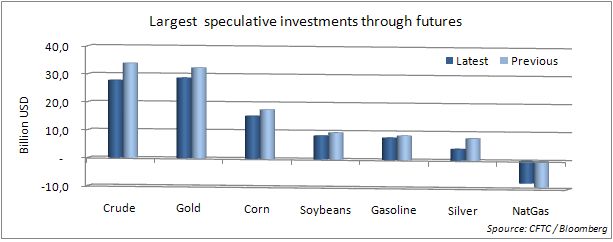
CFTC week 18: Speculative longs cut by 4% before the carnage

This is one of the weeks were the CFTC data does not give that much of a picture considering the carnage that unfolded last week, especially after the data was comprised on Tuesday May 3.
By then hedge funds and large investors had already begun to react to the early signs of correction which was triggered by the steep drop in the price of silver. By Tuesday positions had been cut by 4% but no doubt that number as of last Friday would have been much higher. Unfortunately we have to wait until this coming Friday to get a feel for how much further positions were cut during the carnage. The sell-off is expected to have knocked $99 billion off market value and will undoubtedly have driven out a lot of speculators, thereby leaving the market in a much better position to recover - conditions permitting.
A brief look at the numbers show that all of the seven largest investments were already scaled back by last Tuesday. Three sectors: metals, grains and meats saw reductions while energy was unchanged and softs rose.
Of more interest was  currencies where the accumulated dollar short rose by 10% to $40 billion just two days before Trichet disappointed the hawks, which sent the Euro sharply lower and the dollar higher. Such were the expectations about continued hawkishness from the ECB President that Euro longs had risen by one third ahead of the meeting.

 Background information: The Commitments of Traders is a report issued by the Commodity Futures Trading Commission every Friday with data from the previous Tuesday. It comprises the holdings of participants in various U.S. futures markets split into "commercial" and "non commercial" holdings. The non commercial or speculative holdings are typically institutional investors such as hedge funds and CTAs. The above chart tracks a total of 27 different commodities split into sectors.

How the U.S. government is now monitoring everything you Do


From SHTF Plan:

When President Obama talked about a transparent administration during the run up to the 2008 election, most Americans assumed he was talking about openness in government dealings.

Obviously, this is not the case, as evidenced by the administration's handling of the universal health care legislation, which was passed without a single American having had a chance to read it for 72 hours before a vote as the President promised would be the case with all legislation, refusal to release photographic evidence of the Osama bin Laden raid, the President's own birth certificate which has taken two years to be made public, and the many secret meetings held with Congressional members behind closed doors.

It should be clear by now that Big Government's domestic surveillance policies under Presidents Bill Clinton and George Bush are being furthered expanded by Mr. Obama. Transparency, it seems, had nothing to do with making government more visible. It did, however, have everything to do with…
 

Equity Update: Economic data battles sovereign debt concerns

The U.S. market is expected to open flat following the sell-off yesterday as solid economic data clashes with a new round of sovereign debt concerns in the Eurozone and continuing Middle East commotion.
Germany is doing all it can to lift the rest of the Eurozone as another report released earlier today shows that factory orders grew 2.9 percent month-on-month in January, beating the 2.5 percent consensus forecast. Axel Weber also provided more fuel for the risk bulls as he delivered a rather upbeat speech in Frankfurt. The former frontrunner for the ECB presidency said "Germany's strong cyclical recovery will continue in 2011, albeit at a somewhat slower pace". He expects the growth drivers not just being limited to capital expenditure, but also sees consumer spending picking up on the back of the strong German labour market.
All is not well in the Eurozone, though, as emphasised by today's development in the Greek 10-year government bond, which is now at the highest rate ever since Greece joined the Eurozone. The 10-year yield is at 12.8 percent, up 47bps alone today, following Moody's downgrade of the country's debt yesterday which sent European indices down. This is killing the EUR in the process with EURUSD down 66 pips.
With economic data, including company announcements, expected to have little influence for the rest of the day we look for stocks to range trade around the current levels.

Bankruptcy - The sneaky way America will default on its massive debts

 By Terry Coxon, The Casey Report:

It was Otto von Bismarck who explained that "politics is the art of the possible." We can thank him for that much, but he didn't tell the whole story. I'll give you the rest of it. Politics is the art of the possible fictions you can get away with.

Politics is mostly dissembling, and the dissembling is mostly about dodging personal responsibility for the messes governments make. It works out that way because making messes is most of what governments do. So when we ponder how the U.S. government will go about defaulting on its debts, a good way to approach the question is to consider how a default might be presented.

At this point, there is no room for doubting the government will renege on the commitments it has made to give people money. The $9.2 trillion in Treasury securities held by the public is just the tip of the iceberg. Estimates differ, but if you add in the unfunded obligations for Social Security and Medicare, it's hard to avoid getting a total that exceeds $80 trillion. That works out to $260,000 for every man, woman, and child in the country, including the two-year olds. It can't be paid, so it won't be paid.

But don't expect any clarity about the matter. Whatever happens, you can count on it not being called a default. No one in the U.S. government is going to say, "Tough luck, Treasury bond investors. We're not going to pay you another dime. Go pound sand." And no politician is going to tell the 51 million Americans on Social Security, "If you're fit enough to pump that rocker, you're fit enough to work." It will all be done far more diplomatically...

Government Stupidity - Top trend forecaster : A MAJOR war is coming

From George Washington's Blog:


Gerald Celente has been a leading trend forecaster for years:


"When CNN wants to know about the Top Trends, we ask Gerald Celente."
- CNN Headline News

"There’s not a better trend forecaster than Gerald Celente. The man knows what he’s talking about."
- CNBC

"Those who take their predictions seriously ... consider the Trends Research Institute."
- The Wall Street Journal

... Celente is now predicting... that the Tunisian and Egyptian protests are not isolated incidents, but the start of revolts and wars...


The experts… are saying what's going on in Tunisia and Egypt, this is going on in Arab nations. Nah, this is the beginning of something much greater. Figure it out. Civil wars to regional wars to world wars. The Crash of '29 equals the Panic of '08. The Great Depression equals the Great Recession. World War II equals the First Great War Of The 21st Century...
 Read full article...

An Answer to the Most Popular "End of America" Question

By Porter Stansberry with Braden Copeland
Saturday, February 5, 2011
I've been on the radio a few times in the last month.

Producers are contacting us with interview requests because of our new promotional video, "The End of America."

I imagine most readers have seen this video already. You know the core components of our argument: The debts assumed by the Western democracies will overwhelm their economies and lead to the end of our current dollar-denominated, global currency regime. This has profound implications for Americans' standard of living and our empire's role in the world.

Doing these interviews and taking call-in questions from people around the country reminds me of why we made the video: People suffer from a shocking lack of knowledge about the serious financial problems facing our country. For example, the most popular question is: "When will the crisis begin?"

The question assumes we ought to ignore the collapse of the automakers, the complete destruction of America's investment banks, and the receivership of the world's largest mortgage firms (Fannie and Freddie), and the world's biggest insurance company (AIG)…

The question implies nothing unusual has taken place with housing prices… or in the markets for strategic commodities like lithium, copper, oil, coal, and corn – all of which are soaring in the face of the moribund U.S. economy. The question assumes nothing is going on with the value of our dollar, despite silver trading near $30 and gold trading close to $1,500 – up 100% in only two years.

We respond to the popular question with a question of our own: What will have to happen before you'll say we're in a crisis right now?

How high will gas prices have to get before your neighbors notice something is wrong? How high will gold have to get? Or silver? How many banks will have to go under? How high will unemployment have to rise? How many cities will have to go bankrupt? Where's your threshold? How bad will things have to be before you begin to see what's really happening?

In addition to raising these questions, I've compiled a list of seven key facts that might spring people into taking action to protect themselves. They are the factors I believe MUST lead to the end of the global U.S. dollar standard – what we call "The End of America."

1) The price of gold has gone up 10 years in a row. We can't think of another market that's ever risen for 10 consecutive years. This is a historical anomaly, and it means something has gone badly wrong with the world's reserve currency (the U.S. dollar). Markets, if left to find their own equilibrium, will naturally fluctuate. Gold isn't fluctuating. Its steady move up proves something strange is happening to our money.

2) Our government's deficits are out of control. The government's annual deficits now routinely surpass $1 trillion. The first $1 trillion deficit came in 2008 – and the government explained it away as the consequence of the financial crisis. But we racked up another $1 trillion deficit in 2009 and yet another in 2010.

We'll have another in 2011 and so on. Our national debt has doubled since 2005. We've borrowed more money in the last five years than we had in the entire history of our government until then. This isn't sustainable.

3) The government cannot increase tax revenues enough to cover our spending or repay our debts – ever. Our annual deficits have become completely unlinked to taxes. Total federal income taxes and corporate taxes generate $1.1 trillion a year in revenue, and we still ran a $1.3 trillion federal deficit last year. So even if we increased tax revenues by 100%, we would still have fallen $200 million short. This is totally unsustainable.

4) Special-interest groups – particularly government unions – are looting our Treasury. Self-serving special-interest groups have completely hijacked government spending. We now spend $200 billion a year on federal pensions. We're spending another $450 billion on welfare. This spending, combined with our defense spending ($700 billion), exceeds total federal tax revenue and leaves nothing to pay the $200 billion in interest on our debt, nothing to pay for actual government services (like roads), and nothing to pay towards the inevitable Social Security/Medicare shortfall.

Remember… most voters do not pay taxes. It's politically impossible to reform this interest group-based spending. These people are robbing the Treasury. They will cause our currency and eventually our government itself to collapse.

5) We're printing money just like the banana republics we used to mock. To support the government's runaway spending, the Federal Reserve is now continuously buying government debt. This process was commonly called "monetizing the debt" or, more simply, "printing money."

In addition to the inevitable economic consequences of monetizing debt (massive inflation), there's another, even more serious problem: a lack of confidence in the leadership of the Fed. We would support an audit of the Fed. We would support replacing Fed Chairman Ben Bernanke. After all, Bernanke has alternately defended his decision to print massive quantities of new money and denied ever doing it. However, we are certainly aware that as people (rightly) lose confidence in the Fed and in the dollar, there will be serious consequences for our economy.

6) We can't repay our debts. Total debt outstanding in the U.S. currently exceeds $55 trillion. That's $681,165 in debt per U.S. family. There is simply no way to repay (or even maintain) debt of this magnitude using the income of the average American family, which is slightly less than $50,000 per family per year. Interest alone on these debts (based on a 5% rate) would total $34,000 per family every year. Total debt in the U.S. economy is unsustainable and can't be financed without printing vast new sums of money.

7) Shockingly, new debt issuance in the U.S. is soaring, with the lowest-quality debtors borrowing record amounts. Despite all the evidence that the U.S. economy carries far too much debt, both public and private debt issuance soared to new record levels in 2010. Overall, more than $3 trillion in new corporate debt was issued last year – the second record year in a row.

And junk-bond issuance set a new, vastly higher record. In 2010, 509 speculative-grade corporate borrowers sold $287 billion worth of new debt. That compares to the previous record (2009) of $167 billion. Our economy has become so warped by its debt load, it cannot function without ever-larger amounts of debt.

In summary, anyone who carefully looks at these numbers must realize this is not safe and will not last long. That's why I'm telling everyone: Don't ask, "When will the crisis begin?" Instead, ask, "Where can I get the best deal on gold and silver bullion to protect my family's finances?"

Good investing,

Porter Stansberry
 

A special "End of America" message from Dr. Steve Sjuggerud

How America Became a Communist Nation

The Greeks may be the most notorious of the world's profligate nations… but they are not the real problem.

The real problem is much larger and more complex.

The root of the problem the world is facing right now isn't really governments… or banks. The real problem is simply a very bad idea – the idea that the State ought to sit in the center of society. Let me explain…

The last 100 years (since 1914) saw not only the end of the classic gold standard, but also the fantastic ascendancy of the nation-state.

These two trends are inherently and dangerously related.

Until World War I, the central government of the United States, for example, played a small role in the lives of its citizens. Its powers were strictly limited, as were its revenues. It was specifically barred from taxing citizens directly. It was a humble government that interacted with the individual states in the union, but didn't interact much with individual citizens.

The first signs of change came after the Civil War. "Progressive" ideas began to emerge. Most of these ideas came from Germany, from philosophers like Karl Marx and Friedrich Engels. The core of these ideas was that the State itself was superior to its citizens. Therefore, the argument went, society ought to be organized to better accomplish the goals of the State.

Today, most Americans have no idea that the foundations of our modern State are based – nearly verbatim – on the demands of Karl Marx's Communist Manifesto.

In 1848, Marx threatened to organize a worker's revolution unless European governments:

1. Abolished property rights and applied all rents towards public purposes.

[Modern corollary: Don't pay your property taxes, lose your house. So who really owns your house?]

2. Levied a heavy, progressive income tax to equalize wages.

[Modern corollary: Combined federal and state marginal income and payroll taxes approach (or surpass) 50% in many U.S. states.]

3. Abolished all rights of inheritance.

[Modern corollary: The estate tax.]

4. Confiscated the property of all emigrants.

[Modern corollary: The 2008 "Hero's Act," which forces people leaving the U.S. to pay the equivalent of their estate taxes on the global assets before they turn in their passports.]

5. Centralized access to credit in the hands of the State by means of a national bank and an exclusive monopoly.

[Modern corollary: Fannie Mae and Freddie Mac, which make more than 90% of all of the mortgages in the U.S. and have dominated the market for mortgages for decades.]

6. Centralized the means of communication and transport in the hands of the State.

[Modern corollary: AT&T was a legal monopoly for decades. Amtrak is a ward of the states. The government owns all the roads. And the State controls all air traffic.]

7. Provided free education for all children in public schools.

[Note the emphasis on public schools. Paying for education isn't enough. What counts is indoctrinating the kids in glorifying the State.]

8. Produced a common agricultural policy to maximize the productivity of the land.

[Modern corollary: Massive ethanol and agricultural subsidies.]

Most people in democracies like these ideas for one simple reason: They hold the allure of getting something for nothing. They are the siren song of living at the expense of your neighbor.

These ideas became extremely popular over the last 100 years, all around the world. As a result, as democracy spread, so did these ideas. Politicians of each party and persuasion throughout the Western world quickly adopted them as their own (and never mentioned Marx).

As these ideas took hold, one big problem developed… How do you pay for them?

Progressive politicians believed they had the answer. They just took Marx's big innovation: A progressive income tax. Let the rich pay!

It's a popular idea – but it never works because decisions to add more benefits don't take into account the expense of paying for them. It doesn't take long for the budget to get out of control. Or said another way, everyone can't live at the expensive of his neighbor. His neighbor can't afford it… and he moves.

More serious, the flaw in communism is obvious. Communism doesn't account for the fact that people expect to control the fruits of their labor. People don't like their assets being stolen and their wages being heavily taxed by a government that regulates their businesses and sends their children off to war. Incrementally, people stop working. Wealthy people flee… or hide their incomes.

Tax revenues fail to meet projections. Deficits grow. Deficit spending soars. And debts mount.

That's where paper money comes in. Paper money isn't only good for financing a war. It's also perfect for closing the gap between what an economy ought to produce and its paltry real production when it has been beaten into submission by communist ideas. I like to explain it this way…

The central truth of economics is scarcity. There can never be enough of anything to satisfy everyone. The central truth of politics is patronage: promising to give everything to everyone. Paper money is the bridge between economics and politic s.

The unpaid debts of an entire generation of people in Western countries are coming due. The so-called "baby boomers" grew up in a world dominated by Marxism and Keynesian economics. These are bad ideas. They are destined to collapse.

And the collapse is here.

Regards,

Porter Stansberry
 

FedEx follows Best Buy: missing estimates

Yesterday we had Best Buy missing estimates and issued a profit warning. Today we have FedEx out with second quarter results reporting EPS excluding certain items of USD 1.16 a share compared to USD 1.32 per share expected and revenue of USD 9.63 billion compared to USD 9.77 billion expected. The stock is trading 2 percent lower in early trading.
The company is experiencing its second quarter in a row with falling annualized revenue growth rate driven primarily by lower growth in international freight volumes. Annualized net income growth rate is also coming down driven primarily by higher fuel and maintenance costs for its jet fleet. With current estimated forward P/E ratio at 17.8, we don’t think, given the current trend in revenue growth and beginning pressure on margins, the stock has attractive upside compared to other stocks on risk-reward basis.
Today’s earnings report from FedEx leaves two questions on the table. Is this confirming our view that sell-side analysts have too high earnings expectations for 2011? Where does the sharp decrease in annualized revenue growth rate leave the economic prospects for 2011?

Stocks in the week ahead: Riding the wave

With the European debt crisis somewhat taking the backstage over the past week, the most important event in our view was the agreement reached by the Obama administration and the Republicans over the extension of the George W. Bush tax breaks.
At a cost of USD 700 billion (to be added to the national debt, of course!), the agreement cleared a major hurdle for the stock rally to find renewed impetus. Another market that took notice of the political deal was the bond market, with the yield on 10-year treasuries rising sharply above the 3% key level on the news:
 
We have no doubt that the recent increase in long yields will soon be used by the perma-bears as a major justification to their on-going argument that stock markets are about to collapse.
Call us naive, but we believe that the rise in yields may well be a sign that the tide is turning against deflation. Hence we see this development as part of the process of recovery and potentially very positive for 2011.
Obama tax breaks, Christmas rally, Central Banks Puts… whatever the reason behind it, the S&P500 is still in rally mode and our long advertised 5-wave cycle is still playing out nicely. As we suspected, we are now in the fifth-wave of a 5-wave move and the question now is (as always ), where are we headed?
Following the logic of the cycle and knowing how 50s and 100s attract trading activity on the S&P500 and its components, we expect the index to close in on 1250 by next week and hover around the level for a bit.
We also note how 1220 provided good support after the dynamic break of the previous week, despite the printing of a very bearish shooting star mid-week:

Ultimately, a wave of equal length to the “July 2010” move would bring the S&P500 towards 1291. We therefore look for the 1300 round number to be reached in the coming few weeks.
A level of 1300 points would mean that the S&P500 trades at a 15.2 forward Price Earnings ratio (2011) versus the current level of 14.4, nothing too taxing. From the 1300 level, we would then prepare for some kind of correction.
In Europe, we warned traders last week not to try and fight the ECB by shorting stock indices . Instead, we were preparing for the Euro Stoxx 50, the European benchmark for large caps, to recover towards the middle of its recent uptrend:
 Euro Stoxx 50 cash index (Daily chart), source Bloomberg
Europe was therefore a strong relative performer versus the US.
Looking forward to next week, we expect the Christmas rally to continue and the index to settle closer towards the 2900 level, with 2800 the obvious support zone of this V-shaped index recovery.
Have a safe trading week!

We Are All German Jews Now

The introduction of so-called porno scanners at America’s airports and the egregious pat downs of airline travelers have turned every American into a German Jew. Instead of dehumanizing and demeaning one segment of the population in order to pave the way for the Holocaust, all airline travelers are being treated like German Jews by our government for our own good — to keep us safe from terrorists on airplanes.

The TSA now considers every American a potential “enemy of the state,” because any one of us may be carrying a bomb aboard an airplane, despite the fact that young men from the Middle East perpetrated the 9/11 attacks.

“Hold on,” say TSA officials and their lackeys in Congress and in the media, “Our federal government is not out to harm us let alone kill us like the Nazis did to the Jews; our government needs to conduct “aggressive measures” to “protect” us on all commercial flights from potential terrorists.” That is the party line.

I can understand objections to those who point to Nazi Germany and warn that this is what current day America is about. But I disagree with this objection.

The ultimate horrors in Nazi Germany were, indeed, much more terrible than anything close to what has occurred so far in America. But one should do more than only consider just the ultimate horrors of what went on in Nazi Germany. One must think about the road that was traveled by the Germans to get to that point.

I believe one of the most serious misunderstandings about totalitarianism is that it arrives as a full package that requires no assembly. That it is put on the people, like a winter coat. All at one time, and in full view for all to see.

This is a grave misunderstanding.

I often wondered why more Jews didn’t flee Nazi Germany. The answer did not come to me until I saw Roman Polanski’s important movie, The Pianist.

In the movie, Polanski demonstrates how many Jews were simply one step behind. When Nazi Germany limited how much money a Jew could have, instead of leaving the country, many Jews debated where they should hide their money. When Jews were required to move to certain parts of the city, many Jews simply focused on how to find the best place to live, instead of leaving the country. And then, of course, eventually it was too late to leave the country.

Would some Jews, perhaps a few, have listened and benefited from early warnings of ”fringe” voices about dangers? I think so. Would it have made sense to object to the Nazi limit on how much money a Jew could hold, and thus put at least a speed bump in the way of the Nazis? I think so.

No, they haven’t pulled up the trains in America, yet. But, when the trains do pull up, it is too late.

It’s clear what totalitarianism looks like and when I see it in America, I am going to object loud and clear. Whether it is groping TSA agents, or spying SEC agents. For it is those first steps where the battle needs to be won. Dehumanization in Germany, as Murray Sabrin points out, came step-by-step.

Dehumanization, whether it is groping or limiting how much money an ethnic group can hold, is still dehumanization. It’s the same road. We all know where that road led to in Nazi Germany. Maybe we can learn from history and stop the US from heading any further down that road.

Do my cries of warning put me on the fringe? Yes, they do. But it is a fringe group that I am proud to stand with.

Regards,

The New Saudi Arabia of Energy

It's Happening…
Crude's on the run, up more than $5 a barrel this month. We've been anticipating this move, of course. But it's just the start of something bigger. Much bigger. Here it is. As you'll see, everything about the energy business is changing... with only one exception: It's still the biggest, most profitable game in town. Go here, and Kent will show you how to play it... and win.

The New Saudi Arabia of Energy
by Dr. Kent Moors

Dear Oil & Energy Investor,

Sometimes the most important impact on a raw material commodity comes less from its actual extraction and more from how product is introduced into new markets.

Indeed, that is becoming the next major development in North American natural gas. The expansion in liquefied natural gas (LNG) exports may well hold the key to turning a glut into advancing profit.

The LNG process cools gas into a liquid form, allowing it to be stored and transported via tanker. The liquid is then "regasified" on the other end and injected into existing pipeline systems. This provides for the development of genuine spot markets, since the movement of gas is no longer limited by how far pipelines extend.

The prospect of a long-term natural gas surplus has caused some to ask whether the additional volume coming on-line will simply depress prices. As I have mentioned here several times, this is not a question of conventional, freestanding gas reserves. This is all about unconventional production - primarily shale gas - and where it is likely to be increasing overall availability.

With the gas glut turning into a more permanent energy fixture in North America, the market will progressively become (even more than currently) one in which production will primarily meet regional needs, with contract swaps acting to offset differences between regions.

We will be moving into a very different way of balancing the market. Henceforth (and probably for decades to come) that balance will be affected by the knowledge that there is more supply than required, and it's easily able to move into the market.

In short, unlike crude oil - where we are beginning to see very early signs pointing to the development of a supply-constricted environment - gas will provide a supply-expansive environment.

Now the recent regulatory changes we discussed last week ("Two Non-Carbon Regulations About to Rock the Coal Sector") are certain to spur on the accelerating transition from coal to gas and renewables for electricity generation. And that will require additional gas, as will its expanding use in the production of petrochemicals. A cold winter will also drain stockpiles. In storage volume, we are currently well below the levels at this time last year (although those were record levels). Nonetheless, gas out of the ground - but not in the market - still occupies most of the pipeline capacity in the U.S.

And that simply points toward a continuing surplus.

The Advantage of Two North American Plays

Once we consider the impact beyond fulfilling local requirements, some plays will have greater benefits than others. Two are particularly noticeable in North America, and we have discussed both of them in the past.

The first is the rapid development of the Big Horn, Montney, and related basins in western Canada ("Natural Gas Comes Roaring Back in Western Canada"). The second is the Marcellus in Pennsylvania, New York, Ohio, and West Virginia ("Marcellus Shale About to Take Off On One Sweet Ride").

Both of these are quite likely to provide volume more cheaply than some other basins.

In a surplus condition, cheaper volume will displace more expensive - especially when you consider broader geographical applications (inter-regional trade). Both North American reserves, therefore, should see increasing drilling, even when prices in the market as a whole are going down and drilling is stagnating elsewhere.

And that is the case currently. Despite natural gas contract prices below $4 per 1,000 cubic feet, production and rig usage are increasing in both the Marcellus and western Canada.

But what does this do to the profitability of production companies and pipeline operators? Doesn't feeding a glut always lead to a downward pressure on prices and a decline in profitability?

Not when a positive spread between production costs and market prices can actually be improved upon. And that's done simply by moving the gas to locations where the demand is so great, it provides a premium on the return expected.

The development will benefit gas sourced from both conventional and unconventional North American basins.

But first, the current cost-pricing spread. The new shale and tight gas sources in British Columbia and Alberta are providing the likelihood of prices at a $1 to $1.25 discount to Henry Hub (the Louisiana location at which pricing for NYMEX gas contracts is determined). There are some additional costs for transport to distribution points, but recently completed spur lines to the TransCanada Mainline pipeline allow the gas to enter large markets.

In the Marcellus, wells are coming in cheaper than anticipated. The average well spud this year will come in profitable, at less than $3.60 per NYMEX contract, with a rising percentage coming in significantly below that level. Unlike western Canada, the Marcellus has the advantages of much closer proximity to end users and an increasing network of pipelines to serve both throughput and storage.

The concern, however, remains that the enormous amount of volume that both basins could put on-line would still flood the market and depress pricing, regardless of the additional demand for electricity generation or how cold our winters become.

Enter LNG... and two gigantic markets seeking additional gas for which they will pay a premium over North American prices.

Where the Demand Is

Asia needs the increased volume of natural gas to fuel its expansion. Europe needs it to wean itself from reliance on conventionally pipelined (and overpriced) Russian Gazprom volume.

Canada has already decided to move the new gas volume from western Canada to the Kitimat LNG terminal on the Pacific coast of British Columbia for export to Asia. Kitimat is scheduled to come into operation in late 2014. Already, there is a near certainty that its capacity will be doubled.

European requirements combine well with the rapidly expanding volume coming out the Marcellus. And on that count, there is Cove Point, Maryland.

Already in operation, Cove Point is the largest LNG facility on the U.S. east coast. As the need collapses for LNG imports into the U.S. - another result of our ongoing gas surplus - don't be surprised if this terminal begins reversing operations to export volume. This is tailor-made to provide a major outlet for additional production from the Marcellus.

LNG trade is no flash in the pan. It is becoming the single most important advance in balancing the global gas market. Currently, 86 gasification or regasification terminals exist worldwide; there are another 246 in planning stages or under construction.

Which means, as additional volume comes out of the ground in western Canada, the Marcellus, or other basins in the U.S., it will be shipped to higher-paying markets abroad.

Welcome to North America: the new Saudi Arabia of energy.

Sincerely,
Kent Moors  
   

The 15 Things You Must Know to Survive the Fall of America

 The 15 Things You Must Know
to Survive the Fall of America
“Must Do” #10: Getting Off the Grid
More ways to be self-sufficient and thus self-reliant.

While on assignment in Hawaii back in the 1980s, I had the pleasure of Sea Trekking between the islands. At about the halfway point on our journey we pulled into a small bay on the North shore of Molokai. After a 20 minute hike up the mountainside surrounding the bay we came upon a remote homestead.

Time has passed and while I forgot the name of the couple whose homestead this was, the memory of what they had accomplished remains front and center. They had created what I viewed as Nirvana, an entirely self-sufficient, self-dependent existence on a piece of paradise.

Here’s how they did it. First, they started with a dream. That dream led them to years of pouring over county maps, looking for the perfect piece of property. After many false starts they struck gold. The owner of this idyllic spot on the island of Molokai listened to their vision and ended up deeding them the property for $1. That turned out to be the easy part.

Next, they endeavored to provide shelter for themselves. To say the location they had chosen was remote doesn’t convey how isolated they were. There are only two ways to access their plot of land. By sea, which is only possible for six months during the year due to the high wave action in the fall and winter months. By land, which required a two day hike from the nearest road.

Over the next four years they endeavored to build their dream home. Hauling lumber, cement, plumbing, wiring by boat and over land. From the mountain tops, two miles distant, they ran water pipes from a natural spring. Part of their genius was using this water source to provide additional water (they had set up a water catchment system to collect rain water for bathing and drinking) for irrigation of their garden and to run a series of propellers to generate electricity. Of course, being in Hawaii, they used solar power to heat their water and provide backup power for their battery system. They also had a generator in case all else failed.

The bay which they overlooked was an abundant source of food. The hillsides surrounding their home were populated by deer and wild pigs. Combined with their garden of vegetables, food was in year round supply. They had also made arrangements with a few regularly passing ships who plied the seas around their homestead to bring in occasional supplies like reading materials, toilet paper, gasoline (for the generator) and clothing. This was the status of their place when I visited. By now, I imagine they’ve installed wind generators and figured some way to connect to the internet. They are nothing if not resourceful.

To me, this husband and wife team define getting off the grid. Back in the mid 80s, when I visited them, the concept was not widely thought of, and certainly not the topic of conversation it is these days. But what they illustrate more than what the end result of getting off the grid can be, is the careful planning, hard work and commitment required to truly get off the grid and be self sufficient.

It’s not for everyone, you have to be ready to say “If I never see another person in my life, I’ll be ok.” A lot of us can’t do that. Or at least not without losing our sanity. Quite frankly, most of us couldn’t do the back-breaking work required to achieve this dream.

But for those of you to whom such an existence resonates, you can save a lot of time, energy and false starts by picking up a copy of the hit underground documentary, “The Fall of America and the Western World.” This film talks at length about many topics including our current financial state, how we got here and why it’s likely to stay this way. It also offers extensive actionable tips about how to protect yourself from the coming Greater Depression. But for our purposes in today’s newsletter, the film also offers great advice and concrete ideas on how to get off the grid. How to provide your own power. How to create your own garden. How to provide your own heating and air conditioning, naturally. And while a homestead overlooking a bay on the island of Molokai may not be possible for you, getting off the grid can be done practically anywhere. So start dreaming, and then get to work .

Regards,
Jimmie Rivers
 

The $15 Million Death Incentive

By Dr. Steve Sjuggerud
Wednesday, July 14, 2010
"You don't know whether to commit suicide or just go on living and working," Eugene Sukup told the Wall Street Journal over the weekend.

Sukup is an 81-year-old maker of grain bins in Sheffield, Iowa. If he dies this year, his death tax will be zero. If he dies after December 31 this year, his death tax could be more than $15 million.

It's not just Sukup… Tens of thousands will be affected. By December of this year (if Congress does nothing), Jack Kevorkian might find himself with a line of patients out the door – people in Sukup's situation avoiding the coming tax bomb. It's the "largest increase in a major tax that we've ever seen," says tax historian Joseph Thorndike.

Here's the situation…

The estate tax is set to rise from 0% this year to 55% next year. While many people think the "death tax" is only for the ultra-rich, they've got it wrong… The death tax will kick in at a 55% rate starting on estates with just $1 million.

Look, a million-dollar estate ain't what it used to be… You surely aren't ultra-rich. If you're earning 3% interest on a million-dollar estate, that's $30,000 a year to live on. That's hardly enough to cover health insurance and the simple cost of living.

On the floor of the Senate a month ago, Iowa Senator Chuck Grassley talked about the upcoming death tax situation and two families (including the Sukups) from his home state…

These two family-owned companies will be facing a very large combined estate tax bill. That bill could total tens of millions of dollars between the two companies. That is tens of millions of dollars that will leave the state of Iowa.

These companies might face a fire sale and so often in this circumstance a company is sold to someone with no interest or desire to maintain the current location or contributions to the community.

After describing the jobs that would be destroyed by a big tax on these estates, Grassley continued…

What amazes me is the zeal by some to use tax policy to inflict this kind of damage on family farms and small businesses. All of this to fund an ever-expanding set of federal benefits to many who don't pay any income tax. The signal sent is that those who work hard, save, and want to pass something onto their families exist solely to fund these bloated federal programs.

Why work hard? Why save? Why not work less? Why not go into debt or live beyond your means? In the end, the government levels everyone out, at death, by, as the President said, "spreading the wealth around."

Grassley summed it up, "Taxing people's assets upon their death is just plain wrong…"

I agree with Senator Grassley. These days, entrepreneurs like Eugene Sukup give nearly half of their income to the government in the form of income taxes, property taxes, and sales tax. To then be forced in death to give half of what's left – that is… extraordinary.

In very rough terms, the government is expropriating three-quarters of your money. Where are we, North Korea?

The death tax rate should not be 55%. It should not kick in as low as $1 million. And no tax should be so bizarrely punitive that there's a $15 million "death incentive" for Americans like Eugene Sukup.

You may have a different opinion than I do. If you think it's right for a 55% death tax to kick in on estates starting at $1 million, then do nothing – that's the current law for 2011.

But if you think it is ridiculous, you'd better do something.

Senator Grassley said fixing the death tax that starts in 2011 is "nowhere on the Senate's radar screen." So contact your congressman, contact your senator, and let them know something has to be done.

Regards,

Steve.
 

How to Beat the Stock Market with Less Risk

By Dr. Steve Sjuggerud

Eight hundred thirty six percent.

That's how much you'd be up if you'd invested with hedge-fund manager Dan Loeb from the start of his fund in late 1996.

For comparison, the S&P 500 is only up 4.5% a year since then.

Even better, Dan earned those returns with less risk – less volatility – than the stock market.

He has only underperformed the S&P 500 twice since inception. Importantly, he didn't lose money in either of those two years. His average gain was 11%.

His track record continues this year… He's up by double digits (percentagewise), in a flat stock market.

What's his secret for 2010? What's his big theme?

He's trading Obama…

Earlier this month, in a letter to his hedge-fund shareholders, Dan complained, "the rules are continually changed, and the goalposts repeatedly moved. The Administration appears unable, or unwilling, to let free-market capitalism resume."

He says it's not health care or financial reform that's caused stress in the markets. It's the "continued politicizing of the regulatory process."

Loeb says the Obama Administration doesn't understand that its "regulatory volatility" is killing confidence. "Main Street is not independent of Wall Street," Loeb wrote. "We are each part of an intricate ecosystem and the failure to lay out clear rules of the road in intellectually honest tones is beginning to show signs of sabotaging the overall recovery."

Loeb gave examples of cheap stocks he's avoided thanks to regulatory volatility. Dan sold banks and health care companies because of this. He said: "We have come to the realization that from a risk management perspective, the anti-business, short-term politically motivated activities we're seeing in Washington make investments in certain industries simply impossible to evaluate."

Where to from here? Is there any good news?

Loeb says "the good news is that the bad news seems to be out in the sunshine: we all know that Europe has 'issues'; China may or may not be slowing down or turn out to be a bubble (we think not); the government hates Wall Street; taxes are going up; there has been a catastrophic oil spill in the Gulf of Mexico; Japan's economic situation is not sustainable; and so on."

Loeb thinks stocks are cheap.

"…we remain optimistic that we can continue to put up solid returns. We have not seen equity valuations this cheap in ages, with the S&P trading at 12.5x 2010 forecast earnings."

I agree with him. The bad news is out in the sunshine, and blue chips are cheap.

Dan Loeb's track record is fantastic. I want to know what the best-performing investors like Dan are thinking. So I like to read their letters to shareholders.

A great place to find hedge-fund manager letters, for free, is www.hedgefundletters.com.


Good investing,

Steve
 

This is what deflation could do to gold

From Pragmatic Capitalism:

Despite being a highly misunderstood asset (in my opinion) regular readers know I have no hatred of the yellow metal. In fact, I love any asset that has potential for appreciation regardless of its tangible “value”.

Like a good view, this precious metal carries a certain intangible value. Of course, as a form of currency, I think investors are...

FX Update: Truly awful US consumption data - does the market care?

FX Update: Truly awful US consumption data - does the market care?
Very little action overnight, as markets feel like they are at an important inflection point here, with risk having rallied to important levels and the bulls wondering whether they dare take this bear squeeze higher or if yesterday was just another one day wonder that will quickly yield to the bear again. AUDUSD is tickling the top of the range. USDCAD has fallen to a key Fibonacci retracement area and just beyond recent lows. EURUSD is toying with key resistance in the 1.2150 area and USDJPY is caught in a no-man's land between 93 and 91. Meanwhile, the Dow Jones Industrial average continues its cat and mouse game with 10,000 and the S&P500 has yet to take out the important 1040 low or the critical 200-day moving average (now at 1108). Our risk models show improving risk conditions across the board yesterday, but those models still suggest that we are in "decelerating risk aversion" rather than improving risk appetite, an important distinction for the time being. This observation was all before the day's big release.....
US Advance Retail Sales
US Retail Sales saw a very ugly drop in May, with the sharpest drop in the ex Autos and ex Autos and Gas data since December of 2008 and March of 2009, respectively. It is very rare for this number to take this kind of drop. Prior to August 2008, (when the financial world began to come unhinged and we saw a brutal, unprecedented decline in consumption) in fact, there have only been four (!!) instances when the ex Autos number was at -1.1% or worse since the data series began in 1992. Of those four instances, two occurred in January and were preceded by strong holiday shopping numbers, and one was the month of 9/11, with the last being a mysterious single monthly drop in Feb. 1995. If we get another weak data point for the June data, we are talking about serious double dip potential for the US economy - this number is a true rarity. A fall in US consumption is a very rare thing indeed.  This kind of data point is a real hard piece of evidence that the market needs to chew on and consider, not the kind of "general level of fear vs. hope" trade that has been driving markets for some time now. Let's see how the market takes us into the close.
Chart: US Retail Sales ex Autos and Gas (data source: US Census Bureau)
We generally like to track the ex Autos and Gas number for the US retail sales, which amazingly shows that besides these two categories, Americans are spending more than ever until May of this year(data not adjusted for inflation, but there hasn't been much of that since 2008...
Chart: US Retail Sales ex Autos  (data source: US Census Bureau)
We also ran the number for US Retail Sales ex Autos and with Autos, where an interesting picture emerges, showing how total retail sales is actually lower than at the peak, mostly because gas prices are much lower than they were back in 2008.
Chart: US Revolving Credit Outstanding (data source: US Federal Reserve)
This is a fascinating data series that shows how the use of credit cards has declined in a way never before seen in a generation. The decline has continued despite the supposed resurgence of consumption that we look at above as some consumers have taken themselves out of the credit card market through widespread defaults and as banks are extending less credit because of balance sheet challenges. Clearly, the deleveraging continues....imagine if that US government had failed to prop up the entire home lending market through its Fannie/Freddie takeovers.
Looking Ahead
If risk goes on to rally here, it is really ignoring a very alarming piece of data in the form of the US Advance Retail Sales release. Bonds are going ballistic on the news, far outpacing the action elsewhere, especially in FX so far this morning, where the market is mostly scratching its head and doing nothing save for GBP crosses, which were hit by the ugly production data from the European session. Watch the 0.8400 area in EURGBP as a key resistance level. GBPUSD, after closing so strongly yesterday right under the huge 1.4750 resistance area, is now in full retreat. How on earth is USDCAD down below 1.0350 nearly a half hour after the US Retail Sales release? (as we write this, it jumps to 1.0365 - a strong close toward 1.0400+ sets up an interesting bullish reversal argument for USDCAD - stay tuned).
Watch out for University of Michigan confidence data up shortly. There is almost nothing of interest on the calendar for Monday, so we will review next week's economic calendar highlights on Monday.
Many market participants may be thinking more about the World Cup heading into this weekend than the markets at the present time, though we have to remember that for the US, the World Cup is about 10 steps below the other major American sports for generating interest, (especially in the midst of an exciting NBA finals series) so don't count on the US being out of the office today on World Cup distractions. Hopefully, though, we end the day relatively calmly so we can all enjoy a great weekend of football, or even soccer, as the case may be.
In any case, stay very careful out there.
Economic Data Highlights
  • China May Producer Price Index rose 7.1% YoY vs. 6.8% expected and 6.8% in Apr.
  • China May Purchasing Price Index rose 12.2% YoY vs. 11.5% expected and 12.0% in Apr.
  • China May Consumer Price Index rose 3.1% YoY vs. 3.0% expected and 2.8% in Apr.
  • China May Retail Sales rose 18.7% YoY vs. 18.5% expected and 18.5% in Apr.
  • China May Industrial Production rose 16.5% YoY vs. 17.0% expected and 17.8% in Apr.
  • China May New Yuan Loans out at 639.4B vs. 600B expected and 774B in Apr.
  • Germany May Wholesale Price Index rose +0.3% MoM and 6.2% YoY vs. +0.2%/6.1% expected, respectively
  • UK May PPI Input out at -0.6% MoM and +11.2% YoY vs. -1.0%/+10.7% expected, respectively and vs. +13.1% YoY in Apr.
  • UK May PPI Output rose +0.3% MoM and +5.7% YoY vs. +0.5%/+5.8% expected, respectively and vs. 5.9% YoY in Apr.
  • UK Apr. Industrial Production out at -0.4% MoM and +2.1% YoY vs. +0.4%/+2.2% YoY expected, respectively
  • UK Apr. Manufacturing Production out at -0.4% MoM and +3.4% YoY vs. +0.5%/+3.8% expected, respectively
  • Canada Q1 Capacity Utilization out at 74.2% vs. 73.2% expected and 71.3% in Q4.
  • US May Advance Retail Sales out at -1.2% MoM vs. +0.2% expected
  • US May Advance Retail Sales ex Autos out at -1.1% MoM vs. +0.1% expected
  • US May Advance Retail Sales ex Autos and Gas out at -0.8% MoM vs. +0.2% expected
Upcoming Economic Calendar Highlights
  • US Jun. preliminary University of Michigan Confidence (1355)
  • US Apr. Business Inventories (1400)
  • US Fed's Kocherlakota to Speak (1600)
  • New Zealand Apr. Retail Sales (2245)

Ratings and Recommendations