Financial Advisor
Showing posts with label EURGBP. Show all posts

Market Salutes Mass Confusion with Further Risk Rally

The coming “solution” to the EU’s debt crisis is creating ever mounting piles of research outlining the if’s, and’s and but’s – so the market shrugs its shoulders and says “they’ll figure something out.”

The discussion surrounding the potential form of the EFSF has become an endlessly confusing cacophony for which readers can find far better sources than this column to review and understand all of the various nuances of the proposed solutions and the questions outstanding. The bulls have largely made their case on the potential outcome for what is now next Wednesday (Summit, part Two) with the extensive rally in the rear view mirror. The bears are licking their wounds and still running for cover. The essential bottom for the bigger picture here boils down to three interlocking questions, none of which are likely to be answered beyond the next couple of weeks to couple of months, in my view.

Confidence? All of the solutions rely on the market’s confidence and the hope that officialdom has gone far enough in back-stopping sovereign debt to a sufficient degree far more than the actual deployment of funds. The solution is more one of – if something goes wrong, we’ll be there – trust us! It works as long as market participants believe it will work, in other words. But if enough confidence is lost and the actual mechanisms are being tested, is there really enough firepower in place? Which leads us to the next question…

Where is the money? The issue of leverage has not been resolved. Yes, an all-out money printing fiesta from the ECB or something closer to what the French wanted could have generated a more QE2-like large scale liquidity-induced rally, but none of the currently more likely sounding resolutions generate huge liquidity – only implied liquidity via backstopping. This is a highly complex, have-our-cake-and-eat-it-too tight money solution to the situation.

A closer union or not?  The risk at all times given the incredibly cumbersome EU framework is one of one more bad actor spoiling the party – Greek exceptionalism in this department is an awfully risky assumption. Most are discussing Greek defaults only. Every round of this crisis has shown how tenuous the political EU framework remains, and the trend doesn’t appear to be toward a firmer commitment to union, but rather the opposite. The framework may survive this round, but what about the next one?

These are awfully big questions. Yes, we could see confidence for a time because yes, there may be enough funding for the center to hold – but the third question is the real challenger down the line. If the confidence fails because more money is needed or more money is needed because confidence fails, the political will for another round of bailouts is unlikely to be there as our Chief Economist said in yesterday’s Chronicle – maximum intervention will eventually yield to Crisis 2.0, whether it is in this quarter or not until next year.

Meanwhile, back in the East
Two things going on in Asia at the moment: China’s equity market is looking very shaky and satellite indicators like the price of copper are a significant cause for concern, particularly given copper’s odd use in China’s collateralized credit market in recent years. Meanwhile, AUDUSD is following equity markets and the Euro-phoria rather than its more traditional orientation with industrial commodities – an awkward path at best for the currency. The direction of AUDUSD and copper/China indicators is unlikely to diverge for much longer – one of the two markets is “wrong”.

Elsewhere, complacent USDJPY longs were attacked in the early US hours as the USD was crumbling across the board in today’s trade as risk appetite stormed higher and 76.0 was taken out as USDJPY briefly touched a new all-time low. There is risk of further downside if Japanese officialdom prefers to wait for the other side of the G20 to make its presence more forcefully felt. The move lower is actually at odds with the interest rate spreads at the short end of the US/Japanese yield curves, though there has been a general move away from these kinds of correlations holding much sway of late.

Looking ahead
So what are the potential outcomes once we are on the other side of next week’s EU summit and the G20 in early November? A further extension of the rally for the shorter term is quite possible if the EU solution continues to generate more complacency – so we have to allow for, for example, EURUSD to challenge anything from its 55-day MA above 1.3900 to its 200-day MA above 1.40. But that’s our line in the sand, as we discuss in the chart below.

EURGBP pulled a number on the market today – as EURGBP took out downside stops before rallying well back into the range, a move that makes sense as GBP and USD are in similar boats and their general direction versus the EUR is likely to remain loosely correlated at minimum.

Chart: EURUSD scenarios
Assuming that the EURUSD isn’t preparing for a full trend change to the upside, the scenario indicated on the chart below is a possible trajectory for the pair – a brief further extension of the rally as we head into/out of the EU Summit followed by a reversal and then disappointment further down the line. If the pair remain above 1.40 for any length of time, we’ll have to reconsider our assumptions.
Have a great weekend and stay careful out there.


Economic Data Highlights
  • Germany Oct. IFO out at 106.4 vs. 106.2 expected and 107.4 in Sep.
  • Canada Sep. CPI out at +0.2% MoM and +3.2% YoY vs. +0.2%/+3.1% expected, respectively and vs. +3.1% in Aug.
  • Canada Sep. CPI Core out at +0.5% MoM and +2.2% YoY vs. +0.2%/+2.0% expected, respectively and vs. +1.9% YoY in Aug.
Upcoming Economic Calendar Highlights (all times GMT)
  • US Fed’s Kocherlakota to Speak (1700)
  • US Fed’s Fisher to Speak (1720)
  • US Fed’s Yellen to Speak (1900)
  • US Fed’s Duke to Speak (Sat 1400)
  • Japan Sep. Merchandise Trade Balance (Sun 2350)
  • Australia Q3 Producer Price Index (0030)
  • China Oct. HSBC Flash Manufacturing PMI (0230)

Action, not words, required to take pressure off the EUR

An element of doubt came back into the mind of market participants Monday as (in particular, German) officials began to raise the possibility that the much vaunted ‘grand plan’ (which the rhetoric and inference by eurozone leaders commentary has been since the initial formulation by Merkel and Sarkozy on the 9th October) may not be the all-encompassing solution to the woes of the eurozone.
German Government spokesman Seibert stated “Dreams of a swift Euro solution won’t materialise”. In conjunction with the German Finance Minister’s statement that the “upcoming EU summit will not present [a] final solution for [the] eurozone debt crisis.”  Both comments added to the weigh of an already seemingly faltering EUR.
Broader risk assets also struggled yesterday as concerns filtered through into the banking sector, despite the significantly better than expected Q3 earnings figures from Citigroup. With little in the way of top tier data this week, headlines will continue to dominate sentiment. A clear example of this was seen yesterday when a Der Spiegel online article suggested that “top German economists are warning that France’s AAA rating could be in danger should additional measures become necessary to prop up indebted eurozone members of to save ailing banks.” This is not a new concept and, indeed, it is one which I have discussed on this page a number of times. But the timing of the story into a market already feeling vulnerable top bad news exacerbated the impact.
This morning the spread between French and German 10 year yields has hit another new record at 100bps and despite Finance Minister Baroin’s protestations that France will do “everything” to maintain its debt ratings, we have reached a pinnacle. We have reached the point at which the rousing, determined words of officials are no longer enough; a point where action is needed.  Schaeuble’s words yesterday, that seem to have undone all the calming work of the G20, could well see the EUR decline back to the lows, seen before the irrationally exuberant, Merkozy-inspired rally, over the next week.
In China overnight data came in better than broad expectations as Industrial Production and Retail Sales data picked up again in September after a decline in August.  Fixed Asset investment was broadly stable yet GDP for Q3 slowed to 9.1% (its slowest pace since 2009). Whilst GDP growth is the envy of the developed world it is widely believed that the structure of the Chinese Economy requires it to maintain growth above 8% to maintain stable unemployment. The current easing of growth saw interest rate swaps fall as, in addition to a marked slowdown in money supply and an easing in inflation, the market has begun to price in a halt to monetary tightening in order to support growth.
In the UK today we get CPI data for September, where the market is expecting a print close to the 5%, up from 4.5% in August. In the eurozone we await the ZEW economic sentiment index but as I suggested yesterday the current market is not driven by the data but predominantly by the politics and that will continue until we get a resolution in the eurozone.

For the rest of the week I would anticipate that the EUR, in particular, but broad risk assets (including the AUD) will underperform, and after the capitulative deleveraging rally of last week, the support on the downside is likely more fragile than before. I still favour EURGBP throughout this week, but risk off sentiment is likely to pick up as we approach the weekend.

The Bullish Case for GBP?

"From the errors of others, a wise man corrects his own.” - Publilius Syrus

So European Central Bank President Trichet disappointed those looking for an interest rate cut but delivered just about everything else. The announcement of a reopening of covered bond purchases to the tune of EUR40 billion and the introduction of two one-year LTRO financing operations was a huge commitment to the ‘separation principle’ whereby the distinction between liquidity provision to the financial system is clearly ‘separated’ from the core function of interest rate, or monetary policy under the ECB's sole mandate of price stability. 

Ultimately in expanding the separation principle and throwing all but the kitchen sink at liquidity in the financial system, Trichet has maintained both the credibility of the ECB and himself, giving some interim support to the EUR (at least until the focus comes back on the Eurozone political leadership’s efforts to contain the Sovereign Debt crisis). The surprise uptick in inflation in the Eurozone at the last time of asking (driven largely by 0.5 percentage points annualised increase in German inflation) highlights the fact that cutting rates clearly didn’t sit comfortably with what was a consensus (but not unanimous) view of the governing council.  

BOE's QE and Moody's downgrade of UK banks
Arguably though, the big news of the day was the surprise move to re-open the electronic printing presses in the UK. The Bank of England’s Quantitative Easing programme was increased by GBP75 billion to GBP275 billion in a move that Mervyn King described as “pre-emptive action to try and prevent the slowdown from becoming too serious”. 
This I feel is a very important nuance to the actions of the Central Bank. King was also specific in his rationale that loosening monetary policy further was necessary because “the impact of the rest of the world on the U.K. does threaten our recovery”. Banking liquidity has clearly become a significant issue and one which has driven the actions of messrs Trichet and King into further stimulative action (whilst taking different paths to achieve it). The downgrading of 12 U.K. banks by rating agency Moody’s this morning highlights the concerns, as does the growing amount of deposits from Eurozone banks placed at the ECB, when lending to other banks would earn significantly higher returns. 

GBP to outperform?
Whilst in the short term GBP has suffered on foreign exchange markets I feel that there is now a case for GBP to outperform. The pre-emptive action of the Bank of England in light of what is ultimately a global downturn in confidence and a result of significant risks in the global economy – primarily the Eurozone (as King clearly stated yesterday) – should underpin the U.K. economy and GBP going forward. Particularly against the EUR and in that sense I still see any rallies in EURGBP as offering value. 

US jobless data in focus
For the day however, the focus of market attention will likely be on the US employment report and with economists estimates of the headline payroll change at a low level (55k) the risks are that we get a slightly more positive number (although unlikely to be enough to warrant any serious comfort at the fed – above 200k is widely thought needed to stabilise the unemployment rate).  Ultimately that means that for the day, the USD will likely remain on the back foot and risk assets will continue to outperform. Next week however may be a different matter altogether!

ECB Likely Unch, but Raft of Other Measures Possible (Desired)

Despite the fact that Friday we will witness the US employment report, today is undoubtedly the most important day of the week and will likely shape the dynamic for EUR and GBP (in addition to UK and eurozone assets) over the coming weeks. The focal points obviously being the interest rate meeting decisions from the Bank of England and the ECB.
In the UK speculation will be on the initiation of a further tranche of quantitative easing.

Having seen a significant swing in the MPC last month towards the dovish end of the recent spectrum I still think that it is a little early for the MPC to embark on the next stage of QE. It is true the economic backdrop has deteriorated further yet the most recent activity surveys in both manufacturing and service sectors in the UK showed a modest improvement back into moderate expansion. Confidence data, and admittedly the consumer activity (as indicated in the Q2 GDP revision yesterday), has remained weak. But the predominant driver of global confidence remains at the hands of European policy makers and the implications for global confidence.

As I see it, expanding the money supply in the UK may be successful in pushing interest rates lower, but this impact will be minimal when you consider where they are already. Gilt yields are already trading around historic lows and whilst I understand the desire to give confidence a boost, QE (which is largely already priced in by the market) at this stage may be a waste of bullets – at least until there is a resolution to the eurozone crisis, of some form. Back revisions to the economic growth data by the ONS released yesterday showed that the peak to trough drop in UK output was 7.1% rather than 6.4%, but there were upward revisions to 2009 and 2010. Ultimately there is little in the data to impact on the current policy debate, as I see things.

In the eurozone the question mark will be on whether Trichet, in his final meeting as head of the ECB, sanctions an interest rate cut. Whilst the economists are estimating no change in rates, the interest rate market has priced in around a 50% probability of a 25bp cut in the benchmark rate.  Whilst I view a rate cut from the ECB as unlikely, a raft of further measures including a 1 year LTRO, a revival of covered bond buying and or further liquidity provision commitments are distinctly possible as the much more is still needed from Europe in terms of supporting, liquidity, European banks and, ultimately, global confidence.

Whatever the outcome of the two seminal meetings today, there is likely to be a sharp pick up in volatility as the market repositions. With the US employment report tomorrow and a US market holiday on Monday, liquidity will likely be reduced, which will likely add further to the volatility.
Elsewhere, EURCHF has traded above its 200 day moving average this morning for the first time in around 2 years, and with bounce being supported by official suggestion (not action at this stage) that the ‘peg’ may be moved up to 1.3000 or even 1.4000 in due course.

The other news of note overnight was the proposition of a second Homeland Investment Act in the US, or effective tax amnesty for USD repatriation. Whilst the announcement gave a short-lived bid to the USD, the likelihood of passing the bill is very remote in my view as the figures from the first act (2004) suggested that the 5.25% amnesty rate, reduced the effective tax intake over the following 10 years by around USD80 billion – not something that would be seen as prudent in the current fiscal deficit reduction debate.

Euro Squeeze Over With Ahead of Trichet’s Last Stand?

Tomorrow is Trichet’s last press conference as head of the ECB. While an interest rate cut is likely not in the cards and might be seen as a reason for a further squeeze on Euro bears, other factors may weigh more heavily.

UK Data and BoE pre-preview for tomorrow
The UK PMI Services data was rather strong today – at 52.0 vs. 50.5 estimated and an improvement from 51.1 in August. This did very little to help the sterling’s case, however, as the general focus on Euro-relief (or at least a Euro-squeeze) saw EURGBP remaining rather buoyant and GBPUSD was in no hurry to tack onto yesterday’s bounce. The GDP and consumption data from Q2 were a downer (increased government spending obviously accounting for all of the GDP growth), meanwhile, and confidence surveys have been very poor lately, so there may be little bearing on the timing of the BoE’s additional asset purchase expansion. Odds are perhaps 50/50 heading into tomorrow’s BoE meeting on an expansion of the target, with a consensus of 50B for those who think an expansion is on the way and a smattering looking for 100B.

Odds and ends
A fine example of how the AUD is more a product of volatility in risk in the shortest of short terms rather than from moves on fundamental indicators like rate expectation. Tuesday’s 17-tick jump in Sep 2012 STIRs saw the AUDUSD  fall a further 100 pips or so (to be fair, the pair had been selling off steeply), but then a sharp wall street rally late yesterday, and mixed Aussie data (great retail sales, weak services survey) saw the same STIR off about 3 ticks, but AUDUSD rallying as much as 200 pips.

The US ADP employment change number was more or less in-line with expectations and with last month’s data (91k vs. 89k last month) and vs. last month’s Verizon strike-affected +17k US private payrolls number. In the meantime, some of the weekly jobless claims numbers ticked much higher before last week’s apparently calendar-affected low claims number. A bit more worrisome was the Challenger job cut survey that showed mass firing plans were the largest in more than two years, with Army and Bank of America cuts accounting for 70% of the total.  It all adds up to a yawn or slightly negative surprise this Friday, barring any dramatic evidence from the ISM non-manufacturing employment sub-index out a bit later today.

A great FTAlphaville article discusses the difficulties in addressing the Euro-debt situation, as it quickly becomes clear that anything short of a blanket guarantee will mean continued uncertainty, even if it is theoretically possibly to construct a credible haircut on Greece and some of the other peripheral countries and recapitalize banks. Meanwhile, Italy suffered the massive downgrade overnight and Merkel is not playing ball with the pro-EuroBond contingent, so the situation isn’t going much of anywhere at the moment as we await the ECB's next moves.

Chart: EURUSD
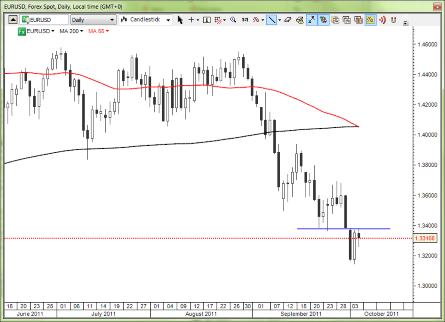
EURUSD reached its first major resistance area just below 1.3400 as we await tomorrow’s ECB outcome. (more on that below.) Above that, and we have 1.35 to contend with as the next resistance area of note.
Looking ahead – ECB pre-preview
Remember that tomorrow is Trichet’s last press conference at regular ECB meetings as Draghi is scheduled to take over at the end of this month. While many are predicting a rate cut from the ECB, it is hard to believe that Mr. Vigilance Trichet would want to leave the bank with a rate cut after having hiked as recently as July of this year. Leave it for the following meeting… More important will be further signals on the ECB’s plans to relieve the pressure on European bank funding as the general expectation is that Mr. Trichet will announce the reintroduction of unlimited 12-month funding but perhaps most importantly, will the ECB announce a new covered bond purchase program? Odds are perhaps even on the latter. And if it does launch such a program, will the move be seen as Euro positive because of the immediate relief. After all, is not a bond purchase program (despite vague possible claims that any purchases would somehow be sterilized) the same as the BoE expanding its asset purchase target. Very intriguing to see how the market will judge the ECB’s actions in addition to what the ECB does. Eventually, the only thing that keeps the banks liquid is effectively QE.

Economic Data Highlights
  • Germany Sep. Final PMI Services survey lowered to 49.7 vs. original 50.3 estimate
  • Euro Zone Sep. Final PMI Services survey lowered to 48.8 vs. original 49.2 estimate
  • UK Sep. PMI Services survey out at 52.9 vs. 50.5 expected and 51.1 in Aug.
  • UK Q2 GDP revised down to 0.1% QoQ and +0.6% YoY vs. +0.2%/+0.7% original estimates, respectively
  • UK Q2 Private Consumption dropped -0.8% QoQ vs. -0.3% expected
  • UK Q2 Government Spending rose +1.1% QoQ vs. -0.1% expected
  • US Sep. Challenger Job Cuts out at +211.5% YoY vs. +47.0% in Aug.
  • US Sep. ADP Employment Change out at +91k vs. +75k expected and +89k in Aug.

Upcoming Economic Calendar Highlights (all times GMT)
  • US Sep. ISM Non-manufacturing (1400)
  • US Weekly DoE Crude Oil and Product Inventories (1430)

Weekly Review and Outlook Risk Recovery Short Lived, Dollar to Extend Rally in a Busy Week ahead

Risk markets attempted a recovery last week on some positive news as Germany and Finland approved expansion of the EFSF while Troika returned to Greece finally. However, strength of the recovery was far from impressive and lost momentum towards the end of the week. While major US and European stock indices managed to hold well above recent low, the CRB commodity index made a new low on Friday and closed below 300 level for first in almost a year. Dollar index's retreat was rather shallow and was contained at 77.30 while Friday's rally put the index back pressing recent high of 78.86. This could also be reflected in major dollar pairs which lost momentum. Commodity currencies also turned weak with Canadian dollar and New Zealand dollar making new record low against US dollar.
Markets are facing a number of even risks this week and it's great opportunity for traders to watch the reactions, and thus, get a sense on the underlying sentiments. China manufacturing PMI was released on Saturday and has surprisingly rose to 51.2 in September. More importantly, this marked the second consecutive months of increase, though little. There have been much worries on hard landing in China. While PMI only showed little improvements in the outlook, at least, it's not deteriorating and indicates that economic development is stabilizing.

EU finance ministers are not likely to approve the disbursements of next EUR 8b tranche of Greece bailout this week. However troika, the EU/IMF/ECB inspection team will complete an evaluation as early as on Monday and thus give the signal on whether Greece has done their austerity jobs satisfactorily. Also, as the Bundestag has now passed the bill for expanding the EFSF, there would possibly be some news on how the fund would be enlarged to a size that's capable to contain Italy and Spain eventually.

While the surprised surge in inflation dented hope for a rate cut from ECB, the bank would nonetheless announce new stimulus measures in Trichet's last meeting as President this week. The unconventional measures to be adopted would include resumption of the one-year refinancing operations and restart of covered-bonds purchase. These should be positive to the markets.

While these events might trigger some recovery in risk markets, we'd anticipate that the impact would be short-lived. We're staying bearish in risks and bullish in dollar. The technical developments suggest that dollar is ready for another round of rally this week while stocks would likely revisit recent lows. Market sentiment would once again be proved to remain bearish if the above mentioned events fail to provided sustainable boost to risk markets. And, extension in decline in the CRB, if accompanied by a break of 10600 level in dow, and a sustained break of 79 in dollar index, should confirm the trend of risk selling in the first half of Q4.

The week ahead
In addition to the above events, Fed will also start the operation twist program on October. Fed will purchase a total of $44b of longer-mautrity treasuries and sell that same amount of short term debts. Four central banks will meet including RBA, ECB, BoE and BoJ. In addition, there will be key economic data release including Japanese Tankan, UK PMIs, US ISM indices and Non-farm payroll, Canadian job report. So, be prepared for a busy and volatile week.
  • Monday: Japanese quarterly Tankan; Swiss retail sales, SVME PMI; Eurozone PMI manufacturing final; UK PMI manufacturing; US ISM manufacturing
  • Tuesday: Australian building approvals, trade balance, RBA rate decision; UK construction PMI; Bernanke speech, US factory orders
  • Wednesday: Australian retail sales; Eurozone PMI services final, retail sales; UK services PMI, GDP final; US ADP job, ISM services
  • Thursday: BoE rate decision; ECB rate decisions; Canada building permits, Ivey PMI; US jobless claims
  • Friday: BoJ rate decision; Swiss unemployment; UK PPI; Canada employment; US non-farm payrolls
Technical Highlights
Dollar index's strong rally on Friday suggests that recent rise from 72.69 is ready to resume. Initial focus is on 78.86 resistance today and break there will confirm this bullish case and should send the index through 80 psychological level to 50% retracement of 88.70 to 72.69 at 80.69 next. Break of last week's low of 77.30 will delay this case and bring more consolidations but we'll stay bullish as long as 76.06 support holds. 
The CRB commodity index extended recent down trend to close at 298.15. Near term outlook will remain bearish as long as last week's high of 312.26 holds and further fall should be seen to 50% retracement of 200.15 to 370.70 at 285.43. The main focus would indeed be on whether the current decline would accelerate again. That's crucial in determining whether CRB could draw support inside 247.25/293.75 zone and rebound. 
S&P 500 stayed in recently established range last week but felt strong pressure well ahead of 55 weeks EMA at 1230.3. While the 38.2% retracement support at 1101.7 might provide some more support in near term, it shouldn't last long. Friday's fall puts initial focus this week on 1101.54 recent low. Break there will resume whole decline from 1370.58 and should send the index through 1010.91 support within October. In any case, we'll stay bearish as long as 1258 head and shoulder resistance holds. 

EUR/USD Weekly Outlook

EUR/USD turned into brief recovery last week but such recovery was likely finished at 1.3689 already. Initial bias is mildly on the downside this week for 1.3362 first. Break will confirm resumption of recent decline and should target 161.8% projection of 1.4939 to 1.3969 from 1.4548 at 1.2979, which is close to 1.3 psychological level. On the upside, above 1.3689 will delay the bearish case and bring more consolidations. But recovery is, nonetheless, expected to be limited below 1.3936 resistance and bring another fall eventually.
In the bigger picture, current development indicates that medium term rise from 1.1875 has completed with three waves up to 1.4939 already. That also suggests that it's merely part of the consolidation pattern that started back in 2008 at 1.6039. Further decline would now be seen to 1.2873 support first and break will target 1.1875 and below. On the upside, above 1.4548, resistance is needed to confirm completion of the fall from 1.4939 or we'll stay bearish in EUR/USD.
In the long term picture, EUR/USD turned into a long term consolidation pattern since reaching 1.6039 in 2008. Such consolidation is still in progress and we'd expect range trading to continue for some time between 1.1639 and 1.6039.

EUR/JPY Weekly Outlook

EUR/JPY formed a temporary bottom at 101.93 last week and recovered to 104.95. Such recovery is treated as consolidation in recent decline only. Hence, while another rise cannot be ruled out yet, even in that case, we'd expect upside to be limited by 106.98 resistance (50% retracement of 111.93 to 10.93 at 106.93) and bring fall resumption. Below 103.00 minor support will flip bias back to the downside. Further break of 101.93 should target 100 psychological level next.
In the bigger picture, whole down trend from 2008 high of 169.96 is still in progress and is building up downside momentum again. Sustained trading below 100 psychological level should pave the way to 100% projection of 139.21 to 105.42 from 123.31 at 89.52, which is close to 88.96 all time low. On the upside, break of 111.93 resistance is needed to be the first signal of medium term reversal. Otherwise, we'll stay bearish.
In the long term picture, up trend from 88.96 (00 low) has completed at 169.96 and made a long term top there. Based on the five wave structure of the rise from 88.96 to 169.96, we're favoring that fall from 169.96 is corrective in nature. Hence, look for reversal signal ahead of 88.96 low.

USD/CHF Weekly Outlook

USD/CHF's consolidation form 0.9182 continued last week but drew some support from 4 hours 55 EMA and recovered. The development suggests that retreat from 0.9182 might be cover already and initial bias is back on the upside this week. Break of 0.9182 will confirm resumption of the whole rise from 0.7065 and should target 161.8% projection of 0.7065 to 0.8246 from 0.7710 at 0.9621 next. On the downside, below 0.8917 minor support will delay the bullish case and bring more consolidations first. But we'll stay bullish as long as 0.8647 support holds and extend another rise eventually.
In the bigger picture, medium term down trend from 1.1730 is already completed at 1.7065. But there is no indication of long term reversal yet. Rebound from 0.7065 is treated as part of a medium term consolidation pattern. Such rebound would possibly extend to 0.9916/1.1730 resistance zone. But strong resistance should be seen there and bring reversal. On the downside, break of 0.7710 is needed to indicate completion of the rebound from 0.7065. Otherwise, we'll stay near term bullish in the pair for the moment.
In the longer term picture, long term down trend from 2000 high of 1.8305 is still in progress and there is no indication of a reversal yet. Such down trend would still extend to 100% projection of 1.8305 to 1.1288 from 1.3283 at 0.6266 after finishing the consolidation from 0.7065.

GBP/USD Weekly Outlook

GBP/USD's recovery from 1.5327 extended to 1.5715 last week and lost momentum since then. Such recovery might be finished already and initial bias is cautiously on the downside this week for retesting 1.5327 first. Break will confirm resumption of recent fall from 1.6746 and should target 161.8% projection of 1.6746 to 1.5780 from 1.6618 at 1.5055 next. On the upside, above 1.5715 will delay the bearish case and bring another recovery. But upside should be limited by 38.2% retracement of 1.6618 to 1.5327 at 1.5820 and bring fall resumption eventually.
In the bigger picture, rise from 1.4229, which is treated as the third leg of consolidation from 1.3503 (2008 low) should be finished at 1.6746 after GBP/USD completed a head and shoulder top reversal pattern (ls: 1.6298, h: 1.6746, rs: 1.6618). Fall from 1.6746 could be the fourth leg of the consolidation pattern from 1.3503 (2008 low) or resuming long term down trend from 2.1161 (2007 high). In either case, retest of 1.4229 resistance should be seen. Break of 1.4229 will bolster the down trend resumption case and would possibly push GBP/USD through 1.3503 low. On the upside, break of 1.6618 resistance is needed to invalidate this view. Or we'll now stay cautiously bearish in GBP/USD.
In the longer term picture, the corrective nature of the multi-decade advance from 1.0463 (85 low) to 2.1161 as well as the impulsive nature of the fall from there suggests that GBP/USD is now in an early stage of a long term down trend. Another low below 1.3503 is anticipated after consolidation from 1.3503 is confirmed to be completed.

USD/JPY Weekly Outlook

USD/JPY sideway trading from 75.94 continued last week and outlook remains unchanged. Stronger recovery might be seen initially this week but upside is expected to be limited by near term falling trend line (now at 77.71) and bring fall resumption eventually. Below 76.11 will turn bias back to the downside and break of 75.94 low will confirm resumption of whole fall from 85.51 and would target 70 psychological level.
In the bigger picture, USD/JPY is still staying well inside the falling channel that started back in 2007 at 124.13. There is no indication of trend reversal yet even though medium term downside momentum is diminishing with bullish convergence condition in weekly MACD. Such down trend is still in favor to continue to 70 psychological level. In any case, break of 80.23 resistance is first needed to indicate completion of fall from 85.51. Secondly, break of 85.51 is needed to be the first signal of medium term reversal. Otherwise, we'll stay cautiously bearish in the pair.
In the long term picture, current decline suggests that the long term down trend in USD/JPY is still in progress. Such down trend is expected to extend further into uncharted territory with 70 psychological level as next target. In any case, we'd at least need to see sustained break of 85.51 before considering trend reversal.

EUR/CHF Weekly Outlook

EUR/CHF struggled around 1.22 level for most of last week but finally gave up and dipped to close at 1.2155. More sideway trading would be seen in near term with bias mildly on the downside to send the cross back below 1.21 level. Nevertheless, note that SNB has made it clear about their intention to keep a floor at 1.2 and any decline attempt should be contained by this level. On the upside, even in case of another rise, strong resistance should be seen in 1.2399/3243 resistance zone to limit upside unless there is a drastic turn in risk sentiments.
In the long term picture, so now after SNB intervention, the long term down trend in EUR/CHF is put into a halt at 1.0061. But there is no scope of a trend reversal yet before a break of 1.3243 resistance. EUR/CHF should stay in range for sometime.

USD/CAD Weekly Outlook

After brief retreat, USD/CAD rally resumed last week and jumped to as high as 1.0502 so far. Initial bias remains on the upside this week and further rise should be seen to 161.8% projection of 0.9406 to 1.0009 from 0.9725 at 1.0701 next. On the downside, below 1.0372 minor support will turn bias neutral and bring consolidations. But retreat should be contained above 1.0142 support and bring rally resumption.
In the bigger picture, sustained trading above 55 weeks EMA affirms the case that whole down trend from 2009 high of 1.3063 has finished at 0.9406 on bullish convergence condition in weekly. Current rally from 0.9406 should now target 1.0851 resistance (38.2% retracement of 1.3063 to 0.9406 at 1.0803). Break there will extend the rebound to 61.8% retracement 1.1666 and above. On the downside, break of 1.0009 support is needed indicate completion of the rally from 0.9406. Otherwise, we'll stay bullish in USD/CAD.
In the longer term picture, there is no clear indication that the long term down trend from 2002 high of 1.6196 has reversed even though bullish convergence condition was seen in monthly MACD. The fall from 1.3063 to 0.9406 looks corrective and could either be part of a sideway pattern from 0.9056, or a corrective to rise from there. The long term outlook, i.e., the possibility of taking out 1.3063 high, will depend on whether rise from 0.9406 would eventually develop into a strong impulsive wave. We'll wait and see.

EUR/GBP Weekly Outlook

After brief consolidations, EUR/GBP dived to as low as 0.8578 towards the end of the week. The development affirmed the case that rebound from 0.8529 is already finished at 0.8795 after failing to sustain above 55 days EMA. Fall fro 0.9083 should be ready to resume. Initial bias remains on the downside this week for 0.8529 first. Break will target 100% projection of 0.8884 to 0.8529 from 0.8795 at 0.8440 next. On the upside, above 0.8651 minor resistance will delay the bearish case and turn bias neutral for more consolidations first.
In the bigger picture, price actions from 0.9799 (2008) should be unfolding as a consolidation pattern in the long term up trend. The first leg is completed with three waves down to 0.8067. Second leg should also be finished at 0.9083. Fall from 0.9083 is treated as the third leg and should now target 0.8067 first and possibly further to 61.8% projection of 0.9799 to 0.8067 from 0.9083 at 0.8013 (which is closes to 0.8 psychological level). Nevertheless, we'd expect strong support from 0.7693/8186 support zone to contain downside to finish off the consolidation. On the upside, break of 0.8884 resistance is needed to invalidate this view or we'll stay bearish now.
In the long term picture, long term up trend from 2000 low of 0.5680 shouldn't be over yet and the choppy fall from 2008 high of 0.9799 should be a correction only. We'd expect such correction to be contained by 0.7963/0.8186 support zone and bring up trend resumption. Rise from 0.5680 is still expected to extend beyond 0.9799 high eventually.


Week, Month and Quarter End Flows Affect Markets

Germany successfully ratified the European Financial Stability Facility expansion yesterday with a very clear coalition majority for Merkel which gave the EUR and risk assets a brief bid initially.  Following on from the German parliamentary ratification of the expanded EFSF (as agreed on the 21 July across the Eurozone) the spread between 10yr Greek Bonds and German Bunds has come in from recent highs and the 2-year note yield found a bid in the improved sentiment, driving the yield as much as 500bps lower.

US Data Highlights
In addition to the relief of the German EFSF ratification the highlights of US data were a slightly better than expected Q2 GDP, which was revised slightly higher at the third time of calculating and a substantial improvement in the weekly jobless claims data (though there may be some seasonal anomalies that are likely see the improvement revised away - at least partially) gave risk assets and equities a boost and sentiment was generally improved.

That however appeared to be the top of the risk rally and the squeeze in positioning in short EUR positions that we were looking for at the start of this week that was supported by a sharp sell off in Euribor futures (or a rally in short end Eurozone rates). The revelation that Italy’s deficit rose to 3.2 percent of GDP in Q2 (up from 2.5 percent in Q2’10) just as Italy paid a high of 5.86 percent in its first long dated bond auction since its recent downgrade also helped take the shine off the EUR as the European Central Bank bond buying support seems to have waned or is having a smaller impact on lowering the yield on its debt.

Whilst for the most part of the week the headlines expounding concerns about and the flaws of the European Monetary (but not fiscal) Union have continued, their impact has been minimal.  Overnight S&P action to downgrade New Zealand’s Sovereign rating along with a more fragile start to the day for risk assets will likely bring Eurozone woes back to the fore today and I would expect to see the EUR underperform.

SNB action supports GBP
The announcement yesterday that the Swiss National Bank (SNB) “will likely raise the share of (their reserve) portfolio in GBP” should help GBP to outperform into the USD rally and EURGBP will start to look weak below the important 0.8660 level.  Whilst I have been emphasising the virtues of GBP for a while now I will stop short of suggesting that I was expecting the SNB action but I do strongly believe that GBP will continue to benefit on diversification and safe haven reserve allocation flows going forward. While Greece continues to remain the core focus of concern, the UK exposure to the troubled periphery nation, which is smaller than you might imagine should also be of some relief and despite the fact that everything is far from rosy in the UK economy (though UK consumer confidence rose for the first time in four months) at the moment I continue to be a GBP bull.

Today in the US sees month end index extensions, quarter end, and the twist to ‘operation twist’ as the long-end assets for purchase are announced by the Fed. The US curve is already markedly flatter with 10s 30s at a mere 105bps and I would expect this to remain a broad positive for risk assets and the US.

Data wise again there are no first tier releases today but confidence and activity data out of the US will be closely watched for sentiment into the close of the week month (and quarter).  On the day volatility is likely to pick up around the fixing times as rebalancing flows are potentially greater than usual following some relatively big moves this month, particularly in Emerging Markets and high yielders.

EURUSD in Temporary Limbo

Too early to tell whether that was it for the bear squeeze, but EURUSD failed to hold a minor new high today in the wake of the Barroso speech. 1.3550 is a tactical focus if the bears want to tactically regain the upper hand.

Odds and ends
Some ugly confidence numbers out of Sweden. While the manufacturing confidence was steady (though still at a negative level), consumer confidence plummeted and the economic tendency survey was also very weak, with both of the latter two at their worst levels since 2009. The Swedish krona is back in the range against the Euro after the recent risk meltdown saw It make and attempt at new 10-month high before the sell-off eased.

US durable goods orders data out of the US were subdued. There have been very few swings in the ex Transportation data series for several months now, an usual state of affairs for this normally volatile data series. On the bright side, the core “Capital goods non-defense ex Aircraft” measure saw a strong rebound, even from heavily upward revised July data. The question going forward is the degree to which durable goods orders will slow after the end of the year due to the hefty writedown incentives provided by the Obama administration that expire at the end of this year.

Dovish utterances from the BoE’s Miles today in an interview with The Times newspaper as he indicated he was leaning more toward voting in favor of more asset purchases today, though his mind was still “finely balanced”. This and Barroso’s speech to help drive EURGBP higher, but the pair then moved back just below the 200-day moving average (around 0.8710) again by the time of this writing. 0.8650 looks like an important level if the pair heads lower.

Chart: EURGBP
Interesting to see EURGBP so rangebound when we have such important outstanding questions about the Euro. But both currencies are quite weak as the BoE is clearly leaning toward more quantitative easing. The pair are in the vice grip of a range at the moment, with 0.8650 the first interesting are of support to the downside, followed by the recent 0.8530 area low.
Looking ahead
The Euro rally on the “strength” of EU commission president Barroso has so proved choppy, as we suggested this morning it might not last long, though it is too early to tell as of this writing, as 1.3595 minor support and bigger support down at 1.3550 are still in place after we surprisingly rallied all the way to new local highs earlier in the day.  The risk appetite side of the equation is an important one from hour to hour as well. Regarding Barroso’s speech: again, the assumption is that it will be very difficult to get Germany on board Barroso’s “stability bond” train and that yet another chapter of the extend-and-pretend saga is a more likely route to be taken. On that note, the SPV solution appears more likely, the question being whether the EU’s shenanigans have become so desperate that the market refuses to play ball without a better quality solution. 

As for the financial transaction tax – Britain will never go for it and large European banks would look to start pulling up as many stakes as they can in order to take their operations abroad before the eventual implementation date, assuming legislation is ever passed. There’s something not right about Barroso upbraiding the banks for bad behavior when a significant reason EU banks are in trouble is due to their massive sovereign debt holdings – which under strain because of poor political leadership.

Watch out for the SNB’s Jordan set to speak in basel at 1615 GMT today – this could get CHF crosses to sit up and pay attention. Less importantly, watch out for Bernanke out enlightening a Cleveland, Ohio audience on “Lessons from emerging market economies on the sources of sustained growth”. Hmmm.

Economic Data Highlights
  • Australia Aug. New Home Sales rose +1.1% MoM vs. -8.0% in Jul.
  • Germany Aug. Import Price Index fell -0.7% MoM and rose +6.6% YoY vs. -0.3%/+6.7% expected, respectively and vs. +7.5% YoY in Jul.
  • Sweden Sep. Consumer Confidence out at -5.8 vs. +1.2 expected and +4.3 in Aug.
  • Sweden Sep. Manufacturing Confidence out at -3 vs. -6 expected and -3 in Aug.
  • Sweden Sep. Economic Tendency Survey out at 96.9 vs. 97.3 expected and 100.3 in Aug.
  • Germany Sep. CPI out at +0.1% MoM and +2.6% YoY vs. -0.1%/+2.4% expected, respectively and vs. +2.4% YoY in Aug.
  • US Aug. Durable Goods Orders out at -0.1% MoM and ex Transportation out at -0.1% MoM, vs. -0.2%/-0.2% expected respectively.
  • US Aug. Capital Goods Orders – non defense and ex Airplanes out at +1.1% MoM vs. +0.4% expected
  • Canada Jul. Teranet/National Bank Home Price Index rose +1.3% MoM and +5.3% YoY vs. +1.7%/+4.5% in Jun., respectively
Upcoming Economic Calendar Highlights (all times GMT)
  • US Weekly DoE Crude Oil and Product Inventories (1430)
  • Switzerland SNB’s Jordan to Speak (1615)
  • US Fed’s Bernanke to Speak (2100)
  • Japan Aug. Retail Trade (2350)

Modest Excitement Over Barroso Speech to Quickly Fade?

A modest rally in Euro crosses this morning in the wake of a speech by EU Commission president Barroso, who proposed Euro Bonds and a Financial Transaction tax. Anything in this for the Euro?

In a State of the Union speech this morning before the EU parliament, Mr. Barroso proposed the introduction of EuroBonds or Euro “stability bonds” (with specifics to arrive in “coming weeks”) and a Financial Transaction Tax (FTT rumored to be 0.01% per transaction on equities, bonds and derivatives. Status on currency transactions unknown). On the subject of the FTT, the recent round of debate on this matter from some 10 days ago saw Italy, Britain and Sweden against the measure, while France, Spain, Denmark, Belgium and Germany  are considered in favor. The tax, if it is passed one day, may not be implemented until 2014, so one wonders at the immediate impact, even if the whole idea is a rather significant one. On the subject of Euro Bonds or stability bonds, can Germany ever pass such a thing? Seems doubtful and the more likely route may be the “Enronized” EFSF proposals that have come to the fore of late.

While the Euro rallied a bit during Mr. Barroso’s speech, we make a brief reality check by looking at the forwards, interest rate spread changes and basis swaps, all which suggest nothing has materially changed from this speech, and thus suggesting that the range will hold here all other things being equal. So from here, the EURUSD will likely go back to following the influence on risk appetite/positioning/end of month/quarter developments. On that note, Zero Hedge reminded us in its dramatic way this morning that many funds out there are hurting (and Goldman Sachs announced the closing of its Global Alpha fund – a key industry indicator if there ever was one).

Chart: EURUSD
EURUSD rallied closed back to yesterday’s highs, but various indicators point to little reason for today’s rally and suggest that the pair is getting expensive at current levels given the backdrop. Of course, any extension of yesterday’s equity rally could put the greenback under pressure. To the downside, the 1.3550 area has taken on considerable significance over the last few days and might act as a support/pivot zone.

GBP and NOK in Focus Ahead of FOMC

Today’s obvious focus is the US FOMC meeting much later today, but in the meantime, we’ve got a couple of important event risks for GBP and NOK in the form of BoE minutes and the Norges Bank rate decision.

Hard to believe that it isn’t topping all of the new services today, but we’ve got a massive news item out of the US the bears directly on today’s FOMC meeting and all future Fed activities: here we’re talking about the news that Boehner and the House Republican leadership have penned a missive to Fed Chairman Bernanke that asks the Fed to “refrain from further stimulus” as
this Bloomberg article puts it, in order to avoid “further harm” to the economy. This is a tremendous development – a drawing of a line in the sand. How will the Fed respond, not so much today, but in the weeks and months to come?

BoE Minutes

The BoE minutes are squarely in focus for the UK today (to be published at 0830 GMT), as continued relatively weak data combined with still uncomfortably high inflation levels paint an ugly picture for sterling, which has fallen precipitously versus the greenback and the yen of late on the expectation that the next round of QE is nigh. Looking at the status in the charts, one wonders how much more the market is willing to punish the currency even assuming the BoE September meeting minutes show the MPC gearing up for another round of asset purchases. Certainly from a rate differential perspective, the GBPUSD move appears overdone, though that pair may move more on tonight’s FOMC meeting than . EURGBP may be a better indicator on the market’s sentiment toward sterling.

Norges Bank

As we have previously discussed, the Scandies received some degree of interest as safe haven currencies in the wake of the SNB’s declared war on the strengthening franc earlier this month, but EURNOK quickly righted itself after a brief swoon. Norges Bank will be out declaring its interest rate policy today at 1200 GMT. The increasing dovishness of the central bank has seen the forward expectations fall from +60 bps in July to about -60 bps at present. EURNOK is not priced fairly according to that movement, obviously as the market is also pricing Euro according to the latest sovereign debt woes. But further reminders from the Norges Bank that it doesn’t like NOK appreciating too much or that its stance is relatively dovish could see the NOK  lose some more of its shine. Our position is that viewing the NOK as a safe haven currency is a difficult proposition – the attraction of the impeccable sovereign balance sheet is undeniable, but the currency has a more compelling history as a petro-currency and its relatively thin liquidity more or less disqualifies it for true safe haven status.

It will be interesting to see how the Norges Bank discusses the housing bubble, which is the only factor that has kept rates as high as they are. The job of suppressing further bubble risks, however, may fall more toward the Financial Supervisory Authority with possible new tougher rules, rather than to the Norges Bank.


Chart: EURNOK

EURNOK rebounded from new multi-year lows recently, as the market shied back from the break lower, a reversal that has somewhat neutralized the downtrend. Does today’s Norges Bank finally see the pair pull back higher through the 200-day moving average? (black line)
Chart: EURNOK vs. interest rate spreads
The NOK has already been outperforming the indications from interest rate spreads due to the Euro’s unique sovereign debt situation, but the premium for NOK has been particularly large of late as rate expectations for the Norges Bank have crumbled.

Risk Aversion Continues on Greek Default Worry, Troika Conference Call Watched

Selloff in risk asset continues in early US session as concern on Greek default remains the focus of the markets. DOW opens sharply lower and is down over -200pts at the time of writing while major European indices are deep in red, with FTSE down -2.4%, DAX down -3.6% and CAC down -2.9%. US 10 year yield dives below 2% again. Dollar benefits from risk aversion with dollar index jumping sharply to 77.51 so far and is set to take on recent high of 77.78.

Main focus will now turn to the result of a conference call between troika and Greek officials last today to review Greece's progress in meeting the requirements for the next tranche of bailout fund of EUR 8b and the second bailout that worth EUR 109b. IMF and EU experts paused their review on Greece's progress earlier this month after discovering an unexpected hold in the budget. If Greece could not commit to speed up the deficit reduction measures, it might be left with not change but a default as the government wouldn't have enough cash to make it past mid-October. And markets are deeply concerned with the possibility of a disorderly default of Greece.

US President Obama will announce a $1.5T tax proposal today including around $800b realized over 10 years from repealing Bush-era tax cuts for couples making more than $250k. In addition, there will be $580b in cuts in mandatory benefits program including Medicare, Medicaid and farm subsidies. Also, there will be $430b in savings from lower interest payments on national debt. And, there will be around $1T savings from the withdrawal of troops from Iraq and Afghanistan.

On the data front, US NAHB home builder sentiment index dipped to 1 point to 14 from 15 in September, below expectation of 15. The gauge of sales expectations in the next six months slipped to 17 from 19. UK rightmove house prices rose 0.7% mom in September. New Zealand consumer confidence was unchanged 112 in Q3.

Dollar index's sharp rise today suggests that retreat from 77.784 is already finished at 76.06 and recent rise from 73.42 is resuming. Bias is back on the upside and break of 77.784 will confirm this bullish case and should send the index towards 38.2% retracement of 88.70 to 72.69 at 78.80. As mentioned before, the whole fall from 88.70 might have completed at 72.69 already and a break above mentioned 78.78 fibo level will pave the way for a test on 80 psychological level a weeks ahead.

EUR/GBP Daily Outlook

Daily Pivots: (S1) 0.8702; (P) 0.8745; (R1) 0.8779; 

The break of 0.8686 minor support suggests that EUR/GBP's recovery from 0.8529 is already completed at 0.8790. While such rebound was a bit stronger than expected, there is no change in the bearish outlook with 0.8884 resistance intact. Intraday bias is flipped back to the downside for retesting 0.8529 first. Break will resume the whole decline from 0.9083. On the upside, above 0.8790 will flip bias back to the upside and turn focus to 0.8884 again.
In the bigger picture, price actions from 0.9799 (2008) should be unfolding as a consolidation pattern in the long term up trend. The first leg is completed with three waves down to 0.8067. Second leg should also be finished at 0.9083. Fall from 0.9083 is treated as the third leg and should now target 0.8067 first and possibly further to 61.8% projection of 0.9799 to 0.8067 from 0.9083 at 0.8013 (which is closes to 0.8 psychological level). Nevertheless, we'd expect strong support from 0.7693/8186 support zone to contain downside to finish off the consolidation. On the upside, break of 0.8884 resistance is needed to invalidate this view or we'll stay bearish now.

Weekly Review and Outlook Euro Tumbled as Support Removed after ECB's Turn, More Downside ahead

Euro tumbled sharply last week as was the weakest major currency just next to the SNB intervened Swiss Franc. While sovereign debt crisis had been dragging along for some time, Euro have been receiving strong support from ECB's hike this year and expectation of of further tightening. Hence, EUR/USD stayed above 1.4 for most of the year and on every occasion of selloff due to negative news about Greece, Portugal or even Italy, the dips were relatively brief. However, ECB's turn into neutral stance last week sort of removed such strong support for the Euro. And this time, EUR/USD took out 1.4 psychological level with relative ease. Similar situation was found in in EUR/GBP, which stayed above 0.86 for most of the year but finally gave up last Friday.

ECB Trichet sounded quite dovish on the Eurozone economy in the post meeting pressing conference. The central bank revised lower growth forecasts and did not signal upside risks to inflation. The tone appeared that the central bank is ready for a rate cut should the economy deteriorate further. 
Executive Board member Jurgen Stark's resignation on Friday also surprised the markets. Stark was know to be in strong opposition to purchases of peripheral bonds. And Stark's resignation prompted some speculations to the markets that it's now easy for ECB to extend the quantitative easing program and even cut rates.

The Eurozone debt crisis would not go away easily. There were talk on Friday about a Greek default. Greece CDS hit all time high of 3238 basis points last week on concern that Greece cannot meet the terms for bailout. The CDS is implying over 90% chance of default indeed. And, further then that, there are also worries on that a Greek default will lead to default in Italy, Spain and elsewhere. Greece rejected talk of a default as "organized speculation," according to an e-mailed statement from the finance ministry. Nonetheless, Germany is believed to be preparing plans to shore up German banks in the worst case.

After release of lower than expected CPI data, SNB announced it's setting a floor of 1.2 in EUR/CHF, with immediate effect. The bank pledged to "enforce this minimum rate with the utmost determination and is prepared to buy foreign currency in unlimited quantities. In addition, the bank warned that EUR/CHF at 1.2 is still high for the economy and is deflation risks requires, the SNB will take "further measures". EUR/CHF jumped from around 1.1 to as high as 1.2190 after the announcement and was trapped between 1.20 and 1.22 since then. Recently, the Swiss Franc traded in diverged direction with Euro but the peg has now aligned the two currencies together.

Dollar was broadly higher last week on safe haven flow. Stocks stayed in range the week but are looking vulnerable to more another selloff soon. After the peg swiss franc's role as safe haven currency will recede. Yen did strengthened against most currencies except dollar but markets will be cautious on intervention threat from BoJ. Dollar, US Treasuries, UK Gilts and gold will be left as the choices in case of more risk aversion. US President Obama unveiled his USD 447b proposal to stimulate the US job markets last week but reactions was relatively mild. Fed Chairman Bernanke's speech was largely the same as the one at Jackson Hole. Fed is expected to announce new stimulus later this month but there is no hints on what will be offered. It's believed that the committe members are uncertain too and the two day FOMC meeting will involve some heated debate.

US President Obama unveiled his proposal to stimulate the US job markets last week. Obama's USD 447b job proposal mainly targets tax cut and investments. While more details will be released on September 19, the measures include a tax-cut for small businesses if they hire new workers or raise workers; a 4000 tax credit if a company hires anyone who has spent more than 6 months looking for a job and extra tax credits if they hire America's veterans; a 1-year payroll tax cut; extension of unemployment insurance and assistance on refinancing homeowners' mortgages. Obama called for an end to the 'political circus' which he believed is the main reason for S&P's downgrade.

Speaking to the Economic Club of Minnesota in Minneapolis, Fed Chairman Bernanke acknowledged that the pace of recovery has been 'much less robust' than previously anticipated' with 'the weakness of the housing sector' and 'continued financial volatility' being the two key factors resulting in the situation. Moreover, a 'substantial fiscal consolidation in the shorter term could add to the headwinds facing economic growth and hiring'. As far as inflation is concerned, the Chairman said the Fed saw 'little indication that the higher rate of inflation experienced so far this year has become ingrained in the economy'. Against this backdrop, the Fed is prepared to employ all necessary tools to 'promote a stronger economic recovery in the context of price stability'. The content of the speech was largely the same as the one at Jackson Hole.

Moderation of headline CPI to +6.2% y/y in August from +6.5% in the prior month signaled that inflation in China probably peaked in July. Yet, price levels remained elevated and it would be premature to expect China will abandon tightening or even shift to easing monetary policy. Growth of industrial production and fixed asset investment and retail sales decelerated further in August as a result of government's tightening measures. Yet, the rate of expansion remained resilient despite recent global economic turmoil. We expect to see further slowdown in economic activities in coming months but do not envisage any signs of hard landing.

Technical Highlights
The strong rally in dollar index and the break of 76.71 resistance in dollar index last week carries important technical implications. Also, note that dollar index closed above 55 weeks EMA. The overall development indicates that 72.69 is at least a medium term bottom. More importantly, the down trend from 88.7 might be finished with three wave down to 72.69 too. Outlook in the index is turned bullish now and further rise should be seen to 38.2% retracement of 88.70 to 72.69 at 78.80 in near term. Sustained break there will likely send the dollar index through 81.31 resistance in medium term to 61.8% retracement at 82.58 and above. In any case, we'll now stay cautiously bullish as long as 75.38 support holds. 
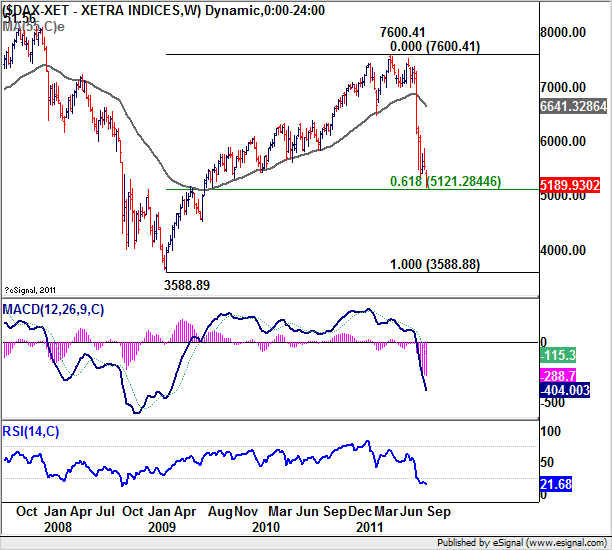
While major stock indices stayed in range last week, German DAX seemed to be leading the way again. Last week's dive to 5150 met some brief support above 61.8% retracement of 3589 to 7600 at 5121 and recovered. But there is clearly no strength in the recovery as the index weakened again on Friday to close at 5189. The index is vulnerable to more downside this week and we'd anticipate a test on 5000 psychological level ahead. 
DOW didn't break through 10604 support last week as we anticipated and turned sideway instead. Nevertheless, overall bearish outlook remains unchanged and it's just a matter of time when recent sharp decline from 12876 resumes. We'd expect more pressure on DOW this week and would favor more downside to retest 10604 this week. Decisive break there could bring accelerated selloff towards 50% retracement of 6469 to 12876 at 9672, which is close to 9614 medium term support. 
The Week Ahead
G7 issued a relatively brief statement over the weekend, noting "significant challenges to growth, fiscal deficits and sovereign debt" which is "reflected in heightened tensions in global financial markets." The group pledged to "strong and coordinated international response to these challenges." Initial focus this week will be on reaction to this rather dull statement. After that main focus will be on a number of UK data as well as US inflation data. Of course, developments in the Europe, in particular about Greece default, will be watched all the time.
  • Monday: BoJ Minutes, Japan tertiary industry index, Australia trade balance
  • Tuesday: UK RICS house price balance, CPI, trade balance, DCLG house price; US import prices, Fed budget
  • Wednesday: Swiss PPI; UK job report; Eurozone industrial production; US retail sales, PPI, business inventories; RBNZ rate decision
  • Thursday: SNB rate decision; UK retail sales; Eurozone CPI; US CPI, jobless claims, empire state manufacturing, Philly Fed survey, industrial production
  • Friday: Eurozone trade balance; US TIC capital flow, U of Michigan consumer sentiment

EUR/GBP Weekly Outlook

EUR/GBP drops sharply to as low as 0.8591 last week and the break of 0.8642 support confirms resumption of whole decline from 0.9083. Initial bias remains on the downside this week and deeper fall should be seen to 100% projection of 0.9083 to 0.8642 from 0.8884 at 0.8443 next. on the upside, above 0.8648 minor resistance will turn bias neutral and bring consolidations. But recovery should be limited by 0.8732 support turned resistance and bring fall resumption.

In the bigger picture, price actions from 0.9799 (2008) should be unfolding as a consolidation pattern in the long term up trend. The first leg is completed with three waves down to 0.8067. Second leg should also be finished at 0.9083. Fall fro 0.9083 is treated as the third leg and should now target 0.8067 first and possibly further to 61.8% projection of 0.9799 to 0.8067 from 0.9083 at 0.8013 (which is closes to 0.8 psychological level). Nevertheless, we'd expect strong support from 0.7693/8186 support zone to contain downside to finish off the consolidation. On the upside, break of 0.8884 resistance is needed to invalidate this view or we'll stay bearish now.

In the long term picture, long term up trend from 2000 low of 0.5680 shouldn't be over yet and the choppy fall from 2008 high of 0.9799 should be a correction only. We'd expect such correction to be contained by 0.7963/0.8186 support zone and bring up trend resumption. Rise from 0.5680 is still expected to extend beyond 0.9799 high eventually.

Ratings and Recommendations