Financial Advisor
Showing posts with label Economic Data Highlights. Show all posts

Daily Report: Dollar Weak as Risk Appetite Lifted by Solid Asian Data

Dollar remains broadly weak as the week starts as markets sentiments are boosted by solid Asian economic data. The preliminary HSBC China Manufacturing PMI rebounded from 49.9 to 51.1 in October, back in expansionary territory for the first time since July. HSBC noted that the data confirmed their view there is no risk of hard landing in China. Japan trade deficit narrowed to JPY -0.02T in September. Impressively, exports rose 2.4% yoy, marking the second month of growth following five month decline after the March natural disaster. Asian stock indices are broadly up today, partly following the QE3 triggered rally in US last week. Nikkei is up 1.9%, HSI up over 4%, Aussie All Ordinaries up 2.62%, crude oil is back above 88 level while dollar index is pressing 76.

After the EU summit on Sunday, no agreement was made on major issues including bank recapitalization, private sector involvements in Greece second bailout and the way to boost the EFSF. Though, one thing seemed to be sure is that using ECB to leverage the bailout fund is ruled out. The latest news flow said that policymakers are threatening to trigger a formal default on Greek debt unless banks accept losses of as much as 140B euro on their holdings or a haircut of around 50%. Both Reuters and Bloomberg also quoted the need of around 100B euro for bank recapitalization. The Reuters report also mentioned a haircut of 50% but emphasized that 'several major areas of disagreement remain', especially in the EFSF plan and 'it will require vast amounts of hard negotiation between Sunday and Wednesday to strike a deal that convinces financial markets and Europe's major trading partners that the crisis is in hand' while according to the Bloomberg report policymakers are heading toward using the EFSF to 'guarantee bond sales as a way to extend its reach. A second option is to set up an EFSF-insured fund that would seek outside investment in troubled bonds'. 

Data from Australia saw PPI rose less than expected by 0.6% qoq, 2.7% yoy in Q3. The year over year rate was much lower than Q2's 3.4%. The data is arguing inflationary pressures have eased further in Australia. RBA would be on hold for longer than expected and is raising the prospect of a rate cut if global economic conditions deteriorate further. Though, the CPI data to be released later this week will be more crucial in near term rate outlook.
Looking ahead, Eurozone PMI data will be the main focus. German PMI manufacturing is expected to drop slightly to 50 in October PMI services is expected to recovery to 49.8. Eurozone PMI manufacturing and services are expected to drop to 48.1 and 48.5 respectively. Eurozone industrial orders are expected to rise 0.1% mom in August.

EUR/AUD Daily Outlook

Daily Pivots: (S1) 1.3350; (P) 1.3424; (R1) 1.3463;

EUR/AUD's fall from 1.4086 resumed by taking out 1.3368 and reaches as low as 1.3327 so far today. Intraday bias is back on the downside and further decline should be seen to retest 1.3022 support next. On the upside, note that break of 1.3497 resistance, though, will indicate short term bottoming, possibly on bullish convergence condition in 4 hours MACD, and will bring stronger rebound.

In the bigger picture, price actions from 1.2926 are treated as a medium term consolidation pattern, which is still in progress. Such pattern might extend further in range of 1.2926 and 1.4341. Nevertheless, we'll stay bearish as long as 1.4341 resistance holds and favor an eventual downside breakout. Sustained trading below 1.2926 should pave the way to 1.2 psychological level next. 

Economic Indicators Update

MT Ccy Events Actual Consensus Previous Revised
23:50 JPY Trade Balance (JPY) Sep -0.02T -0.11T -0.29T -0.27T
0:30 AUD PPI Q/Q Q3 0.60% 0.80% 0.80%
0:30 AUD PPI Y/Y Q3 2.70% 2.90% 3.40%
4:00 CNY HSBC Flash China Manufacturing PMI Oct 51.1
49.9
7:30 EUR German PMI Manufacturing Oct A
50 50.3
7:30 EUR German PMI Services Oct A
49.8 49.7
8:00 EUR Eurozone PMI Manufacturing Oct A
48.1 48.5
8:00 EUR Eurozone PMI Services Oct A
48.5 48.8
9:00 EUR Eurozone Industrial New Orders M/M Aug
0.10% -2.10%

Market Salutes Mass Confusion with Further Risk Rally

The coming “solution” to the EU’s debt crisis is creating ever mounting piles of research outlining the if’s, and’s and but’s – so the market shrugs its shoulders and says “they’ll figure something out.”

The discussion surrounding the potential form of the EFSF has become an endlessly confusing cacophony for which readers can find far better sources than this column to review and understand all of the various nuances of the proposed solutions and the questions outstanding. The bulls have largely made their case on the potential outcome for what is now next Wednesday (Summit, part Two) with the extensive rally in the rear view mirror. The bears are licking their wounds and still running for cover. The essential bottom for the bigger picture here boils down to three interlocking questions, none of which are likely to be answered beyond the next couple of weeks to couple of months, in my view.

Confidence? All of the solutions rely on the market’s confidence and the hope that officialdom has gone far enough in back-stopping sovereign debt to a sufficient degree far more than the actual deployment of funds. The solution is more one of – if something goes wrong, we’ll be there – trust us! It works as long as market participants believe it will work, in other words. But if enough confidence is lost and the actual mechanisms are being tested, is there really enough firepower in place? Which leads us to the next question…

Where is the money? The issue of leverage has not been resolved. Yes, an all-out money printing fiesta from the ECB or something closer to what the French wanted could have generated a more QE2-like large scale liquidity-induced rally, but none of the currently more likely sounding resolutions generate huge liquidity – only implied liquidity via backstopping. This is a highly complex, have-our-cake-and-eat-it-too tight money solution to the situation.

A closer union or not?  The risk at all times given the incredibly cumbersome EU framework is one of one more bad actor spoiling the party – Greek exceptionalism in this department is an awfully risky assumption. Most are discussing Greek defaults only. Every round of this crisis has shown how tenuous the political EU framework remains, and the trend doesn’t appear to be toward a firmer commitment to union, but rather the opposite. The framework may survive this round, but what about the next one?

These are awfully big questions. Yes, we could see confidence for a time because yes, there may be enough funding for the center to hold – but the third question is the real challenger down the line. If the confidence fails because more money is needed or more money is needed because confidence fails, the political will for another round of bailouts is unlikely to be there as our Chief Economist said in yesterday’s Chronicle – maximum intervention will eventually yield to Crisis 2.0, whether it is in this quarter or not until next year.

Meanwhile, back in the East
Two things going on in Asia at the moment: China’s equity market is looking very shaky and satellite indicators like the price of copper are a significant cause for concern, particularly given copper’s odd use in China’s collateralized credit market in recent years. Meanwhile, AUDUSD is following equity markets and the Euro-phoria rather than its more traditional orientation with industrial commodities – an awkward path at best for the currency. The direction of AUDUSD and copper/China indicators is unlikely to diverge for much longer – one of the two markets is “wrong”.

Elsewhere, complacent USDJPY longs were attacked in the early US hours as the USD was crumbling across the board in today’s trade as risk appetite stormed higher and 76.0 was taken out as USDJPY briefly touched a new all-time low. There is risk of further downside if Japanese officialdom prefers to wait for the other side of the G20 to make its presence more forcefully felt. The move lower is actually at odds with the interest rate spreads at the short end of the US/Japanese yield curves, though there has been a general move away from these kinds of correlations holding much sway of late.

Looking ahead
So what are the potential outcomes once we are on the other side of next week’s EU summit and the G20 in early November? A further extension of the rally for the shorter term is quite possible if the EU solution continues to generate more complacency – so we have to allow for, for example, EURUSD to challenge anything from its 55-day MA above 1.3900 to its 200-day MA above 1.40. But that’s our line in the sand, as we discuss in the chart below.

EURGBP pulled a number on the market today – as EURGBP took out downside stops before rallying well back into the range, a move that makes sense as GBP and USD are in similar boats and their general direction versus the EUR is likely to remain loosely correlated at minimum.

Chart: EURUSD scenarios
Assuming that the EURUSD isn’t preparing for a full trend change to the upside, the scenario indicated on the chart below is a possible trajectory for the pair – a brief further extension of the rally as we head into/out of the EU Summit followed by a reversal and then disappointment further down the line. If the pair remain above 1.40 for any length of time, we’ll have to reconsider our assumptions.
Have a great weekend and stay careful out there.


Economic Data Highlights
  • Germany Oct. IFO out at 106.4 vs. 106.2 expected and 107.4 in Sep.
  • Canada Sep. CPI out at +0.2% MoM and +3.2% YoY vs. +0.2%/+3.1% expected, respectively and vs. +3.1% in Aug.
  • Canada Sep. CPI Core out at +0.5% MoM and +2.2% YoY vs. +0.2%/+2.0% expected, respectively and vs. +1.9% YoY in Aug.
Upcoming Economic Calendar Highlights (all times GMT)
  • US Fed’s Kocherlakota to Speak (1700)
  • US Fed’s Fisher to Speak (1720)
  • US Fed’s Yellen to Speak (1900)
  • US Fed’s Duke to Speak (Sat 1400)
  • Japan Sep. Merchandise Trade Balance (Sun 2350)
  • Australia Q3 Producer Price Index (0030)
  • China Oct. HSBC Flash Manufacturing PMI (0230)

Daily Report: Sentiments Reversed Again as Expectations for EU Summit Change

News from Eurozone continues to drive markets up and down. This time, sentiments were hurt by reports that France and Germany are clearly still having diverged stance on the role of ECB in solving the debt crisis. France is still pushing the proposal to have the EFSF turned into a bank licensed with ECB for leveraging the capacity. But Germany maintained its opposition to this idea. And European officials are playing down the expectation for this weekend's EU summit. German Chancellor Angela Merkel stated that 'it won't be the final point where we regain the confidence of others, but it will be a stepping stone, a marker on the road' and 'all of the sins of omission and commission of the past cannot be undone by waving a magic wand'. EC President Jose Barroso also said that 'even if we do arrive at a political decision on everything that's on the table, which I hope we will, that doesn't necessarily mean that there will not then have to be an implementing phase'.

The US monthly Beige Book covering the period on the before October 7 indicated that many districts described the pace of growth as 'modest' or 'slight' and there was higher uncertainty for business decision making, although economic activities continued to expand. Consumer spending improved 'slightly' in most districts as driven by auto sales and tourism. Business spending also increased due to the rise in expenditure in construction and mining equipment and auto dealer inventories. Yet, restraints in hiring and capital spending remained. While the October report may be slightly better than the previous one, economic outlook on the US remained uncertain and is highly determined by global factors. 

It's reported that Japan will set up a task force to tackle the problems caused by yen's persistent strength. The task force will involve vice cabinet ministers and a BoJ deputy governor. The fund shifted to state-run Japan Bank for International Cooperation to help exporters would be boosted by 25% from JPY 8T to JPY 10T. In addition, there was also call for BoJ to use "bold" monetary policy in close coordination with the government to manage the yen.

On the data front, UK retail sales will be a main feature in European session, together with Swiss ZEW expectations. From US, initial jobless claims are expected to remain elevated at 400k. Existing home sales is expected to drop to 4.90m in September, leading indicator rose 0.2%. Philly Fed survey is expected to improve to -9.5 in October.

EUR/JPY Daily Outlook

Daily Pivots: (S1) 105.15; (P) 105.84; (R1) 106.36; 

At this point, we're still favoring the case that EUR/JPY's rebound from 100.74 is finished at 107.67 already. Below 104.77 will extend the fall from 107.67 to retest 100.74 low first. On the upside, though, above 107.67 will invalidate this immediate bearish view and bring another rise. But upside should be limited by 38.2% retracement of 123.31 to 100.74 at 109.36 to finish off the rebound.

In the bigger picture, whole down trend from 2008 high of 169.96 is still in progress and is building up downside momentum again. Sustained trading below 100 psychological level should pave the way to 100% projection of 139.21 to 105.42 from 123.31 at 89.52, which is close to 88.96 all time low. On the upside, break of 111.93 resistance is needed to be the first signal of medium term reversal. Otherwise, we'll stay bearish. 

Economic Indicators Update

MT Ccy Events Actual Consensus Previous Revised
0:30 AUD NAB Business Confidence Q3 -4
6 5
6:00 EUR German PPI M/M Sep 0.30% 0.20% -0.30%
6:00 EUR German PPI Y/Y Sep
5.50% 5.50%
6:00 CHF Trade Balance (CHF) Sep
1.37B 0.81B
8:30 GBP Retail Sales M/M Sep
0.20% -0.10%
8:30 GBP Retail Sales Y/Y Sep
0.60% -0.10%
8:30 GBP Retail Sales w/Auto Fuel M/M Sep
0.00% -0.20%
8:30 GBP Retail Sales w/Auto Fuel Y/Y Sep
0.60% 0.00%
9:00 CHF ZEW Survey (Expectations) Oct

-75.7
12:30 USD Initial Jobless Claims
400K 404K
12:30 CAD Wholesale Sales M/M Aug
0.40% 0.80%
14:00 EUR Eurozone Consumer Confidence Oct A
-20.1 -19.1
14:00 USD Existing Home Sales Sep
4.90M 5.03M
14:00 USD Leading Indicators Sep
0.20% 0.30%
14:00 USD Philly Fed Survey Oct
-9.5 -17.5
14:30 USD Natural Gas Storage
111B 112B

Storming Aussie Employment Data, but China trade Data Halts AUD

Asia saw a busier day on the macroeconomic front Thursday, and though there were arguments for both risk-on and risk-off, currencies remained at the top of their ranges.

For the pro-risk brigade, Australia’s employment data was a stormer with 20.4k jobs added in September, more than the 10.0k expected and more than compensating for the revised 10.5k jobs lost in August and halting a 2-month declining streak. Jobs gains were spread almost evenly between full-time and part-time workers and an unchanged participation rate of 65.6% was enough to tilt the unemployment rate a tad lower to 5.2% from 5.3%. Seen as a solid number, the AUD rocketed higher across the board with AUDUSD reaching 3-week highs.

After we had settled at higher levels, the China trade data was released and slightly disappointed. The trade surplus shrunk for the second successive month, declining to +$14.51 bln from +$17.76 bln with a drop in exports seen as the main culprit. Exports grew “only” 17.1% y/y and, perhaps more disappointingly, growth in imports fell to +20.9% y/y after recording 30.2% y/y in August. This took some of the shine off the AUD’s gains and AUDUSD retreated sub-1.02 again.

During the session we had additional dovish comments from BOE’s Bean who felt the outlook for the UK economy had worsened in the past 3-4 months which, if prolonged, would need an additional round of QE. He was of the opinion that inflation will cool in 2012, just in time for the Olympics! His comments on the economy echoed those we heard from BOE’s Dale who expressed concern about UK growth prospects for the rest of the year. GBP traded sidelined for most of the Asian session though.

The broader risk-on trade had extended overnight to the detriment of the greenback with a number of events forcing the EUR squeeze higher. Slovakian leaders said a second EFSF vote was likely by week-end and expected to pass while the EU Commission offered a framework for a European bank recapitalization plan. Euro-zone data was also impressive with industrial production up 1.2% m/m, 5.3% y/y, well above forecasts and higher than the previous month. EURUSD squeezed up to 1.3830+, one-month highs, before finding some resistance.

Economic Data Highlights
  • CA Aug. New Housing Price Index out at +0.1% m/m, +2.3% y/y, both as expected and unchanged from prior
  • US Aug. JOLTs Job Openings out at 3,056 vs. revised 3,213 prior
  • NZ Sep. Business PMI out at 50.8 vs. revised 52.7 prior
  • JP Sep. Bank Lending out at -0.3%y/y vs. -0.5% expected and -0.5% prior
  • JP Aug. Tertiary Industry Index out at -0.2%m/m vs. -0.3% expected and revised -0.3% prior
  • AU Oct. Consumer Inflation Expectation out at 3.1% vs. 2.8% prior
  • AU Sep. Employment Change out at +20.4k vs. 10.0k expected and revised -10.5k prior
  • AU Sep. Unemployment Rate out at 5.2% vs. 5.3% expected and 5.3% prior
  • China Sep. Trade Balance out at +$14.51b vs. +$16.3b expected and +$17.76b prior
  • China Sep. Exports out at +17.1% y/y vs. +20.5% expected and +24.5% prior
  • China Sep. Imports out at +20.9% y/y vs. 24.2% expected and 30.2% prior
Upcoming Economic Calendar Highlights
(All Times GMT)
  • GE CPI (0600)
  • Swiss PPI (0715)
  • Sweden Unemployment rate (0800)
  • UK Trade Balance (0830)
  • CA Int’l Merchandise Trade (1230)
  • US Trade Balance (1230)
  • US Initial Jobless Claims (1230)
  • US Bloomberg Consumer Comfort (1345)
  • US Fed’s Kocherlakota to speak (1830)

The "End of America" is Beginning in California

One of the more controversial aspects of Porter's "End of America" thesis is his prediction that – as the financial crisis deepens – many government services people have come to rely on will stop. The government simply won't collect enough tax revenue to pay the pensions, benefits, and salaries of government employees. States and municipalities will declare bankruptcy. Huge cutbacks will take place. Riots and protests (like those going on in New York City and Greece right now) will become commonplace.

This is a problem that runs through the system at all levels: local, state, and federal. It's going to cripple the government's ability to pick up garbage, police communities, and fight fires.

We're in this situation because public employees – and a good portion of the public they serve – have discovered that they can vote themselves the Treasury. Rather than viewing the government as an entity that should set and enforce rules and protect the public in times of war, many people see it as a gravy train.

As Michael Lewis writes in his latest article for Vanity Fair, the gravy train is crashing in California. Lewis, who in our opinion is the best financial journalist in the world, recently traveled to California to investigate the state's financial crisis.

He notes that in the city of Vallejo (which is next to San Francisco), you can park anywhere you like. There aren't any meter maids around to write tickets. Police and fire departments have been cut in half. The city declared bankruptcy in 2008. The pay and benefits of "public safety" workers consumes 80% of its budget. The city's finances have been crushed because too many promises were made for too many years.

This story is playing out in many California cities… and others across America. It's playing out in the private sector as well. Lewis notes his thoughts while talking to Vallejo city manager, Phil Batchelor…

... as he talked about the bankrupting of Vallejo, I realized that I had heard this story before, or a private-sector version of it. The people who had power in the society, and were charged with saving it from itself, had instead bled the society to death. The problem with police officers and firefighters isn't a public-sector problem; it isn't a problem with government; it's a problem with the entire society. It's what happened on Wall Street in the run-up to the subprime crisis. It's a problem of people taking what they can, just because they can, without regard to the larger social consequences.

It's not just a coincidence that the debts of cities and states spun out of control at the same time as the debts of individual Americans. Alone in a dark room with a pile of money, Americans knew exactly what they wanted to do, from the top of the society to the bottom. They'd been conditioned to grab as much as they could, without thinking about the long-term consequences. Afterward, the people on Wall Street would privately bemoan the low morals of the American people who walked away from their subprime loans, and the American people would express outrage at the Wall Street people who paid themselves a fortune to design the bad loans.


Lewis' article also contains an interesting section on former California Governor Arnold Schwarzenegger, who he interviewed for the piece. It details the suffocating bureaucracy and incredible power of special interest groups that control California... and prevent any meaningful change from taking place.

The story of Vallejo, the section on Schwarzenegger, and the story of a fat pheasant named Henry all make for a great article. It's long... So you might want to print it off and save it for weekend reading. Right now, the article is free on Vanity Fair's website. You can read it here.

More on the "End of America":

You can watch the two-part video interview below:

Click here to watch Part 1

Click here to watch Part 2 
 

The Bank of Japan Leaves its Monetary Policy Steady in October

The Bank of Japan released today its decision about interest rates, where the Japanese monetary policy makers have decided to keep the rates unchanged in one of the government's efforts to give more supports for the economic recovery. 

Mr. Shirakawa, governor of the Bank of Japan and his board, left the benchmark interest rate to "virtually zero" a range of 0.0% to 0.10%, after the meeting of the bank, while this decision came compatible with anticipations which noted that. 

On the other hand, the leaders of BOJ decided to leave the amount of asset-purchase fund at 15 trillion yen along with keeping the credit-loan program unchanged at 35 trillion yen to encourage the banks lending. 

Moreover, the Bank of Japan noted that the economic recover bas returned to normal level and now is picking up amid the sluggish global economy, while the economy is facing a downward pressure as the European financial crisis beside the sluggish US economy. 
Japanese economy success to start the recovery phase this quarter as the industry sector continued to introduce more cheerful signs these days after manufacturers restored their production cycle after the massive quake that hit the nation during the first quarter of this year. 

Meanwhile, Japanese companies have restored their facilities that damaged by the March 11 quake, while Toyota Motor Co. is one of the world's biggest carmakers and it's the Japan's first largest automakers, reported that the domestic demand for vehicle sales has advanced by 1.7% in September, which is the first increase in 13 months. 
On the other hand, Japanese economy witnessed a first drop for its retail trade in three months as Japan's economy is in a critical phase these days amid the current events that threaten the global economic growth along with the yen's appreciation crisis that is a concern to major Japanese companies, adding that Japanese economic growth needs time and more stimuli to rebound. 

Further, the ECB leaders would reintroduce purchases of covered bonds and yearlong loans for banks to support markets rattled by the region’s sovereign-debt crisis and they announced that EU plans to coordinate recapitalization of European banks, reducing European debt crisis concern. 

On the contrary, Goldman Sachs Group Inc. cut its forecast for Japan’s growth to 2.1% from 2.5% in the fiscal year starting April 2012 and to 0.1% from 0.2% for this fiscal year, due to a slowdown in global expansion.

Euro Squeeze Over With Ahead of Trichet’s Last Stand?

Tomorrow is Trichet’s last press conference as head of the ECB. While an interest rate cut is likely not in the cards and might be seen as a reason for a further squeeze on Euro bears, other factors may weigh more heavily.

UK Data and BoE pre-preview for tomorrow
The UK PMI Services data was rather strong today – at 52.0 vs. 50.5 estimated and an improvement from 51.1 in August. This did very little to help the sterling’s case, however, as the general focus on Euro-relief (or at least a Euro-squeeze) saw EURGBP remaining rather buoyant and GBPUSD was in no hurry to tack onto yesterday’s bounce. The GDP and consumption data from Q2 were a downer (increased government spending obviously accounting for all of the GDP growth), meanwhile, and confidence surveys have been very poor lately, so there may be little bearing on the timing of the BoE’s additional asset purchase expansion. Odds are perhaps 50/50 heading into tomorrow’s BoE meeting on an expansion of the target, with a consensus of 50B for those who think an expansion is on the way and a smattering looking for 100B.

Odds and ends
A fine example of how the AUD is more a product of volatility in risk in the shortest of short terms rather than from moves on fundamental indicators like rate expectation. Tuesday’s 17-tick jump in Sep 2012 STIRs saw the AUDUSD  fall a further 100 pips or so (to be fair, the pair had been selling off steeply), but then a sharp wall street rally late yesterday, and mixed Aussie data (great retail sales, weak services survey) saw the same STIR off about 3 ticks, but AUDUSD rallying as much as 200 pips.

The US ADP employment change number was more or less in-line with expectations and with last month’s data (91k vs. 89k last month) and vs. last month’s Verizon strike-affected +17k US private payrolls number. In the meantime, some of the weekly jobless claims numbers ticked much higher before last week’s apparently calendar-affected low claims number. A bit more worrisome was the Challenger job cut survey that showed mass firing plans were the largest in more than two years, with Army and Bank of America cuts accounting for 70% of the total.  It all adds up to a yawn or slightly negative surprise this Friday, barring any dramatic evidence from the ISM non-manufacturing employment sub-index out a bit later today.

A great FTAlphaville article discusses the difficulties in addressing the Euro-debt situation, as it quickly becomes clear that anything short of a blanket guarantee will mean continued uncertainty, even if it is theoretically possibly to construct a credible haircut on Greece and some of the other peripheral countries and recapitalize banks. Meanwhile, Italy suffered the massive downgrade overnight and Merkel is not playing ball with the pro-EuroBond contingent, so the situation isn’t going much of anywhere at the moment as we await the ECB's next moves.

Chart: EURUSD
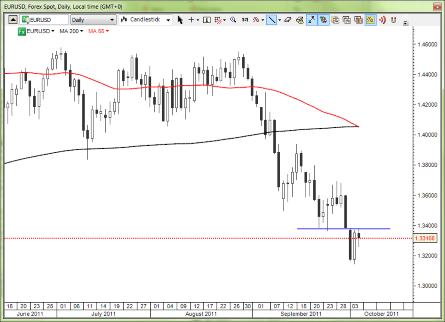
EURUSD reached its first major resistance area just below 1.3400 as we await tomorrow’s ECB outcome. (more on that below.) Above that, and we have 1.35 to contend with as the next resistance area of note.
Looking ahead – ECB pre-preview
Remember that tomorrow is Trichet’s last press conference at regular ECB meetings as Draghi is scheduled to take over at the end of this month. While many are predicting a rate cut from the ECB, it is hard to believe that Mr. Vigilance Trichet would want to leave the bank with a rate cut after having hiked as recently as July of this year. Leave it for the following meeting… More important will be further signals on the ECB’s plans to relieve the pressure on European bank funding as the general expectation is that Mr. Trichet will announce the reintroduction of unlimited 12-month funding but perhaps most importantly, will the ECB announce a new covered bond purchase program? Odds are perhaps even on the latter. And if it does launch such a program, will the move be seen as Euro positive because of the immediate relief. After all, is not a bond purchase program (despite vague possible claims that any purchases would somehow be sterilized) the same as the BoE expanding its asset purchase target. Very intriguing to see how the market will judge the ECB’s actions in addition to what the ECB does. Eventually, the only thing that keeps the banks liquid is effectively QE.

Economic Data Highlights
  • Germany Sep. Final PMI Services survey lowered to 49.7 vs. original 50.3 estimate
  • Euro Zone Sep. Final PMI Services survey lowered to 48.8 vs. original 49.2 estimate
  • UK Sep. PMI Services survey out at 52.9 vs. 50.5 expected and 51.1 in Aug.
  • UK Q2 GDP revised down to 0.1% QoQ and +0.6% YoY vs. +0.2%/+0.7% original estimates, respectively
  • UK Q2 Private Consumption dropped -0.8% QoQ vs. -0.3% expected
  • UK Q2 Government Spending rose +1.1% QoQ vs. -0.1% expected
  • US Sep. Challenger Job Cuts out at +211.5% YoY vs. +47.0% in Aug.
  • US Sep. ADP Employment Change out at +91k vs. +75k expected and +89k in Aug.

Upcoming Economic Calendar Highlights (all times GMT)
  • US Sep. ISM Non-manufacturing (1400)
  • US Weekly DoE Crude Oil and Product Inventories (1430)

Daily Report: Euro Off as Greece Decision Delayed Again, Aussie Down as RBA Turned Dovish

Euro extends recent decline broadly after the six-hours EU finance ministers meeting in Luxemburg yielded few concrete conclusion on the Greece and the measures to contain European debt crisis. Belgian Finance Minister Reynders noted that they're informed by Greece that funds will have to be made available in "mid-November" and EU will now wait for the report from troika to decide on release the next tranche of bailout fund. Nonetheless, EU President Juncker later assured that there's "no one advocating a default for Greece" and it will be avoided. Focus will turn to next meeting on October 13 and it's still doubtful whether the decision will be delayed once again. Meanwhile, the finance ministers are also reviewing the size of private sector involvement in the second bailout for Greece.
Regarding the discussion on expanding and leveraging the EFSF, it appears that the possibility is low as finance ministers are divided on the issue. Bank of France Governor Noyer said he supported leveraging the fund. However, it's unrealistic to expect an increase in the beefed-up rescue fund and it's unlikely for leverage. Juncker said the ceiling of the rescue fund shouldn't be raised and the ECB should not be involving in any future leveraging of the fund. German Finance Minister Schaeuble said that expansion talk was premature as 3 countries have yet to even ratify the EFSF plan agreed in July.

Japanese Finance minister Azumi urged Europe to "make the process of rescuing Greece more transparent to the markets" in order to "halt the extreme strength in the yen and weakness in the euro". after EUR/JPY drops to decade low and is heading towards 100 psychological level. There are increasing speculation that Japan will target the next intervention move towards EUR/JPY even though such speculation is premature for the moment.

Fed debuted that operation twist program yesterday by buying USD 2.5b in treasuries maturing in 25-30 years. 30 year yield dived to close to 2.761% overnight, hitting the lowest level in almost three years. 10 year yield also dropped to 1.785%. Bernanke will appear before the Join Economic Committee today on economic outlook and would likely face questions on how effective the operation twist will be.

Aussie extends recent fall against dollar and breaches 0.95 level today on risk aversion and as RBA turned dovish. As expected, the RBA left the cash rate unchanged at 4.75%. Yet the post-meeting statement came in more dovish than the previous one. Governor Glenn Stevens downplayed impacts of recent deterioration US and European outlook. Nevertheless, it now appears more likely that the central bank will consider a rate cut in coming months if inflation is under control. We retain our view that a rate cut will be carried out in the fourth quarter. 

AUD/JPY extends recent down trend this week as reaches as low as 72.46 so far. Near term outlook remains bearish as long as 76.65 resistance holds and we'd expect further fall to 71.84 support next. Current development is also inline with the view that whole medium term rise from 2008 low of 55.09 is already completed at 90.01 and deeper fall should be seen to 61.8% retracement of 55.09 to 90.01 at 68.42 and below. 

EUR/JPY Daily Outlook

Daily Pivots: (S1) 100.19; (P) 101.70; (R1) 102.47; 

EUR/JPY's fall is still in progress and reaches as low as 100.74 so far today. Intraday bias remains on the downside for 100 psychological level. Break will target 200% projection of 123.31 to 113.41 from 117.74 at 97.94 next. On the upside, above 102.22 minor resistance will turn bias neutral and bring consolidations. But break of 104.92 resistance is needed to signal short term bottoming. Otherwise, outlook will remain bearish.

In the bigger picture, whole down trend from 2008 high of 169.96 is still in progress and is building up downside momentum again. Sustained trading below 100 psychological level should pave the way to 100% projection of 139.21 to 105.42 from 123.31 at 89.52, which is close to 88.96 all time low. On the upside, break of 111.93 resistance is needed to be the first signal of medium term reversal. Otherwise, we'll stay bearish. 


EUR/USD Daily Outlook

Daily Pivots: (S1) 1.3098; (P) 1.3240 (R1) 1.3313; 

EUR/USD drops further to as low as 1.3163 today so far and intraday bias remains on the downside for 161.8% projection of 1.4939 to 1.3969 from 1.4548 at 1.2979, which is close to 1.3 psychological level. On the upside, above 1.3381 minor resistance will turn bias neutral and bring consolidations. But break of 1.3689 resistance is needed to signal short term bottoming. Otherwise, outlook will remain bearish.

In the bigger picture, current development indicates that medium term rise from 1.1875 has completed with three waves up to 1.4939 already. That also suggests that it's merely part of the consolidation pattern that started back in 2008 at 1.6039. Further decline would now be seen to 1.2873 support first and break will target 1.1875 and below. On the upside, above 1.4548, resistance is needed to confirm completion of the fall from 1.4939 or we'll stay bearish in EUR/USD.

USD/CHF Daily Outlook

Daily Pivots: (S1) 0.9122; (P) 0.9170; (R1) 0.9262; 

USD/CHF's break of 0.9182 resistance confirms resumption of recent rally from 0.7065. Intraday bias remains on the upside and further rally should be seen to 161.8% projection of 0.7065 to 0.8246 from 0.7710 at 0.9621 next. On the downside, break of 0.8917 support is needed to signal short term topping. Otherwise, outlook will remain bullish in near term.

In the bigger picture, medium term down trend from 1.1730 is already completed at 1.7065. But there is no indication of long term reversal yet. Rebound from 0.7065 is treated as part of a medium term consolidation pattern. Such rebound would possibly extend to 0.9916/1.1730 resistance zone. But strong resistance should be seen there and bring reversal. On the downside, break of 0.7710 is needed to indicate completion of the rebound from 0.7065. Otherwise, we'll stay near term bullish in the pair for the moment.

 Economic Indicators Update

GMT Ccy Events Actual Consensus Previous Revised
23:50 JPY Monetary Base Y/Y Sep 16.70% 16.30% 15.90%
0:30 AUD Trade Balance (AUD) Aug 3.10B 2.14B 1.83B 1.82B
0:30 AUD Building Approvals M/M Aug 11.40% 1.00% 1.00% 1.80%
1:30 JPY Labor Cash Earnings Y/Y Aug -0.60% 0.70% -0.10% -0.20%
3:30 AUD RBA Rate Decision 4.75% 4.75% 4.75%
8:30 GBP PMI Construction Sep
51.6 52.6
9:00 EUR Eurozone PPI M/M Aug
-0.20% 0.50%
9:00 EUR Eurozone PPI Y/Y Aug
5.80% 6.10%
14:00 USD Fed Chairman Bernanke Testifies


14:00 USD Factory Orders Aug
-0.10% 2.40%

Euro Weak in the Knees Again as Week/Month/Quarter Ends

The Euro ground lower today after a German minister said further EFSF expansion was not likely and despite a very high CPI estimate for September. Bonds rebounded from key support and risk remains on the defensive.

The US and German 10-year benchmarks continued to flirt with the 2 percent yield level, but both have failed to take out that support level and the strong rebound in bonds today suggested a renewed bout of safe haven seeking, particularly after a very high Euro Zone September CPI estimate failed to generate sustainable selling interest. Ahead of today’s trading session, Germany’s economy minister Roesler said in a television interview that German lawmakers were unlikely to approve another raising of the EFSF ceiling or an effective increase in the fund through leveraging. Among our usual indicator suspects: Euro 3-month basis swaps also eased another couple of bps lower (more pressure on Euro) and Italian/German yield spreads widened out again by the early US hours after attempting to tighten earlier in the day.

The action in bond markets is spilling over to JPY crosses as today marks the end of the first half of the year in Japan and the end of the quarter for the rest of the financial world. EURJPY topped  out again well above 104 but was pushed sharply back lower on the enthusiastic rally in Bunds today. It is interesting that USDJPY remained joined at the hip despite considerable volatility in rate spreads between the US and the Japan this week – apparently the market is content to express the volatility in rate spreads in non-USD terms, but USDJPY can’t remain in a vice grip forever. The Bank of Japan will see considerable pressure if we get another wave of risk off soon and global government bond yields probe their recent cycle lows.

Looking ahead
Some of the moves yesterday across markets certainly looked a bit like they might have been driven by end of month/quarter flows and that kind of activity could continue for the rest of the day today. This week has mostly been one vicious churn for those looking for a directional move – though a swoon in risk in the US session today could put an exclamation point on weekly candlesticks. Next week offers plenty in the way of even risks, certainly worth mentioning here, though we are likely to refresh this list on Monday:

  • Central Bank Meetings: RBA (Wednesday) and ECB, BoE (Thursday), BoJ (Friday)
  • Euro Zone: EcoFin meetings on Monday and Tuesday
  • US Data: ISM Manufacturing (Monday), ISM Non-Manufacturing (Wednesday), US Employment Report (Friday)
  • Other Highlights: Japan Q3 Tankan (Monday) Fed’s Bernanke to Testify (Tuesday) Canada Employment Report (Friday)
The Bernanke appearance on Tuesday will be an interesting appearance before the Joint Economic Committee, which includes Ron Paul, who will likely take the opportunity once again to bash the Fed and demand it be audited. Let’s not forget he’s a presidential candidate with a campaign in need of a boost as well.

Chart: AUDUSD Weekly 
AUDUSD challenging key levels last week and this week, confirming the huge trendline break from the 2009 lows. From here, there is a gap down to the sub-94 area and then not much to hold the pair until 0.8250. 
We asked this Monday whether the market might be treacherous for the balance of the week. (“Could heavy positioning and heavy batch of event risks mean more of this kind of churn in markets for the rest of the week?”) Next week is unlikely to yield the same result – either the risk bears give up here for a short while and the range expands upward a bit (though without changing secular trend) or the action heats up again to the downside and we start to see a full capitulation unfolding. Regardless, it behooves all of us to be careful out there, particularly since, given the backdrop, the odds of the latter remain elevated.


Economic Data Highlights
  • Germany Aug. Retail Sales out at -2.9% MoM vs. -0.5% expected
  • Norway Sep. Unemployment Rate out at 2.5% vs. 2.6% expected and 2.7% in Aug.
  • Norway Aug. Credit Growth Indicator out at +6.5% YoY vs. +6.3% expected and +6.3% in Jul.
  • Euro Zone Sep. CPI Estimate out at +3.0% YoY vs. +2.5% expected and +2.5% in Aug.
  • Switzerland Sep. KOF Swiss Leading Indicator out at 1.21 vs. 1.30 expected and 1.61 in Aug.
  • US Personal Income out at -0.1% MoM vs. +0.1% expected
  • US Personal Spending out at +0.2% MoM as expected 
  • US PCE Core out at +0.1% MoM and +1.6% YoY vs. +0.2%/+1.7% expected, respectively and vs. +1.6% in Jul.
  • Canada Jul. GDP rose +0.3% MoM and +2.3% YoY as expected and vs. +2.1% in Jun.


Upcoming Economic Calendar Highlights (all times GMT)
  • Chicago Sep. Chicago PMI (1345)
  • US Sep. Final University of Michigan Confidence (1355)
  • US Sep. NAPM – Milwaukee (140)
  • US Fed’s Bullard to Speak (1500)
  • China Sep. PMI Manufacturing (Sat 0100)
  • Australia Sep. AiG Performance of Manufacturing Index (Sun 2230)
  • Japan Q3 Tankan survey (Sunday 2350)
  • China Sep. Non-manufacturing PMI (Mon 0100)

Daily Report: Risk Aversion Recedes on EU Hopes, Dollar Retreats

Dollar retreats mildly today as risk aversion recedes on hope that European central bankers and officials are putting up a plan to resolve the region's debt problems. Asian equities recover broadly following the 272 pts rebound in DOW overnight. While there is no details yet, it's thought that Eurozone leaders are seriously considering to expand the EFSF fund by borrowing from ECB and leverage while ECB could also announce to restart covered-bond buying next week. Such anticipation will provided support to deeply oversold financial markets in near term but sentiments will remain vulnerable to more negative news out of Europe.

Also, note that the recovery in risk is more technical than fundamental, in particular in precious metals. Gold just few strong support from a key support level of 1577 while silver also rebounded strongly from 26.3 key support. It's totally normal and reasonable for traders to take profits on short positions after the steep dive, and after gold and silver hit the mentioned support levels. Current rebound doesn't warrant a change in overall bearish trend. As mentioned in our weekly report, major stock indices are still holding above August low. We don't take that as sign of resilience, but rather as a sign that the down trend isn't finished but stocks are just still carrying on the consolidations. More risk selloff is still anticipated at a latter stage.

Spain's bond auction will be a focus today which the country is planning to EUR 2.5b and EUR 3.5b of three- and six-months bills today. Meanwhile, Italy will sell as much as EUR 14.5b of government debts later in the week. On the data front, Japan corporate service price index dropped -0.4% yoy in August. Swiss UBS consumption indicator dropped to 0.79 in August. German GFK consumer sentiment was unchanged at 5.2 in October. Eurozone M3, UK CBI reported sales US S&P case shiller house price and consumer confidence will be released later today.

Dollar index faced some resistance from 38.2% retracement of 88.70 to 72.69 at 78.80 and retreats. Some consolidations would be seen below 78.86 temporary top is near term. But we'd expect downside to be contained above 76.06 support and bring another rise. There is no change in the view that whole decline from 88.70 has finished at 72.69 already. And current rise from 72.69 is expected to continue further through 80 psychological level to 61.8% retracement at 82.58 and above in medium term. 

AUD/USD Daily Outlook

Daily Pivots: (S1) 0.9690; (P) 0.9763; (R1) 0.9905; 

AUD/USD's recovery and break of 0.9866 minor resistance suggests that a temporary bottom is in place at 0.9621, just ahead of 100% projection of 1.1079 to 0.9926 from 1.0764 at 0.9611. Intraday bias is turned neutral and some consolidations would be seen. But upside should be limited below 1.0177 support turned resistance and bring another fall. Below 0.9621 will target 0.9404 key support level next. Nevertheless, break of 1.0177 will be the first signal that whole correction fro 1.1079 has completed and will turn focus to 1.0764 resistance for confirmation.

In the bigger picture, the break of long term channel from 2008 low of 0.6008 was relatively brief so far. And AUD/USD manages to recover ahead of mentioned 0.9611 projection level. Thus, the steep fall from 1.1079 could possibly be a correction only, or part of a medium term consolidation. In any case, we'll still prefer to see firm break of 0.9404 key support level to confirm trend reversal, or we'll stay long term bullish in AUD/USD.

Economic Indicators Update

GMT Ccy Events Actual Consensus Previous Revised
23:50 JPY Corporate Service Price Y/Y Aug -0.40% -0.40% -0.50% -0.30%
6:00 CHF UBS Consumption Indicator Aug 0.79
1.29
6:00 EUR German GfK Consumer Sentiment Oct 5.2 5.1 5.2
8:00 EUR Eurozone M3 Y/Y Aug
1.90% 2.00%
10:00 GBP CBI Reported Sales Sep
-14 -14
13:00 USD S&P/Case-Shiller Composite-20 Y/Y Jul
-4.40% -4.50%
14:00 USD Consumer Confidence Sep
46.5 44.5
 

The Central Bank Is a Violent, Thieving, Political Monster, Not a Business

Central Banks Aren't Banks

I am going to make a number of obvious statements that we all can agree are true, but what they add up to is a startling conclusion. What we call "central banks" are not banks at all.

What is a bank? According to a helpful little essay on banks for students at ThinkQuest helpfully titled "What is a Bank?", a bank is a financial organization in which people deposit their money. A bank is a business. According to the aforementioned essay, "each bank tries to make THEIR bank look better than all of the other banks by offering services that some other banks might not have." That is to say, banks compete in a market. This is true, conceptually at least, and also true to some extent in reality, although numerous banking laws seriously alter the market and the competition. But it is the pure idea we are after here, and in the pure idea, a bank is a business that competes in a market.

I won't analyze every "central bank" in the world. I don't have to because their setup is more or less the same everywhere. I'll use the Federal Reserve System (the Fed) to represent all of them.

Historically, the Fed and other "central banks" came to be called "central banks" for several reasons. First, they are financial organizations. Second, they hold deposits of other banks and governments. Third, their assets are largely financial assets. Fourth, they make advances or loans to other banks on collateral. Fifth, the government has made them to be at the heart or center of the banking industry and the monetary system. Sixth, government power is itself centralized or national. All of these statements are factual.

Now, this is an imposing array of reasons why "central banks" are called "central banks." But the most important of these reasons is the fifth reason, which is that the government has used its power to make the "central bank" central. And because the government has used its power to create the "central bank" and make it central, we know that the "central bank" is not a free market institution.

This is the main ground upon which I challenge the notion that a "central bank" is a bank. The concept of "central bank" fails to distinguish a free market business and a bureau created by government power. The term "central bank" undermines this distinction between free market and government. Indeed, it erases it altogether.

The Fed is not a business. It has powers that no ordinary bank has. It has privileges that no ordinary banks have. It doesn't compete with other banks. The government created the Fed. The government gave it power to create fiat money. The government can alter the Fed's organization and powers at any time. The Fed's so-called independence from the government is mythological. It is that of a dog on a long leash. The only independence the Fed has is from the public.

Let's go back for a moment to the essay on banks that I just cited, because it displays this erasing of any distinction between the free market and government. After defining the term "bank," it lists the kinds of banks. Quite suddenly, it introduces the term "central bank" in the same breath as ordinary banks that have national or state charters. It says, "There are different kinds of banks. There are national banks, state banks and central banks. The Federal Reserve Bank is the United States government's central bank. The Bank of England is England's central bank."

Suddenly, what this essay told us earlier disappears. We were told that a bank was a business that competed with other banks. But now we are told that the Fed "decides how much money is in circulation" and that it "may tell the [ordinary] banks to charge more interest or keep more money in 'reserve.'"

Obviously, if the "central bank" has such powers, it gets them from the government. Just as obviously, the "central bank" is not a business and not in competition with other banks if it exercises these and other powers over ordinary banks.

Furthermore, distinctions between monies that ordinary free market banks deal in and the fiat money that central banks produce are completely glossed over and erased.

This essay is representative of the usual thought in the field of economics. Banks are businesses. But then, all of a sudden, there is another so-called "bank" that has an array of powers that business banks do not have. This "bank" is actually a government bureau. Its fiat money is made into legal tender by the government. The government states that it stands behind this money. This "bank" has powers to control and organize the ordinary banks into a cartel.
 
The facts I've pointed out are widely recognized. There is a Wikipedia article titled "Central Bank" that confirms this:
"A central bank, reserve bank or monetary authority is a public institution that usually issues the currency, regulates the money supply and controls the interest rates in a country. Central banks often also oversee the commercial banking system of their respective countries. In contrast to a commercial bank, a central bank possesses a monopoly on printing the national currency, which usually serves as the nation's legal tender."
This too makes it very clear that a "central bank" is not a bank, but a powerful Monetary Authority and Fiat Money Administration.

However, the same Wikipedia article almost immediately contradicts itself when it states: "Central banks in most developed nations are independent in that they operate under rules designed to render them free from political interference."

How can a bureau that is established by the government and possesses extraordinary powers be independent and free from political interference? The "central bank" embodies political interference!

And to the extent that a Monetary Authority such as the Fed has been granted powers that it can exercise free of political interference, how can such an institution be held accountable? How can it operate without being responsible to the government and, indirectly, to the people?

"Central bank" independence is to a large extent a myth, that is, in the essence of the institution and in those activities in which it is not mythical, it is an unaccountable power.

It may seem as if I am splitting hairs, but what I see is that the common explanations of central banking confuse banking as might occur in free markets with so-called banking as executed by a "central bank" that is empowered by government. They are two entirely different kinds of operations. A thoughtful or questioning reader is bound to feel a degree of discomfort when he encounters these explanations that blur important distinctions.

A "central bank" is a government department. It is a government bureau. It is the government's fiat money bureau. The "central bank" is the government's money-printing machinery or money-printing organization or money-printing bureau or money-printing agency. As contrasted with monies produced in a free market, the Fed's money is state-produced "money." In the sense of comparing the Fed's money to free-market money, it is counterfeit. It is held up by the force of government law and power. It is imposed on the public.

A more accurate term for the Fed might be the "Fiat Money Administration." Perhaps the term "Monetary Authority" would be more accurate. It would be more accurate if the latter were the official name. In the U.S. Constitution, at least, it is clear that there is no power to create a Monetary Authority, and if there were such a power, it could not possibly be delegated in such a way as to make that Monetary Authority independent.

The "central bank" is not a real bank. Everything about it is permeated with government power. At the heart of the financial and monetary system of a nation that is supposed to be an exemplar of free markets is a government money-bureau.

Regards,

Michael S. Rozeff

Michael S. Rozeff is a retired professor of finance living in East Amherst, New York. He is the author of the free e-book Essays on American Empire: Liberty vs. Domination and the free e-book The U.S. Constitution and Money: Corruption and Decline. 

Daily Report: Dollar Extends Rally as Crash in Metals and Stocks Continue

Dollar extends recent rally and rises broadly as the week starts as risk aversion continues to dominate the markets. Investors' sentiments received no boost from the week's IMF/World Bank annual meeting as policymakers are divided on what to do on tackling the current crisis. PBoC Governor Zhou's comment over the weekend reflected that China is still deeper concerned with inflation and sends China stocks to lowest level since July 2010. Aussie and Kiwi are hardest hit today, by the crash in precious metal markets as well as wider than expected trade deficit from New Zealand.

At the meeting over the weekend, IMF called for world policymakers to 'act now and act together' to resume global economic recovery. The world lender said that 'the global economy has entered a dangerous phase, calling for exceptional vigilance, coordination and readiness to take bold action from members and the IMF alike'. World Bank President Robert Zoellick stated that 'the world is in a danger zone' while UK Chancellor George Osborne European leaders had 6 weeks to end the crisis as credible solutions are required to be ready by the next G20 summit in Cannes on November 4. News reports said that German and French leaders have come to some news plans of resolving the sovereign crisis in the 17-nation region. The measures include recapitalization of European banks, expansion of the EFSF to as much as 2 trillion euro and a partial default of Greek debts. Yet, the measures were not verified.

PBoC Governor Zhou Xiaochuan said that "high inflation remains the top concern in China" and there is no "immediate" way to control inflation. China is facing challenges from "relatively fast rises in consumer prices and relatively large amount of capital inflows in the short term". Zhou noted that is "no need for a fundamental change in the monetary or fiscal policies", suggesting China will continue to tighten to curb inflation. Regarding European debt crisis, Zhou noted that he's see if " euro-zone countries can implement their July 21 decision" before determining how China can further help.

The crash in commodity markets since last week is having much pressure on commodity currencies, in particular Aussie. Gold is diving another -5% today and is now trading at around 1550 level, way off the historical high made just weeks ago above 1900. Silver is even weaker as it's losing over -11% today so far. There is no help to Kiwi after reporting wider than expected trade deficit of NZD -641m in August. RBNZ will definitely refrain from further removing policy accommodation in near term while there are already some speculations that RBA would even cut rates within the next six months.

EUR/JPY Daily Outlook

Daily Pivots: (S1) 102.47; (P) 103.09; (R1) 103.95; 

EUR/JPY's fall resumes after brief consolidations and dips to as low as 101.93 so far. Intraday bias is back on the downside for 100 psychological level first and then next near term target at 100% projection of 111.93 to 103.88 from 106.98 at 98.93. On the upside, above 103.75 minor resistance will turn bias neutral again and bring consolidations. But recovery should be limited by 106.98 resistance and bring fall resumption.

In the bigger picture, whole down trend from 2008 high of 169.96 is still in progress and is building up downside momentum again. Sustained trading below 100 psychological level should pave the way to 100% projection of 139.21 to 105.42 from 123.31 at 89.52, which is close to 88.96 all time low. On the upside, break of 123.31 resistance is needed to confirm trend reversal or we'll stay bearish.


EUR/USD Daily Outlook

Daily Pivots: (S1) 1.3422; (P) 1.3494 (R1) 1.3570; 

EUR/USD's fall resumes after brief consolidations and dips to 1.3362 so far today. Intraday bias is back on the downside for 61.8% projection of 1.4548 to 1.3498 from 1.3936 at 1.3287 and then 161.8% projection of 1.4939 to 1.3969 from 1.4548 at 1.2979, which is close to 1.3 psychological level. On the upside, above 1.3566 minor resistance will turn bias neutral and bring consolidations. But recovery should be limited below 1.3936 resistance and bring fall resumption.

In the bigger picture, current development indicates that medium term rise from 1.1875 has completed with three waves up to 1.4939 already. That also suggests that it's merely part of the consolidation pattern that started back in 2008 at 1.6039. Further decline would now be seen to 1.2873 support first and break will target 1.1875 and below. On the upside, above 1.4548, resistance is needed to confirm completion of the fall from 1.4939 or we'll stay bearish in EUR/USD.


GBP/USD Daily Outlook

Daily Pivots: (S1) 1.5349; (P) 1.5420; (R1) 1.5513;

Intraday bias in GBP/USD remains neutral for the moment and some more consolidations would be seen above 1.5327 temporary low. Nevertheless recovery is expected to be limited below 1.5868 resistance and bring fall resumption. Break of 1.5327 will target 161.8% projection of 1.6746 to 1.5780 from 1.6618 at 1.5055 next.

In the bigger picture, rise from 1.4229, which is treated as the third leg of consolidation from 1.3503 (2008 low) should be finished at 1.6746 after GBP/USD completed a head and shoulder top reversal pattern (ls: 1.6298, h: 1.6746, rs: 1.6618). Fall from 1.6746 could be the fourth leg of the consolidation pattern from 1.3503 (2008 low) or resuming long term down trend from 2.1161 (2007 high). In either case 1.4229 resistance should be seen. Break of 1.4229 will bolster the down trend resumption case and would possibly push GBP/USD through 1.3503 low. On the upside, break of 1.6618 resistance is needed to invalidate this view. Or we'll now stay cautiously bearish in GBP/USD.

Economic Indicators Update

GMT Ccy Events Actual Consensus Previous Revised
21:45 NZD Trade Balance (NZD) Aug -641M -321M 129M 111M
8:00 EUR German IFO - Business Climate Sep
106.5 108.7
8:00 EUR German IFO - Current Assessment Sep
115.5 118.1
8:00 EUR German IFO - Expectations Sep
97.4 100.1
14:00 USD New Home Sales Aug
295K 298K

Ratings and Recommendations