Financial Advisor
Showing posts with label Weekly Call. Show all posts

Weekly Review and Outlook Risk Recovery Finished, Revisiting Recent Lows ahead of Jackson Hole?

The recovery in market sentiments was rather short-lived as risk selloffs resumed towards the end of the last week. Disappointment from the Franco-German summit turned market around and there was renewed worry on interbank liquidity stress. Global economic data continued to disappoint and point to further slowdown while investment banks such as Citigroup and JP Morgan downgraded their forecasts on US growth while Morgan Stanley trimmed its global growth outlook, warning the US and Europe are 'dangerously close to recession'. Major equity indices stumbled on Thursday and Friday while gold made another record high at 1881.4 and is marching towards 1900. The currency markets, though, were relatively calm. Commodity currencies were generally low but loss was so far limited. Swiss Franc is relatively indifferent to risk aversion on concern of intervention from SNB. Yen was higher but momentum as unconvincing. Surprisingly, Sterling was the strongest currency last week on safe haven flows. At this point, it looks like there will be another around of risk selloffs to push equities to new yearly low ahead of the highly anticipated Jackson Hole symposium.

The Franco-German meeting failed to come up with solutions to settle the debt crisis. Leaders of biggest economies in the 17-nation region proposed to create a 'true European economic government' which will eventually lead to a common tax and fiscal policies within the Eurozone. Concerning fiscal issues, Germany and France will create a common corporate tax base and tax rate between the 2 countries from the start of 2013. Moreover, they will propose in September the imposition of a new financial transaction tax across all Eurozone members. While the details of the types of taxes were not provided, investors were obviously irritated by the financial transactions tax as the euro and equities plunged after the announcement.

The ECB said that it has recently lent US$ 500M in its 7-day liquidity-providing operation to a bank at above market rates. This was the first time since February that the facility was used. Fears that more banks will seek ECB's funding because of their heavy exposure to debts of Greece and other debt-ridden countries increased and would make the market outlook negative. Concerns over contagion of Eurozone's sovereign crisis have spread to the US. The WSJ said that US regulators are taking a closer look at the US units of Europe's biggest amid concerns that the region's debt problems will spread to the US banking system. The report said that the New York Fed is 'very concerned' about the issue and has been seeking information about the banks' ability to access funds to maintain their US operations. New York Fed President Dudley denied the officials are watching a particular group of banks closely and reiterated that the central bank treats US and European banks 'exactly the same' and is 'always scrutinizing banks'.

Sterling was somewhat supported by safe haven flows into UK government debts even though the economy remains weak and chance of more easing from BoE is high. Yield also sank after minutes revealed that MPC members Dale and Weale abandoned the call to hike rates in last meeting.  UK 10 year gilt yield dived to record low of 2.273% on Thursday before closing the week at 2.39%. Safe haven flows pushed EUR/GBP to as low as 0.8653 last week but the rebound on Friday suggests that investors are not ready to get themselves more committed to the pound yet and the cross will remain mixed in near term.

Selloff in stocks was steep on Thursday and Friday, where we have DOW down from intraday week high of 11529 to close at 10817. DOW, S&P 500, NASDAQ, FTSE 100 and CAC 40 managed to hold above recent low. However, note that DAX has indeed dived through prior week's low of 5487 and closed at 5480. The German index could be leading the way down as other major global indices extend the fall to test recent lows this week. 

Sentiments somewhat stabilized briefly on news that Olli Rehn, the European Union commissioner for economic and monetary affair said that EU may present a report to European Parliament and the Council on the setup of a "system of common issuance of European sovereign bonds" under joint and several liability". However, the idea of Eurobond will face strong opposition just as European Union President Herman Van Rompuy expressed that there will be Eurobonds only when there is " genuine budgetary convergence, the day when everyone is in balance or virtually in balance."
Technical Highlights
DOW's recovery from 10604 might have completed at 11529 last week, ahead of mentioned 11862 resistance as expected. It's a bit early to confirm fall resumption for the moment, but the index is nonetheless vulnerable to deeper fall ahead. We'll stay cautiously bearish as long as 11529 resistance holds and expect an eventual downside breakout soon towards 61.8% projection of 12753 to 10604 from 11529 at 10201 in near term. As noted before, the index has completed a head and shoulder top reversal pattern earlier and the current fall should eventually target key cluster level of 9614 (50% retracement of 6470 to 12876 at 9673) and below. 
While gold made another record high against dollar at 1881.4 last week, it's also exceptionally strong against other major currencies. XAU/EUR jumped to new record high at 1312.92 last week before retreating back below 1300 psychological level to close at 1286.23. Near term outlook will remain bullish in any case as long as 1201.96 support holds and we'd expect further rise towards 261.8% projection of 954.11 to 1088.1 from 1021.21 at 1371.97 next.
The dollar index continued to stay in familiar range as recent consolidation continued, just like the EUR/USD. At this point, a downside break out is mildly in favor as long as 75.383 resistance holds. Break of 71.48 will target 72.69 first. Further break there will confirm resumption of the whole down trend from 2008 high of 88.70 and should target historical low of 70.70. On the upside, above 75.38 will turn focus back to 76.71. resistance but break there is still needed to signal trend reversal. Or, we'll stay neutral at best in the index.
The Week Ahead
A number of important economic indicators will be released this week, including Eurozone PMIs, German ZEW and Ifo, US and UK GDP revision. Nevertheless, main focus will definitely be on the Jackson Hole symposium. After the Fed announced to keep interest rates at exceptionally low levels at least through mid-2013 on August 9, the market has been increasingly speculating that Chairman Ben Bernanke will signal additional easing measures at the meeting next week. According to a CNBC survey done after the FOMC meeting, 46% of respondents said the Fed will resume QE, up from 19% in the July survey while 37% said the Fed will not do QE, down from 68% in July. Also, of those who believe the Fed will resume QE, the asset purchases are expected to average at 628B, up from 377B in July.
  • Tuesday: Eurozone Flash PMIs, German ZEW; Canada retail sales; US new home sales; New Zealand trade balance
  • Wednesday: German Ifo; US durable goods; New Zealand retail sales
  • Thursday: German Gfk consumer sentiment; Swiss ZEW; US jobless claims
  • Friday: Japan CPI; UK GDP revision; Swiss KOF; US GDP revision

EUR/GBP Weekly Outlook

Despite dipping to as low as 0.8653 last week, EUR/GBP held above 0.8642 support and recovered strongly before closing. The development suggests that recent sideway trading is not finished yet and we'll continue to stay neutral. on the upside, above 0.8886 will re-affirm the case that fall from 0.9083 has completed at 0.8642 and should bring stronger rise to retest 0.9083. On the downside, however, break of 0.8610/42 support zone will has medium term bearish implication and should bring deeper fall to 0.8284/8355 support zone first.
In the bigger picture, price actions from 0.9799 (2008) should be unfolding as a consolidation pattern in the long term up trend. The first leg is completed with three waves down to 0.8067. At this point, EUR/GBP is still holding above 0.8610 support with daily MACD staying above signal line. Thus, there is no confirmation of completion of the second leg from 0.8067. Though, even in case of another rise, we'd expect strong resistance ahead of 0.9410 medium term resistance to bring reversal and starts the third leg. On the downside, break of 0.8610/42 support will now be an important bearish signal for 0.8067 and below.
In the long term picture, long term up trend from 2000 low of 0.5680 shouldn't be over yet and the choppy fall from 2008 high of 0.9799 should be a correction only. We'd expect such correction to be contained by 0.7963/0.8186 support zone and bring up trend resumption. Rise from 0.5680 is still expected to extend beyond 0.9799 high eventually.


USDCHF - Bullish above 0.7486

Our bearish call for USDCHF sentiment for last week was confirmed with aggressive selling that took it more than 5 big figures lower – to new all-time lows. But these lows were not maintained. In fact, all initial losses were powerfully reversed and although this rally was inspired by non-technical factors, the formation of a Bullish Hammer on weekly candle charts indicates scope for gains to continue.

In view of this our call is Bullish above 0.7486, although exact risk levels in such volatile conditions are hard to gauge. The immediate objective is 0.7836, the open from August 2nd, with a move beyond that point targeting 0.7954, the 2-week peak, then 0.8119, the open from 3 weeks ago.

The risk to this call is that the improvement was more temporary and limited than currently assessed and this would be signalled by a move below 0.7486, 38% pullback of Thursday’s net rise. Prices and sentiment should then fall to 0.7265, that day’s open, or even 0.7181, Wednesday’s base.


Weekly Review and Outlook : Swiss Franc to Remain Strong in Rough Markets

Risk assets tumbled sharply in panic selling last week. The three major US stocks indices, DOW, S&P 500 and NASDAQ had the worst week since the 2008 financial crisis. DOW lost -5.75% during the week, erasing all gains made since the beginning of 2011. The S&P 500 Index plummeted -7.19% to settle at 1199.38, the lowest level since November 2010. NASDAQ was down -8.12%. More importantly, all three indices broke through key support levels to complete significant medium term head and should top patterns which had very bearish implications. The CRB commodity index dived through key support level at 326 to extend the medium term decline while crude oil was down -9.22%. Safe haven flow boosted US treasures, where 2 year yield made record low, and gold, which made new record high.

In the currency markets, commodity currencies, the Aussie, Kiwi, and Loonie, were the biggest losers, reversing most, if not all of July's gain. The picture of who's the biggest winner was complicated by intervention acts from SNB and BoJ.Dollar managed to gain against most of other major currencies, thanks to the moves from SNB and BoJ to curb gains in Swiss Franc and the Japanese Yen. Meanwhile, dollar was also boosted by strong depend for US treasury yields. Nevertheless, we'd like to emphasized that firstly, Swiss Franc remained the strongest currency in the risk averse markets and managed to make new record highs against Dollar and Euro even after SNB announcement. Secondly, Yen also, pared much of it's loss on Friday and there was no confirmation of reversal in yen's up trend so far. Thirdly, dollar is indeed still bounded in range against Euro and Sterling.

ECB's lack of address to the Spain and Italy problem was taken as the scapegoat for Thursday's selloff. Markets has indeed stabilized on Friday on news that Italy will speed up it's austerity and ECB would buy Spain and Italy bonds. But in any case, investors were getting increasingly inpatient and concerned on the never-ending European debt crisis, which simply won't go away in investors' minds. Austerity measure will also certainly drag down growth in the region and risk bringing the region back into recession. On the other hand, in spite of a better than expected Non-farm payroll figure released on Friday, other economic data from US were mostly, if not all, pointing to deeply slowing growth. Speculation on QE3 from Fed intensified but this time, markets were very doubtful on the effectiveness of further easing.

Volatility will certainly continue for this week considering that firstly, S&P downgraded US' rating to AA+ (from AAA) after the US market closed on Friday. Secondly, European central bankers will hold an emergency conference call on Sunday to discuss latest development in the debt crisis. Thirdly, it's believed that G7 leaders will also hold a conference call on both issues.

Looking further ahead, note firstly that last week's development in risk assets could have marked a major medium term turning point. Some recovery in risks might be seen in near term after last week's panic selling. But there are now tremendous risks on the downside in medium term as global economic outlook deteriorates further. Hence, one should avoid catching rebounds in commodity currencies unless risk outlook does change. Secondly, we're maintaining our view that Dollar, Euro and Sterling are going nowhere against each other, even though Sterling appears to be having a small upper hand against the other two. Thirdly, Yen would have some difficulty in extending its up trend on threat of intervention but we don't believe that unilateral intervention would have much effect. So, we'd indeed try to avoid going long or short on yen crosses. And by the way, Yen is highly correlated to risk and yields, but it's not a safe haven currency. Fourthly, Swiss Franc indeed still the preferred safe haven currency, in particular in consideration of the debt problems in Eurozone. AUD/CHF, NZD/CHF and CAD/CHF offer much downside potential should sentiment worsens.

Technical Highlights
Head and shoulder top patterns were seen in DOW, S&P 500 and Nasdaq last week. S&P 500's pattern was the prettiest among the three (ls: 1344.07, h: 1370.58, rs: 1339.62). From a short term point of view, some support might be seen around 61.8% retracement of 1010.91 to 1370.58 at 11408.30. But rebound attempts should face strong resistance from the neck line, which is around (1260 level). We'll stay bearish as long as 1260 holds. 

In the bigger picture, the long term trend line from 2009 low of 666.79 has clearly been broken by last week's sharp decline. It's at bit early on determining how far the current fall would go but 38.2% retracement of 666.79 to 1370.58 at 1101.73 will likely be breached. The key level should indeed be near term 1010.91 support, which is close to 50% retracement at 1018.68. We'll revisit the possibility of taking out this key level after seeing the structure of the anticipated near term rebound.

Outlook in the CRB commodity index is also bearish as the break of 326.74 support last week confirmed resumption of the whole fall from 370.70. Further decline should be seen ahead. At this point, there is no clear indication of trend reversal yet. Main focus will be on 300 psychological level, which is close to 38.2% retracement of 200.15 to 370.70 at 305.55 and 100% projection of 370.70 to 326.74 from 350.50 at 306.50. Decisive break of this cluster level will pave the way to 250 and below.

Dollar index's rebound last week invalidated the immediate bearish case and turned outlook neutral. The dollar index might stay in range of 74/77 for a while but the current development is still favoring more downside. Break of 74.18 will likely send the index through 72.69 towards 70.70 record low.

The Week Ahead
Markets will certainly be rough considering the uncertainties we're facing. Initial focus will be on market's reaction to US downgrade and any announcements from Eurozone leaders or G7. Focus will then turn to FOMC where markets are expecting a change in the statement's language to reflect the deteriorated outlook and for starting to set the stage for more easing. We're anticipating recovery in risk assets but such recovery shouldn't last long. 12000 in DOW, 1260 in S&P 500 will be the key levels to watch for and as long as these levels hold, selloff in stocks should resume sooner or later. In such case, swiss franc will remain the main beneficiary while commodity currencies will be hardest hit.
  • Monday: Swiss unemployment rate; Eurozone Sentix investor confidence
  • Tuesday: UK BRC retail sales, RICS house price balance, industrial and manufacturing production, trade balance; China CPI; Canada housing starts; FOMC rate decision
  • Wednesday: China trade balance; BoE inflation report;
  • Thursday: Australia employment; Canada trade balance; US trade balance, jobless claims
  • Friday: US retail sales; U of Michigan sentiment

EUR/CHF Weekly Outlook

EUR/CHF extended recent down trend last week and made another record low at 1.0707. It's possibly losing some downside momentum for the moment, but further decline is still expected as long as 1.1148 minor resistance holds. Current down trend should continue to 161.8% projection of 1.2344 to 1.1404 from 1.1891 at 1.0372 next. On the upside, though, note that break of 1.1148 resistance will suggest short term bottoming and will bring lengthier consolidations before resuming the down trend.
In the bigger picture, whole down trend from 1.6827 (2007 high) is still in progress and in any case, medium term outlook will remain bearish as long as 1.2399 support turned resistance holds. Next target is 200% projection of 1.3833 to 1.2399 from 1.3243 at 1.0375. Nevertheless, break of 1.2399 will be the first sign of bottoming and should bring stronger rebound to 1.3243 resistance for confirmation.
In the long term picture, fall from 1.6827 should be resuming whole down trend from 1993 high of 1.8234. The is some sign of re-acceleration as seen in weekly MACD and break of 161.8% projection of 1.8234 to 1.4391 from 1.6827 at 1.0609 and break will target 200% projection at 0.9141. 

Weekly Review and Outlook Underlying Trends in Volatile Markets, Strength in CHF, AUD, NZD and JPY

We had a lot of noises in the markets recently. The US debt ceiling debate remained a major focus as the drama dragged on before the August 2 deadline. Moody's warned earlier in the month of a possible US downgrade. But the rating agency said in a statement on Friday that the triple A rating would likely be kept if the government could continue to pay bond-holders even if a deal can't be reached by the deadline. The Greece situation seems to be solved by markets' focus turned to Spain now as Moody's warned of a Spain downgrade. IMF also said in a report that outlook in Spain is "difficult" with risks "elevated" and the country is still in "danger zone". These noises triggered much volatilities in the markets but under these volatilities, there are trends.

And, the trends that really worth noting are, firstly Dollar, Euro and Sterling are staying in range against each other for the moment. Dollar is a bit weaker against the other two. Sterling also seems to be building momentum against euro. But, they're kept in range as each region has its own problems. Growth in US and UK was dismal. US real GDP grew at 1.3% annualized pace in Q2, substantially below market expectation of 1.7%. Prior quarters figure was also revised down from 1.9% to a very poor 0.4%. UK Q2 GDP grew a mere 0.2% qoq. Outlook in both US and UK reflect fragility in economic recovery and would likely prompt Fed and BoE to add stimulus if situation worsens. Eurozone CPI unexpectedly moderated to 2.5% yoy in July, reducing the need for ECB to continue tightening while the region is still in the middle of the never-ending peripheral debt crisis. The trends between the three currencies are indeed, not too clear.

Secondly, Swiss France and Gold are both strong on safe haven demand. Swiss franc extended the long term up trend and made new record high against Dollar, Euro, and Sterling last week. Gold also jumped to record high against Dollar at 1637. Investors are still in deep concern on the debt problems across the Atlantic. Swiss Franc and gold would likely remain strong in near term ahead.

Thirdly, with all the talk about US downgrade, long term treasuries were still strong. Considering sluggish growth, risk aversion as well as possible reversal in stocks, US treasuries remained one of the preferred place for funds. Yield on 10 year and 30 year bonds both hit fresh low for the year last week. The strength in US bonds, weakness in yields, helped drive USD/JPY lower last week, taking EUR/JPY and GBP/JPY with it. The medium term down trend in yields are confirmed and we'd possibly see 10 year yield heading back to lower side of the range near to 2.35% while 30 year yield would possibly head towards 3.50% level Such development will likely support the Japanese yen further.

Fourthly, Aussie and Kiwi are both strong in spite of risk aversion in the equity markets, both supported by resilience in their economy, strength in the Asia Pacific region as well as commodity prices. The stronger than expected Q2 CPI reading in Australia killed unjustified talk of rate cut from RBA. Instead, markets are back to consensus that the bank would indeed be forced to raise rate again by the end of the year and such expectations boosted Aussie to new record high against dollar. In the post meeting statement, RBNZ delivered clearly the attention to remove the post-earthquake 50 bps insurance cut as 'current global financial risks recede and the economy continues to recover'. It's very likely that the rate hike will place in as soon as September.While also a commodity currency, trend in Canadian dollar is not clear, in particular as weak data cooled speculation of BoC hike in near term.

So in short, we're not too enthusiastic on trades in EUR/USD, GBP/USD and EUR/GBP. Instead, we'd be more interested in going long Swiss Franc and Yen on days of risk-off, and long on Aussie and Kiwi on days of risk-on.

Technical Highlights
GBP/CHF's long term down rend resumed last week and dived to new record low of 1.2880. Current fall should continue in near term and target 161.8% projection of 1.5691 to 1.4168 from 1.5183 at 1.2719 next. 
In the larger picture, we'll stay bearish as long as July's high of 1.3697 holds and expect the down trend to continue to 61.8% projection of 2.4965 to 1.5112 from 1.8113 at 1.2024 in medium term, which is close to 1.2 psychological level. 

NZD/USD's up trend accelerated further last week and made new record high at 0.8797 so far. We're staying bullish in the pair and expect the up trend to extend to 100% projection of 0.4890 to 0.7632 from 0.6560 at 0.9302 in medium term. Key short term support is last week's low of 0.8611 while the medium term key support level is 0.7975. 
Canadian dollar is clearly the weaker one among commodity currencies. AUD/CAD's strong rally last week suggests that pull back from 1.0555 has already finished at 1.0124. Current rise should extend through 1.0555 high in near term to target 61.8% projection of 0.9605 to 1.0555 from 1.0124 at 1.0711. 
In the larger picture, we'll stay bullish in AUD/CAD as long as 1.0124 holds and expect further rise to 100% projection of 0.7168 to 0.9913 from 0.8589 at 1.1333. 
The sharp fall in 10 year yield on Friday took out 2.847 support to close at new yearly low of 2.805. The fall might indeed be reaccelerating based on current structure. 2.688 Fibonacci projection will be a key level to watch in near term and a decisive break there will indeed suggest further downside acceleration ahead for a test on lower side of the medium term range near to 2.334. 
Dollar index attempted for a recovery last week but was limited by near term trend line turned resistance. No change in the outlook that consolidation pattern from 72.69 has finished at 76.71. We'll stay bearish in the index as long as 55 days EMA (now at 74.83) holds and expect an eventual break of 72.69 support to extend the down trend from 88.70. Nevertheless, note again that the outlook in EUR/USD is not cleared yet. And, a break of 55 days EMA in the dollar index will also mix up its outlook too. 

The Week Ahead
US debt ceiling outcome will be one of the major focuses on early part of the week. Four central banks will meet this week, RBA, ECB, BoE and BoJ and all are expected to stand pat. The main market moving one would be RBA and the statement could send Aussie further higher if it delivers a hawkish tone. Meanwhile a number of economic data would be released during the week.
As noted before, firstly Euro, Sterling and Dollar are so far kept in range against each other and the development among these crosses will very much depends on the PMIs and US job data. Also, these data would be important to determine the level of risk aversions and thus determine whether Swiss Franc or Aussie/Kiwi are the preferred currency to go long against dollar, euro and sterling. There are also a number of important data to determine how far the Aussie could go, including Australia retail sales, housing, trade balance and more importantly, China manufacturing PMI. New Zealand dollar bulls will look into New Zealand job data too. Meanwhile, also note that Canadian job data is also featured which could trigger some volatility in CAD crosses even though we don't expect it to change the larger trend.
  • Monday: China Manufacturing PMI; Eurozone manufacturing PMI, unemployment rate; UK manufacturing PMI; US ISM manufacturing
  • Tuesday: RBA rate decision, Australia building approvals, house price index; Swiss retail sales, SVME PMI; UK construction PMI; Eurozone PPI; US personal income and spending
  • Wednesday: Australia retail sales, trade balance; Eurozone services PMI final, retail sales; UK services PMI; US ISM non-manufacturing, factory orders; New Zealand employment
  • Thursday: BoE rate decision; ECB rate decision; US jobless claims
  • Friday: RBA monetary policy statement; BoJ rate decision; Swiss CPI; UK PPI; Canadian employment, building permits, Ivey PMI; US non-farm payroll

Weekly Review and Outlook: Eurozone Dominated Headlines but Kiwi and Aussie Shone; Important Week ahead, Dollar Vulnerable

Eurozone debt crisis dominated headlines last week and the highly anticipated EU summit delivered new measures to fund Greece and stabilize the situation. The results gave the common currency a strong boost towards the end of the week but Euro is so far limited below near term resistance level against dollar, yen and swissy and thus, there is no confirmation of a return to confidence. Improved risk sentiments, though, helped commodity currencies rally across the board together with strength in equities. New Zealand dollar and Australian dollar were both strong while Canadian dollar pared much of the earlier gains on weak inflation data. The greenback was broadly lower except versus swiss franc and dollar index's breach of 74 level suggested more downside to come ahead. 

The EU summit ended with new measures to fund Greece and stabilize the sovereign crisis in the Eurozone as a whole. he leaders also agreed on an ambitious reform of the EFSF, making it more flexible and effective. However, markets were somewhat disappointed with the lack of details on reform of the EFSF. The new bailout package for Greece by EU/IMF will total EUR 109B. Involvement in private sector will be on a 'voluntary basis' and the total contribution will be around EUR 50B (the net contribution of EUR 37B and EUR 12.6B from a debt buy back program). The document stressed that the private sector involvement arrangement is an 'exceptional and unique solution' for Greece only. Interest rates are lowered to 3.5%. Maturity of the loan, as well as other loans from the EFSF in the future, will be extended 'from the current 7.5 years to a minimum of 15 years and up to 30 years with a grace period of 10 years'. Rate reduction and maturity extension should also benefit Portugal and Ireland on their current debts, too. Greece is required to accelerate implementation of fiscal consolidation measures including privatization of Government assets worth of EUR 50B. The leaders also reached a common position to enhance the importance of ESFS, giving it the ability to buy Eurozone debts in secondary markets. This, however, can only be done upon approval of the ECB and under 'mutual agreement' of the EFSF/ESM member countries. The fund can also give countries 'precautionary' credit lines and recapitalize financial institutions through loans.

In the US, hopes that the White House and the Republicans would reach an agreement soon faded after the news that Obama met with Democratic leaders from the House and Senate at the White House for about two hours as some of them rejected the plan proposed by the 'Gang of Six' on July 19, aiming to cut spending by 3.75 trillion over 10 years. House Speaker John Boehner said after Friday market close that he will instead talk with Senate leaders on a way to avoid a U.S. default. Meanwhile, S&P issued a new warning that it would downgrade US' credit rating if a deal failed to be reached by August 2. The rating agency said there's at least 50% chance that it would cut the country's AAA rating for the first time.

BOC left interest rate unchanged at 1% in July. GDP growth forecast was revised to +2.8% for 2011, down from +2.9% projected in April, while estimates for 2012 and 2013 stayed unchanged at +2.6% and +2.1% respectively. Policymakers saw higher inflationary pressures with core inflation slightly firmer than expected, due to 'temporary factors' and 'more persistent strength in the prices of some services'. Core CPI is expected to 'remain around 2%' through 2013 while total CPI should return to the 2% by the middle of 2012. Concerning monetary policy outlook, the BOC concluded that 'to the extent that the expansion continues and the current material excess supply in the economy is gradually absorbed, some of the considerable monetary policy stimulus currently in place will be withdrawn'. The reference this month, with the term 'eventually' being taken away, sent the market a signal that a rate hike may come earlier than previously anticipated. Canadian dollar surged after the statement but later pared much of the gains on Friday as CPI dropped more than expected to 3.1% yoy in June. while core CPI also unexpectedly moderated to 1.3% yoy. 

Australian dollar and New Zealand dollar were the two biggest winners last week and fear on European debt crisis eased and risk appetites came back. The Aussie lagged behind other commodity currencies in July on talk that RBA might cut rates in the next twelve months. But the idea, as proposed by Westpac, didn't gain many followers and the Aussie jumped as Gold reached new record high above 1600, as well as on strength in global equities. New Zealand dollar was even stronger as Q2 CPI accelerated more than expected to 5.3% yoy, highest number since 1990. Along with the better than expected GDP figure released a week ago, markets are now expecting RBNZ to start tightening again in Q4. 

Technical Highlights

Dollar index's break of 74.13 support suggests that rise from 73.35 has finished at 76.71. Also, the consolidation pattern from 72.69 might be completed with three waves up to 76.71 too. Bias is cautiously bearish this week for a test on 73.50 support. Break there will affirm the case the the down trend in dollar index from 88.70 is resuming for another low below 72.69. Ideally, that should be accompanied by a break of 1.4577 in EUR/USD. 

NZD/USD is one of the strongest pair in July so far and made another record high of 0.8674 last week. There is no sign of topping yet and the pair is indeed accelerating. We're staying bullish and expect further rally ahead. From a medium term angle, NZD/USD should be targeting 100% projection of 0.4890 to 0.7632 from 0.6560 at 0.9302 next. 

The Week Ahead

Talk on US debt ceiling will be a main focus this week. An agreement must be made to raise the current $14.3T borrowing limit by August to avert a default. Meanwhile, a number of key economic data will be released this week. From US and UK, Q2 GDP preliminary reading will be the major focus. Canadian dollar will also need a strong GDP number affirm the expectation of BoC hike in H2 and fuel another rally. Meanwhile, Q2 inflation data from Australia will also be crucial on whether RBA's next move would be a hike or as some said, a cut. RBNZ is expected to leave rates unchanged at 2.50% this week but may start to hint on tightening in H2 and thus, give the New Zealand dollar further boost. 

Meanwhile, a key focus of the week will also be on whether US stocks could extend recent rally. So far, DOW is still limited below May's high of 12876 but it's looking increasingly likely that rise from 11862 is resuming the medium term up trend. We'd expect any retreat to be contained above last week's low of 12296 and DOW should break through 13000 level, maybe after agreement on US debt ceiling and deficit reduction, or after Q2 GDP data. Such development, if happens, will give much pressure on the dollar. 

 AUD/USD Weekly Outlook

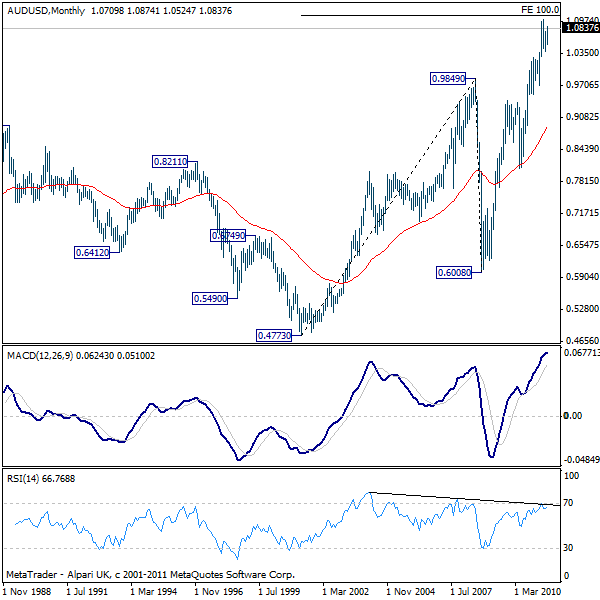
AUD/USD broke out of near term range last week and rose to as high as 1.0874. Rise from 1.0390 has resumed and should be target a test on 1.1011 resistance this week. Overall outlook remain unchanged. we're still favoring the case that correction pattern from 1.1011 is finished with three waves down to 1.0390 already and rise from there is tentatively treated as up trend resumption. Break of 1.1011 will confirm and target 61.8% projection 0.9703 to 1.1011 at 1.0390 at 1.1198 next. On the downside, below 1.0774 minor support will turn bias neutral and bring consolidations first. But downside should be contained well above 1.0524 support and bring another rise.

In the bigger picture, rise from 0.8066 is part of the up trend from 2008 low of 0.6008 and is still in healthy status. Such up trend should target 100% projection of 0.6008 to 0.9404 from 0.8066 at 1.1462 on resumption. On the downside, Break of 1.0182 resistance turned support is needed to be the first signal of medium term reversal. Or we'll stay bullish in AUD/USD.

In the longer term picture, long term up trend from 0.4773 (01 low) is still in progress and would possibly target 100% projection of 0.4773 to 0.9849 from 0.6008 at 1.1084. AUD/USD is staring to show loss of upside momentum with weekly MACD crossed below signal line and there is possibility of bearish divergence condition too. Nevertheless we'd still prefer to see at least sustained trading below 55 weeks EMA (now at 1.0055) before considering long term reversal. 
 

Forex Weekly Outlook – July 18-22

US Housing data, Euro-Zone German ZEW Economic Sentiment and German Ifo Business Climate and US Unemployment claims are among the big market movers this week. Here is an outlook on the major events ahead.

 Last week President Barack Obama pressured congressmen to resolve the impasse over the debt limit and fiscal policy by summoning Congressional leaders to the White House aiming to reach an agreement and present a full scale plan within the next few days. Will the US congress reach a resolution this week?
Apart from the usual events, the beginning of the week will see a reaction to the stress tests published on Friday. Some banks’ stocks might see a “Black Monday” and this may impact the euro.
Let’s Start
  1. New Zealand CPI: Sunday, 22:45. CPI gained by 0.8% in the first quarter above the RBNZ’s comfort zone. While some of this will reflect the lagged effect of the Goods and Services Tax last October. Nevertheless the RBNZ does not expect rates to increase until the fourth quarter, even though GDP was great in New Zealand.
  2. US TIC Long-Term Purchases: Monday, 13:00. TIC Long-Term Purchases increased in April to $30.6B better than the previous month but still very low due to the Greek bonds affair. A larger increase to $48.4B is predicted.
  3. Euro-Zone German ZEW Economic Sentiment: Tuesday 9:00. The Greek crisis spoiled German sentiment in April falling from 3.1 to -9.0 when 3.0 drop was predicted by analysts. However the decrease characterizes the financial sector rather than the manufacturing industry gaining some positive readings.  Further drop to -10.9 is expected now.
  4. US Building Permits: Tuesday 12:30. Approved building permits increased in May added 0.5M from to the previous month reaching 0.61M above the 0.55M expected. This positive reading indicates increased activity in the market and may also increase home prices. The sale number of building permits is predicted now.
  5. Canadian Rate decision: Tuesday, 13:00. The Bank of maintained its benchmark overnight rate at 1% in May 31 however announced in its last rate statement it would closely monitor inflationary pressures to decide upon a possible rate hike however no change is predicted this time.
  6. US Existing Home Sales: Wednesday, 14:00. A decrease occurred in sales of existingU.S. homes dropping to a 4.81 million annual rate from 5.00 million in the previous month. 1.8 million Properties under foreclosure lower existing home prices and sluggishness is expected to continue for the time being. An increase to  4.95 million is forecasted.
  7. US Unemployment Claims: Thursday, 12:30.  Initial jobless claims dropped 22,000 to 405,000 last week, much better than the 413,000 anticipated and following 427,000 claims in the week before. The low reading is partially due to fewer layoffs than predicted on the auto industry. A small increase to 406,000 is predicted now.
  8. US Philly Fed Manufacturing Index: Thursday, 14:00. Manufacturing activity in the U.S. Mid-Atlantic region decreased unexpectedly in June to the lowest level since July 2009 plunging to -7.7 from 3.9 points gain in the previous month and contrary to predictions of a rise to 6.8. A rise to 4.6 is forecasted.
  9. Euro-Zone German Ifo Business Climate: Friday, 8:00. German business confidence unexpectedly grew in June to 114.5 from114.2 in May indicating a possible ending to the debt crisis clouds overshadowing the Euro-Zone in the past months. Analysts expected a drop to 113.4 howeverGermany’s domestic economy is thriving.  A small decrease to 113.7 is forecasted.
  10. Canadian inflation data: Friday, 12:30. Core consumer price inflation inCanada increased more than expected in May by 0.5% after gaining 0.2% in April. economists had expected core CPI to rise by 0.2% in May. The rise was led by higher petrol prices. CPI is expected to drop 0.2% and Core rates are expected to be flat this time.


Weekly Review and Outlook Euro Broadly Pressured after a Volatile Week, USD/JPY Heading Back to 80

It's been an extremely volatile week with lots of headlines flying around but three developments should be paid more attention to. Firstly, Euro was broadly weak in spite of ECB's rate hike and the signal of maintaining tightening bias. Even though the Greece situation was temporarily resolved, worries on contagion has indeed intensified. Secondly, the sharp reversal in US treasury yields took yen crosses broadly lower on and could be setting the stage for more upside in the Japanese yen ahead. Thirdly, even though the job data from US was deeply disappointing, selloff in risk was relatively brief and shallow. There is no confirmation of reversal in risk sentiments and dollar remains vulnerable to more selling ahead.
ECB raised the main refinancing rate by +25 bps to 1.5%, the highest level since March 2008. The interest rate corridor stayed unchanged at +/-75bps. While there were few changes in the language in the accompanying statement, the central bank noted the momentum of economic recovery has moderated. The ECB continued to describe the monetary stance as 'accommodative'. Concerning inflation, the ECB stated inflation rates will likely stay above +2% in coming months and it pledged to prevent faster inflation to give rise to 'second-round effects'. The central bank did not signal when the next rate hike will be. Yet, the comment that 'it is essential recent price developments do not give rise to broad based inflation pressures over the medium term' indicates further rate hike later this year cannot be ruled out. 

In spite of rate expectation, Euro's upside was limited by intensifying concern on debt crisis contagion. Moody downgraded the credit rating of Portugal to Ba2, or junk, citing there is 'growing risk that Portugal will require a second round of official financing before it can return to the private market'. The downgrade was also affected by the rollover plan for Greek debts. Moody worried that involvement of private investors in a new bailout plan for Greece will later be set as a pre-condition in Portugal's rescue plan. That is 'very significant because not only does it affect current investors, but it is likely to discourage new private sector lending going forward, and therefore reduce the likelihood that a country like Portugal will be able to regain access to the capital markets at a sustainable cost'. The downgrade triggered worries about a 'downgrade contagion' to Ireland. CDS on Portuguese, Irish and Greek sovereign debts rose to record highs last week. Indeed , CDS on Portugal is suggesting more than 50% chance of default in five years.


Technically, EUR/USD is still staying inside a triangle pattern in converging range, suggesting indecisiveness in the market. However, The sharp fall in EUR/CHF last week is opening up the case for another record low below 1.18 in near term. The steep decline in EUR/GBP also suggests that the cross is vulnerable to more selloff back to 0.86 level. EUR/JPY reversed ahead of 117.88 resistance and the technical development indicates that fall from 123.31 is likely resuming in near term to below 113. EUR/AUD's break of 1.3228 support also suggests that recent down trend is resuming for 1.2926 record low. We'd believe that 1.4 in EUR/USD and 1100 in XAU/EUR are important levels for Euro to defend. While Euro is bearish against swissy, yen and aussie, and to a lesser extent sterling, the selloff might not accelerate as long as these two levels holds. However, break will trigger much steeper and broad based selloff in the common currency. 

The benchmark 10 years US yield dropped sharply last week after disappointing US non-farm payroll report and just managed to hold 3.00%. Expectation on the non-farm payroll report was high the impressively strong ADP report. But, investors were hit back to reality after NFP showed merely 18k job growth in June and that's way off market expectation of 89k, not to mention that 150-200k adjusted expectation following the 157k ADP job growth. May's data was also revised down to 25k. April's figure was revised down slightly to 217k. May and June together were the worst two months total since last August and September. Unemployment rate also unexpectedly ticked higher to 9.2%. The poor job data reignited talks on the prospect of QE3. A former BoE policy maker, now a professor at Dartmouth college commented on the US situation and said "QE3 looks increasingly on the table. What are they going to do, let unemployment start rising again?"


Yen crosses were generally lower following US treasury yield on Friday. In particular, USD/JPY seemed to have finished the recovery pattern that started back in June and is possibly heading to below 80 again. Further weakness in USD/JPY, if accompanied by 10 year yield sustaining below 3%, will likely take other yen crosses lower ahead. 
DOW looked like going to have a take on 12876 high after the ADP number on Thursday but the brake was pressured hard after the poor NFP number. Nevertheless, at this moment, we're not seeing a reversal in stock year and that is possibly just a brief retreat. Stocks are indeed supported by the QE3 speculations. And as long as 12539 in DOW and 1330 in S&P 500 hold, we're still expecting more upside in stocks in near term. Similarly, commodities are still near term bullish as long as the CRB index stays above 340 level. And such developments will continue to support Canadian, Aussie and Kiwi. Indeed, AUD/USD and USD/CAD were just staying in tight range in spite of the post NFP pull back. Kiwi even managed to close at new record high against the greenback. Strength in equities, commodities and weakness in treasury yield will limit dollar's rebound attempt.  

 Dollar index continued to stay in triangle pattern from 72.69 last week. More sideway trading would likely be seen in near term. But after all, we'll stay bearish as long as 76.36 resistance holds and expect an eventual downside breakout to extend the down trend from 88.70 to 70.70 historical low. 


Bernanke's testimony at House Financial Services Committee on monetary policy and economy and FOMC minutes will be a main focus of the week. The minutes will likely provided details of the discussion on monetary policy normalization strategy. Bernanke will likely further provide details in the testimony. A main focus is on whether Bernanke would loosen up his guard on further quantitative easing in consideration of the poor job data in Q2. Another focus will remain on the development in Greece's second bailout package. It's reported that no progress was made on the details of private sector involvement in the second bailout after two weeks of negotiation among EU, ECB and IIF. EU finance ministers will also discuss the results of stress tests on 91 European banks that are due to be released on July 15 by the European Banking Authority.
  • Monday: Japan household confidence; Canada housing starts
  • Tuesday: BoJ rate decision; UK RICS house price balance, CPI, trade balance; US trade balance, FOMC minutes; Canada trade balance
  • Wednesday: China GDP; Swiss PPI; UK jobless claims; Eurozone industrial production; US import prices, Bernanke testimony
  • Thursday: New Zealand GDP; Eurozone CPI; US retail sales, PPI, jobless claims
  • Friday: BoJ Minutes; Eurozone trade balance; US CPI, Empire state manufacturing, industrial production, U of Michigan confidence;

USD/JPY Weekly Outlook

USD/JPY edged higher to 81.46 last week but subsequent reversal and break of 80.76 minor support suggests that choppy recovery from 79.69 has completed already. Initial bias remains on the downside this week and break of 80.25 minor support will affirm the case that fall from 82.21 is resuming. Further break of 79.56/69 support zone will also confirm resumption of whole fall from 85.51 and should target 61.8% projection of 85.51 to 79.56 from 82.22 at 78.54 next. On the upside, break of 81.46 is needed to invalidate hits view or we'll stay cautiously bearish.

In the bigger picture, note that USD/JPY's rebound from 76.41 low was held by medium term long term falling trend line as well as the 55 weeks EMA. Thus, down trend from 124.13 could still be in progress. Current fall from 85.51 might now extend through 75.98 for a new record low. In any case, break of 85.51 is needed to revive the case that USD/JPY's down trend has finished. Otherwise, we'll stay cautiously bearish in the pair.
In the long term picture, the minimum target of trend resumption, that is, a break of 79.75 low (1995 low) was met. While the rebound to 85.51 was strong, there is no indication of reversal of the multi-decade down trend yet. We'd look at the structure of the rise, as well as whether USD/JPY could take out 100 psychological level before giving favor to the trend reversal case. Otherwise, we'll treat current price actions as part of a long term consolidation pattern at best.

Do or die time for the USD?

Looking across a number of USD charts, it would appear we’re at a crossroads here for the USD at current levels, in which it is either time for the greenback to make a show of force, or for it to crumble anew and possibly test its all time (trade weighted) lows. Event risks that could provide the trigger for a move one way or the other include the US employment report tomorrow and then the beginning of earnings season next week in the US. (On that note, read ZeroHedge’s  coverage of a recent piece by SocGen’s Albert Edwards, which contains a fascinating read on the corporate earnings cycle backed up with a few very interesting charts.)
Here is a brief look at a number of USD pairs/measures.

Carry Trade Index
The recent weakness in risk appetite saw a reasonable recovery in the USD, though not as large as the normal negative correlation between risk and the USD would suggest should have been the case. Part of the reason for the wan USD performance may be that the data picture from the US was so incredibly weak that the interest  rate view outside the US failed to compress much relative to the US interest rate view, though the US interest rate comparisons have offered some support recently.

The recent jump in risk appetite has pulled our carry trade index all the way back into positive territory and  our sample USD carry trade is close to its all time high in response after briefly testing a multi-month low on the nervousness in markets in May and June.
Chart: USD Index
The USD Index is clearly at a crossroads, as the rising trend-line has so far held, though the upward impulses have been equally inconclusive and the index is about as near the middle of the recent range as possible. A directional commitment would seem imminent. (Chart courtesy of Bloomberg)
Chart: Trade weighted USD
The trade-weighted USD is sagging a bit more, though it’s still a ways off its all time low from the beginning of May. (Chart courtesy of Bloomberg).
 Chart: EURUSD
The majority of the USD index is EURUSD, so no surprise that the charts are similar. The ascending and descending lines of consolidation show how the pair is eventually headed for decision time and a break either way. Note how the pair is closing almost precisely at the midpoint of the formation today – the “pinnacle” of indecision.
 Chart: USDCHF
EURCHF is probably the more dominant pair traded as its ups and downs are one of the preferred ways in FX to express a positive or negative view on the Euro based on Europe’s sovereign debt situation, nonetheless, we have pointed out a few times recently that the pair is diverging quite strongly now from the interest rate spreads, which have moved quite sharply in the USD’s favor. The key area that must be taken out remains up toward 0.8550, as we discussed this morning.
 Chart: USDJPY
USDJPY has been stuck in a range for a long time now. Besides the spasm in March after the earthquake/tsunami, USDJPY has been in a 300-400 pip range since last September. USDJPY doesn’t correlate particularly well relative to other USD pairs, and may continue doing its own thing, as the focus tends to be more on the direction of interest rates. The JPY will look increasingly shaky if interest rates head higher from here. If not, the huge 80 level would swing into focus again for USDJPY. Note how the pair is poking at the important Ichimoku daily cloud on the close today – an important tactical resistance for the next couple of days of trading.
 Chart: AUDUSD
AUDUSD Is poised today at the resistance area that has twice held it recently at 1.0780, which also happens to be the approximate are of the 0.618 Fibo retracement area for the sell-off wave from the 1.1014 top to the 1.0391 low. Aussie fundamentals have not been particularly compelling lately, but the market has been shrugging that off in favor of the focus on using the Aussie as a yuan proxy and playing its normal positive correlation with pro-risk trades like equities and commodities. There’s a train-wreck out there somewhere for the Aussie, but short term visibility is very poor.
 Conclusion
So clearly, we’re at an interesting level in the USD, and the potential outcomes are endless as always – including a treacherous false break lower followed by no real follow through and choppy range trading, an outcome that would seem likely if the market decides to take it easy on committing to its positions over the heart of the summer period and the data and event catalysts prove inconclusive. Our preference remains for the USD to continue building a base and even rally eventually, though that view is certainly under heavy artillery fire from the equity bulls who have mounted an impressive blitz here. If that blitz survives earnings season and continues, any USD recovery may have to wait until fall.

Laying out what just happened. A simple, step-by-step look at the Greek situation.

Over the past week, the Greeks passed the framework for an austerity package which would cut 28.4 billion Euros over the next 5 years. They also will look to sell 50 billion Euros worth of public assets including water works, ports, public owned banks and the countries gambling operations.  Next on tap on Saturday is the passing of the next tranche (12 billion Euros) of fresh money to the Greece which represents the 5th installment from the $110 billion Euro package passed in May 2010. 
There has been rioting in the streets, rocks thrown (reports of protesters taking hammers to the steps from around parliament - that will cost more money to repair guys!), tear gas tossed and tossed back. What do you expect when 75% of the population don’t approve and you have to work longer in life and may even have to work for a private company(with profit goals and accountability)  rather in the public sector. That’s life.   Greece is not supposed to be a Germany. It is simply supposed to be Greece and find it’s niche in the EU economy while keeping their budget in balance. They did not do that, so the adjustment has to be made. That adjustment will take time.  Going from public to private will take time and if so, it will also take money – money from the likes of Germany, France, the other members of the EU and the IMF (and world). 
Speaking of which, the EU finance ministers are hoping to be able to put together another framework for a 2nd rescue package by July 11th. Greece would like another package like the first. The purpose is to give them the money to get them through their boorowing needs going forward, i.e. so they don’t have to source the debt auction markets.  The below graph shows why (5 year note yields on select EU bonds).  The yields on debt of Greek bonds have soared. Although they came down this week (to 18.82 % from 19.67% last week), borrowing in the market is prohibitive and would only increase the burden they are trying to fix. Oh my!
So that gets to the next hurdle which was in the news this week, the rollover of the current debt outstanding (or the French Plan as it is commonly being called). 
The Germans want the private sector, that is the Greek bond buyers to bear some of the burden of a bailout.  In laymans terms, they do not want the owners of Greek debt (ie. banks in Germany, France, etc), to simplysay “give me my money back” when the bonds mature.  You see countries with debt assume (rightly or wrongly – USA take note) that the holders of that debt will rollover that debt when those bonds mature.  That is not a guarantee.
In the Greek situation, some bond buyers may actually like to rollover at 18% and take their chances. Some may not be able to because the investors have restrictions on the quality of the paper/debt they can buy. With Greece’s credit rating being that of junk status those with restrictions would not be able to rollover their debt – even if they wanted to.   The fact that yields are up at 18% suggest that the process of liquidation has already occurred amongst some participants.  In other words, aa credit ratings dropped, those owners sold. Who did they sell to?  The ECB has taken up the slack by buying that paper and increasing their balance sheet in the process (you can call it their own QE but they don’t term it that way).
Anyway, when the Greek paper/debt matures over the next three years,  the members of the EU (Germany in particular) do not want to be solely responsible for taking up  the slack with more rescue money. In other words, they want the banks who hold the paper still, to rollover the proceeds in new Greek paper/debt.   This would share some of the burden with the private sector.
So the French (it is called the French Plan), devised a plan whereby they would ask the bond holders of maturing debt between now and 2014 to rollover their debt into a portion consisting on new 30 year bonds at 5.5% with a provision for profit sharing tied to Greek GDP. The current bonds that are held are earning coupon rates around this level. 
A second portion would be voluntarily rolled into zero coupon bonds backed by the full faith and credit of a triple AAA rated entity of the EU.  This would protect the bond buyers of some principal loss in case of default by Greece (since it is backed by the AAA rated entity and that entity would be responsible for payment of the principal upon default). 
The goal is to rollover 50% of the maturing Greek debt into the 30 year bonds at 5.5%, 20% in the zero coupon bonds and they assume 30% of the bondholders will simply say “I would like to help, but I simply cannot rollover anything into anything Greece – let alone for 30 years”. 
If that mix can happen, 70% of the Greek debt rollover would be assured over the next 3 years and the private sector would have participated (perhaps appeasing the taxpayers of the EU in the process).  Greece would be free of having to tap the bond market at prevailing market rates. Phew.
The German banks approved this plan this week. I am sure (or think the French banks would approve as well).  How the other bond holders fall in line, I do not know. 
A caveat of this voluntary rollover is how do the credit agencies view this event. There is worry that they will consider it as a default of the bond provisions of the current bonds.  The thought is bond holders are forced to accept lower than market interest rates (I guess).  I look at it if it is voluntary as a maturing bond gets paid off, and the holders say “I want these new bonds now”.  The new bonds are at lower rates then market, but the investors are aware of that.  In essence, the Greeks (well EU)  paid the bond holders their money back upon maturity. Therefore they did alter the original bonds provisions. NO default. No event. 
If the credit agencies disagree and say it is a default, that is when all hell is likely to break loose. 
For one, the Credit DefaultSwap (CDS) market would trigger a default event and although the implications are unclear, it is likely it will not be pretty for financial institutions.  The owners of CDS who bet on a default would be happy, but it is those who bet that there would not be a default, who would be hurting.  Typically, those who take the losing side on a default are the market makers who make two-way prices in the CDO’s  (not the speculators). That typically means financial institutions who feel they have an obligation to be the market maker (i.e. show a 2-way price) at all times. The exposure they have could cause stress to those banks and in turn on the financial markets in general.
The second implication of a default is that the ECB would be in a quandary as far as the collateral they accept for loans.  The ECB has been a source of liquidity to Greek banks who are obviously under stress. The Greek banks – in return for the liquidity from the ECB i.e. hard cash – will give the ECB Greek bonds that pays a coupon payment (as long as they are not in default). 
The ECB has provisions that the paper they accept as collateral, has to be a certain investment grade before they give a loan. Well, the ECB has already changed that rule to accommodate both Greece and Ireland whose ratings bave dipped below the acceptable investment grade level.   That is, they have said that they will accept Greece’s below grade debt as collateral for a loans to banks who own Greek bonds and need cash. This has already prevented a collapse of the Greek banking sector. 
In the event of “default”, the ECB would now have to say in effect, “I will accept as collateral an issuer of a country that has defaulted”. How do you explain that to the markets.  How do you justify that as a central bank. That would be very difficult.
As a result, although the newswires will be full of speculation on a default possibility by credit agencies, I would bet the political pressure (from the worlds central bankers) on the rating agencies will be such to not let it happen. 
If the credit agencies give a default verdict  anyway, they better get ready to start marking down ratings on many, many more banks, sovereign debt, etc. as French banks will be under pressure, German banks will be underpressure. UK banks which have exposure in France willl be under pressure, US banks which have exposure will be underpressure, etc, etc, etc.  In other words, the “default” will in turn start a whole series of events that will be catastrophic to not just Greece but to the fabric of the global  financial markets in general (buy gold).  This is “the contagion” that the experts talk of.
For that reason, it should not happen (I hope it does not happen at least).
So that is what just happened and a little look as what is likely to happen. The goal (again) is to take the steps – one by one that will hopefully allow a healing. In order to do that, the EU needs to  buy time and keep Greece solvent. That time will hopefully allow  Greece to restructure from a socialist economy to a more capitalist economy focused on areas that they as a nation can build.  They will never be Germany. Can they find their own niche? They willl have to, but it will have to be within their means. They simply do not and will not have the full support of the capital markets to tap at will.  It will take time and until then, the EU will likely continue to support the progression. 
For the forex markets, the EURUSD has the potential to get a pop on the back of credit agencies saying the “French Plan is ok. There will not be a default” (I don’t know when that will happen)  Meanwhile, the ECB is largely expected to raise rates this week and the US has their unemployment numbers which are expected to be weakish (on Friday).  This should favor the EURUSD but who knows what is priced in already.
The other key event will be the US debt crisis which has less than 3 weeks to sort itself out (July 22nd would likely be the drop dead date for an agreement to be made to have enough time to vote on it by August 2nd).    If progress is made – and the Greek events unfolding this week should have lit a fire under lawmakers to get going – that could help the dollar. If they continue to fight and not make progress, the dollar could be in for a rough ride.
I do expect that the US does not have a choice but to get something done. The implications of the US defaulting on August 3rd or having their credit rating lowered would be devastating (Think Greece times a factor).  Therefore, not having an agreement is not an option. An agreement will happen.
That does not mean that Washington, in their inevitable style, will not fumble along (I wish they did not). However, on or around July 22nd and then again on August 2nd, you can expect the bi-partisan photo shoots with arms joined hand in hand raised up, big smiles on  their faces in fromt of the backdrop of neatly folded flags (why they don’t just let the flags hang naturally instead of having them starched and folded as if they were an oragami figurine- makes me cringe with embarrassment).
They will then chatter about how hard they worked and what a monumental day it is that a debt ceiling (since when should be proud of raising a debt ceiling) can now be raised – not simply by signing on a line, but with real progress on working toward a balanced budget.  Horray!   More debt.  Instead they should humbly go back to work, like the rest of us, and leave the self promotion out of the news, and realize that they are simply buying time – just like the Greeks.

Written  by Greg Michalowski 

Ratings and Recommendations