Financial Advisor
Showing posts with label GBP. Show all posts

Q4 FX Outlook: USD Rally to Extend

Waiting for a US dollar rally this year has felt like Waiting for Godot at times as we anticipated one for a long time before the greenback finally rallied sharply in late August and early September after a long period of stagnation over the summer, despite a number of market developments that have normally proven positive for the currency in the past. Those included falling equity markets, rising signs of worry in other risk indicators and in global growth concerns, particularly in Asia and emerging markets.

In our Q3 FX outlook, we discussed the “ugly horse-race” among the G-10 currencies because we felt that few if any of the major or minor developed economies would offer compelling reasons to buy their currencies and that it would be a question of which currencies appeared the least hobbled by fundamentals. The basic outlines of such a development have come to pass, though the USD was very slow to begin rallying as economic data out of the U.S. was terrible as well. But, the relative slowing in other economies and thus a tightening in interest rate spreads was indeed a positive driver for the eventual USD rally. And because U.S. rates were already so low, the tightening has even occurred despite Federal Reserve Chairman Ben Bernanke’s promise to keep the monetary pedal to the metal on low rates until at least mid 2013 – and despite hints that QE3 in some shape or form is on the way. To take the most pronounced example of falling yield spreads, the highest yielding currency among the G-10, the Australian dollar (overnight rate at 4.75 percent as of mid-September) saw its 2-year government bond yields drop from 4.75 percent at the beginning of Q3 to about 3.50 percent by mid-September, a 125-bp drop as compared with a drop in US 2-year rates of a mere 25 bps or so in the same time frame.

We suspect a further tightening in yield spreads between the USD and other currencies will continue to unwind the carry advantage built up against the USD last year and at the beginning of 2011 as economies around the world, particularly in Europe and to some degree in Asia and in developing markets, stumble through a soft patch in growth or worse. At the same time, yet another round of government stimulus and Fed QE could see a few quarters of solid GDP performance as US politicians pull out all the stops to get the economy going and then jostle to take credit for it ahead of the presidential election next November. Efforts in this direction will be aided by the long period of dollar weakness, which has made the U.S. extremely competitive for sourcing production and services and attractive for investment.
Chart: US 2-year yields vs. average G-10 currency yield. In the chart above we have plotted the spread of the 2-year swap rates for the USD vs. an average of the 2-year swap rates for the remainder of the G10 currencies. We’ve then compared this with the USD’s performance vs. an evenly weighted basket of the remainder of the G10 currencies. It is clear that from a yield perspective, owning the USD is far less unattractive than it was just a few months ago. It is also clear from the chart above that the USD has been slow to respond to this development.

There are two further potential sources of USD strength – one is the likely return of the Homeland Investment Act (HIA), the original version of which allowed U.S. companies to repatriate profits tax free back in 2005. Q4 would appear to be the most likely timeframe to discuss and enact an HIA2, which would then go into effect in the New Year. Estimates of the amounts that might be repatriated this time around are far higher than the original HIA and could reach far over half a trillion dollars.

The other potential source of strength for the USD is that there is simply no alternative in a deleveraging world going where participants are unwinding their previous bets on “everything up versus the USD”. The lack of credibility of the Euro as the single currency faces an existential crisis now and in the coming few quarters will also continue to delay the demise of the USD’s status as the world’s reserve currency. Of course, these developments will not boost the U.S. currency forever and we wonder how long it will be until the long run accumulation of the twin U.S. deficits eventually returns to haunt the U.S. debt market and its currency.

Europe - crunch time
As we discuss in our introductory article to this publication, it is crunch time for the European Union, as the efforts of the European Central Bank and EU politicians have failed to outrun the galloping problems caused by the awkward framework of a single currency and 17 finance ministries and 17 sovereign bond markets. As we are leaving Q3, the situation is fast reaching the ultimate crossroads: either the EU makes a strong show of solidarity or a solution will quickly be forced upon it by the markets. 
The Euro could see a relief rally if the EU manages to muddle through with the solidarity enforced by the market’s discipline, but a longer term solution to European debt woes would likely involve some form of QE by the ECB to keep bond markets orderly and dig European banks out of their liquidity pinch. And if the USD has been so punished for the Fed’s various rounds of QE, why shouldn’t a similarly dim view be taken of the Euro for also engaging in money printing? Of course, the immediate relief that sovereign debt investments won’t go immediately bad could offset some of the deleterious effects of a European version of QE (save for Greece, where a severe haircut or Greek exit is a question of time). And a more stable sovereign debt and financial services environment could see the Euro rewarded for its deep liquidity versus higher beta, more pro-cyclical currencies as global growth possibly hits a soft patch over the next couple of quarters.

The Scandies - safe havens?
There was a flurry of talk about the potential for NOK and SEK to become safe haven currencies in the wake of the Swiss National Bank’s frantic and so far successful efforts to put a floor in EURCHF at 1.20. Immediately in the wake of the SNB’s announcement in early September, the market drove both NOK and SEK sharply stronger, completely out of proportion to any other development that could have explained the situation besides the idea of safe haven seeking (or reversals based on positioning?). Afterwards, however, the strengthening in these currencies was erased. So are they potential safe havens or not? There are two important features a currency must have in order to be considered a safe haven in today’s environment – a superior sovereign balance sheet and deep liquidity. CHF used to be the best option until the franc’s incredible strength made the SNB and Swiss government “go nuclear” in their intervention. Sweden has a very solid balance sheet and Norway has an impeccable one, but both SEK and NOK fail the liquidity requirement for a true safe haven. Also, SEK is traditionally a pro-cyclical currency due to its economy’s dependence on export markets. NOK is similarly dependent on oil exports, though it tries to sterilise oil revenues with its pension fund. Of the two, NOK would appear a safer harbour than many of the rest of the G-10 currencies, but it would be surprising to see performance similar to the Swiss franc’s (where the oversized Swiss financial industry was an additional contributor to the franc’s aggravated rise).

The Antipodeans: still waiting for the fall
Last time around we asked whether the strength in the Aussie and Kiwi versus the rest of the market was a bit overdone. Both currencies have begun to trade a bit more sideways in Q3, including one particularly sharp sell-off as equities slid off a cliff in early August. The kiwi has been the stronger of the two due to a few months of perkier economic data and the belief that the Reserve Bank of New Zealand might unwind the emergency rate cut taken in the wake of the earthquake earlier this year. But both rather extremely overvalued – particularly the Aussie, given present market circumstances and our expected scenario for Q4. Because Australia has the highest policy rate among the G10 currencies, it also will likely have the highest beta to risk as the Reserve Bank of Australia has more potential for policy accommodation. The housing bubble appears to be in near full deflation phase now Down Under and could cause a considerable pinch in the Australian banking sector, suggesting that eventually even the RBA has to get in on the Maximum Intervention game in the quarters to come.
Chart: AUD and NZD against the rest of the G-10. Aussie and kiwi rose to new multi-year highs against the rest of the major currencies during 2011 and were remarkably resilient despite the heavy sell-off in risk and weakening emerging market currencies. Just before publishing time, however, they suffered a setback in the wake of the FOMC meeting, which may serve as a catalyst that pushes them lower to a fairer value, given the darkening clouds in the global economic outlook and their normal pro-cyclical correlation.

G-10: the bottom lines

USD:
A lack of alternatives and Maximum Intervention gone global will make the USD continue to look less unattractive in Q4 and the currency has been so weak for so long that the U.S. economy could reap some of the benefit.
EUR: It is crunch time for the Eurozone, which will need to pull together or face a further – and this time more urgent – existential challenge. Will Germany step up to foot the bill for the periphery?
JPY: The government bond rally and declining interest rate spreads (the carry in the carry trade) are the only real supports, as the domestic Japanese economy is relatively moribund. If bond markets pivot some day, so will the JPY, until then, it could remain strong for a while yet.
GBP: Sterling shows us the degree to which the Euro’s woes are driven by its untenable political and central bank framework rather than by the absolute magnitude of its sovereign debt as the UK debt load and deficits are far worse. Yet, GBP has already been endlessly punished, and similar to the USD, could rally “by default” due to dimmer prospects elsewhere relative to previous expectations.
CHF: The Swiss franc has become the latest, most impressive victim of maximum intervention, which makes the world believe that no fiat currency can be a true safe haven forever. We assume that the determination of the SNB and Swiss Government will keep the CHF weaker.
AUD: Aussie did sell-off when risk appetite swooned in early August, but it is far too resilient given risk averse circumstances, prospects for slower growth in Asia, and on the risk of a disorderly unwinding of the domestic housing market. A heady adjustment lower could finally arrive in Q4 for the Aussie.
CAD: It will continue to trade as an “in-betweener” – a lower beta risk currency that may find resilience in its exposure to a less weak than feared U.S. economy. Still, the currency has only so much upside despite the solidity of the sovereign balance sheet and banks, as Canada features the world’s most overleveraged consumer.
NZD: Some of its strength has derived from economic activity from earthquake rebuilding and some of it from Chinese diversification interest (which throws huge weight around in the less liquid kiwi). The rally could falter in Q4 on weaker than expected Asian growth prospects and as the RBNZ stays pat.
SEK: Likely to remain a pro-cyclical currency – the country could face a slowdown that could be multiplied by a European demand slowdown. In addition, Sweden’s housing market is a raging bubble, though the signs of strain have yet to show much. Could they begin to do so in Q4?
NOK: Rate expectations have tumbled as with most other currencies where there is enough rate to cut. NOK may find a safe harbour bid to a degree due to the country’s unmatched sovereign balance sheet, so strength versus the most pro-cyclical currencies might come into play in Q4 and Q1.

Dollar Firm ahead of FOMC, Sterling Down after BoE Minutes

Dollar strengths mildly today as global stocks are mildly softer ahead of the highly anticipated FOMC announcement. It's widely expected policymakers will announce something called 'operation twist' -increasing the average maturity of securities holdings by swapping holdings of lower maturities Treasuries with longer ones, after the 2-day meeting. Compared with outright bond purchases (QE3), one advantage of operation twist is that the size of the Fed's balance sheet would remain unchanged and is less unlikely to invoke inflation. 

Sterling is notably lower broadly after BoE minutes revealed that most MPC members thought "stresses of the past month had significantly strengthened the case for an immediate resumption of asset purchases". And "for some members, a continuation of the conditions seen over the past month would probably be sufficient to justify an expansion of the asset purchase program at a subsequent meeting." Markets interpreted that as a signal BoE is opening the door wide for more quantitative easing sooner rather than later. And there are speculation that BoE would start in October with another GBP 50b of asset purchases even though November would probably the more likely timing. In additional Sterling is pressured by data showing larger than expected public sector net borrowing, excluding the temporary effects of financial interventions, of GBP 15.9b in August. That was the highest in record for the month.

The Swiss France remains soft today on speculation that SNB would raise the floor of EUR/CHF to 1.5. Ernst Baltensperger, an adviser to SNB said he considers it's possible and said in an interview that all fundamental data are pointing toward a range of between 1.30 and 1.40. SNB spokesman declined to comment on the speculation yesterday and there is no announcement from SNB so far today.

European Commission President Barroso said that the Eurobond should remain an option to be discussed and should not be excluded. This is seen by markets as a signal that he's softening his stance after facing strong opposition from Germany and France on the idea of Eurobonds. Meanwhile, it's reported that Eurozone debt crisis will be the main subject of discussion in the next G20 meeting, which holds alongside IMF's annual meeting in Washington later this week.

Data from Canada saw CPI jumped more than expected to 3.1% yoy in August while core CPI rose to 1.9% yoy. But the data provides little support to the Canadian dollar. Other data saw Japan all industry activity index rose 0.4% mom in July, trade deficit at JPY -0.29T in August. China leading indicator rose 0.6% in July. Australian Westpac leading index rose 0.5% in July.

GBP/USD Daily Outlook

Daily Pivots: (S1) 1.5678; (P) 1.5713; (R1) 1.5770;

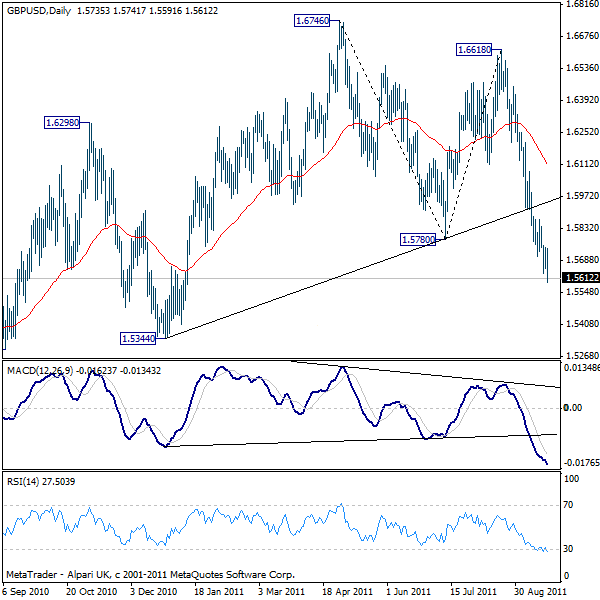
GBP/USD's fall resumes after brief consolidations and drops to as low as 1.5591 so far today. Intraday bias is back on the downside and further decline should be seen to next key medium term support at 1.5344. On the upside, above 1.5747 minor resistance will argue that a short term bottom is formed with bullish convergence condition in 4 hours MACD. In such case, lengthier consolidation would be seen before GBP/USD stages another decline.
In the bigger picture, rise from 1.4229, which is treated as the third leg of consolidation from 1.3503 (2008 low) should be finished at 1.6746 after GBP/USD completed a head and shoulder top reversal pattern (ls: 1.6298, h: 1.6746, rs: 1.6618). Fall from 1.6746 could be the fourth leg of the consolidation pattern from 1.3503 (2008 low) or resuming long term down trend from 2.1161 (2007 high). In either case, a test on 1.3503/4229 support zone should be seen. On the upside, break of 1.6618 resistance is needed to invalidate this view. Or we'll now stay cautiously bearish in GBP/USD.

USD/JPY Daily Outlook

Daily Pivots: (S1) 76.27; (P) 76.52; (R1) 76.68; 
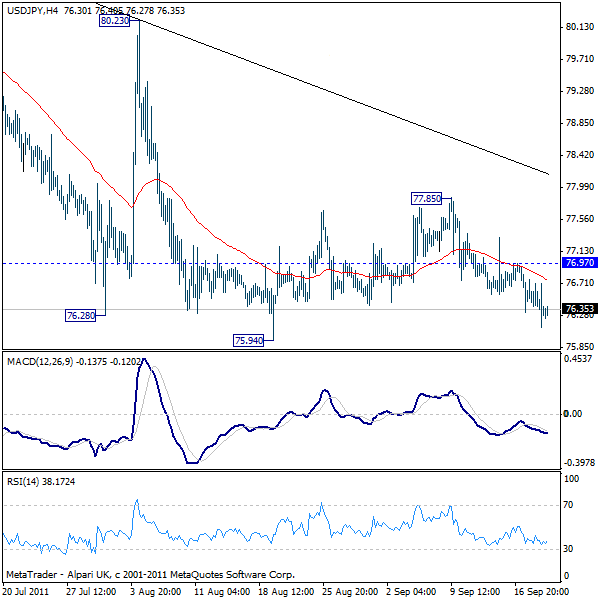
Intraday bias in USD/JPY remains on the downside and current fall is still in progress for 75.94 support. As noted before, consolidation from 75.94 should have completed at 77.85 already. Break of 75.94 will confirm resumption of whole fall from 85.51. On the upside, above 76.97 minor resistance will delay the bearish case again and turn bias neutral to extend the consolidation from 75.94.

In the bigger picture, USD/JPY is still staying well inside the falling channel that started back in 2007 at 124.13. There is no indication of trend reversal yet even though medium term downside momentum is diminishing with bullish convergence condition in weekly MACD. Such down trend is still in favor to continue to 70 psychological level. In any case, break of 80.23 resistance is first needed to indicate completion of fall from 85.51. Secondly, break of 85.51 is needed to be the first signal of medium term reversal. Otherwise, we'll stay cautiously bearish in the pair.


Economic Indicators Update

GMT Ccy Events Actual Consensus Previous Revised
22:45 NZD Current Account Balance Q2 -0.92B -0.69B -0.10B -0.09B
23:50 JPY Trade Balance Aug -0.29T -0.01T -0.13T -0.16T
0:30 AUD Westpac Leading Index M/M Jul 0.50T
0.10%
2:00 CNY Leading Indicator Jul 0.60%
1.00% 0.90%
4:30 JPY All Industry Activity Index M/M Jul 0.40% 0.50% 2.30%
8:30 GBP BoE Minutes 0--0--9 0--0--9 0--0--9
8:30 GBP Public Sector Net Borrowing (GBP) Aug 13.2B 11.4B -2.0B -5.2B
11:00 CAD CPI M/M Aug 0.30% 0.10% 0.20%
11:00 CAD CPI Y/Y Aug 3.10% 2.90% 2.70%
11:00 CAD BoC CPI Core M/M Aug 0.40% 0.20% 0.20%
11:00 CAD BoC CPI Core Y/Y Aug 1.90% 1.60% 1.60%
14:00 USD Existing Home Sales Aug
4.75M 4.67M
14:30 USD Crude Oil Inventories
-1.6M -6.7M
18:15 USD FOMC Rate Decision
0.25% 0.25%

Daily Report: Aussie Firm after GDP, BoJ on Hold, BoC Next

Australian dollar is lifted mildly by stronger than expected GDP data and rebound in stocks in Asian session. The RBA statement yesterday basically indicates that the bank will be on hold for a while and there is no intention for rate cut yet. And the view is affirmed by today's GDP data, which showed 1.2% qoq expansion in Q2 versus consensus of 1.0% qoq. Meanwhile Q1's contraction was also revised from -1.2% qoq to -0.9% qoq. Asian equity indices are also broadly higher as DOW managed pare much earlier loss to close down -100pts only overnight.

BoJ kept monetary policies unchanged as widely expected today. Interest rates is kept at 0-0.1% while the asset purchase program was kept at JPY 50T. The vote was unanimous. In the accompanying statement, the bank said that the virtually zero interest rate policy will continue until "price stability is in sight on the basis of the understanding of medium- to long-term price stability." While the bank refrained from adding stimulus this time, it's believed that BoJ is just waiting to see how this month's FOMC meeting affects markets and after the new government settles before acting.

BoC will be a main focus today. Recent headwind in global economic outlook should deter BOC's tightening schedule. We believe the central bank will leave the policy rate unchanged at 1% in September. Indeed, Fed's decision to keep interest rates at exceptionally low levels at least until mid-2013 and the increasing downside risks to inflation signaled the BOC will leave the overnight rate unchanged at least until mid -2012. That said, it's also unlikely for the central bank to trim interest rates as headline inflation remains high and the job market is robust. 

On the data front, UK BRC shop price index rose 2.7% yoy in August. Japan leading indicator rose to 106 in July. Australia Q2 GDP expanded 1.2% qoq. UK industrial and manufacturing production are both expected to be flat mom in July. German industrial production is expected to rose 0.5% mom in July. Canada Ivey PMI is expected to rise slightly to 46.7 in August. Fed will also release the Beige Book economic report.

AUD/CAD's long term up trend is still intact and is possibly resuming. Near term focus will be on 1.0555 resistance and break will confirm up trend resumption. However, note that the cross has been losing upside momentum as seen with bearish divergence condition in weekly MACD. Thus, even in case of strong rise, we'll be cautious on reversal signal as AUD/CAD approaches 100% projection of 0.9605 to 1.0555 from 0.9913 at 1.0863. 

AUD/USD Daily Outlook

Daily Pivots: (S1) 1.0434; (P) 1.0530; (R1) 1.0580;

AUD/USD formed a temporary low at 1.0481 and recovered. Intraday bias is turned neutral for the moment. So far, we're still favoring the case that corrective rebound from 0.9926 is over with three waves up to 1.0764. Hence, we'd expect the current recovery to be limited below 1.0764 and bring another fall. Below 1.0481 will target 1.0314 support first. Break will target a test on 0.9926 low. Nevertheless, break of 1.0764 will invalidate this view and bring stronger rise towards 1.1079 high instead.

In the bigger picture, rise from 0.8066 has completed with bearish divergence in daily MACD at 1.1079. However, AUD/USD is staying well inside long term rising channel from 2008 low of 0.6008. Hence, there is no indication of trend reversal yet and the price actions from 1.1079 are viewed as a correction only. Hence while deeper decline would be seen to long term channel support and possibly below, we'd expect strong support from 0.9404 resistance turned support to contained downside. 

Daily Report: Concern on European Sovereign Crisis Sends Gold to Record High, Dollar Firm

Concerns over European sovereign crisis continue to wait on market sentiments and support dollar and yen. Funds continue to flow into safe haven assets, pushing gold to new record high against dollar and euro. Dollar index's break of 75.38 resistance suggests more upside in the greenback in near term. Asian equities are broadly lower with Japanese Nikkei closed at the lowest level since April 2009. Meanwhile, German bund yields extends recent decline and reached new all time low of 1.799%.

There were intensified worry as ECB and the IMF were in disagreement regarding the capital requirements of European banks. In a draft of the Global Financial Stability Report, the IMF unveiled that the funding needs for European banks would be as much as 200B euro. ECB President Trichet said 'there is a very important disagreement on the methods for calculating the capital needs' and he is 'convinced that the final IMF figure will not be that[probably much lower]'. At the same time, Trichet urged debt-ridden countries such as Greece and Italy to strictly implement austerity measures as planned.

As expected the RBA left the cash rate unchanged at 4.75% in September. The initial market reaction was a rebound in the Aussie as the post-meeting statement turned out to be less dovish than previously anticipated. The central bank attributed the pause to the growing uncertainty in global economic outlook. Recent developments have damped confidence and tamed inflation. Against some of the market participants' forecasts, the RBA did not hint any signs on rate cut.

On the data front, UK BRC retail sales monitor dropped -0.6% yoy in August. Australian current account deficit narrowed to AUD -7.4b in Q2 but was wider than expected. Australian home loans rose 1.0% in July CPI dropped -0.3% mom rose 0.2% yoy in August. Looking ahead Eurozone CPI revision, German factory orders will be released. Main focus should be on US ISM non-manufacturing index while is expected to drop 51.3.
XAU/EUR's uptrend resumes this week by taking out 1331.41 resistance and reaches as high as 1366.56 so far. There is no sign of topping yet and further rise is still expected. Break of 261.8% projection of 954 to 1088 from 1021 at 1372 should send XAU/EUR through 1400 psychological level. 
Dollar index's break of 75.38 minor resistance suggests that stronger rebound is under way for 76.71 resistance. It also raises the chance that whole down trend from 88.70 has completed at 72.69 already. Nevertheless, we'd still prefer to see sustained break of 76.71 to confirm. Otherwise,we'll stay neutral. 

EUR/USD Daily Outlook

Daily Pivots: (S1) 1.4045; (P) 1.4109 (R1) 1.4158; 

EUR/USD's fall from 1.4548 extends further to as low as 1.4038 and breaks mentioned 1.4054 support. Intraday bias remains on the downside and further decline should now be seen towards 1.3837 support next. On the upside, above 1.4175 minor resistance will turn bias neutral and bring recovery first. But after all, as long as 1.4548 resistance holds, consolidations from 1.4939 is still in progress and more choppy sideway trading would be seen in near term.

In the bigger picture, EUR/USD is still trading above medium term trend line support from 1.1875 (now at 1.3941) and thus, rise from there should still be in progress. Break of 1.4939 should confirm rally resumption and should send EUR/USD through 1.5143 resistance towards 1.6039 high. However, considering that weekly MACD has been staying below signal line for some time now, a break below 1.3837 will have the trend line support, as well as 55 weeks EMA firmly taken out. That would argue that the rally from 1.1875 has indeed finished and will bring deeper fall towards 1.2873 support and possibly below.

Daily Report: Risk Rally Continues Cautiously as Manufacturing Data in Spotlight Today

Risk rally extend mildly today but investors are generally cautious ahead of some important manufacturing data today. Appetite for risks is also dampened mildly by slightly weaker than expected China Manufacturing PMI as well as the surprised rate cut from Brazilian central bank. Euro and sterling are mildly softer as dragged down by rebound in Swiss Franc in EUR/CHF and GBP/CHF. Also, commodity currencies are also losing some upside momentum against the greenback.


Manufacturing data will be a key focus today. China PMI recovered from 29 month low of 50.7 to 50.9 in August but was slightly below expectation of 51. Eurozone manufacturing PMI finalized release will be released in European session today and is expected to be unrevised at 49.7 UK manufacturing PMI is expected to rise slightly to 49.5. Swiss SVME PMI is expected to dropped to 51.2 in August. US ISM manufacturing is expected to dropped to 48.5 in August. If inline with expectation, all, Eurozone, UK and US manufacturing PMI will be below 50, which suggests mild contraction ahead and will raise of risk that the global economy is entering back into recession. Other data to note include Australia retail sales, which rose slightly more than expected by 0.5% mom in July. Swiss Q2 GDP, retail sales, US jobless claims, non-farm productivity and construction spending will also be featured.


Swiss Franc remains firm as markets believe SNB won't intervene for the time being. Switzerland's Economy Minister Johann Schneider-Ammann said yesterday that the country have to "keep living with the strong franc for some time. It must be a combination of measures that will lead us into the future." Meanwhile, the Swiss government also pledged to use CHF 870m for an economic stimulus package to lessen the impact of the strength in Swiss Franc, aiming at supporting tourism, and exports. Technically, USD/CHF, EUR/CHF and GBP/CHF seem to have made short term tops earlier this week and are likely to pare back some of the strong intervention inspired gains. Nevertheless we'd be cautious in particular when EUR/CHF dips back below 1.1 level. It's still believed that SNB is determined to defend parity in EUR/CHF.


While risk appetite remains firm so far, we'd like to point out that stocks should be facing strong resistance in near term and investors would start to be cautious at current level and would likely weight for September's FOMC meeting for Fed to announce new stimulus. 55 days EMA in DOW at 11771 and 11862 resistance should hold in near term at least and traders will use every reason for profit taking, including possibility of poor ISM today and NFP tomorrow. 

EUR/CHF Daily Outlook

Daily Pivots: (S1) 1.1452; (P) 1.1651; (R1) 1.1778; 

Considering bearish divergence condition in 4 hours MACD, EUR/CHF might have made a short term top at 1.1971. Intraday bias is cautiously on the downside for the moment and sustained break 4 hours 55 EMA (now at1.1555) should bring deeper pull back to 1.1163 support and below. On the upside, though, above 1.1971 will extend the strong rebound from 1.0061 towards 1.2399 medium term support turned resistance next.

In the bigger picture, the strength of the rebound from 1.0061 argues it's a medium term bottom and EUR/CHF has turned into a phase of medium term consolidation. Sustained trading above 55 days EMA should bring stronger rise back to 1.2399/3243 resistance zone but strong resistance should be seen there to bring reversal. On the downside, decisive break of parity is needed to confirm down trend resumption. Otherwise, we'll now stay neutral in the cross and expect some more consolidations above there. 

Economic Indicators Update


GMT Ccy Events Actual Consensus Previous Revised
22:45 NZD Terms of Trade Index Q/Q Q2 2.30% 0.60% 0.90% 0.80%
1:00 CNY PMI Manufacturing Aug 50.9 51 50.7
1:30 AUD Retail Sales M/M Jul 0.50% 0.30% -0.10%
5:45 CHF GDP Q/Q Q2
0.40% 0.30%
6:00 EUR German GDP Q/Q Q2 F
0.10% 0.10%
7:15 CHF Retail Sales (Real) Y/Y Jul
4.60% 7.40%
7:30 CHF SVME-PMI Aug
51.2 53.5
8:00 EUR Eurozone PMI Manufacturing Aug F
49.7 49.7
8:30 GBP PMI Manufacturing Aug
49.5 49.1
12:30 USD Initial Jobless Claims
409K 417K
12:30 USD Unit Labor Costs Q2 F
2.30% 2.20%
12:30 USD Non-Farm Productivity Q2 F
-0.50% -0.30%
14:00 USD Construction Spending M/M Jul
0.10% 0.20%
14:00 USD ISM Manufacturing Aug
48.5 50.9
14:00 USD ISM Prices Paid Aug
55 59
14:30 USD Natural Gas Storage
61B 73B

Weekly Review and Outlook: Markets Stayed in Range as Bernanke Delayed Focus to Sept FOMC Meeting

Markets were generally quiet before Bernanke's highly anticipated speech in Jackson Hole symposium, except that gold jumped to record high above 1900 then dropped to 1705 on a sharp pullback. And, after the speech, which Bernanke provided no signal of QE3, markets went wide from initial risk-off and reversed to risk-on. But after all, the activities, most instruments stayed in recent ranges. DOW is bounded inside 10604/11529, Crude oil inside 75.71/89.00, 10 year yield inside 1.978/2.29, dollar index inside 74.18/75.38. Risk sentiments would likely remain steady this week as investors await the next key event of US non-farm payroll.

To make it short, Bernanke dropped no hints on QE 3 from Fed in the speech on Friday and instead, pledged that Fed is "prepared to employ its tools as appropriate to promote a stronger recovery". Also the September FOMC meeting will be extended by one day to “to allow a fuller discussion” on "relative merits and costs" of further monetary stimulus, as well as "economic and financial developments". While stocks were initially sold off after Bernanke's speech, the strong rebound afterwards could be seen as a sign that investors are still optimistic that Fed would do something in September.
The currency markets were generally mixed last week as major crosses were bounded in familiar range. Though, Swiss Franc was noticeably weaker on Friday. There were rumors that Swiss banks would start to charge for franc deposits. This would be another step by SNB to revers Franc's exceptional strength this year, after boosting liquidity, lowering rates earlier.

The Japanese yen attempted a rally after Prime Minister Naoto Kan stepped down. However, gains were limited so far. New prime minister will be selected on Monday and the new government will outline a list of suggestions to deal with a strong yen. However, Economic and Fiscal Policy Minister Kaoru Yosano noted that yen-selling intervention "is a necessary weapon but not one we can use frequently." So, yen crosses would possibly feel heavy at the start of the week.

Australian dollar was also strong after RBA Governor Steven's comments lowered speculations of rate cut from the central in near term. Stevens said that markets are in times of "tremendous turbulence" and it's a "good thing just to sit still". The comments dented that speculation that RBA would kick start a rate cutting cycle and helped lifted AUD/USD towards the end of the week, in particular as stocks rebounded following Bernanke's speech.

Technical Highlights
After much volatility, DOW continued to stay in familiar range above 10604 short term bottom. Consolidations from there would like expect continue for a where. But there is no change in the bearish outlook. 12876 is at least a medium term top on head and shoulder reversal. Current consolidation from 10604 is expected to be limited by 11862 support turned resistance and bring another fall. Break of 10801 support will signal fall resumption to 10000 psychological level first eventually to 9614 (50% retracement of 6470 to 12876 at 9672) at least. 
The CRB commodity index also stayed in tight range after drawing some support from 55 weeks EMA earlier. The structure of the pull back from 370.70 to 315.40 looked corrective so far and more rally could still be seen. Though, we'd prefer to see a break of 351.54 resistance before turning bullish on commodities. Otherwise, then index would possibly gyrate further lower. 
Dollar index continued to stay in tight range of 74.18/75.38 inside a not so wider range of 73.50/76.71. Outlook in the index remains neutral even though we'd prefer a downside breakout as long as 75.38 resistance holds. Break of 74.18, is accompanied by a break of 351.54 in CRB, would likely send the dollar index through 72.69 support to extend the down trend from 88.70. However, note that stocks would likely remain steady at best and is vulnerable to deeper selloff later in September. Indecisive to bearish risk sentiments would possibly keep downside of the dollar index contained by historical low of 70.70 even in case of down trend resumption. And there would be prospect for a sizeable rebound on risk aversion should DOW breaks 10000 level later. 
The Week Ahead
Heavy weight economic data, including ISM and NFP from US will be the main focus this week on driving risk sentiments. In additional, markets will also watch China manufacturing PMI closely. FOMC minutes should reveal the intense debate on using the language of keeping rates low till mid-2013. Also, markets will pay attention to any new measures from Japan curbing yen strengthen as well as from SNB regarding Swiss Franc.
  • Monday: German CPI; US personal income and spending;
  • Tuesday: Japan household spending, unemployment rate, retail sales; Australia building approvals; Swiss UBS consumption indicator; UK M4 money supply, mortgage approvals; Canada IPPI, RMPI; US S&P/Case Shiller house price, consumer confidence, FOMC minutes
  • Wednesday: UK Gfk consumer confidence; Japan manufacturing PMI, industrial production, housing starts; German unemployment; Eurozone CPI, unemployment; US ADP job report, Chicago PMI, factory orders; Canada GDP
  • Thursday: China manufacturing PMI; Australia retail sales; Swiss GDP, retail sales, SVME PMI; Eurozone manufacturing PMI; UK manufacturing PMI; US jobless claims, ISM manufacturing
  • Friday: UK construction PMI; US non-farm payroll

USD/CHF Weekly Outlook

USD/CHF's rebound form 0.7065 extended further to as high as 0.8156 last week and closed strongly. Initial bias remains on the upside this week for further rally. We'll be cautiously looking for reversal signal at current level as USD/CHF is now pressing the falling 55 days EMA as well as facing medium term calling channel resistance. Nevertheless, break of 0.7769 support is needed to signal short term reversal, otherwise, outlook will remain cautiously bullish. Break of 0.8275 will pave the way to 38.2% retracement of 1.1730 to 0.7065 at 0.8847.

In the bigger picture, while the rebound from 0.7065 was strong, there is no indication of trend reversal yet. We'll stay bearish as long as 0.8275 support turned resistance holds. Current down trend from 1.1730 is still expected to extend through 0.7 psychological level. Though, that would come after some more consolidations above 0.7065 first. Meanwhile, sustained trading above 0.8275 will indicate that such fall from 1.1730 might have finished and open up the possibility of rebounding back to 0.9634 support turned resistance.
In the longer term picture, long term down trend from 2000 high of 1.8305 is still in progress. There are various interpretation of the price actions. But after all, USD/CHF should be resuming the set of impulsive fall from 1.8305 to 1.1288. The current down trend might now be targeting next projection level of 100% projection of 1.8305 to 1.1288 from 1.3283 at 0.6266.

Sterling At 3 Month High Against The Usd

Again a lot of the action on forex markets in the past 24 hours has centered around the Swiss franc. This fell in early trade yesterday on speculation that the Swiss might either intervene directly or set a floor on the €-CHF exchange rate after the government met to discuss measures to curb the currency’s appreciation. Markets, though, were disappointed as neither of these measures were announced. Rather the Swiss National Bank just boosted liquidity though it reiterated that it would take additional steps if necessary. As a result the CHF regained its ground against the euro. It has, though, again spiked lower against the euro in early trading this morning on talk that the SNB was again adding liquidity through the currency markets.
While firmly within recent ranges, the euro yesterday had another choppy day’s trading against the dollar. It initially rose strongly against the US currency, with concerns about the weakening global environment weighed on the USD. Meanwhile, the euro benefited from an improvement in risk appetite as corporate earnings helped Wall Street higher. However, the rallies in both stocks and the euro faltered. Dovish comments from the ECB’s Nowotny this morning have also been unhelpful and the euro again starts the day trading around the $1.44 level ahead of a heavy US data schedule.
Sterling, meanwhile, hit a three and a half month high against the dollar. This in part reflected short covering as traders who had sold the UK currency following the weak labour market data and dovish MPC minutes were forced to buy back sterling as the dollar subsequently weakened. The minutes of the August MPC meeting showed all nine members voted for keeping rates steady, which is the first time we’ve seen this convergence of views since May 2010. Given the recent data, combined with developments in the global economy, the shift was not that much of a surprise. It would have been more surprising to see both members (Dale and Weale) sticking to their guns and continuing to vote for higher rates.

Daily Report: USD/JPY Recovers as BOJ and MOF Met to Discuss Yen's Strength

The greenback was confined in relative narrow range after yesterday's volatile price actions in thin trading conditions in Asia. After falling sharply against European counterparts yesterday, dollar recovered against most major currencies. USD/JPY edged higher on news of a meeting between senior finance ministry and Bank of Japan officials today and they exchanged views on currency rates. Japanese officials also expressed their concerns over the negative impact of yen strength to the country's export sector. Vice Finance Minister for International Affairs Takehiko Nakao and Bank of Japan Executive Director Hiroshi Nakaso held a meeting at the BOJ headquarters, giving a sign to the market that Japanese officials are ready to take further action to curb yen's rise. The official made comment after the meeting that both BOJ and MOF will work as a team to deal with the yen's strength. Similar meeting between the BOJ officials and Senior member of MOF was held before also in August 2010 discussing the same topic, the two organizations gave a joint statement warning markets against excessive yen volatility last time but no plan for such statement yet according to BOJ spokesman. With the USD/JPY trading comfortably below 77.00 for more than a week, more and more traders are expecting the currency pair to hit record low of 76.25 soon (later this week or next week the latest), some dealers suggest it needs to clear stops and option barriers below 76.25 first before hitting decent size bids below 76.00, then the greenback would have the power to stage a real rebound back to 77.00 and even 78.00 level. Market liquidity may improve next week when most Japanese investors and traders return from their summer holidays (O-Bon holidays), however, one should note that exporters may also resume their selling of dollar for month end transactions. At the moment, it looks like orders in EUR/JPY are working the round with offers in good size at 111.00-10 (stops above) whilst bids are also reported protecting stops below 110.00.

Although the single currency rose quite sharply yesterday from 1.4325 to a 3-week high of 1.4517, traders found it very difficult to push euro further north with recent releases of soft growth and production data in eurozone. Comments from ECB's council member Ewald Nowotny also seen pressured the single currency as he expressed in an interview with newspaper on his fears of a phase of low growth rates and low inflation in the eurozone, He said growth has slowed more than expected in the region with the debt problems, he also indicated that it is too early to make decision about implementing eurozone bond. In order to solve the regional debt problems, he would prefer to prioritize the implementation of policies agreed earlier in July meeting. EUR/USD gave back over half of yesterday's advance partly due to risk-off trades as most Asian equities are in red zone, bids at 1.4390-00 were filled. Option maturity today include 1.4250, 1.4225 and 1.4500 all NY cut.

The British pound traded with a relatively firmer footing as dealers await the release of UK July retail sales data, as indicated in our previous update that some traders are betting the number to show better-than-expected readings due to the boost from Royal Wedding.
The Swiss franc remained locked in familiar range after yesterday's disappointment from SNB, however, USD/CHF and EUR/CHF just rebounded in European morning on talk of SNB injecting liquidity into the market, in line with what the central bank said it would do yesterday. USD/CHF quickly bounced from 0.7891 to 0.7991 and EUR/CHF also jumped sharply from 1.1370 to 1.1515. At the moment, there are also rumors of rate checking by SNB.

On the data front, in addition to the indicated UK retail sales data, focus will be on the release of U.S. existing home sales figure (14:00GMT) and more importantly the July CPI data at 12:30GMT with market consensus centered at 0.2% m/m and 3.3% y/y, core CPI at 0.2% m/m and 1.7% y/y.

USD/JPY Daily Outlook

Daily Pivots: (S1) 76.37; (P) 76.60; (R1) 76.80; 

USD/JPY is still staying in tight range for the moment and intraday bias remains neutral. No change in the outlook that further decline is expected with 77.32 minor resistance intact. Break of 76.28 will confirm resumption of the whole decline from 85.51 and should target 100% projection of 81.46 to 76.28 from 80.23 at 75.05 next. On the upside, above 77.32 minor resistance will bring stronger recovery. But we'll stay cautiously bearish as long as 80.23 resistance holds.

In the bigger picture, USD/JPY is still staying well inside the falling channel that started back in 2007 at 124.13. There is no indication of trend reversal yet even though medium term downside momentum is diminishing with bullish convergence condition in weekly MACD. Such down trend is still in favor to continue to 70 psychological level. In any case, break of 80.23 resistance is first needed to indicate completion of fall from 85.51. Secondly, break of 85.51 is needed to revive the case that USD/JPY's down trend has finished. Otherwise, we'll stay cautiously bearish in the pair.

Daily Report: Euro Retreats from 3-week High ahead of Eurozone GDP

The single currency retreated from 3-week high against the greenback as some traders booked profit on their long euro position ahead of the meeting between French President Sarkozy and German Chancellor Merkel. The meeting will be held in Paris and is scheduled to start at 1400 GMT, followed by a joint news conference at 1600 GMT. As indicated in our previous update that Eurobonds will not be discussed in the summit, investors bet the meeting will be very much non-event and only the two leaders may only talk about improving economic governance, so no specific measures will be announced to deal with the regional debt crisis contagion. If that is that case, then traders' focus will probably shift back to the release of several European economic data today, including German Q2 GDP (forecast at 0.5% vs previous 1.5%) at 06:00GMT and eurozone Q2 GDP (consensus at 0.3% against prior 0.8%). Both are preliminary data and the forecasts are weaker than previous readings, if the data (especially the eurozone GDP) do come in weaker than expected, concerns over debt crisis of peripheral countries plus Spain and Italy will be once again heightened. Basically traders are already betting there may be higher chance the number will be weak with previous manufacturing PMI all showed soft readings. Stops below 1.4400 were triggered and only light bids are reported at 1.4370 and 1.4350 with more stops seen below latter level and 1.4300.

The retreat in EUR/CHF was another reason on today's pullback in euro, after surging over 1300 points from the record low of 1.0075, the currency pair finally reached a temporary top at 1.1458 yesterday. Although EUR/CHF opened higher yesterday and rose by 2.2% on Sunday's newspaper report that the SNB was poised to set a target rate above 1.10 Swiss franc per euro, the pair retreated as traders found the level of 1.13-1.14 too attractive to buy Swiss franc. With more and more dealers not convince of an actual EUR/CHF peg plus persistent eurozone debt problem, sooner or later renewed safe-haven demand will emerge again. Current speculation is that the SNB may take action tomorrow (17 Aug) and if there is any disappointment caused by the Swiss authorities, the franc may once again surge across the board. It was quite obvious that the Swissy met heavy offers right ahead of the psychological 0.8000 level and bids at 0.7800 were absorbed this morning, next batch of buying interest is tipped at 0.7700 by UK name and offers from same party are also noted at 0.7850-60 and further out at 0.7900-10.

The British pound also slipped since overnight New York session as traders squared there long cable position ahead of some important UK data due out later today. The highlight of the day will be on July CPI with forecast centered at -0.1% m/m and 4.3% y/y, consensus for core CPI at 3.0%; UK RPI will also be released at 08:30GMT with economists expecting -0.2% m/m and 5.0% y/y. DCLG house price data will also be published at the same time but will have much less effect on sterling. Some traders already priced in a lower-than-expected CPI which may lead to a downward revision of BOE quarterly inflation report, hence put pressure on the British pound.

Elsewhere, the release of RBA's August meeting minutes dragged aussie down a bit, overall tone from the minutes was quite balance but it did not suggest any sign that the central bank was considering cutting rates in the near future. In wake of the ‘acute' uncertainty in global financial markets, committee members voted against a rate hike in the last meeting. The minutes also stated that subdued consumer spending and higher Australian dollar were seen dampening inflation, the central bank saw downside risks more pronounced and it was prudent to hold rates whilst assessing the economic growth. Nevertheless, no surprise was seen from the document but some traders interpreted as there is very much unlikely that RBA will raise rates.

EUR/JPY Daily Outlook

Daily Pivots: (S1) 109.94; (P) 110.49; (R1) 111.49; 

Intraday bias in EUR/JPY remains neutral for the moment. While recovery from 108.01 might extend further, we'd continue to expect upside to be limited by 111.23 minor resistance and bring fall resumption. Below 109.62 minor support will flip bias back to the downside. Further break of 108.01 will extend the whole decline from 123.31 towards 105.42/106.28 support zone. On the upside, above 111.23 will bring stronger rebound. But after all, we'd stay cautiously bearish as long as 114.17 resistance holds and expect more downside ahead.

In the bigger picture, current development suggests that rebound from 105.42 medium term bottom was merely a correction and has completed at 123.31 already. Whole down trend from 2008 high of 169.96 was not finished yet and should extend beyond 105.42. Also, as weekly MACD will most likely break its trend line as the current fall from 123.31 extends, EUR/JPY is possibly regaining medium term downside momentum too. Break of 105.42 will target 61.8% projection of 139.21 to 105.42 from 123.31 at 102.42 first. Though, note that break of 123.31 resistance will in turn revive the case that the medium term trend has reversed and will turn focus back to 139.21 resistance instead. 

Weekly Review and Outlook: Risk Sentiments Stabilized for Now, More Consolidations Before Jackson Hole

Risk selloff intensified initially last week in response to S&P's downgrade of US rating and the hollow statement G7 regarding the current market turmoil. Though, sentiments "stabilized" as the week went on, after Fed pledged to keep rates low until mid-2013. The attempt to extend the spotlight of European debt crisis to France was unsuccessful and that's followed by banning of shorting financial stocks in France, Italy, Spain and Belgium. Also, Spanish and Italian yields dropped sharply after ECB buying. Major world equity indices recovered strongly from intra-week lows. However, we believe that the market sentiments were just "stabilized" rather than reversed. The European debt crisis won't go way that easily. And global economies, including US, UK and Eurozone are poised to slow down on austerity measures, dragging down other parts of the world. So, risk assets will remain vulnerable to further selloff even though more consolidations would likely be seen before Bernanke's Jackson Hole Speech on August 26.

The Fed delivered a much more dovish policy statement in August as the path of recovery has been 'considerably slower than expected'. As a prelude to additional easing, the central bank pledged for the first time that interest rates will stay at exceptionally low levels at least until mid-2013 and reinvestment of maturing proceeds will be maintained. Wall Street rebounded after the report as investors looked forward for additional stimulus in coming meetings. Meanwhile, markets will be eagerly waiting for Bernanke's speech in the Jackson Hole meeting. Bernanke announced QE2 at Jackson Hole last year and there are rumors that he will also announcement something that moves market this year. That might include additional bond purchases of over $1T, targeting at long term securities like 10 year and 30 year bonds to push funds back to risk assets. In addition, Fed might remove the interest payments given to excess bank reserves at the central bank. We'll wait and see what Bernanke finally delivers.

In the currency markets, the biggest shock was the reversal in Swiss Franc's strength after SNB official talked about temporary peg to Euro. SNB Vice Chairman Thomas Jordan was quoted saying "any temporary measures to influence the exchange rate are permissible under our mandate as long as these are consistent with long-term price stability," and that could include a temporary peg to Euro. SNB's move of cutting rates, adding liquidity to the markets are so far very ineffective. Meanwhile, SNB officials should be aware of the fact that outright intervention in the markets in 2009/10 caused substantial losses with little impact and almost triggered Chairman Philipp Hildebrand to step down. While we should still have a long distance from pegging Swiss Franc with Euro, the SNB might have strong determination to defend EUR/CHF from breaching parity. A wide range of tools could still be used and as Jordan hinted, that might include creating negative interest rate environment for non-resident Swiss Franc deposits. There is also call for tax on foreign deposits.

While the Swiss franc pulled back sharply, the Japanese yen was the strongest currency last week on safe haven flows. Though, we saw some hesitation to push the Japanese yen further lower towards the end of the week, partly due to recovery in stocks. Japan's Finance Minister Yoshihiko Noda declined to comment on the effectiveness of the unilateral intervention on August 4. But he warned that Japan would consider various options to curb yen's strength if excessive yen rises persist.

The BOE lowered its economic forecasts amid global economic turmoil. In the latest quarterly inflation report, policymakers stated that the biggest risk came from sovereign crisis in the Eurozone. Risks to growth are skewed to the downside as slowdown in growth may turn out to be more persistent than previously expected. The BOE retained the view that inflation will return to a little below target in the medium-term. The BOE left the Bank rate unchanged at 0.5% and the asset purchase program at 200B pound at the meeting last week. Yet, it reiterated the flexibility to add or remove stimulus measures when conditions warrant.

Technical Highlights
S&P 500 dived to as low as 1101.54 last week before drawing support from 38.2% retracement of 666.79 to 1370.58 at 1101.73 and recovered. A short term bottom is in place. However, note firstly that price actions from 1101.54 are so far corrective which suggests it's merely consolidations. Also, please be reminded that S&P 500 completed a medium term head and shoulder reversal pattern earlier (ls: 1344.07, h: 1370.58, rs: 1339.62). The trend line from 666.79 was also firmly broken. So, we'd believe that whole up trend from 666.79 was over. Hence, upside of the current consolidation should be limited by neck line resistance at around 1260 level and bring fall resumption. S&P 500 should eventually break through 1101.54 towards 1010.91 key support and below. 

Dollar index continued to engage in range trading around 55 days EMA last week. Near term outlook remains neutral. The dollar index might continue stay in range of 74/77 for a while but the current development is still favoring more downside. Break of 74.18 will likely send the index through 72.69 towards 70.70 record low.  

GBP/CHF basically followed other swiss crosses, diving to new record low of 1.1464 initially then rebounded strongly. A short term bottom is in place after brief break of long term target of 161.8% projection of 2.4965 to 1.5112 from 1.8113 at 1.2024. More rise would likely be seen initially this week. But at this point, we'd expect strong resistance from 1.3038 cluster resistance (38.2% retracement of 1.5691 to 1.1464 at 1.3079) to limit upside. We'd expect some sideway consolidation above 1.1464 before the long term down trend finally resumes to parity. 

Australian dollar has been extremely weak in the past two weeks, just as other commodity currencies. EUR/AUD's rebound from 1.2927 extended to as high as 1.4261 but failed 1.4341 resistance and retreated. AUD/USD is at a junction as it's just hold above a medium term retracement level. And Aussie's fate would very much depends on whether AUD/USD would have another deep fall and on whether EUR/AUD would take out 1.4341 resistance. Decisive break of 1.4341 will complete a double bottom reversal pattern (1.2926, 1.2927) and would signal completion of the down trend from 2.1127 and medium term reversal. But before that, we'll stay neutral in cross first.

The Week Ahead
Risk sentiments should remain stable this week and stocks, as well as commodity currencies might extend recovery. But upside potential should be relatively limited and markets would like like stay in range for a while. Dollar, Euro and Sterling would likely stay in range against each other, going nowhere though the pound is vulnerable to some weakness considering the even risks. Swiss France and Japanese yen might try to regain some strength towards the end of the week.
  • Monday: Japan GDP; US Empire State Manufacturing, TIC capital flow, NAHB housing market index
  • Tuesday: RBA minutes; German GDP, Eurozone GDP; UK CPI; US new residential construction, industrial production; New Zealand PPI
  • Wednesday: UK employment, BoE minutes; Eurozone CPI; UK PPI
  • Thursday: Japan trade balance; UK retail sales; US CPI, jobless claims, existing home sales, Philly Fed survey
  • Friday: German PPI; UK public sector net borrowing; Canada CPI

USD/CHF Weekly Outlook

USD/CHF dived to new record low of 0.7065 last week but staged a strong rebound since then as the Swiss Franc pulled back sharply after SNB comments. At short term bottomed is formed at 0.7065 and we'd expect more consolidations above this level for a while. Further rebound is expected initially this week to 0.7801 resistance and above. Though, we'd expect upside to be limited below 0.8081 resistance and bring another fall to extend the consolidations. Below 0.7548 minor support will flip bias back to the downside for retesting 0.7065 first.
In the bigger picture, while the rebound from 0.7065 was strong, there is no indication of trend reversal yet. We'll stay bearish as long as 0.8275 support turned resistance holds. Current down trend from 1.1730 is still expected to extend through 0.7 psychological level. Though, that would come after some more consolidations above 0.7065 first. Meanwhile, sustained trading above 0.8275 will indicate that such fall from 1.1740 has finished and open up the possibility of rebound back to 0.9634 support turned resistance.
In the longer term picture, long term down trend from 2000 high of 1.8305 is still in progress. There are various interpretation of the price actions. But after all, USD/CHF should be resuming the set of impulsive fall from 1.8305 to 1.1288. The current down trend might now be targeting next projection level of 100% projection of 1.8305 to 1.1288 from 1.3283 at 0.6266.

Ratings and Recommendations