Financial Advisor
Showing posts with label Daily Market Commentary. Show all posts

EURUSD - Cautiously Bearish below 1.4258

After initially continuing Wednesday’s decline, EURUSD selling pressure stalled near 1.4100 Thursday. This downside failure was countered by the weakness of subsequent demand and a renewal of some selling pressure in Asia.

Overall this week's trading has been volatile but ultimately without direction. Nonetheless overnight price action gives a mildly negative tone and so our call is very Cautiously Bearish while below 1.4258. The immediate objective is 1.4155 with a move beneath that point targeting yesterday's 1.4104 low, or even 1.4055, last week's  bottom.

The risk to this call is that selling pressure is weaker than currently assessed although a fresh outright Buy signal would only be generated by a move through 1.4258. Prices and sentiment should then improve to 1.4293, yesterday's top, or even 1.4375, Wednesday’s open.


USD/JPY Sentiment Bullish as Rate Spikes Up on BOJ Intervention Talks

By Barbara Zigah

The Japanese Yen spiked lower versus the greenback during the Asian session on Thursday as rumors of the Bank of Japan intervening in the currency markets proceeded to weaken the Yen spread. While actual market intervention was not confirmed by the BOJ, Japan’s Finance Minister Yoshihiko Noda upped his verbal efforts to weaken the Yen by noting that, “The movement doesn’t reflect fundamentals and has been one-sided” with respect to the recent Yen gains.
USD/JPY sentiment remained bullish overall as the rate traded from a low of 78.45 made on Thursday to peak as high as 79.59 just a few hours later in a dramatic reversal for the pair. The low point was the strongest the Yen had been observed at since USD/JPY reached an all time low of 76.41 on March 17th. After the spike upward in USD/JPY, the Yen recovered somewhat to see the rate range trade between 79.26 and 78.88 for the rest of the day and into Friday’s early session.
Another key factor continuing to put pressure on USD/JPY was Wednesday’s dovish comments by Fed Chairman Ben Bernanke that indicated the Fed would ease further if softer economic growth conditions warranted. Also weakening the greenback is the ongoing debate over raising the U.S. debt ceiling that has already led to U.S. debt downgrade warnings from the Moody’s and S&P rating agencies.
Nevertheless, support for the U.S. Dollar emerged after the release of some relatively favorable data on the U.S. employment front after last week’s spectacularly poor Non-Farms Payrolls.  Specifically, Weekly Initial Jobless Claims fell to 405,000 compared with the 413,000 expected and the former 427,000 result.  U.S. Retail Sales also rose by +0.1% to show an improvement over the -0.1% decline economists’ had expected. Furthermore, while PPI fell more than expected at -0.4%, Core PPI rose by 0.3% on the month.
Also, the BOJ late yesterday released its Monetary Policy Meeting Minutes for the June 13th to June 14th monetary policy board meeting. The minutes indicated that two members of the board saw potential for further easing. Also, the minutes noted, “Many members expressed the view that downside risks from overseas economies have somewhat heightened.”
In the absence of Japanese data out on Friday, U.S. data includes: Core CPI (0.2%), CPI (-0.1%), the Empire State Manufacturing Index (4.5) and the Preliminary University of Michigan Consumer Sentiment survey (72.5).

Japanese Yen Rises as Economic Recovery Continues


The Japanese yen made gains against major rivals on Tuesday, following signs that the Japanese recovery is continuing. At the moment, the U.S. dollar lost 0.15% of its value to trade around ¥80.14, while the euro lost 0.64% to trade around ¥111.88.
The yen found support in better than expected economic activity data. According to the Ministry of Economy, Trade and Industry data, Japan's tertiary industry activity index rose 0.9% in May, from a month earlier, which was above analysts' expectations of a 0.7% increase. The May value is still much below April's 2.5% rise. In April, however, the index rebounded strongly following the earthquake and tsunami that have caused havoc in Japan in March.
The Japanese economy has been hit hard by natural disasters recently, which caused energy shortages and supply disruptions. An inadequate response from the Japanese government has forced Japan's prime minister to announce he will leave his post early. The latest results, however, will come as an encouragement to traders as Japan shows more signs that its economic recovery is gaining speed.
The Bank of Japan is still not convinced that Japan's economic recovery is on firm footing, so it decided to leave its interest rates unchanged at 0.1%. The Japanese interest rates have very low for some time now, as inflation remained low. The latest data, however, points to a rising inflation. In June, Japan's corporate goods price index rose 2.5%, compared to a year earlier. The June value was above 2.2% recorded in May and 2.4% expected by most analysts.
Rising inflation is generally a sign to start worrying about the economy overheating. Japan, however, has been fighting deflationary pressures for over a decade now. Japan's experience has suggested fighting deflation is much more difficult than fighting inflation. As a result, some analysts might see rising inflation as a good sign, since it might signal that the time of deflation is behind the world's third largest economy.
Japan's economic results might not seem spectacular, but when taken into comparison with the news from the Eurozone and the United States, Japan's economic data starts looking much brighter. In Europe, the Eurozone still did not resolve the Greek crisis and it seems the crisis has spread to Italy, the Eurozone's third largest economy. On Friday, the shares of the largest Italian banks fell sharply, and their losses continued in Monday's trading as well. In the United States, President Obama and his Democrats are locked in a battle with the Republicans, which control the House of Representatives, over raising the debt ceiling. If there is no agreement soon, the U.S. government might be forced to shut down, which could send massive shockwaves through the financial markets.
ACTION ITEMS:

Bullish:
Traders who believe that the Japanese recovery will continue gathering speed, which should provide a lot of tailwind for the yen, especially in the light of massive problems in the Eurozone and the United States, might want to consider the following trades:
  • WisdomTree Dreyfus Japanese Yen Fund (NYSE: JYF) is a long play on the yen. JYF will rise if the yen appreciates.
  • ProShares Ultra Yen ETF (NYSE: YCL [FREE Stock Trend Analysis]) is another long play on the yen. YCL will rise more than JYF, however, if the yen appreciates.

Non-Farm Data Worse Than Expected, Investors Flip To Crowded Dollar Selling


Given  unexpectedly good ADP payroll report, it was a certainty that analysts would upwardly revise their earlier predictions for the official release of Labor Department data today. The most recent consensus called for an additional 120,000 new jobs created, but the topside range went as high as 200,000. In actuality, the U.S. Labor Department reported that only 18,000 new jobs were added in June, far fewer than predictions and well below the downwardly revised 25,000 number in May. Additionally, the U.S. unemployment rate was reported higher at 9.2%, even as a majority of analysts had predicted that the unemployment rate, would, in fact, decline to 9.0%
That news should come as quite a disappointment to Ben Bernanke and the Federal Reserve members, as well as to investors who questioned the possibility of another round of quantitative easing. Even in spite of the Fed’s stance to the contrary, it appeared that the stalled economy might warrant a QE3. The recent signs of recovery, coupled however with an uncertain labor picture, would suggest that the Fed may still have to keep QE3 in its monetary basket of tricks.
The diminished likelihood of QE3 is important to the recovery, and the U.S. Dollar’s continued weakness. A stronger U.S. Dollar would result in higher savings rates and lower inflation. Likewise, given that it is so closely linked with their employment mandate, it improves the Fed’s monetary outlook for economic growth; this, even in spite of looming budget cuts aimed at reducing the deficit, a prerequisite for the U.S. to maintain its stellar credit rating.
Ahead of the report’s release, the U.S. Dollar was rallying against the majors. The EUR/USD pair was trading at 1.4313, and eToro trading floor sentiment was bullish with 23 buyers to 9 sellers.

Gold moves back toward midpoint resistance at $1518.50 area


Gold moves back toward the 50% retracement level at the 1518.57 level. The level was briefly tested in earlier trading today but fell off the level. In the last few minutes there has been increased buying interest and the price has moved back toward the level.

USDCAD tests intraday 38.2% level


The USDCAD will be tied to oil and oil is volatile but the price has continued its move higher today. In the chart above the pair is testing the 38.2% of the days range which could provide trend resumption clues. If the level holds, the pair could see some additional upside potential.
On the daily, the trend down is still in charge, as the price remains below the upper trendline in the chart below. That level comes in around the 0.9711.  Is it possible to get there? Of course. Last month the price was at the level. The non trending nature and break out over the last few days is a clue that corrective moves are in place and it could trend.  So be aware.
PS Canada Ivey PMI due with expectations of 65.

Financial Advisor FX Update: Market dithers on direction

Market not quite sure what to do with this environment as the cross currents of the Japan earthquake fall-out, EU bailout revamping and FOMC expectations make for a confusing cocktail at the moment. Meanwhile, FX volatility is justifiably rising. Where do we go next?
In our post from earlier today, we mentioned that damage estimates are running in “up to $35 billion” range for the quake damage in Japan, with everyone quoting some “risk modeling” company called AIR worldwide, but what we did not notice was that this estimate does not include “additional tsunami losses…not yet counted”.  With every news report from the affected region ofJapan, meanwhile, horrifying estimates of the human toll are mounting, and the financial damage is likely an order of magnitude higher than that estimate.  The Nikkei was off some 6% overnight and is down more than 10% from its close last Wednesday, essentially qualifying as a crash. It will be hard for the markets to simply brush this tragedy aside as the after-effects will ripple around the financial world in coming weeks.
Looking ahead
The reaction pattern to events in the major currencies is a bit confusing at the moment – the Euro has caught a bid from the surprisingly convincing re-jiggering of the EFSF bailout mechanism at this weekend’s EU Summit, where expectations for real progress were virtually nil. While the bonds for the most peripheral countries remain unloved at the moment (due to the fact that mention is made in the new deal about possible purchase of bonds in the primary rather than secondary market), the yields on Spanish and Italian bonds has fallen dramatically on the weekend’s events. Elsewhere, the USD is neutral and the pro-cylical currencies like CAD, AUD, NZD and SEK are trading on the weak side. 
Chart: AUDJPY
The pro-risk currencies are trading weaker today as the true extent of the disaster in Japan becomes evident. Meanwhile, the market can’t decided whether to buy the yen on repatriation flows aimed at paying for the damage or sell it due to the frightening fiscal picture for the country. The bond-ratings agencies are avoiding making comments at this time, but the market will make its own estimates well in advance. From a technical angle, the pair looks fairly ugly, but it has looked this way on numerous occasions in recent months and the sell-offs never seem to catch hold.
 Chart: EURCAD
The likes of EUR/commodity currencies are doing well after the weekend’s positive developments for Europe while risk appetite is shying away from the pro-cyclical currencies.  Can the Euro outperform the likes of the Canadian dollar here? Interest rate spreads and the development in PIGS debt seem to suggest that the answer is why not?
 It is interesting to note that US treasuries have popped back to the higher end of the range after yields at the long end of the curve in the US fell to their lowest level since late January on Friday. Risk aversion is suddenly a risk again despite Friday’s head-spinning turnaround and strong close. The nuclear reactor situation in Japan is still unstable and the Middle East situation continues to burn as well, with Libya’s pro-Gadhafi forces continuing to gain the upper hand (we have maintained that a Gadhafi victory is the same as effectively taking all of Libya’s oil off-line, since European/Western powers would inevitably enact sanctions. And Saudi troops are entering Bahrain. 

Now more than ever, let’s all stay careful out there. FX volatility is finally responding to what is going on in the world and side swings could be in store.
Economic Data Highlights
  • EuroZone Jan. Industrial Production out at +0.3% MoM and +6.6% YoY vs. +0.3%/+6.5% expected, respectively and vs. +8.8% YoY in Dec.
  • Canada Q4 Capacity Utilization rose out at 76.4% vs. 76.2% in Q3
Upcoming Economic Calendar Highlights (all times GMT)
  • Australia Mar. RBA Meeting Minutes (0030)
  • Australia Feb. New Motor Vehicle Sales (0030)

FX Update: How long can USD keep head of steam?

The USD followed through on its smart little technical reversal yesterday with follow-up strength today, but will the currency follow through to the strong side here, or is this simply another modest consolidation that will fade to yield further gains for the greenback like all previous attempts by the currency to make a stand?
UK BRC Sales
The UK Like-for-Like sales number for February were very weak (though overall sales did rise +1.1% YoY) and suggests rather weak end demand from consumer. This makes sense in light of the austerity descending on the British population since the first of the year. The weak demand wasn’t as evident in January due to pent up demand from historically disruptive winter weather that kept people pinned up in their homes in December. Continued weak demand will be an interesting possible theme for the UK in coming months.
Riksbank
The Swedish Krona caught a bit of a bid today despite generally souring risk markets and despite dovish talk from the Riksbank Deputy Governor Svensson. He was out arguing for a “lower repo rate path” and for a focus on employment as well as inflation. Sounds like Mr. Svensson needs to join the Bernanke Fed. Another Riksbank member is out speaking later today.
Chart: EURUSD
EURUSD is reversing after its extensive grind higher all the way from the . So far, we can only speak of an orderly consolidation. The key is whether the sell-off cuts deeply through the 1.3860 area support provided by the previous high, a move that would weaken the uptrend. Note that the recent test above 1.40 just barely took out a falling trendline – a tease that proved a false break. Round numbers have often been important in EURUSD’s history and that 1.40 level remains the key upside resistance for now as we inch close to the EU summit later this month.
 Chart: AUDUSD
The technical situation in AUDUSD is becoming a farce, with an ever-shrinking range between 1.02 and higher and higher lows. The nominal technical formation is an ascending triangle, normally considered a bullish formation, but the longer the pair dallies, ironically, the weaker the formation becomes as an indicator of future direction. Parity is the key downside support beyond the tactical 1.0075 level.
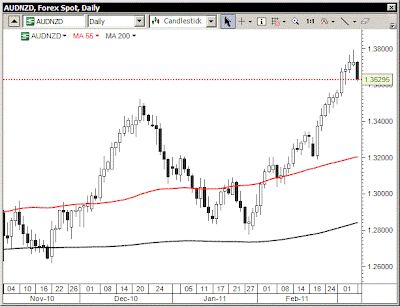
Chart: AUDNZD
A large scale reversal in AUDNZD, which shows the most significant crack in the uptrend in over a month. This may be the beginning of the end of the uptrend – as valuation here is extreme and there is only so much an earthquake can do to a country’s currency. Longer term fair value lies closer to 1.30 if not 1.25 for the pair.
Looking ahead
The USD has followed through a bit stronger today, a development presaged by yesterday’s neat technical reversal in key USD crosses. The question now is whether we follow through and move back through more strategic resistance levels for the greenback. To take three USD pairs, that would be on the order of 1.3860 in EURUSD, parity in AUDUSD and 1.6000 in GBPUSD.  Certainly from a contrarian perspective, there are grounds for further USD strength as USD shorts are out there in record swarms by some measures. Again (as we discussed yesterday), a continued rally in fixed income (which should tend to favor the USD in interest rate spreads), a easing off of crude oil prices and another couple of percent of downside for equities could prove powerful medicine for the greenback in coming days.
For USDJPY, we await today’s 3-year auction with interest. Expectations are relatively low after last month saw a very anemic auction despite relatively high yields (if you can call 1.25% a high yield – but that was higher than the 0.45% the 3-year debt was yielding around the time of Bernanke’s official QE2 announcement). The 3-year debt is yielding about the same now as it was at last month’s auction – so this will be an interesting one to see whether recent events and disruptions in equity markets see a stronger bid coming into the market.
The rest of the week’s calendar is fairly heavy for Australia, with Consumer Confidence and Home loan data tonight, and the employment report tomorrow night. Seems like by this time next week, we are either trading above 1.0200 or below parity.
Economic Data Highlights
  • New Zealand Feb. QV House Prices fell -1.7% YoY vs. -1.5% in Jan.
  • Japan Jan. Adjusted Current Account Total out at ¥1089B vs. ¥1167B expected and ¥1519B in Dec.
  • UK Feb. BRC Like-for-Like Sales out at -0.4% YoY vs. +0.7% expected and +2.3% in Jan.
  • UK Feb. RICS House Price Balance out at -26% as expected and vs. -31% in Jan.
  • Australia Feb. NAB Business Conditions out at -2 vs. -6 in Jan.
  • Australia Feb. NAB Business Confidence out at 14 vs. 4 in Jan.
  • Switzerland Feb. Unemployment Rate fell to 3.4% as expected and vs. 3.5% in Jan.
  • Germany Jan. Factory Orders rose +2.9% vs. +2.5% expected and -3.6% in Dec.
  • US Feb. NFIB Small Business Optimism out at 94.5 vs. 95.0 expected and 94.1 in Jan.
  • Canada Feb.  Housing Starts out at 181.9k vs. 174k expected and 170.6k in Jan.
Upcoming Economic Calendar Highlights (all times GMT)
  • US Fed Nominee Diamond to Testify (1500)
  • Sweden Riksbank’s Ekholm to Speak (1500)
  • US Fed’s Krieger to Speak (1620)
  • US Weekly API Crude Oil and Product Inventories (2130)
  • Australia RBA Assistant Governor Lowe to Speak (2230)
  • Australia Mar. Westpac Consumer Confidence (2330)
  • Japan Jan. Machine Orders (2350)
  • UK Feb.  BRC Shop Price Index (0001)
  • Australia Jan. Home Loans (0030)


Financial Advisor Daily Report : Dollar Rally Stalls, Swissy and Yen Mildly Lower

Daily Report: Dollar Rally Stalls, Swissy and Yen Mildly Lower

Dollar's recovery against Euro stalls in Asian today and is waiting for new momentum. On the one hand, investors are cautious ahead of this week's EU summit on Friday, where leaders are expected to nail down a comprehensive package to tackle the debt crisis in long term. However, there are some concerns that no concrete results would be out of the meeting. Meanwhile, oil price also stabilizes at around 104 level after OPEC refrained from pumping more output after yesterday's meeting. On the other hand, Euro is still supported by rate expectations. ECB Governing Council member Weber said that he "wouldn't do anything here to try to correct market expectations" where three quarter-point hikes are priced in.
Swiss Franc and yen are mildly lower today as risk aversion eases. S&P 500 rose 0.89% overnight and is followed by strength is Asian equities. Retreat in oil price helps like stocks in general. Data from Japan was positive with machinery orders rose 4.2% mom, 5.9% yoy in January. That's the strongest reading in five months and is viewed as a signal that companies are boosting spending as global recovery strengthens. Nevertheless, Aussie is soft after data showed consumer confidence dropped -2.4% in March while home loans dropped -4.5% in January.
Looking ahead, Swiss CPI is expected to rise 0.3% mom, 0.4% yoy in February. UK trade deficit is expected to narrow to GBP -8.5b in January. Germany industrial production is expected to rise 1.7% mom in January. Canada new housing price index is expected to rise 0.1% mom in January while US wholesale inventories are expected to rise 1.0%.
The RBNZ will very likely reduce its OCR from 3.00% in the coming Asian session. We expect a cut of -25 bps is appropriate though policymakers will state further easing cannot be ruled out depending on how economic data evolve. Prime Minister revealed his preference on a rate cut as the earthquake in Christchurch on February 22 will trim the country's economic growth this year. The market has fully priced in a -25 bps cut and bets for a -50 bps cut have been rising.

Daily Report: USD/CHF at Record Low on Safe Haven Flow, Heading to 0.9

Swiss Franc soars to record high against dollar as worry on the middle east situation intensified. Crude oil breached 100 level overnight on the fact that the developments in Libya has caused production cut by 25%. Markets are seeing no ends in sight in the turmoil in Middle East and North Africa and are deeply concerned that the current developments will spread to other countries in the region, in particular other large oil production countries like Saudi Arabia. Safe have currency Swiss Franc is strong across the board, followed by Japanese yen. However, dollar once again lagged as it remains soft against Euro and Sterling on rate speculation over ECB and BoE. USD/CHF breached key support level of 0.9300 and should be heading towards 0.9 psychological level now.
Rate expectations and oil prices are two factors that's holding dollar back in the current risk aversion market conditions. Some major global central banks seem ready to tighten monetary policy earlier than expected including ECB, BoE and BoC. However, the current development is not expected to push up Fed's timetable as it's tied with the dual mandate of price stability and full employment with unemployment rate standing at 9.0%. On the other hand, apart from the disruption in oil production in Libya, investors worried that the unrest, if spread to other OPEC countries, will affect production in the world's largest producer to Saudi Arabia. It's possible that the unrest would spill over into the country's eastern provinces, neighboring to Bahrain. Saudi's eastern provinces are home to oil production and refining. It is also where the Ghawar oil field, the world's largest oilfield and the Ras Tanura oil port are located.
Among the major currencies, New Zealand dollar remains the weakest one. Markets are raising the bet for a rate cut from RBNZ at its March 10 meeting. Pricing in markets jumped from 28% before the Christchurch earthquake, up to over 50% currently. On the other hand, Aussie is relatively much firmer as reports showed that business investment jumped to a record in Q4 of 2011. Also RBA Governor Glenn Stevens said mining investment may increase by as much as 2 percent of gross domestic product in the next few years.
On the data front, Australia conference board leading indicator rose 0.7% in December, German Q4 GDP final, Eurozone confidence indicators, Swiss employment level and UK CBI report sales will be released in European session. From US jobless claims, durable goods, new home sales and house price index will be featured.
NZD/JPY's strong break of 61.69 support confirmed our view that fall from 65.34 has resumed. Also, the three wave structure of the rebound from 58.38 indicates that it's merely a correction in the larger decline and has completed at 65.34 already. We'll stay bearish in the cross for the momentum and expect at least a test on 58.38 support ahead. Note that it's possibly the whole decline from 2010 high of 69.32 is resuming but we'll watch whether current fall would accelerate first.

Daily Pivots: (S1) 0.9294; (P) 0.9342; (R1) 0.9378;
USD/CHF drops to as low as 0.9273 so far today and the break of 0.9300 support confirms resumption of the larger down trend. Intraday bias remains on the downside and current fall should now be targeting 100% projection of 1.0065 to 0.9300 from 0.9774 at 0.9009, which coincides with major medium term target. On the upside, above 0.9391 minor resistance will turn bias neutral and bring recovery. But upside should be limited by 4 hours 55 EMA and bring another fall.
In the bigger picture, the break of 0.9300 support confirms resumption of the long term decline from 2010 high of 1.1729. Next target will be 61.8% projection of 1.8305 to 1.1288 from 1.3283 at 0.8946, which is close to 0.9 psychological level. On the upside, break of 0.9774 resistance is needed to be the first signal of medium term bottoming. Otherwise, outlook will stay bearish even in case of strong rebound.

Wake-up Call

Bearish News Flooding In Today's Markets

Spain’s central bank announced that it will release results from a stress test of banks while BP announced that it won’t pay a dividend and will also resort to asset sales to fund the Oil-spill fund.

What's going on?

Theme Comment
·         News overnight was mostly bearish. Spain’s central bank announced that it will release results from a stress test of banks while BP announced that it won’t pay a dividend and will also resort to asset sales to fund the Oil-spill fund demanded by President Obama. Of course, the large decline in US housing starts didn’t help matters much despite a solid display from the manufacturing sector with industrial production up 1.2% MoM.
·         Spain will test the market today with EUR 3.5bn in 10y and 30y bond auctions, and if recent Spanish auction are any indication then spreads will once again widen relative to the prior auction (in the spring).
·         It’s another busy day for economic releases led by US CPI, Jobless Claims, and Leading Indicators. The latter is expected is improving despite an 8% drop in S&P500 in May, which is one of the leading indicators.


Calendar

Economic Data Releases
Country Time (GMT) Name Saxo Consensus Prior
UK 08:30 Retail Sales MoM (MAY) 0.0% 0.1% 0.1%
US 12:30 CPI / Core CPI MoM (MAY) 0.0% / 0.1% -0.2% / 0.1% -0.1% / 0.0%
US 14:00 Leading Indicators MoM (MAY) 0.4% -0.1%


FX

FX Daily stance Comment
EURUSD 0/+ Buy break abv 1.2350, or dip to 1.22, for tgt 1.2420. Stop below 1.23, 1.2165 resp.
USDJPY  0/- Resistance edging down to 91.40. 90.85 next suppt. Expect to trade a range
EURJPY  0/- Break below 111.90 risks 111.50 before any suppt. Ranging 111.50-112.50 with slight –ve bias
GBPUSD 0 See n/term suppt at 1.4680. Below risks fall to 1.4615 else trade a 1.4680-1.4750 range
AUDUSD 0 0.8575 next suppt level. Below sees 0.8510 first or a 0.8575-0.8665 range
USDCAD 0 Seems to be building n/t base at 1.0225. Ranging 1.0225-1.03 again


FX Options

FX-Options Comment
EURUSD Market still well bid for EUR puts. Market still very nervous despite  yesterday’s
relatively narrow ranges in spot, with a vol curve remaining well bid throughout the sessions  still remains bid Banks aggressively paying up for EUR puts now and would not be surprised to see
session. Definitely see potential for further downtrend in spot.


Equities

Equities Daily stance Comment
DAX 0/- Sell on rallies towards 6190 targeting 6156. S/L above 6207.
FTSE 0/- Sell on rallies towards 5240 targeting 5208. S/L above 5257.
S&P500 0/- Sell on rallies towards 1118 targeting 1112. S/L above 1119.
NASDAQ100 0/-
DJIA 0/-


Futures

Commodities Daily Stance Comment
Gold 0/ Buy on dips towards 1228 and target 1236. Stop below 1226.
Silver 0/+ Buy at the break of 18.68 and target 18.96. Stop below 18.50.
Oil (CLQ0) 0/+ Sell on rallies towards 79.80 and target 78. Stop above 80.50.

Ratings and Recommendations