Financial Advisor
Showing posts with label FX Closing Note. Show all posts

FX Closing Note: Weekly FX candle-palooza

John J. Hardy, FX Consultant, Saxo Bank

We’re seeing a very interesting close to the week, with a plethora of interesting candlestick patterns worth close consideration. What do the technical tea leaves suggest is in store for the coming days and weeks?
Today we’ll run through a series of charts as we saw a number of very significant developments this week. Leading the pack among the G-10 currencies for this first week of the year was the Canadian dollar, which seems to be piggybacking on the USD strength now – certainly in the crosses. The US dollar was the second strongest currency of the week and managed to shrug off a relatively negative jobs report today to finish the week far stronger than it started it. The pound sterling was a close third.
On the weak side, we had a very weak Euro, weak CHF and a weak SEK as the troubled EuroZone fared poorly this week, and the somewhat weak close today saw the SEK trimming its sails, even while the franc made a sufficiently large comeback to avoid (the CHF reversal from recent outperformance to underperformance, the mirror image of the USD, was one of the more interesting developments this week.)
Below we highlight some of the more interesting charts and ponder what could be in store from a technical perspective in the coming weeks. Have a great weekend and stay careful out there. Volatility is heating up.

Charts
Chart: Weekly EURUSD
As we pointed out this morning, the pair was confronting the critical 1.2965 support zone and 40-week (200-day) moving average and it appears from today’s close that we have a failure of the support to hold, so this sets up a go lower at the next Fibo targets at around 1.2800 (0.618) and even 1.2450 (0.764). 
 Chart: Weekly USDCHF
Finally, the CHF has managed to weaken a bit – enough for USDCHF to make an important engulfing-ish reversal that takes it back well above the previous low, which was the basic resistance. This sets up a possible test higher to the parity area that was probed in late November/Early December.
 Chart: Weekly USDJPY
USDJPY was an interesting one for the week as well. The JPY was weak for much of the week, but the comeback today on a rally in bonds makes the set up far weaker than elsewhere, and if equities can ever figure out how to correct a bit lower, the commodities sell-off and bond rally are already providing a tailwind for the JPY. Also note on the daily USDJPY chart the important support just below 83.00 on the daily (from the Ichimoku cloud).
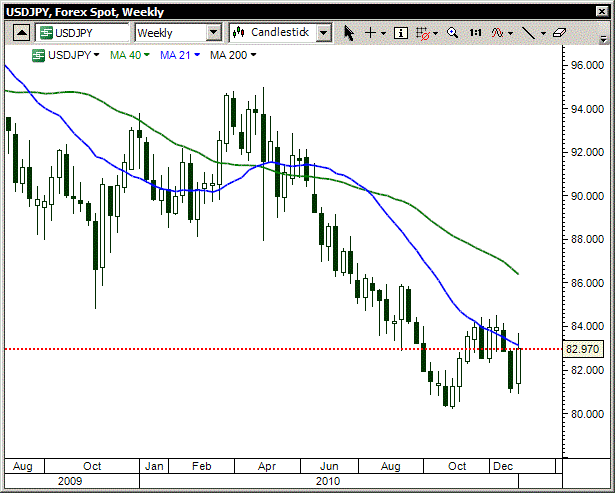
 Chart (Daily CADJPY)
Particularly noteworthy on the daily charts was CADJPY. CAD was the strongest currency this week, but note the vicious reversal precisely off the 200-day moving average today. An interesting one to watch next week after today’s close. 
 Chart: Weekly AUDJPY
AUDJPY has rallied in recent months, but note that each rally wave has seen progressively lower momentum. With the Aussie strength fading this week, the pair seems to be nearing an inflection point. Note the influence of the weekly Ichimoku cloud on the currency pair. The closing level this week is about half-way between the 200-week moving average around 85 and the weekly cloud support at around 80. A renewed bond sell-off and commodities rally means the pair probably tries higher, while a follow-through on today’s bond rally and equity sell-off could mean a sharp consolidation lower. It’s either/or time for the pair after the recent loss of momentum.
 Chart: GBPUSD
Not much to point out with this week’s GBPUSD close, save for the rare harami candlestick and inside week. Also note the influence of the 40-week (200-day) moving average at the last two touches – this is an important area. But strength in the pound and USD seem to be relatively correlated here, so the pair could remain choppy and not terribly directional. Still, interest rate spreads suggest that GBPUSD is very cheap right here.
 Chart: EURGBP
EURGBP re-established the downtrend with an exclamation point this week, engulfing the previous several weeks’ action and handily taking out the 40-week moving average again after the false break higher the previous week. Note the huge trendline in orange that goes way back and the 200-day moving average creeping higher towards 0.8200. 

 Chart: AUDUSD
An important bearish reversal in AUDUSD this week after the apparently false break in the last week of last year. This sets up an important resistance area for the pair. Note the trend-line from May/June and the 40-week moving average rising toward the big flatline support around 0.9400.
 Chart: AUDCAD
This is one of the more interesting AUD pairs to look at, as we discussed this morning. This week’s huge reversal suggests that a double top may now be in place and we may be looking for a test of the 40-week moving average in coming weeks.

FX Closing Note: All clear to the New Year?

It's tempting to believe that we're in the all clear until the New Year, but a couple of niggling divergences and other factors make us not so sure. Certainly, Asia is the focus as we head into the weekend.
House Democrats to stand in Obama's way on tax deal?
House Democrats are hopping made at Obama for turning his back on them and giving the Republicans a victory with the across the board tax cut extension and appear ready to make a big enough stand that the deal will not come to the floor as it is, to paraphrase a quote from a politico.com article. This may be the key news item today that has spooked risk.
US T-bond auction
The US T-bond auction was relatively healthy, and showed further improvement from yesterday's 10-year auction results. The id to cover raio was higher than at the last three 30-year auctions and the indirect bidding, which includes foreign central banks, represented some 49.5% of demand, the highest percentage since the treasury restarted 30-year auctions in 2006. The bid-to-cover ratio at today's auction was better than at any of the last three auctions at 2.74. Somewhat surprisingly, the market didn't react at all to the auction results, which either represents apathy or the risk of a further sell-off. USDJPY found support on the day in the wake of the auction.
Irish bailout vote
The Irish parliamentary vote on the IMF/EU bailout is set for next week, with debate starting on Tuesday. We were confused by the recent schedule announcement of the vote and thought it had already taken place, but this is not yet the case. The latest news is relatively unchanged on the expected thin majority in favor of passage. The EUR swooned briefly today after the Irish Labour opposition said it would vote against the bailout, but this was largely know in advance. 

Looking ahead
The market still looks uncertain here as the push to new highs in the US equity markets failed once again to hold. The market may be awaiting the PBOC news tomorrow or over the weekend. To hike or not to hike is the question. And on that note - below we offer a chart that shows the curious divergence in the performance of the world's equity markets, with the S&P500 fiddling with new highs for the cycle, while the EM markets are making what looks like the right shoulder of a head and shoulders formation (unless they also catches the rally impulse) and the Hang Seng looking even more dour lately. We find it very interesting that the Hang Seng led the S&P500 at the last two major market turns - in April from bull to mini-bear market and in July - when the US market was plunging to new lows for the cycle while the Hang Seng was still well off its May low. Interesting stuff. Let's see if this underperformance is just temporary fear related to the Chinese crackdown on inflation or whether Asia has the world lead at the moment on the direction in risk.
Chart: S&P500 vs. EM and Hang Seng
We put the S&P500 on another axis to simply bring out the fact that it is at a new index high for the cycle, even if overall it has slightly underperformed the other two indices since August 1. Data source is Bloomberg.
 Chart: AUDUSD
AUDUSD continues its struggle with the whether it wants to stay below the 55-day moving average, coming in around the day's close at 0.9830 today. This has been an interesting moving average for the pair for months.


The latest interesting thing we've heard about this crazy rally in copper (historically AUD follows copper very closely) is that JP Morgan might be hoarding the metal in anticipation of the launch of a copper ETF. One thing is for sure: the price of copper probably doesn't have a lot to do with demand for the metal at this point in time - it has become a speculative instrument. Another point - commodities make extremely awkward financial instruments. What good does it do the world to have physical copper in warehouses rather than being bought and. See this article for more on the copper story and the "financialization of commodities" . This is a story worth following in the months to come. So when do we get the first Corn ETF and when will governments ban it on humanitarian grounds? The kind of response this could eventually provoke - not just for food items but for all commodities - from the authorities is certainly worth consideration.
Be careful out there.

FX Closing Note: USD/Risk divergence and more

The USD sharply weaker today as risk and commodities go ballistic, but there are signs that some divergences relative to past behavior may be developing here. Also – we look at AUDUSD and USDJPY technicals today.
USD, risk and Interest rate spreads
We pointed out yesterday that risk measures had been coming off heavily as the USD was rallying. Over the last two days, however, we have seen an epic bounce in risk and a fairly strong sell-off in the USD, so we’re not having much success in finding the leading indicator here in this rather closely correlated market. We do find it interesting that US equity indices are trading at their two-year highs while many of the USD crosses are showing the greenback is still relatively far off its recent lows.  This may be a sign that there is enough belief in some of the stronger numbers coming out of the US at the moment that people are deciding that the US economy isn’t looking so bad relative to other economies and that the Fed might even be sidelined by the strength – in the most extreme instance possibly not even needing to complete the QE2 program. Not our belief – but the market’s. Some proof of this can be found in the interest rate spreads, which still show reasonable support for the USD. Does this mean that we are seeing some weakening of the USD/risk bond? Maybe - the strength of the correlations seems to be a bit weaker in any case due to the introduction of relative US economic reslience.
Interest rate spreads generally USD supportive, but…
The chart below shows that the pressure is still on NZD to fall versus the USD if we are only using interest rate spreads as our guide. USDCHF should be trading at a new high by the same token, but the market isn’t interested at the moment. Let’s see where we are on the spreads and on the FX charts after the close tomorrow.
 Elsewhere, while spreads aren’t particularly supportive of the USD selling off against the AUD and CAD at present, very strong commodity rallies in copper and oil and other parts of the commodity complex mean a struggle to weigh which factors are most important, with commodities clearly winning out at the moment. Below we show AUDUSD vs. the price of copper.
 Technical highlight - USDJPY
Bonds tried to rally and throw the JPY a rope as well, as USDJPY retreated from resistance areas and other JPY crosses found resistance to varying degrees today as well. Later, most of the bond supported eroded as the colossal rally in risk instruments continued elsewhere. Note the importance, once again, of the Ichimoku cloud level for USDJPY - this time it is the upper cloud that is serving as support. Those looking for a continuation of the sell-off will need to this first important support give way (currently around 83.20). To the upside we have the psychological 85.00 area and then the 200-day moving average currently around 83.70.
 Technical highlight – AUDUSD
AUDUSD has rallied very sharply, back above the key flat-line levels that formerly served as support in the 0.9650–0.9700 area. The important resistance levels now are the 55-day moving average around 0.9800, the falling line of consolidation and the 0.618 Fibo retracement for the entire down-move up around 0.9935
 Weekly AUDUSD Chart
On the weekly, the rising trendline has even more strategic importance here, now that we have seen the third touch of the line at the low of the recent sell-off. Generally, a trend-line is far more interesting once three touches are in place, as they are an order of magnitude more rare than the pedestrian two-toucher.
 Topic: US jobless benefits linked to Bush tax cut deal?
It appears that the Republicans are trying a gambit in which any deal on the extension of jobless benefits (which they oppose because there are no announced cuts elsewhere in the budget to pay for them) might be linked to a deal to extend the Bush era tax cuts beyond the end of this year. If no deal is reached on benefits, the US Labor department says that 600,000 will lose their benefits immediately and another 2 million would lose them at the end of this year. 

Euro nervous ahead of Greek election

Risk appetite has exploded higher in the wake of QE as volatility collapsed and complacency seems to know no bounds. How long can we sustain the QE fantasy? Also, we’ve a Greek election over the weekend that is weighing on the Euro.
US employment report was….awful?
The supposed strength of the nonfarm payrolls report notwithstanding, we must also consider the household survey, which is used to create the Unemployment Rate. That survey showed a drop of 330k jobs in October and the participation rate dropped to a paltry 58.3% from 58.5%, which is the lowest level since the beginning of the year.
Graphic: US Household employment data
The graphic below shows the data from the household data, which many consider better than the payrolls data for showing the overall employment level. (Source of graphic: http://www.bls.gov/news.release/pdf/empsit.pdf) Draw your own conclusions, but we would note a couple of things: the overall unemployment rate supposedly topped out exactly one year ago at a shade over 10%, but the total number of workers with a job is now actually 27k less than it was a year ago (meaning all of the change in the unemployment rate has come via a reduced participation rate as discouraged workers are not declared unemployed). Second, the 35-54 year old men and women have been hit the hardest – these are the people with professional, higher paying jobs. All in all, this segment has lost well over a million jobs since last October – when unemployment was supposedly at its worst? This is awful and worrying. And to think that a lot of the consumption data might be looking stronger these days because strategic defaults and people continuing to live in “free” houses they have not yet been kicked out of means that they are able to continue to consume goods and services at the same rate as previously because they are not paying their mortgages any more.
Risk
Now that we have all of yesterday’s data in for our Carry Trade model, we can see that nearly all measures of risk appetite jumped higher in the wake of the FOMC meeting yesterday. Junk bond spreads in particular have shot higher – amazing to think that investors are desperate to go after junk issues yielding less than 200 basis points on top of treasuries if the baseline fear here is that fiat currencies are meant to collapse here. The “logic “is so awful, it’s almost unbearable. One interesting note: EM spreads have not joined the party to the degree that volatility and other risk measures have. Just today, news emerged of HSBC warning of “bumps in the road” ahead for emerging markets. EM spreads and relative performance will be key parameters to follow in coming weeks.

We should remember that cost-push inflation from QE is a bigger risk and higher likelihood than healthy organic growth and it’s already happening. This is the worst kind of inflation - inflation that will squeeze margins for companies, who don’t and won’t have any pricing power in an environment where weak labor markets mean no pricing power for labor either and more money on the part of wage earners dedicated to bare necessities. Thanks, Ben!
 At the rate things are going on commodity inflation, it will only be a matter of weeks before the Fed experiences almost unbearable pressure to cease and desist. That pressure starts at 100 dollars a barrel in crude oil. The only way the Fed is allowed to continue with QE beyond the next few months is if the fears of an economic slowdown are able to collapse the QE speculative bubble on itself and we quickly see a collapse in the twin commodity/equity bubbles.
 
Looking ahead
Greek election is up on Sunday and the government has promised to call a snap election if the result is a clear rejection of the austerity program. Will Greece belong to the EuroZone this time next year?  It is very important from a technical standpoint that EURUSD is closing the week here well back below the 1.4160 old high. The election is a key event for either setting a new cycle of PIGS fears in motion or seeing the market getting back on the old “Respect for the tight, non-devaluing ECB” trade. The Euro’s star may have peaked for now in our view, as the EuroZone’s own internal strife may finally drag the currency down into the mud of more easing, liquidity facilities, and other attempts to hold the shaky edifice together, or we’ll see the PIGS address the real need to default and a massive hit to European banks that this would entail. Alternatively, the PIG countries can exit the union and devalue their currencies (lowest odds). Which way adds up to a stronger Euro? That’s what we thought…. We stick by our EURUSD 1.12 forecast for 12 months from now.


FX Closing Note: Death to fiat currencies?

To complete the thought in our title: Death to fiat currencies. Long live precious metals! Is this market decoupling from its former fundamental underpinnings and transforming into a bubble market centered on competitive devaluation? Will AUDUSD trade at 1.00 next week?
Recent market activity suggests that the market is only investing in currencies not based on traditional metrics like relative growth dynamics and interest rate spreads or even on risk appetite anymore (the former be all/end all for USD direction), but rather on the degree to which various countries’ central banks are bent on devaluing their fiat currencies. Is this just a temporary distraction that will at some point dissipates or are we rapidly falling into a competitive devaluation endgame, one that risks becoming a reflexive market (read up on your Soros for that one) that develops into a full-blown bubble?
If the answer to the latter question is yes, then EURUSD could very well trade at 1.45 or 1.50 relatively soon and AUDUSD to 1.05 or higher. But won’t the ECB and German officials begin to scream bloody murder already at a level of 1.40? And even the RBA might begin to protest starting at around parity in AUDUSD. And In this case, if every country around the world increasingly begins to join the competitive devaluation chorus and threatens intervention/lower rates/controls/you-name-it to prevent currency appreciation, it could spark a super-bubble in the only hard currency – precious metals, a bubble that could even result in the death of all fiat currencies as we know them if the logic of such a bubble is taken to its extreme logical endpoint.
This all sounds terribly dramatic – and the consequences are unimaginable. We bring up the scenario because many of the elements are in place for a super-bubble (or at least a significant bubble) situation to unfold, not because we necessarily believe it is high odds. But a few more missteps from the “right” places, and a bubble we will have. Lets hope for the sake of our fiat currency savings that the wild imaginings of the goldbugs stay in the realm of fantasy. There is always the in-between scenario as well - one that sees a further chunky aggravated sell-off in the USD and perhaps 1500 or 2000 dollar gold followed by a huge unwind of the feverish speculation in the opposite as the powers that be move to avert financial Armageddon.
Chart: Gold vs. selected currencies
If we look at gold vs. some of the majors and a couple of key EM currencies, we can see that the recent focus on the decoupling theme (inferior growth in the US and strong EM performance) is fading relative to the competitive devalution theme as gold has made significant gains on key emerging market currencies (BRL and ZAR shown here) though it is not yet at an all time high vs. many of those currencies Still, these recent gains in gold vs. EM currencies are remarkable considering the enormous inflows into EM countries and the very significant rally in EM equities over the last month. The chart also shows just how much respect the Euro is getting due to the tight ECB (not to mention the overhang from a short speculative market ill-prepared for this new competitive devaluation theme). AUD strength is also remarkable. The point at which all currencies underperform gold is perhaps the Eureka moment that tells us a precious metals bubble is underway. Could that come if the ECB and RBA begin to complain about the strength of their currencies – or will recent developments short-circuit as the death of fiat currencies turns out to be greatly exaggerated?
One of the ways to counter bubble risks here migh be on recognition of poor economic prospects for China and elsewhere in the developing world, which could short-circuit the risk-taking mania in long emerging market and commodities trades that are the flipside of short US dollar trades. Also vital for short-circuiting a new anti-fiat currency bubble is a Fed that declares it is not interested in seeing a disorderly devaluation of the US currency (which this is fast becoming) and if it ends up vastly undershooting the market’s expectations on the magnitude of the next round of QE2. The stakes are huge here – and for the short term at least, it appears that bubble fears may ride roughshod over the market for at least the short term – the momentum in this market is brutal.
With that, have a wonderful weekend and be very careful out there.

FX Closing Note: Fed opens door to QE in November if necessary

The FOMC statement leaned slightly more to the dovish side then we were expecting as it basically opened the door to a move to expand the balance sheet at the November meeting without fully committing to do so. How much of that is priced into the market?
The FOMC statement leaned a bit more toward a commitment to do something if needed than we expected and can be seen as a "set-up" meeting to a possible move in November if conditions warrant, but there was nothing at all specific about what the Fed might do - and to get that discussion we'll need to wait three weeks for the minutes of the meeting. The knee-jerk reaction was of course for dollar weakening as the bond market exploded higher and risk assets basked in the glory of an imminent gravy train of further liquidity. Sarcasm intended…
Some comparisons with last statement
On economic activity: virtually unchanged for the first sentences, but slightly downgraded business' capital spending as being "rising less rapidly than earlier this year". The description of bank lending was nudge slightly higher, described as contracting "less than earlier this year".
Our comment: these changes extremely minor and cancel each other out.
On inflation: The new statement now describes underlying inflation as "at levels somewhat below those the Committee judges most consistent, over the long run, with its mandate to promote maximum employment and price stability." This was compared with the previous description of inflation simply "likely to remain stable for some time:
Our comment: a very pointed statement and strong signal of dissatisfaction - note that "stable" was removed here but kept in the next paragraph in Fed's assumption about the outlook - a bit confusing.
On Fed's policy now: no real change
On Fed's outlook: The addition that the Fed "is prepared to provide additional accommodation if needed to support the economic recovery and to return inflation, over time, to levels consistent with its mandate."
Our comment: This is the door opener to a future move and the second mention of inflation suggests a strong warning that the Fed will not tolerate lower inflation. So going forward, the inflation-related releases (Prices Paid figures for ISM's, too) are going to have an extra weight for the coming couple of months ahead of the next meeting on November 3.
Market reaction: with the tremendous rise in risk appetite and USD weakness leading into this meeting, one would have thought that a fair amount of dovishness was priced in. But the first half hour of market action in the wake of the statement suggests that this is not the case, though of course we'd like to see where the markets settle by the end of the day and even the end of the week. Note that EURUSD (as of this writing trading at around 1.3250) has swooped above its 200-day moving average. The next big level is the 1.3335 top from early August. The AUDUSD, no real surprise is much higher, though AUD is underperforming the Euro - an interesting state of affairs, to say the least.
USDJPY is toying with 85.00 again and one can't help but wonder if Japan will be out blasting the market with USD buying/JPY selling in Asian hours.
Stay careful out there.

FX Closing Note: Is this an audacious Obama hope rally?

John J. Hardy, FX Consultant.

The strong rally in risk into today's close in the US today can't be about this week's economic data - particularly as the ISM non-manufacturing index for August showed a steep deceleration. So why the rally?
The combination of an equity rally and a lousy ISM resulted in the predictable (once those former two variables were known) USD sell-off today. Considering the scary ISM non-manufacturing reading, the market obviously has its eyes fixed on something else besides the data. And we must listen to the market, as it often is trying to look ahead rather than at the present or the past. So what has kept risk appetite elevated all the way through the day today despite an employment report that doesn't even show enough job growth to track the growth in population and despite a services industry survey that suggests employment reductions rather than additions and rapidly slowing service sector growth? The only answer can be the expectations something that will spark at least the hope of short term growth in the economy.
And that hope can only rest on the Obama administration's shoulders rather than on the Fed's, since the Fed is in a bit of holding pattern for at least a couple of months judging from their recent rhetoric. Mr. Obama and his party, however, are experiencing a meltdown in the polls, and don't have the luxury of holding patterns or waiting and seeing. To ensure a better result at the November 2 elections, whey are willing to spend any amount of the nation's capital to kick-start the economy as quickly as possible.
Just yesterday, however, Mr. Obama ruled out any new stimulus package (anything related to spending more government funds would never pass Congress due to united Republican opposition and a new minority of deficit hawk Democrats). And as for the Bush tax cuts, Obama's speech today suggested that an extension of those are unlikely (except for those making less than $200k a year, a stance he has had in the past) since he talked about tax cuts for the "middle class" being in the offing while he talked up the need to pass his new small business bill today. This leaves one big idea out there - the only one that will provide nearly instantaneous stimulus out there to the economy that wouldn't involve new government spending: a payroll tax holiday. It's about the only issue that both parties might agree on since it benefits everyone all the way down to minimum wage earners and puts extra money in consumers' pockets as soon as the next paycheck. Hey, why not even back-date it to June? The only thing holding it back would be the even bigger hole this would leave in public finances and the risk that the bond vigilantes are out there lurking in the shadows (low risk in the short term for that one).
This is our assumption for the "logic" of this tremendous three day rally in risk, at least, as it is certainly difficult to believe that the market invested any real hope in the economic state of affairs after a mediocre employment report and a more important and far more negative ISM non-manufacturing survey. Let's see what Mr. Obama's Labor Day speech brings us (or the speech next Wednesday in Cleveland, which may be "the one"...). After all, we should never underestimate the ability of central bankers and politicians to kick the can of pain down the road in order to get a short term political fix at the expense of long term pain... So if indeed the Obama administration comes up with a tax holiday and it is passed, the question will be how much the faith the market will put in it working magic on the economy. Another few days of rallying or a few months of rallying? This is a potentially big issue as a full payroll tax holiday would certainly put money in consumers' pockets and trigger a spike in end demand, particular for those who habitually spend all of their paychecks every month. If Obama's the new bill aimed at bringing relief to the economy is full of caveats, complex rules and half measures and bears any resemblance to the impenetrable new healthcare and financial regulation efforts, then the upside for risk will be very limited indeed.
If risk markets celebrate Obama's new efforts and the three-rind risk circus remains in full freak-show mode, watch out below on the USD again since it means even more fiscal shortfalls for the US and would mean spillover to the pro-risk emerging markets as well, considering most hard goods purchased in the US are made abroad. On the flipside, if the market is setting itself up for too much and Obama doesn't deliver...uh oh....
Next week will be an interesting one. Stay careful out there.
And now for something completely different
On a side note, an interesting article out earlier today about Japan and the idea that the odds of intervention are lower than the market previously estimated because of US opposition to the idea. Here's the link to the article on Bloomberg.
Have a great weekend.

FX Closing Note: A clean shaven finish to the week for FX

Weekly candlesticks in major FX pairs show some interesting setups for the coming week that suggest high risk of dangerous volatility.
This Friday the 13th didn't particularly live up to its superstitious reputation as there were no particularly alarming developments in risk appetite, though equities are finishing the day on a sour note. But looking at our weekly candles, we can call this a very interesting week - one with a number of "marubozo" closes (Japanese for "clean shaven", which in candlestick terminology describes a candlestick with no, or virtually no, shadow on at least one side of the candlestick. This is most interesting when the side lacking the shadow is on the closing level. This week produced a plethora of marubozu candles as we can see below.
Chart: EURUSD
EURUSD had a particularly ugly finish to the week as most EUR crosses fell. PIGS spreads are marching higher again. The Greek 2-year yield is close to the highest levels since the ECB managed to quash the April-May blowout back in early May - now trading at 10.2%.
Chart: EURCHF
EURCHF is again an excellent measure of the Euro sentiment - the combination of the weak EUR without strong CEE worries this week is high octane fuel for the downside. Could this week set up a test of the lows for the cycle?
Chart: EURGBP
EURGBP saw an ugly close on the week as falling rates around the world generally tends to favor the low yielding pound as rate spreads compress. The weak Euro helped matters out for the pound as well, though the latter still corrected sharply lower vs. the mighty greenback.
Chart: USDJPY
We've seen three strong weekly closes in the last several weeks, but this one interestingly cam after the pair posted a new low close to critical levels. The ability of the greenback to also make a comeback against the JPY this week (thus making the USD far and away the strongest currency on the week) is particularly interesting. And remember that the world is far more short the USD this time around than the JPY, which specs are actually long, if panic strikes in coming weeks. The huge focus if we do see a strong rally extension could likely be the 89.00 area - a previous strong area of contention as well as the current location of the bottom of the daily Ichimoku cloud.
Chart: USDCAD
USDCAD not doing as much as other USD crosses this week, most likely because CAD has suffered collateral damage from US economic weakness, as we have discussed over the last couple of days. The USDCAD pair has been rangebound forever and may stay capped for now before a bigger break higher further out, even if it has room to maneuver up toward 1.0800+ again.
Chart: AUDUSD
AUDUSD closed the week below the 200-day moving average and now the focus shifts to the minor rising trendline and the previous salient high around 0.8860 from late June.
Chart: NZDUSD
The antipodean currencies had a very ugly week and the ugly close at critical levels could set up plenty of further downside in the weeks to come if risk remains wobbly. This 200-day (here shown as the 40-week) moving average has been an interesting one to watch for the pair and now the rising trendline has been broken.
Looking ahead:
So the question for next week is whether this move in risk aversion keeps up a head of steam. The greenback will need for it to do so if we are to believe that this is more than a short term squeeze. The negative momentum in risk in FX-land is pretty ugly here and the equity technicals look hideous, though we've still only seen one single day of ugly downside this week (yesterday). Still, we would be reluctant to stand in the way of USD strength or the risk aversion until the bulls prove that they want to make a stand. Remember that the market "gets back to business" after September 1 (and also realize that seasonally, September is the worst month for equities in market history), but that August has occasionally been a graveyard for risk as well, as we pointed out in a post some time ago. The sell-off in risk in 2008 got started by late July, for example, and continued throughout August. AUDUSD fell as much as 1000 pips intra-month in August of 2008, for example - and that was before the Lehman news hit in mid-September
So keep carefulness at the top of any agenda and have a great weekend.

FX Closing Note: AUDUSD to accelerate lower?

AUDUSD had an ugly day on a meltdown in risk appetite. Could tonight's Australia employment data bring further misery to the pair? From a contrarian point of view, AUDUSD downside has become rather compelling again if we have a look at the IMM positioning (from US CME futures market).
Chart: AUDUSD vs. US futures positioning
It's easy to see that AUDUSD longs have been the only popular trade for a long time now, with US futures speculators only going into an outright short position only once AUDUSD had tumbled to about 0.80 back in 2008 and never really getting short during the panicky deleveraging days. This time around, the participation in the rally has been less enthusiastic (as seen in a lower net long position relative to the AUDUSD level and despite the tremendous rally - an interesting divergence.). Note that this is weekly data and that the latest data point was for positioning as of last Tuesday (releases are made every Friday.). 

Today's developments
Equities in the US closed the day on a very ugly note, with no signs of the last minute rally so often evident from the algo/HFT crowd, which has likely been at least partially sidelined after a day like today. Then after the close, we get a terrible Cisco earnings report from the networking bellwether.
It was the worst day for risk since late June and saw the average closing significantly back below the 200-day moving average that had provided support twice since last Thursday. The developments in FX were largely along the lines one would expect on a day of misery for risk, though it is especially interesting that EUR led the charge lower on the day rather than the normally more risk-prone commodity currencies. Interest rate developments partially supported the Euro weakness, but as we pointed out this morning, so too did the ugly developments in European sovereign debt, with PIGS spreads moving the wrong way once again after the long regime of spread tightening that started back in July finally reversing in the last couple of days.
Another interesting development today was the reasonably strong reversal back from new lows by USDJPY despite the very ugly day for risk appetite and generally higher yields. Will USDJPY continue to churn lower or is this finally a sign that the weak USD story has been overplayed and that traders fear testing the BoJ's/MoF's resolve here. If we look at the speculative positioning in the US future for the Japanese Yen, it also looks very stretched. Is 90 more likely than 80 for USDJPY?
Looking ahead
Next on tap we have the Australian employment report, which is either going to give a better level to push AUDUSD lower or see an additional large acceleration lower in the next couple of days as long as this move in risk aversion is white hot. Stay tuned and stay careful out there. Tomorrow will be a key test for the US bond market with the 30-year US T-bond auction out after the Fed announced that it will be buying treasuries again (but also after an enormous rally in bonds, albeit one that has seen almost no downside in recent weeks in 30-year yields relative to the steep declines in the 10-year yields in recent days.

FX Closing Note: Market reacting "the right way" to FOMC statement?

John J. Hardy, FX Consultant, Saxo Bank

The FOMC statement surprised with a plan that will see further debt monetization, a scenario that was not on everyone's radar screen, and the market bashed the USD anew. How bearish is the statement for the greenback?
The FOMC statement downgraded its view of the economy in today's statement relative to what it said in the June statement. Most importantly, the Fed has restarted a "back door" quantitative easing as it elected to (the following lifted directly from today's FOMC statement) "keep constant the Federal Reserve's holdings of securities at their current level by reinvesting principal payments from agency debt and agency mortgage-backed securities in longer-term Treasury securities. The Committee will continue to roll over the Federal Reserve's holdings of Treasury securities as they mature."
So today's FOMC statement is real, liquidity-enhancing quantitative easing because it will see the Fed monetizing more debt, even if it doesn't require that the Fed expand its balance sheet (and thus one could argue that it is simply an effort to maintain the status quo). And on the surface, this has all of the usual nominally positive implications for risk appetite, lower US rates, and therefore a lower US dollar - hence today's reaction. Importantly for the risk-mongers, the US S&P500 held its 200-day moving average, etc..
But while today's move by the Fed does represent a new move to monetize debt that the Fed likely hopes will keep long rates very low and continue to support the housing market and other asset markets and thus banks' balance sheets, this is not a "real QE2". And a new dribble of US treasury purchasing to offset MBS and agency debt offloading will do nothing dramatic towards solving the fundamental problem in the economy: lack of end demand. Also, the "risk" for those looking for further moves from the Fed is that this is a pre-emptive move, and that the Fed will now have to sit back and see if its new efforts are bearing any fruit before acting again. It is likely that the Fed does little else until after the early November elections in a little over 80 days due to the political headwinds it now faces.
The grand question that looms is whether today's move is a "first step" en route to a true QE2: quantitative easing that goes beyond the traditional policies of manipulating long and short interest rates via the interest rate mechanism, liquidity facilities and debt monetization and instead circumvents the banking system entirely by somehow forcing end users to receive and spend money. This is the true helicopter drop. But will the Fed ever have the political wherewithal to do such a thing or are the Fed's days of true independence fast running out? What the US government giveth away (the creation of the Federal Reserve System in 1913), it can just as easily taketh away if it decides so to do.
That latter paragraph is for the much longer term. For now, any USD negative impact from the Fed's move here may not last for long, especially if the rest of the world enters the soft economic patch that the US now finds itself in - or worse - thus collapsing the interest rate spreads at the short end of the curve that have moved so dramatically against the greenback's favor in recent weeks. That's because this is not a particularly dramatic move by the Fed even though it was not expected - it's just a recycling of QE past. USD calls, anyone?
Stay careful out there.

FX Closing Note: Next week critical for EURUSD and AUD

John J. Hardy, FX Consultant, Saxo Bank

FX Closing Note: Next week critical for EURUSD and AUD

More signs of ugliness in the US economy as the May Factory orders number showed a sharp contraction of -1.4% vs. a much smaller negative reading expected. As we discussed this morning, the US jobs report was far more negative than the headlines suggest, as the absolute number of people working actually declined, making a mockery of the drop in the headline rate - which actually should have gone higher. Another factor suggesting that the private payrolls growth  - smaller than expected as it was - might actually have been even more negative as the "birth and death" adjustment magically added 147k assumed new jobs that may or may not be out there. So the statistical assumption was almost twice the magnitude of the result? Hmm.....
Chart: US Factory Orders
US Factory Orders are back higher, though still only to levels first seen in late 2005. The negative reading for this month was even larger than the deceleration in the manufacturing surveys suggested would be the case. The manufacturing surveys and factor outputs bear watching in coming couple of months for signs that this sector is faltering again.
EURUSD status
Yesterday, we pointed out that EURUSD was being tugged higher by higher rates as shown in the 2-yr. swap spreads. An excellent post over at ftalphaville  helps us understand that the situation and curious rise in Euro short yields relative to the rest of the world probably stems from roll-over of its enormous 12-month liquidity facility that has been taking place recently (this is likely in addition to a squeeze on market positioning we postulate). The effect from this rollover is likely soon behind us, since the rollover is essentially behind us. From here on out, it behooves us to watch the interest rate spreads and it is hard to imagine much upside at the front end of the curve for Europe vs. the US, where yields have dipped sharply on the onslaught of ugly and deflationary data. The combination of higher rates in Europe and the recent sharp unwinding of expectations for the few countries actually hiking their rates also helps us to understand the tremendous squeeze in the likes of EURAUD and EURCAD.
As a side note, if we have a look at European risk markets, the Germans certainly aren't particularly thrilled with the EURUSD trading back above 1.2500. After almost surging to a new high for the cycle back in mid-June, the DAX has since tumbled over -7% and closed today below the critical 200-day moving average.
Chart: EURUSD the tease?
EURUSD closed very strongly yesterday,  a rather convincing move above the 1.2500 resistance level. Today, the action took the pair above even the key 55-day moving average, which also provided resistance when EURUSD was attempting to move higher in April. This is an interesting level to watch in the coming week. The squeeze higher looks severely challenged on any move back below the 1.2400 level. The upside argument is in place if the break higher above 1.2500 holds - and many are pointing out the upside down head and shoulders-like technical formation with the neckline close to that level. Next week looks like an either/or set-up for the currency pair. We prefer the downside eventually, with plenty of uncertainty for the nearest term.
Looking ahead
This weekend is a three-day weekend for the US. The action gets going quickly in the new week with the Australia AiG services survey up on Monday in Asia (Sunday evening for North America) and the RBA on Tuesday. Next week looks critical for the fate of AUDUSD considering the recent bout of risk aversion and all of the data and RBA up next week for Australia. 
Outlook for risk
While on a fundamental basis, we can find very little to celebrate, we do note that our measures of risk are showing no signs of accelerating to the downside at the moment. Junk bond spreads have improved sharply, in fact, and the VIX is divergent at this low from the markets previous low (less fear at the new price low, in other words). This could mean that we get a churning market rather than a grand swoop lower in risk in coming weeks - time will tell. Look at how the market turned around from late 2007 to the fall of 2008 to see how messy things can get before the market really makes up its mind.

FX Closing Note: Back to the brink - how deep is the abyss?

John J. Hardy, FX Consultant, Saxo Bank

FX Closing Note: Back to the brink - how deep is the abyss?

The storm of risk aversion that began in Asia overnight swept around the world and completed its destruction of all major markets with a miserable session on Wall Street, as the major US equity indices fell back below Dow 10,000 and the US S&P500 looks to notch its lowest close on the year - around 1040 and right on the neckline of a rather scary head and shoulders formation. Cursory projections suggest a high risk of a fall toward the 900 area or below if the cold winds of risk aversion continue to blow.
So how would such a continuation of this move in risk aversion affect FX? After some degree of surprising resilience in especially the AUD of late despite generally negative risk tendencies elsewhere, the commodity currencies fell like a trio of lead zeppelins today vs. especially the USD, JPY and CHF. (In EURCHF, we suspect that the time horizon for declines like we have seen in the last three days may only stretch another day from here, as similar markets in the past show that four large days of declines is often the most you get in parabolic kinds of market action. The tricky aspect here is more the price than the time, since acceleration is sometimes at the highest as the trend comes to an end before someone finally steps into the breach.
Apparently it took negative implications from China and a commodity sell-off to get things rolling for the bears on these currencies as the market had perhaps been distracted enough by the weak US economic data to avoid buying greenbacks for a time (perhaps some tired old EM decoupling thinking going on out there?). But today showed the folly of that tack, as an absolutely horrific US Jun. Consumer Confidence surprise (doubly so from the confusing improvement in the Michigan data) triggered a further collapse in market confidence that rewarded the USD rather than the pro-risk currencies - the old pattern, in other words.
The US Consumer Confidence number is made of two equal parts: present situation and expectations. The present situation component moved to a three month low and - very much like the weekly ABC number - has never come very far off the near historic lows established last year. The expectations component dropped to a three-month low after posting a new 20-month high in May.
In the recent past we have theorized that the Euro might eventually be rewarded to some degree for its liquidity whenever a risk sell-off gets particularly steep. This was certainly the case back in mid-May, the first time risk aversion caught the overly short Euro FX market by surprise and saw a huge squeeze in Euro shorts, despite the fact that most of the market's misery was seen as triggered by trouble in the EuroZone sovereign debt market. That's the way the market's twisted logic works sometimes, and this time around we could see tremendous upside for the likes of EURAUD, EURCAD, etc.. if the  head and shoulders scenario for risk plays out and the bear continues its fearsome growl
EURAUD
The huge short squeeze from May only yielded to a grind back toward the cycle low, which is also the record low for this currency pair. This echo rally could set up a sequence of another 1000 pips or more higher as long as risk aversion remains the theme.

EURAUD and rate spreads
Here's a chart showing EURAUD vs. 2-year swap spreads. Of course, some of the divergence here suggesting that EURAUD is underpriced is due to the sovereign debt issue that Australia has almost entirely escaped, but the last squeeze showed us that market positioning can sometimes trump all else.

Looking ahead
Let's see how the weekly US ABC consumer confidence number compares with the monthly Conference Board number. We suspect there may have been a drop in the former considering the latest Obama poll ratings, the action in the markets, and the sense of utter helplessness stemming from the oil spill, not to mention continued high joblessness.
Again - watch out for the Australian housing data tonight, with a poor showing in either prices or volume potentially offering further reason for a capitulation in Aussie longs (and any rally a possible excuse for new bears to lever up now that the 0.8550 area has fallen). Tomorrow we have Canada's GDP number for April, the US ADP employment report for June, and the June Chicago PMI.
Stay careful out there as always.

FX Closing Note: Financial reform relief boosts risk trades

John J. Hardy, FX Consultant, Saxo Bank

FX Closing Note: Financial reform relief boosts risk trades

Odd moves today and odd data. It is very difficult to fathom the University of Michigan data, which showed the strongest level for confidence in the survey since 8 months before the Lehman bankruptcy despite the weekly ABC survey continuing to show confidence mired in recessionary depths. A Zerohedge blog post rains cynicism on the data point and lists all of the reasons why this confidence reading looks fishy. We're allergic to conspiracy theories, but the data does look strange in light of the daily drumbeat of oil spill news and its mounting negative effect on Obama's popularity, as well as relatively ugly equity markets over the past month and signs that housing and consumption are hitting the skids. Let's see if next Tuesday's Conference Board confidence number for June matches the increase we have seen in the Michigan data.
It's hard to take anything away from today's market moves, as it seems the market doesn't want to commit directionally ahead of this weekend's G20 meeting, though it was interesting to note the market's warm embrace of the US financial reform bill as US financial stocks rallied strongly on the day. Worse was apparently feared, but the weekend's G-20 meeting is likely to remind us that not only the US is tightening the rules for banks. The rest of the world is increasingly moving this way as well, as the recent UK moves show. The next target for the major powers could be offshoring, a significant further risk for the financial industry - and therefore a risk for risk as well. Otherwise, we have no specific expectations for this G20, the most important subject on our radar being the sharpness of any anti-China rhetoric after such a blatant political ploy from the Chinese regime ahead of this weekend's meeting. (see Krugman's column in the NY Times on the yuan as well for one perspective.)
Regardless of what is moving the market in today's trading, moves like the dip in USDCAD and snapback rally in AUDUSD do not at all match the goings on in interest rates, where the market continues to unwind forward expectations. BoC expectations for a year from now just hit a new low for the month and RBA expectations are also sharply lower over the last few days. This looks fishy, along with the current environment in which USDJPY stays lower while the commodity currencies rally. One of the market moves out there is the right one and the other is wrong.  CAD traders might be focusing on oil prices because of the potential for a hurricane disrupting Gulf of Mexico oil supply and hampering the oil spill stoppage efforts - but we've been through that drill before. As for AUD - it appears AUD traders are focused more on the rallies in financial stocks and copper at the moment, both of which surged today. 
Chart: AUDUSD and rate expectations
Looking at the last couple of months of data, it is interesting to note that the forward rate expectations are now much closer to where they were when AUDUSD was trading at 0.8100 - though there are, of course, other aspects to the picture, including a new surge in copper prices, dark clouds gathering in the US economic data, the Chinese "reval" giving Aussie a boost, and the new Australia PM's review of Rudd's overly burdensome mining tax. 
 Looking ahead
The USD remains extremely weak technically on the close today. EURUSD snapped back from a test of support, GBPUSD bounced strongly after touching the critical 55-day moving average, and USDCHF headed to a new low. AUDUSD posted a strong reversal, etc. If this weekend's G-20 events can't give the greenback a strong upswing on Monday, the retrenchment could deepen. Next week's calendar features the US ISM manufacturing data and the US employment data for June, which looks to be rather underwhelming judging from recent data trends. We'll look at week's calendar on Monday.
In the meantime, have a great weekend and stay careful out there.

FX Closing Note: Was that the end of the squeeze?

John J. Hardy, FX Consultant, Saxo Bank

FX Closing Note: Was that the end of the squeeze?

The risk rally today in the wake of this weekend's moves by China on its yuan policy looks increasingly like it may have been a blow-off rally for the short term, as the equity and risk rally starting in Asia and following through in Europe turned into a vicious rout in the US, though we had enough of an "algo-bounce" to remind bears how wary we need to remain of this artificial, and perhaps even malevolent, market. The other interesting development on the day was the swoon in gold, which remains close to its low on the day after reversing thirty dollars lower from a record high earlier in the day on news of a strong build in Saudi gold reserves. All who believe that the Saudi central bank is a good market timer, raise your hand.
Reversal City
So after the day's action we have reversal city, with compelling bullish reversals for the USD and to a lesser extent for the JPY vs. a number of other currencies. EURUSD and GBPUSD reversed strongly after attempts at new highs for the cycle. That EURUSD high level overnight at 1.2500 was awfully symbolic.
USDCAD also posted a reversal on the day after new lows since mid-May. The Bank of Canada was out with extremely cautious rhetoric today on the implications of that should give the CAD bulls more pause than we have seen thus fa r(of course, some of the risks to Canada are from household indebtedness being the worst in the OECD - one of the reasons the market is looking for the BoC to hike - but is a known future catastrophe bullish for a country's currency because you think that the BoC will have to hike in order to ensure that the crash will come sooner rather than later?). At the same time, we have endless articles out praising the virtues of Canada at the moment. This is a contrarian's dream. Next step for USDCAD is the 55-day moving average up at around 1.0280 now that we have a bullish candle reversal, but to get a much better structural reversal and sign that USDCAD is turning back around, a move and close above the 200-day is worth a wait for more conviction. The swoon in gold prices should also be seen as CAD bearish.
Other technical action of note: EURGBP found resistance at the ideal 0.8400 level, and it makes sense to see GBP firming a bit today as risk aversion returned (and UK rates look less pathetic as rates fall elsewhere). Still, GBPUSD turned tail today after trying and failing above the 55-day moving average. Lets' see if this is the top for now there. Oddly, the yuan news is still seeing the AUD significantly stronger in places, even if AUDUSD and AUDJPY corrected fairly sharply from the highs. AUDNOK burst to a new 13-year high and EURAUD trying close to the recent all-time low. If equities follow up to the downside in the days to come, we would expect the market to realize that it has played the AUD wrong and that risk appetite still dominates for that currency.
Looking ahead:
As we promised this morning, here is a look at the rest of this week's economic calendar highlights:
Tuesday
  • Sweden May Unemployment Rate. This is Sweden's Unemployment Rate according to Statistics Sweden. It has been rising again - back towards the high of the cycle. Meanwhile, alternative surveys show the employment picture improving. Confusing, to say the least. SEK has moved back toward the stronger side of the range vs. the EUR on the recent risk appetite moves, and that key EURSEK pair will likely continue to track risk appetite from here, now that EURSEK just today broke to the lowest levels since pre-Lehman.
  • Germany Jun. IFO Business Climate. If this survey doesn't disappoint after almost managing to maintain a near 2-year high in April, then we're not sure what can dent the optimism, which must be focusing on the benefits of the weak Euro for German exports rather than the growth implications of a political and banking crisis all across the EuroZone.
  • Canada May Consumer Price Index - no inflation scares in Canada, where the government is looking more at the housing situation and overall growth in judging the need to raise rates. Still, the rhetoric from the BoC has turned extremely cautious of late.
  • US May Existing Home Sales - is the consensus seriously looking for an increase from April when the home-buying incentive expired April 30? Apparently so, the question is why? The NAHB survey and building permits and housing starts fell off a cliff last month.
  • US Weekly Consumer Confidence - we'll make note of this weekly survey when it breaks above -40 and holds there for more than two weeks. The last time it was above that level? April 2008. Prior to that month, it hadn't registered a sub minus 40 reading since the early 1990's, when Ross Perot was making political hay despite erratic behavior and hopeless political ineptitude. This will be an interesting mid-term election in November - just over four months from now.
Wednesday
  • Germany/EuroZone Preliminary Jun. Services and Manufacturing PMI - These have yet to show any real slowing of momentum, but we have to imagine that this is the case soon with European banking at a standstill, as Meredith Whitney recently said.
  • UK Bank of England Meeting Minutes - the bank clearly wants to keep rates low and will look through short term inflation figures
  • UK CBI Distributive Trades - saw an ugly drop in May, which was at odds with BRC and official data. CBI data probably the best, however, so stay tuned.
  • Norway Norges Bank Rate Decision - Norges Bank is on hold, considering the NOK's relatively strong levels vs. the Euro and very poor growth data out of Norway. The Norges Bank's only concern with low rates is likely the overheated housing market, which is a further risk going forward.
  • Canada Apr. Retail Sales - looking for signs of a slowing consumer - especially after recent torrid increases in consumption in a country sporting the OECD's highest private debt level...
  • US May New Homes Sales - see above on Existing Home Sales. Likely to come in very weak after tax incentive expiry at the end of April.
  • US FOMC Rate Decision - expect something along the lines of "low rates forever unless conditions warrant otherwise". The Fed may actually need to focus more on downside risks this time around than it has in the past, though a minority of FOMC members is clamoring for rate increases despite near record low inflation and troubling new signs of a slowdown. Still, the May Fed Beige Book noted improved economic activity in all 12 Federal Reserve districts, though it said improvement was modest.
Thursday
  • New Zealand GDP - the RBNZ recently hiked for the first time for the cycle, but confidence is beginning to slow and there are signs of a tired consumer.
  • US May Durable Goods Orders - notably volatile data series, fell last time, but only after March's largest rise since 2005 ex Autos.
  • US Weekly Jobless Claims - talk that Gulf oil spill will is beginning to have an effect here, so optimists will try to look through that.
Friday
  • New Zealand Trade Balance - not seasonally adjusted data - usually falls from this point until the late fall period. Still, the surplus has been impressive this spring.
  • UK Bank of England Financial Stability Report - stable as long as the bond vigilantes are on the defensive!
  • Japan May CPI - deflation, anyone? Remember the paradox of the carry trade - the spot rate of a currency in a country with deflation should be rising versus higher inflation countries.
  • US Final Jun. University of Michigan Confidence - is the improvement in confidence behind us? According to the weekly survey, the improvement never got started...

Ratings and Recommendations