Risk appetite is extending its recent rally and the USD is weaker – anything new in that refrain? Interestingly, bonds are looking like a fading horse in the crazy “everything up” race. Implications, anyone?
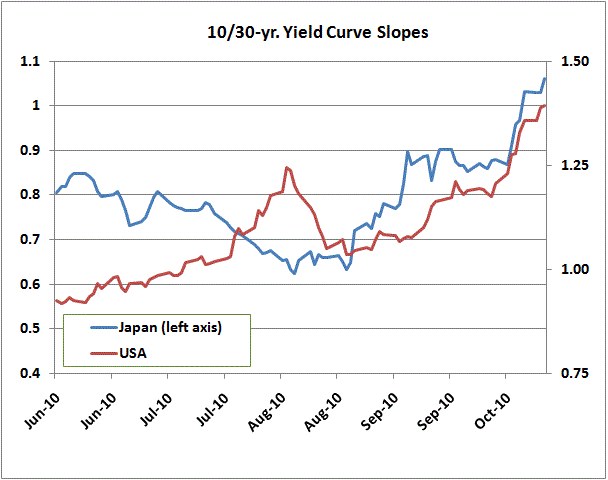
The US equity market is setting new highs since early May on the strength in Intel earnings yesterday and hopes that the global recovery will continue to mean strong corporate earnings. The generally complacent risk atmosphere is also seeing the USD weaker – no big surprise there. But there is still a bit of a divergence in the major asset classes relative to recent action as bond markets are still on a weak footing today after failing to post/hold new lows for the cycle yesterday. This begs the question that must be answered in the days to come: is this a win/win market as the likes of David Tepper has claimed (this was the hedge fund manager who famously appeared on CNBC a few weeks ago and proclaimed that markets could only go up because either there was real growth, which is great, or the Fed will continue to pursue QE which would float all markets anyway, which is also good) or is this purely a speculative mini-bubble that will be pricked as soon as the market’s false hopes of the beneficial effects of QE2 are dashed? We lean more toward the latter, in which case, this bond sell-off bears more significance than the market is currently recognizing. As well, a correction in the bond market could finally give the JPY bears some hope if it proves more durable than the 24-hour consolidation we have seen thus far.
Overnight news items
- China’s FX reserves jumped an absurd $150 billion in September, keeping alive the old global imbalances like 2008-09 never happened. It also points to lots of hot money entering the Chinese economy again. The overall Chinese trade surplus was the smallest in five months, as exports came in slightly lower than expected and imports were very strong. CNY rose….by about 0.12% against the USD, equivalent to about 17 pips in EURUSD….
- UK Jobless claims rose by the most in eight months as the jobs recovery seems to be largely over in the UK. The overall claimant count rate has dropped from 5.0% to 4.5% from the height of the recession to the most recent data, and compared with generally below 3% in the few years before the crisis.
- USDCAD is close to toying with parity after the official house price data nudged slightly higher rather than the slight decline expected. More recent data suggests far less cause for optimism on the Canadian house price front as we maintain the stance that the Canadian housing bubble is ripe for a severe correction in the year(s) ahead based on declining
Looking ahead
One of the more intriguing ideas circulating around at the moment is that Bernanke’s threat of QE2 is causing the “wrong” kind of inflation as the market moves to speculate in hard assets as the fears of currency devaluation mount. This means that the majority of people – whose income is obviously not increasing in line with speculative developments – are seeing their costs rise and buying power decrease. This is a highly destructive path for the economy if it is allowed to continue. The next chance for the Fed to speak comes on Friday as Chairman Bernanke is scheduled to speak at a Boston Fed Conference on Friday and he certainly ought to say something to the markets since the markets have been saying so much about what they believe about the potential effects of his policy trajectory. This would be the first real chance for a sell the rumor (sell the USD on QE2), buy the fact (because it won’t have the salutary effect currently priced into the market’s speculative frenzy) Stay tuned!
One of the more intriguing ideas circulating around at the moment is that Bernanke’s threat of QE2 is causing the “wrong” kind of inflation as the market moves to speculate in hard assets as the fears of currency devaluation mount. This means that the majority of people – whose income is obviously not increasing in line with speculative developments – are seeing their costs rise and buying power decrease. This is a highly destructive path for the economy if it is allowed to continue. The next chance for the Fed to speak comes on Friday as Chairman Bernanke is scheduled to speak at a Boston Fed Conference on Friday and he certainly ought to say something to the markets since the markets have been saying so much about what they believe about the potential effects of his policy trajectory. This would be the first real chance for a sell the rumor (sell the USD on QE2), buy the fact (because it won’t have the salutary effect currently priced into the market’s speculative frenzy) Stay tuned!
In the meantime, watch out for the batch of NZ data out tonight as the NZD rally seems to be having a hard time finding a ceiling. Tomorrow’s highlights include the chance to compare and contrast Canada and the US’ trade deficits, as the former continues to post record deficits that this competitive devaluation obsessed market is not noticing. The BoC can’t be happy as it watches Canadian terms of trade fundamentals crumbling rapidly. Could the next move by the BoC actually be a cut? That is certainly not priced into the market, which is still pricing in some 30+ bps of tightening over the coming 12 months. Is that medium term value we smell in USDCAD?
As for the status of the strength of bond markets, today we have the 10-year US Treasury Auction and tomorrow we get a 30-year T-bond auction. Yesterday’s 3-year auction was notable for its weakness relative to recent auctions.
Economic Data Highlights
- UK Sep. Nationwide Consumer Confidence out at 53 vs. 59 expected and 62 in Aug.
- Australia Oct. Westpac Consumer Confidence out at 117 vs. 113.2 in Sep.
- Japan Aug. Machine Orders out at +10.1% MoM and +24.1% YoY vs. -3.9%/+8.7% expected, respectively and vs. +15.9% YoY in Jul.
- New Zealand Sep. Non-resident Bond Holdings out at 64.0% vs. 62.7% in Aug.
- China Sep. Trade Balance out at $16.88B vs. $17.75B expected and $20B in Aug.
- China Sep. Foreign Exchange Reserves out at $2.65T vs. $2.5T in Aug.
- China Sep. New Yuan Loans out at 596B vs. 500B expected and 545B in Aug.
- Switzerland Sep. Producer and Import Prices fell -0.1% MoM and rose +0.3% YoY vs. +0.1%/+0.4% expected, respectively
- UK Sep. Jobless Claims Change rose 5.3k vs. 4.5K expected
- UK Aug. Average Weekly Earnings ex Bonus rose 2.0% 3M/YoY vs. 2.2% expected and 1.6% in Jul.
- EuroZone Aug. Industrial Production rose 1.0% MoM and 7.9% YoY vs. +0.8%/+7.4% expected, respectively and vs. +7.2% in Jul.
- Canada Aug. New Housing Price Index rose +0.1% MoM vs. -0.1% expected
- US Sep. Import Price Index fell -0.3% MoM and rose +3.5% YoY vs. -0.2%/+3.8% expected, respectively and vs. +4.0% in Aug.
Upcoming Economic Calendar Highlights
- UK BoE’s Sentence to Speak (1740)
- US Fed’s Bernanke to discuss Business Innovation (2010)
- US Weekly API Crude Oil and Product Inventories (2030)
- New Zealand Sep. REINZ Housing Price Index/House Sales (2100)
- New Zealand Sep. Business NZ PMI (2130)
- New Zealand Aug. Retail Sales (2145)
- US Fed’s Lacker to Speak (2345)
- Japan Sep. Domestic CGPI (2350)