Financial Advisor
Showing posts with label GBPUSD. Show all posts

Market Salutes Mass Confusion with Further Risk Rally

The coming “solution” to the EU’s debt crisis is creating ever mounting piles of research outlining the if’s, and’s and but’s – so the market shrugs its shoulders and says “they’ll figure something out.”

The discussion surrounding the potential form of the EFSF has become an endlessly confusing cacophony for which readers can find far better sources than this column to review and understand all of the various nuances of the proposed solutions and the questions outstanding. The bulls have largely made their case on the potential outcome for what is now next Wednesday (Summit, part Two) with the extensive rally in the rear view mirror. The bears are licking their wounds and still running for cover. The essential bottom for the bigger picture here boils down to three interlocking questions, none of which are likely to be answered beyond the next couple of weeks to couple of months, in my view.

Confidence? All of the solutions rely on the market’s confidence and the hope that officialdom has gone far enough in back-stopping sovereign debt to a sufficient degree far more than the actual deployment of funds. The solution is more one of – if something goes wrong, we’ll be there – trust us! It works as long as market participants believe it will work, in other words. But if enough confidence is lost and the actual mechanisms are being tested, is there really enough firepower in place? Which leads us to the next question…

Where is the money? The issue of leverage has not been resolved. Yes, an all-out money printing fiesta from the ECB or something closer to what the French wanted could have generated a more QE2-like large scale liquidity-induced rally, but none of the currently more likely sounding resolutions generate huge liquidity – only implied liquidity via backstopping. This is a highly complex, have-our-cake-and-eat-it-too tight money solution to the situation.

A closer union or not?  The risk at all times given the incredibly cumbersome EU framework is one of one more bad actor spoiling the party – Greek exceptionalism in this department is an awfully risky assumption. Most are discussing Greek defaults only. Every round of this crisis has shown how tenuous the political EU framework remains, and the trend doesn’t appear to be toward a firmer commitment to union, but rather the opposite. The framework may survive this round, but what about the next one?

These are awfully big questions. Yes, we could see confidence for a time because yes, there may be enough funding for the center to hold – but the third question is the real challenger down the line. If the confidence fails because more money is needed or more money is needed because confidence fails, the political will for another round of bailouts is unlikely to be there as our Chief Economist said in yesterday’s Chronicle – maximum intervention will eventually yield to Crisis 2.0, whether it is in this quarter or not until next year.

Meanwhile, back in the East
Two things going on in Asia at the moment: China’s equity market is looking very shaky and satellite indicators like the price of copper are a significant cause for concern, particularly given copper’s odd use in China’s collateralized credit market in recent years. Meanwhile, AUDUSD is following equity markets and the Euro-phoria rather than its more traditional orientation with industrial commodities – an awkward path at best for the currency. The direction of AUDUSD and copper/China indicators is unlikely to diverge for much longer – one of the two markets is “wrong”.

Elsewhere, complacent USDJPY longs were attacked in the early US hours as the USD was crumbling across the board in today’s trade as risk appetite stormed higher and 76.0 was taken out as USDJPY briefly touched a new all-time low. There is risk of further downside if Japanese officialdom prefers to wait for the other side of the G20 to make its presence more forcefully felt. The move lower is actually at odds with the interest rate spreads at the short end of the US/Japanese yield curves, though there has been a general move away from these kinds of correlations holding much sway of late.

Looking ahead
So what are the potential outcomes once we are on the other side of next week’s EU summit and the G20 in early November? A further extension of the rally for the shorter term is quite possible if the EU solution continues to generate more complacency – so we have to allow for, for example, EURUSD to challenge anything from its 55-day MA above 1.3900 to its 200-day MA above 1.40. But that’s our line in the sand, as we discuss in the chart below.

EURGBP pulled a number on the market today – as EURGBP took out downside stops before rallying well back into the range, a move that makes sense as GBP and USD are in similar boats and their general direction versus the EUR is likely to remain loosely correlated at minimum.

Chart: EURUSD scenarios
Assuming that the EURUSD isn’t preparing for a full trend change to the upside, the scenario indicated on the chart below is a possible trajectory for the pair – a brief further extension of the rally as we head into/out of the EU Summit followed by a reversal and then disappointment further down the line. If the pair remain above 1.40 for any length of time, we’ll have to reconsider our assumptions.
Have a great weekend and stay careful out there.


Economic Data Highlights
  • Germany Oct. IFO out at 106.4 vs. 106.2 expected and 107.4 in Sep.
  • Canada Sep. CPI out at +0.2% MoM and +3.2% YoY vs. +0.2%/+3.1% expected, respectively and vs. +3.1% in Aug.
  • Canada Sep. CPI Core out at +0.5% MoM and +2.2% YoY vs. +0.2%/+2.0% expected, respectively and vs. +1.9% YoY in Aug.
Upcoming Economic Calendar Highlights (all times GMT)
  • US Fed’s Kocherlakota to Speak (1700)
  • US Fed’s Fisher to Speak (1720)
  • US Fed’s Yellen to Speak (1900)
  • US Fed’s Duke to Speak (Sat 1400)
  • Japan Sep. Merchandise Trade Balance (Sun 2350)
  • Australia Q3 Producer Price Index (0030)
  • China Oct. HSBC Flash Manufacturing PMI (0230)

GBPUSD - Cautiously Bearish below 1.5787

Wednesday’s reversal of initial downside was extended yesterday but this demand stalled ahead of last week's highs. The subsequent setback corrected half of early gains for GBPUSD and this change in investor sentiment has continued in Asia, with positive momentum showing signs of reversal too. In view of this our call is Cautiously Bearish while below 1.5787. The immediate objective is 1.5711 with a move beneath that point targeting yesterday's 1.5697 low or even towards this week's bottom at 1.5632.
The risk to this call is that selling pressure stalls although a fresh outright Buy signal would only be generated by a move through 1.5787, the overnight high. Prices and sentiment should then improve to 1.5811 then last week's 1.5854 top.


Action, not words, required to take pressure off the EUR

An element of doubt came back into the mind of market participants Monday as (in particular, German) officials began to raise the possibility that the much vaunted ‘grand plan’ (which the rhetoric and inference by eurozone leaders commentary has been since the initial formulation by Merkel and Sarkozy on the 9th October) may not be the all-encompassing solution to the woes of the eurozone.
German Government spokesman Seibert stated “Dreams of a swift Euro solution won’t materialise”. In conjunction with the German Finance Minister’s statement that the “upcoming EU summit will not present [a] final solution for [the] eurozone debt crisis.”  Both comments added to the weigh of an already seemingly faltering EUR.
Broader risk assets also struggled yesterday as concerns filtered through into the banking sector, despite the significantly better than expected Q3 earnings figures from Citigroup. With little in the way of top tier data this week, headlines will continue to dominate sentiment. A clear example of this was seen yesterday when a Der Spiegel online article suggested that “top German economists are warning that France’s AAA rating could be in danger should additional measures become necessary to prop up indebted eurozone members of to save ailing banks.” This is not a new concept and, indeed, it is one which I have discussed on this page a number of times. But the timing of the story into a market already feeling vulnerable top bad news exacerbated the impact.
This morning the spread between French and German 10 year yields has hit another new record at 100bps and despite Finance Minister Baroin’s protestations that France will do “everything” to maintain its debt ratings, we have reached a pinnacle. We have reached the point at which the rousing, determined words of officials are no longer enough; a point where action is needed.  Schaeuble’s words yesterday, that seem to have undone all the calming work of the G20, could well see the EUR decline back to the lows, seen before the irrationally exuberant, Merkozy-inspired rally, over the next week.
In China overnight data came in better than broad expectations as Industrial Production and Retail Sales data picked up again in September after a decline in August.  Fixed Asset investment was broadly stable yet GDP for Q3 slowed to 9.1% (its slowest pace since 2009). Whilst GDP growth is the envy of the developed world it is widely believed that the structure of the Chinese Economy requires it to maintain growth above 8% to maintain stable unemployment. The current easing of growth saw interest rate swaps fall as, in addition to a marked slowdown in money supply and an easing in inflation, the market has begun to price in a halt to monetary tightening in order to support growth.
In the UK today we get CPI data for September, where the market is expecting a print close to the 5%, up from 4.5% in August. In the eurozone we await the ZEW economic sentiment index but as I suggested yesterday the current market is not driven by the data but predominantly by the politics and that will continue until we get a resolution in the eurozone.

For the rest of the week I would anticipate that the EUR, in particular, but broad risk assets (including the AUD) will underperform, and after the capitulative deleveraging rally of last week, the support on the downside is likely more fragile than before. I still favour EURGBP throughout this week, but risk off sentiment is likely to pick up as we approach the weekend.

Correlated GBPUSD & GBPJPY Could Offer Shorting Opportunities

Both GBPUSD and GBPJPY have been moving in tandem and we had a clear downside break Monday. Any correlated pullback to the line could be seen as a chance to short with tight stops in place.

Placing lines is never an exact science so having two charts for reference will be a help for fine tuning the entry point.

The Bullish Case for GBP?

"From the errors of others, a wise man corrects his own.” - Publilius Syrus

So European Central Bank President Trichet disappointed those looking for an interest rate cut but delivered just about everything else. The announcement of a reopening of covered bond purchases to the tune of EUR40 billion and the introduction of two one-year LTRO financing operations was a huge commitment to the ‘separation principle’ whereby the distinction between liquidity provision to the financial system is clearly ‘separated’ from the core function of interest rate, or monetary policy under the ECB's sole mandate of price stability. 

Ultimately in expanding the separation principle and throwing all but the kitchen sink at liquidity in the financial system, Trichet has maintained both the credibility of the ECB and himself, giving some interim support to the EUR (at least until the focus comes back on the Eurozone political leadership’s efforts to contain the Sovereign Debt crisis). The surprise uptick in inflation in the Eurozone at the last time of asking (driven largely by 0.5 percentage points annualised increase in German inflation) highlights the fact that cutting rates clearly didn’t sit comfortably with what was a consensus (but not unanimous) view of the governing council.  

BOE's QE and Moody's downgrade of UK banks
Arguably though, the big news of the day was the surprise move to re-open the electronic printing presses in the UK. The Bank of England’s Quantitative Easing programme was increased by GBP75 billion to GBP275 billion in a move that Mervyn King described as “pre-emptive action to try and prevent the slowdown from becoming too serious”. 
This I feel is a very important nuance to the actions of the Central Bank. King was also specific in his rationale that loosening monetary policy further was necessary because “the impact of the rest of the world on the U.K. does threaten our recovery”. Banking liquidity has clearly become a significant issue and one which has driven the actions of messrs Trichet and King into further stimulative action (whilst taking different paths to achieve it). The downgrading of 12 U.K. banks by rating agency Moody’s this morning highlights the concerns, as does the growing amount of deposits from Eurozone banks placed at the ECB, when lending to other banks would earn significantly higher returns. 

GBP to outperform?
Whilst in the short term GBP has suffered on foreign exchange markets I feel that there is now a case for GBP to outperform. The pre-emptive action of the Bank of England in light of what is ultimately a global downturn in confidence and a result of significant risks in the global economy – primarily the Eurozone (as King clearly stated yesterday) – should underpin the U.K. economy and GBP going forward. Particularly against the EUR and in that sense I still see any rallies in EURGBP as offering value. 

US jobless data in focus
For the day however, the focus of market attention will likely be on the US employment report and with economists estimates of the headline payroll change at a low level (55k) the risks are that we get a slightly more positive number (although unlikely to be enough to warrant any serious comfort at the fed – above 200k is widely thought needed to stabilise the unemployment rate).  Ultimately that means that for the day, the USD will likely remain on the back foot and risk assets will continue to outperform. Next week however may be a different matter altogether!

ECB Likely Unch, but Raft of Other Measures Possible (Desired)

Despite the fact that Friday we will witness the US employment report, today is undoubtedly the most important day of the week and will likely shape the dynamic for EUR and GBP (in addition to UK and eurozone assets) over the coming weeks. The focal points obviously being the interest rate meeting decisions from the Bank of England and the ECB.
In the UK speculation will be on the initiation of a further tranche of quantitative easing.

Having seen a significant swing in the MPC last month towards the dovish end of the recent spectrum I still think that it is a little early for the MPC to embark on the next stage of QE. It is true the economic backdrop has deteriorated further yet the most recent activity surveys in both manufacturing and service sectors in the UK showed a modest improvement back into moderate expansion. Confidence data, and admittedly the consumer activity (as indicated in the Q2 GDP revision yesterday), has remained weak. But the predominant driver of global confidence remains at the hands of European policy makers and the implications for global confidence.

As I see it, expanding the money supply in the UK may be successful in pushing interest rates lower, but this impact will be minimal when you consider where they are already. Gilt yields are already trading around historic lows and whilst I understand the desire to give confidence a boost, QE (which is largely already priced in by the market) at this stage may be a waste of bullets – at least until there is a resolution to the eurozone crisis, of some form. Back revisions to the economic growth data by the ONS released yesterday showed that the peak to trough drop in UK output was 7.1% rather than 6.4%, but there were upward revisions to 2009 and 2010. Ultimately there is little in the data to impact on the current policy debate, as I see things.

In the eurozone the question mark will be on whether Trichet, in his final meeting as head of the ECB, sanctions an interest rate cut. Whilst the economists are estimating no change in rates, the interest rate market has priced in around a 50% probability of a 25bp cut in the benchmark rate.  Whilst I view a rate cut from the ECB as unlikely, a raft of further measures including a 1 year LTRO, a revival of covered bond buying and or further liquidity provision commitments are distinctly possible as the much more is still needed from Europe in terms of supporting, liquidity, European banks and, ultimately, global confidence.

Whatever the outcome of the two seminal meetings today, there is likely to be a sharp pick up in volatility as the market repositions. With the US employment report tomorrow and a US market holiday on Monday, liquidity will likely be reduced, which will likely add further to the volatility.
Elsewhere, EURCHF has traded above its 200 day moving average this morning for the first time in around 2 years, and with bounce being supported by official suggestion (not action at this stage) that the ‘peg’ may be moved up to 1.3000 or even 1.4000 in due course.

The other news of note overnight was the proposition of a second Homeland Investment Act in the US, or effective tax amnesty for USD repatriation. Whilst the announcement gave a short-lived bid to the USD, the likelihood of passing the bill is very remote in my view as the figures from the first act (2004) suggested that the 5.25% amnesty rate, reduced the effective tax intake over the following 10 years by around USD80 billion – not something that would be seen as prudent in the current fiscal deficit reduction debate.

GBPUSD - Bearish below 1.5478

Cable setbacks, in line with Wednesday's bullish call for sentiment, attracted fresh investor demand. But it was unable to recover more than half of Monday’s net decline and this has returned the focus to the downside. The scope of the Asian decline is a concern but we look for any bounce to find fresh selling interest.

In view of this our call is to be Bearish on Rallies while prices are below 1.5478. The immediate objective is 1.5394, yesterday's low point, with a move below that point targeting 1.5341, this week's bottom, or even towards 1.5288.

The risk to this call is that selling pressure is weaker than currently assessed although a fresh outright Buy signal would only be generated by a move through 1.5478, the overnight high. Prices and sentiment should then improve to 1.5493, yesterday's top, then towards this week's open of 1.5550.

Euro Squeeze Over With Ahead of Trichet’s Last Stand?

Tomorrow is Trichet’s last press conference as head of the ECB. While an interest rate cut is likely not in the cards and might be seen as a reason for a further squeeze on Euro bears, other factors may weigh more heavily.

UK Data and BoE pre-preview for tomorrow
The UK PMI Services data was rather strong today – at 52.0 vs. 50.5 estimated and an improvement from 51.1 in August. This did very little to help the sterling’s case, however, as the general focus on Euro-relief (or at least a Euro-squeeze) saw EURGBP remaining rather buoyant and GBPUSD was in no hurry to tack onto yesterday’s bounce. The GDP and consumption data from Q2 were a downer (increased government spending obviously accounting for all of the GDP growth), meanwhile, and confidence surveys have been very poor lately, so there may be little bearing on the timing of the BoE’s additional asset purchase expansion. Odds are perhaps 50/50 heading into tomorrow’s BoE meeting on an expansion of the target, with a consensus of 50B for those who think an expansion is on the way and a smattering looking for 100B.

Odds and ends
A fine example of how the AUD is more a product of volatility in risk in the shortest of short terms rather than from moves on fundamental indicators like rate expectation. Tuesday’s 17-tick jump in Sep 2012 STIRs saw the AUDUSD  fall a further 100 pips or so (to be fair, the pair had been selling off steeply), but then a sharp wall street rally late yesterday, and mixed Aussie data (great retail sales, weak services survey) saw the same STIR off about 3 ticks, but AUDUSD rallying as much as 200 pips.

The US ADP employment change number was more or less in-line with expectations and with last month’s data (91k vs. 89k last month) and vs. last month’s Verizon strike-affected +17k US private payrolls number. In the meantime, some of the weekly jobless claims numbers ticked much higher before last week’s apparently calendar-affected low claims number. A bit more worrisome was the Challenger job cut survey that showed mass firing plans were the largest in more than two years, with Army and Bank of America cuts accounting for 70% of the total.  It all adds up to a yawn or slightly negative surprise this Friday, barring any dramatic evidence from the ISM non-manufacturing employment sub-index out a bit later today.

A great FTAlphaville article discusses the difficulties in addressing the Euro-debt situation, as it quickly becomes clear that anything short of a blanket guarantee will mean continued uncertainty, even if it is theoretically possibly to construct a credible haircut on Greece and some of the other peripheral countries and recapitalize banks. Meanwhile, Italy suffered the massive downgrade overnight and Merkel is not playing ball with the pro-EuroBond contingent, so the situation isn’t going much of anywhere at the moment as we await the ECB's next moves.

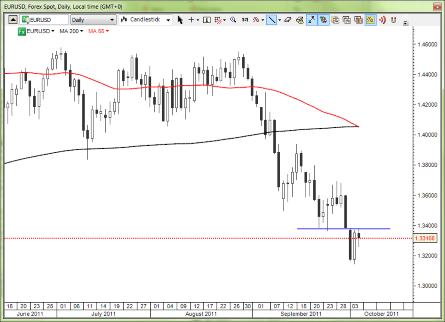
Chart: EURUSD
EURUSD reached its first major resistance area just below 1.3400 as we await tomorrow’s ECB outcome. (more on that below.) Above that, and we have 1.35 to contend with as the next resistance area of note.
Looking ahead – ECB pre-preview
Remember that tomorrow is Trichet’s last press conference at regular ECB meetings as Draghi is scheduled to take over at the end of this month. While many are predicting a rate cut from the ECB, it is hard to believe that Mr. Vigilance Trichet would want to leave the bank with a rate cut after having hiked as recently as July of this year. Leave it for the following meeting… More important will be further signals on the ECB’s plans to relieve the pressure on European bank funding as the general expectation is that Mr. Trichet will announce the reintroduction of unlimited 12-month funding but perhaps most importantly, will the ECB announce a new covered bond purchase program? Odds are perhaps even on the latter. And if it does launch such a program, will the move be seen as Euro positive because of the immediate relief. After all, is not a bond purchase program (despite vague possible claims that any purchases would somehow be sterilized) the same as the BoE expanding its asset purchase target. Very intriguing to see how the market will judge the ECB’s actions in addition to what the ECB does. Eventually, the only thing that keeps the banks liquid is effectively QE.

Economic Data Highlights
  • Germany Sep. Final PMI Services survey lowered to 49.7 vs. original 50.3 estimate
  • Euro Zone Sep. Final PMI Services survey lowered to 48.8 vs. original 49.2 estimate
  • UK Sep. PMI Services survey out at 52.9 vs. 50.5 expected and 51.1 in Aug.
  • UK Q2 GDP revised down to 0.1% QoQ and +0.6% YoY vs. +0.2%/+0.7% original estimates, respectively
  • UK Q2 Private Consumption dropped -0.8% QoQ vs. -0.3% expected
  • UK Q2 Government Spending rose +1.1% QoQ vs. -0.1% expected
  • US Sep. Challenger Job Cuts out at +211.5% YoY vs. +47.0% in Aug.
  • US Sep. ADP Employment Change out at +91k vs. +75k expected and +89k in Aug.

Upcoming Economic Calendar Highlights (all times GMT)
  • US Sep. ISM Non-manufacturing (1400)
  • US Weekly DoE Crude Oil and Product Inventories (1430)

GBPUSD - Cautiously Bullish above 1.5575

Trading was subdued in Cable Wednesday. This confirmed our indecisive call with all trading confined tightly within Tuesday’s price range. This ‘Inside Day’ highlights continuing uncertainty and in fact the weakness of the net decline has been emphasised by a return of investor demand in Asia.

The upside has not been strong enough to break out of Tuesday’s parameters but intraday signals for sentiment are now mildly bullish. Current volatility adds an extra note of caution and so our call is Cautiously Bullish and on setbacks above 1.5575. The immediate objective is 1.5656 with a move beyond that point targeting 1.5706, Tuesday’s peak, or even 1.5748, the high from Sep 21st.

Selling through 1.5575, today’s Asian open, is the risk to this call as it signals that buying pressure is weaker than currently assessed. The market should then decline to 1.5543, the overnight low, then 1.5482, this week's open.

Dollar Firm ahead of FOMC, Sterling Down after BoE Minutes

Dollar strengths mildly today as global stocks are mildly softer ahead of the highly anticipated FOMC announcement. It's widely expected policymakers will announce something called 'operation twist' -increasing the average maturity of securities holdings by swapping holdings of lower maturities Treasuries with longer ones, after the 2-day meeting. Compared with outright bond purchases (QE3), one advantage of operation twist is that the size of the Fed's balance sheet would remain unchanged and is less unlikely to invoke inflation. 

Sterling is notably lower broadly after BoE minutes revealed that most MPC members thought "stresses of the past month had significantly strengthened the case for an immediate resumption of asset purchases". And "for some members, a continuation of the conditions seen over the past month would probably be sufficient to justify an expansion of the asset purchase program at a subsequent meeting." Markets interpreted that as a signal BoE is opening the door wide for more quantitative easing sooner rather than later. And there are speculation that BoE would start in October with another GBP 50b of asset purchases even though November would probably the more likely timing. In additional Sterling is pressured by data showing larger than expected public sector net borrowing, excluding the temporary effects of financial interventions, of GBP 15.9b in August. That was the highest in record for the month.

The Swiss France remains soft today on speculation that SNB would raise the floor of EUR/CHF to 1.5. Ernst Baltensperger, an adviser to SNB said he considers it's possible and said in an interview that all fundamental data are pointing toward a range of between 1.30 and 1.40. SNB spokesman declined to comment on the speculation yesterday and there is no announcement from SNB so far today.

European Commission President Barroso said that the Eurobond should remain an option to be discussed and should not be excluded. This is seen by markets as a signal that he's softening his stance after facing strong opposition from Germany and France on the idea of Eurobonds. Meanwhile, it's reported that Eurozone debt crisis will be the main subject of discussion in the next G20 meeting, which holds alongside IMF's annual meeting in Washington later this week.

Data from Canada saw CPI jumped more than expected to 3.1% yoy in August while core CPI rose to 1.9% yoy. But the data provides little support to the Canadian dollar. Other data saw Japan all industry activity index rose 0.4% mom in July, trade deficit at JPY -0.29T in August. China leading indicator rose 0.6% in July. Australian Westpac leading index rose 0.5% in July.

GBP/USD Daily Outlook

Daily Pivots: (S1) 1.5678; (P) 1.5713; (R1) 1.5770;

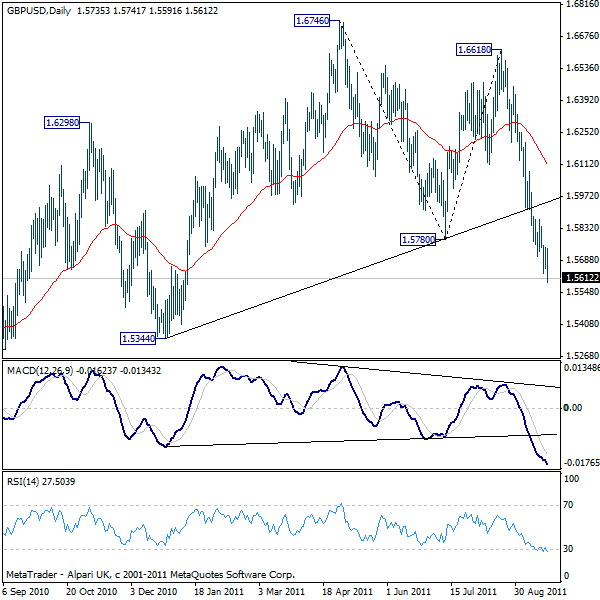
GBP/USD's fall resumes after brief consolidations and drops to as low as 1.5591 so far today. Intraday bias is back on the downside and further decline should be seen to next key medium term support at 1.5344. On the upside, above 1.5747 minor resistance will argue that a short term bottom is formed with bullish convergence condition in 4 hours MACD. In such case, lengthier consolidation would be seen before GBP/USD stages another decline.
In the bigger picture, rise from 1.4229, which is treated as the third leg of consolidation from 1.3503 (2008 low) should be finished at 1.6746 after GBP/USD completed a head and shoulder top reversal pattern (ls: 1.6298, h: 1.6746, rs: 1.6618). Fall from 1.6746 could be the fourth leg of the consolidation pattern from 1.3503 (2008 low) or resuming long term down trend from 2.1161 (2007 high). In either case, a test on 1.3503/4229 support zone should be seen. On the upside, break of 1.6618 resistance is needed to invalidate this view. Or we'll now stay cautiously bearish in GBP/USD.

USD/JPY Daily Outlook

Daily Pivots: (S1) 76.27; (P) 76.52; (R1) 76.68; 
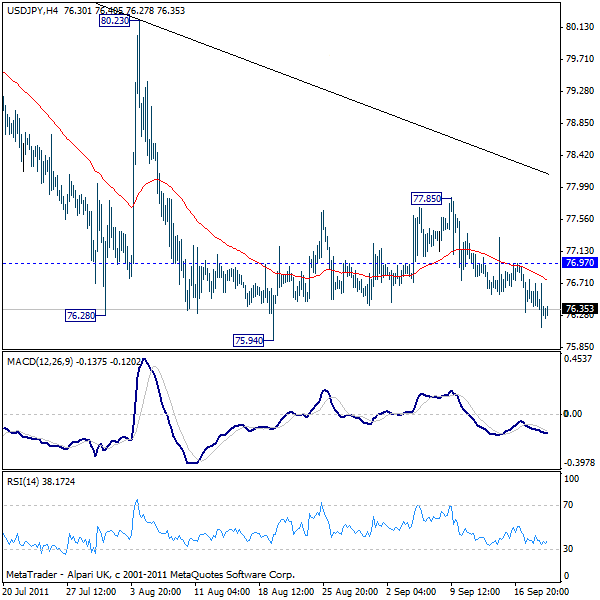
Intraday bias in USD/JPY remains on the downside and current fall is still in progress for 75.94 support. As noted before, consolidation from 75.94 should have completed at 77.85 already. Break of 75.94 will confirm resumption of whole fall from 85.51. On the upside, above 76.97 minor resistance will delay the bearish case again and turn bias neutral to extend the consolidation from 75.94.

In the bigger picture, USD/JPY is still staying well inside the falling channel that started back in 2007 at 124.13. There is no indication of trend reversal yet even though medium term downside momentum is diminishing with bullish convergence condition in weekly MACD. Such down trend is still in favor to continue to 70 psychological level. In any case, break of 80.23 resistance is first needed to indicate completion of fall from 85.51. Secondly, break of 85.51 is needed to be the first signal of medium term reversal. Otherwise, we'll stay cautiously bearish in the pair.


Economic Indicators Update

GMT Ccy Events Actual Consensus Previous Revised
22:45 NZD Current Account Balance Q2 -0.92B -0.69B -0.10B -0.09B
23:50 JPY Trade Balance Aug -0.29T -0.01T -0.13T -0.16T
0:30 AUD Westpac Leading Index M/M Jul 0.50T
0.10%
2:00 CNY Leading Indicator Jul 0.60%
1.00% 0.90%
4:30 JPY All Industry Activity Index M/M Jul 0.40% 0.50% 2.30%
8:30 GBP BoE Minutes 0--0--9 0--0--9 0--0--9
8:30 GBP Public Sector Net Borrowing (GBP) Aug 13.2B 11.4B -2.0B -5.2B
11:00 CAD CPI M/M Aug 0.30% 0.10% 0.20%
11:00 CAD CPI Y/Y Aug 3.10% 2.90% 2.70%
11:00 CAD BoC CPI Core M/M Aug 0.40% 0.20% 0.20%
11:00 CAD BoC CPI Core Y/Y Aug 1.90% 1.60% 1.60%
14:00 USD Existing Home Sales Aug
4.75M 4.67M
14:30 USD Crude Oil Inventories
-1.6M -6.7M
18:15 USD FOMC Rate Decision
0.25% 0.25%

GBP and NOK in Focus Ahead of FOMC

Today’s obvious focus is the US FOMC meeting much later today, but in the meantime, we’ve got a couple of important event risks for GBP and NOK in the form of BoE minutes and the Norges Bank rate decision.

Hard to believe that it isn’t topping all of the new services today, but we’ve got a massive news item out of the US the bears directly on today’s FOMC meeting and all future Fed activities: here we’re talking about the news that Boehner and the House Republican leadership have penned a missive to Fed Chairman Bernanke that asks the Fed to “refrain from further stimulus” as
this Bloomberg article puts it, in order to avoid “further harm” to the economy. This is a tremendous development – a drawing of a line in the sand. How will the Fed respond, not so much today, but in the weeks and months to come?

BoE Minutes

The BoE minutes are squarely in focus for the UK today (to be published at 0830 GMT), as continued relatively weak data combined with still uncomfortably high inflation levels paint an ugly picture for sterling, which has fallen precipitously versus the greenback and the yen of late on the expectation that the next round of QE is nigh. Looking at the status in the charts, one wonders how much more the market is willing to punish the currency even assuming the BoE September meeting minutes show the MPC gearing up for another round of asset purchases. Certainly from a rate differential perspective, the GBPUSD move appears overdone, though that pair may move more on tonight’s FOMC meeting than . EURGBP may be a better indicator on the market’s sentiment toward sterling.

Norges Bank

As we have previously discussed, the Scandies received some degree of interest as safe haven currencies in the wake of the SNB’s declared war on the strengthening franc earlier this month, but EURNOK quickly righted itself after a brief swoon. Norges Bank will be out declaring its interest rate policy today at 1200 GMT. The increasing dovishness of the central bank has seen the forward expectations fall from +60 bps in July to about -60 bps at present. EURNOK is not priced fairly according to that movement, obviously as the market is also pricing Euro according to the latest sovereign debt woes. But further reminders from the Norges Bank that it doesn’t like NOK appreciating too much or that its stance is relatively dovish could see the NOK  lose some more of its shine. Our position is that viewing the NOK as a safe haven currency is a difficult proposition – the attraction of the impeccable sovereign balance sheet is undeniable, but the currency has a more compelling history as a petro-currency and its relatively thin liquidity more or less disqualifies it for true safe haven status.

It will be interesting to see how the Norges Bank discusses the housing bubble, which is the only factor that has kept rates as high as they are. The job of suppressing further bubble risks, however, may fall more toward the Financial Supervisory Authority with possible new tougher rules, rather than to the Norges Bank.


Chart: EURNOK

EURNOK rebounded from new multi-year lows recently, as the market shied back from the break lower, a reversal that has somewhat neutralized the downtrend. Does today’s Norges Bank finally see the pair pull back higher through the 200-day moving average? (black line)
Chart: EURNOK vs. interest rate spreads
The NOK has already been outperforming the indications from interest rate spreads due to the Euro’s unique sovereign debt situation, but the premium for NOK has been particularly large of late as rate expectations for the Norges Bank have crumbled.

GBPUSD - Cautiously Bullish above 1.5676

There was little net movement in GBPUSD yesterday. Minor net gains were posted but all price action was contained within Monday’s range. This ‘Inside Day’ highlights investor indecision but gradually higher lows keep the underlying tone positive and despite intraday signals for sentiment now at overbought extremes, we look for gains to extend.

In view of this our call is Cautiously Bullish above 1.5676. The immediate objective is 1.5756, this week's top, with a move beyond that point targeting 1.5788, Monday’s peak, or even 1.5843, last Friday’s high trade.

The risk to this call is that overbought extremes begin to correct earlier and lower than currently assessed. This would be signalled by a move below 1.5676, yesterday's European afternoon low, with subsequent downside targeting 1.5631, this week's base, or even towards, but not as low as, 1.5568, this year’s open.

US Dollar Outlook Remains Highly Constructive in Current Enviornment

  • EconFin meeting disappoints; Euro back under pressure
  • Strauss Kahn intimates that Greek default is inevitable
  • French banks could be exposed to UBS rogue trading incident
  • WSJ article talk of a more balanced Federal Reserve than markets are looking for
  • Yen at risk for depreciation as government set to unveil plan to deal with strong currency
Any hopes for some form of a constructive resolution to the Eurozone and Greek debt crisis over the weekend, were sorely disappointed after the EconFin meeting failed to produce any significant results. The expectation that things need to get done, and fast, is incredibly high and so long as these expectations are let down, we should see a quick deterioration in sentiment. It is therefore no surprise to see the Euro and risk correlated currencies tracking lower into early Monday. Adding insult to injury have been comments from ex-IMF Director, Dominique Strauss Kahn who basically concedes that Greece will default on its debt obligations. Additional factors seen weighing on the markets have been UBS raised estimates of losses from unauthorized trades executed by rogue trader Kweku Adoboli. A WSJ article cites someone close to the story who says that French banks may be among the counterparties to the fake trades.
Relative performance versus the USD on Monday (as of 10:00GMT)
  1. JPY +0.01%
  2. CAD -0.39%
  3. GBP -0.41%
  4. NZD -0.89%
  5. CHF -0.91%
  6. EUR -0.99%
  7. AUD -1.19%
On the other side of the ocean, yet another WSJ article is gaining some traction early Monday after Jon Hilsenrath talks about the on goings at the Fed and future policy considerations. The article suggests that the Fed is more reticent than many might have thought towards its ultra accommodative bias, and failure to discuss QE3 or other radical stimulus measures should be all the more concerning to those in the dovish camp. At the end of the day it is very difficult to determine just where the chips will fall at the next meeting, but this article certainly does a good job of painting a picture which potentially could open the door for repositioning back in favor of the USD on a less aggressive accommodative central bank outlook.
Elsewhere, despite the uptick in risk aversion and flow of funds back into safe haven bids, the Yen tracks lower against even the buck, with market participants perhaps less inclined to be buying Yen on the news that the Japanese government is expected to unveil its interim plan to deal with the strong Yen early this week. It looks as though the government is now trying to consider the implementation of softer and less aggressive measures to weaken the local currency rather than resorting to aggressive intervention tactics. In our commentary from the previous week, we continue to like the idea of selling Yen aggressively at current levels, with the currency trading by record highs against the buck and due for a major cyclical reversal over the coming weeks and months. We do not see the lure of the Yen as a safe haven currency and anticipate that any additional flows into the currency from the recent measures taken by the SNB will be highly unwelcome.
All of this continues to translate into a highly favorable outlook for the US Dollar, which we expect will be the primary beneficiary from safe haven flows going forward. The Franc and Yen are no longer viable options and the ongoing deterioration within the broader global macro economy demands a flight to safety back into the highly liquid US Dollar. While the following argument isn’t necessarily relevant right now, we also see the US Dollar in a position to benefit on any upside reversal to global growth prospects, with the rebound in the global economy to likely force a material narrowing in yield differentials back in favor of the buck as the Fed looks to reverse its ultra accommodative policy.
Looking ahead, the calendar is exceptionally light in North America, with the only release coming in the form of NAHB housing due at 14:00GMT. US equity futures are tracking a good deal lower and point to an open of some 1.50% in the red. Commodity market price action is jiving well with familiar correlations and market themes with oil a good deal softer and gold managing to find some renewed safe-haven bids.
ECONOMIC CALENDAR
TECHNICAL OUTLOOK
EUR/USD: The sharp pullback below the July lows and establishment below the 200-Day SMA solidifies the prospects for the carving of a major lower top on the monthly chart which now ultimately projects additional declines down towards the 1.2000 area over the coming weeks and months. The latest inter-day rally off of the 1.3500 area lows has stalled out within our projected lower top region between 1.3835 and 1.4055 and a break back below 1.3500 will confirm the lower top at 1.3940 and accelerate declines down towards 1.3000. Ultimately, only back above 1.3940 delays outlook and gives reason for pause. 
USD/JPY:This is a market that looks like it trying very hard to establish some form of a base after recently setting fresh record lows just under 76.00. Although the downtrend remains intact and has been fairly intense, longer-term studies welcome the prospects of the formation of a material base and shift in the overall structure. Price action over the past several days has been confirming, with the market very well supported in the 76.00’s and unable to extend the downtrend to fresh record lows. Instead, the break back above 77.00 is looking more and more constructive, with the weekly chart also showing bullish tendencies after quietly putting in three consecutive positive closes. From here, we look for the establishment back above the 50-Day SMA at 77.90 to reaffirm our recovery outlook and accelerate gains towards next key resistance by 80.25 further up. Ultimately, only a daily close back below 76.50 would give reason for concern.
GBP/USD: Overall price action seems to suggest that this market could once again be looking to roll over in favor of some fresh medium-term declines. Any gains in recent months have proven to be very well capped above 1.6500, and this latest break back below 1.5780 opens the door for a pick-up in bearish momentum towards key support by 1.5345 further down. Any interday rallies are expected to be well capped below 1.6000, while ultimately, only back above 1.6500 would give reason for concern. 
USD/CHF: A recent acceleration of gains beyond critical resistance and a previous lower top at 0.8550 confirms bullish bias and from here, we see room for fresh upside above 0.9000 and towards 0.9500 over the coming days. Look for any setbacks to be well supported above previous resistance now tuned support at 0.8550 on a daily close basis, while ultimately, only back under 0.8200 would delay. A break and close back above the 200-Day SMA for the first time in several months will provide more ammunition for our highly constructive outlook.
 
Written by Joel Kruger, Technical Currency Strategist
 
If you wish to receive Joel’s reports in a more timely fashion, email jskruger@dailyfx.com and you will be added to the distribution list.
        

Major Central Banks to Conduct USD Liquidity Operations

To relieve funding pressures at European banks, the major European central banks and the BoJ will be conducting dollar liquidity operations in co-operation with the US Fed. This relieves the immediate pressure and encourages USD sell-off – but for how long?


The ECB, BoE, and SNB, in co-operation with the Fed, have announced USD liquidity operations to relieve funding pressures that European banks were feeling as funding was drying up lately due to the strains from the sovereign debt situation in Europe and its perceived effects on banks’ creditworthiness and counterparty risk. EURUSD jumped to attention and sailed higher on the news, as did GBPUSD, though to a lesser degree as European banks were in the more intense spotlight.


The liquidity operations are to be for 3-month funding (on top of existing 7-day funding) and are for as much funding as banks want as they are for “full allotment”. The central banks stated that the operations would cover banks through the end of the year. The first tender date will be 12 October with two more to follow, one on 9 November and the following on 7 December.


This added to the recent consolidation in the greenback as it relieved a key source of the pressure on the greenback’s appreciation. But the irony of this situation is that, while it relieves the immediate pressure on USD funding needs, it also formalizes/publicizes the fact that European banks are in desperate need of USD’s and will need to pay them back later if not now.


The move shouldn’t come as any surprise as we’ve become so accustomed to every pinch in liquidity to be relieved by the worlds’ central banks. It’s extend and pretend, kicking the can, etc., and it’s reaching such a degree that our Chief Economist has dubbed the latest all out efforts to plug the ever-leakier dyke “Maximum Intervention”.


SNB

The SNB was out earlier in what amounted to a cage-rattling, threatening to do its utmost to keep the franc weaker and declaring that 1.20 is still very low. It feels like the market wants to see more action and less talk, as there was but a flurry of reaction to these “developments”.


US Data

So much for the hope for mean reversion in the US Empire manufacturing survey, as the Empire survey dropped yet again to notch its worst reading since the one-off tumble last November and its fourth negative reading in a row. The employment and work week sub-indices dropped into negative territory for the first time in the cycle. The Philly Fed was also a bit weaker than expected, though not as catastrophic as the July reading. One can perhaps hope that the hurricane has something to do with the weak Empire and Philly readings. The weekly jobless claims number could certainly have been affected, just as we saw claims data spike in the wake of hurricane Katrina back in 2005.


Looking ahead

The relief rally from this announcement of liquidity operations doesn’t necessarily change the game – it could fade already after today or it might take a couple of weeks, depending on whether additional measures are announced – perhaps an attempt over the weekend by the EU to show far more solidarity than we’ve seen thus far, or perhaps on an enthusiastic response to whatever the maximum intervention Bernanke Fed has to say on Tuesday regarding QE3. Until then, the weakening economies and weak data out of the US are not encouraging and this measure is of the same ilk as all past extend-and-pretend interventions.


Economic Data Highlights

  • Switzerland Q2 Industrial Production out at +3.6% QoQ and +2.3% YoY vs. +3.0% +2.7% expected, respectively and vs. +4.5% YoY in Q1
  • Switzerland SNB left Libor Target Rate unchanged as expected 
  • Norway Aug. Trade Balance out at +32B vs. +38.1B in Jul.
  • UK Aug. Retail Sales ex Auto Fuel out at -0.1% MoM and -0.1% YoY vs. -0.2%/-0.2% expected, respectively and vs. 0.0% YoY in Jul.
  • EuroZone Aug. CPI out at +0.2% MoM and +2.5%YyoY as expected
  • Canada Jul. Manufacturing Sales out at +2.7% MoM vs. +1.4% expected and -1.3% in Jun.
  • US Aug. Consumer Price Index out at +0.4% MoM and +3.8% YoY vs. +0.2%/+3.6% expected, respectively and vs. +3.6% YoY in Jul.
  • US Aug. CPI ex Food and Energy out at +0.2% MoM and +2.0% YoY vs. +0.2%/+1.9% expected, respectively and vs. +1.8% YoY in Jul.
  • US Q2 Current Account Balance out at -$118B vs. -$122.4B expected and vs. -$119.6B in Q1
  • US Weekly Initial Jobless Claims out at 428k vs. 411k expected and 417k last week
  • US Weekly Continuing Claims out at 3726k vs. 3710k expected and vs. 3738k last week
  • US Aug. Industrial Production out at +0.2% MoM vs. 0.0% expected and +0.9% in Jul.
  • US Aug. Capacity Utilization out at 77.4% vs. 77.5% expected and 77.3% in Jul.
  • US Weekly Bloomberg Consumer Comfort Index out at -49.3 vs. -49.0 expected and -49.3 las week
  • US Aug. Philadelphia Fed out at -17.5 vs. -15 expected and -30.7 in Jul.


Upcoming Economic Calendar Highlights (all times GMT)

  • US Fed’s Tarullo to Speak (1745)
  • New Zealand Sep. ANZ Consumer Confidence (0100)
More on this :

GBPUSD - Bearish below 1.5805

Against a background of bearish signals for sentiment for this week, Monday’s minor profit taking was overturned by renewed investor selling. This took CABLE to lower levels for a 6th day in succession, supported by bearish momentum. Asia has continued the negative bias and although intraday signals for sentiment are approaching oversold extremes, we look for rallies to be limited and temporary. In view of this our call is Bearish below 1.5805. Confirmation will be a move through 1.5741, the overnight low, with subsequent downside targeting 1.5705 then 1.5671.
The risk to this call is that selling pressure stalls although a fresh outright Buy signal would only be generated by a move through 1.5805, the overnight high. Prices and sentiment should then improve to 1.5824, half of Tuesday’s net decline, then towards that day’s 1.5871 peak. 

Euro Continues to Stumble, Aussie Playing Catchup

Aussie and its ilk are playing catchup to the downside as the deteriorating risk conditions stemming from the Euro Zone’s existential crisis are making waves all across global markets.


If you missed it Friday, please see our bigpicture look at the G10 currencies, a series of charts showing the relative strength of each of the G10 currencies against an evenly weighted basket of the remainder of its G10 peers.


Dreading the drachma?

The Euro continues to suffer in the wake of Stark’s exit from the ECB, on rumors that Germany is girding itself for a Greek exit from the EU and on ongoing signs that the ECB and EU governments are simply unable to get ahead of the galloping fears of a systemic banking crisis triggered by the lack of trust in sovereign debt. CDS’ on Italian sovereign debt ended last week at a new high for the cycle and Greek 2-year debt trades at a stratospheric yield of 57%, suggesting the investors believe they will receive well under 50 cents on the Euro for their Greek debt in the event of a default. Greece is still making quite a show of trying to meet fiscal targets as Finance Minister Venizelos announced a plan to cut a month’s salary from all publicly elected officials and to impose a new property tax that would be collected via consumers’ electricity bills to secure collection (Greece has an enormous tax dodging problem). The measures are looking increasingly desperate and untenable and we can be sure that there won’t be a third bailout option for Greece – it will either meet the targets or opt to default, with odds rapidly rising of the latter.


European bank equities also continue to crater, led by French banks like SocGen and BNP Paribas. These stocks are the easiest way to track a “live barometer reading” on EU breakup fears in addition to the Euro itself. The technical break of the 1.40 area in EURUSD has also opened up an enormous area that has few support levels for guidance until we get down close to 1.30.


Chart: EURJPY
As bond yields continue to crate, the BoJ has only been barely successful in holding the line on JPY appreciation against the USD, so the yen is rushing higher elsewhere. Against the Euro, the JPY reached its strongest level since well before the actual circulation of the single currency, trading as low as 104.00 before this article’s pixel time. Japanese officials continue to rail against the strong yen and the new FinMin Azumi promised “bold action, especially against speculative trading”. Looking at the JPY charts today, it will take bold action indeed – can Japan succeed in pulling an SNB?
Of course, as the Euro is grabbing all of the headlines for its weak ways, it’s hard for us not to point out that the single currency has rallied, yes, rallied 200 pips versus the Aussie in today’s trading from the lows, as our comment late last week that the Aussies would have some catching up to do on the downside if risk appetite continue to sour proved correct.


Focus this week

The main focus this week will continue to be on the Euro Zone and whether we will continue to see the pressures pushing the Euro into the abyss or whether the ECB and EU can muster a sufficiently robust response to give the market some pause. No signs of the latter just yet, by any means.

In the UK, a government plan to ring fence retail banking operations from investment banking ones is under consideration. Banks are obviously against this due to its high cost, and though the pound continues to thrive as an anti-Euro and a benefactor in the face of risk aversion, it’s popularity may wear off a bit if this package moves toward passage. EURGBP has in fact bounced considerably on the day after the recent steep retreat, with 0.8675 as a key resistance/pivot area.


This week we should look for the first reactions to the new Obama stimulus plan and a taking of the Republican opposition’s temperature that may give an indication on how difficult the birthing process will be for a new stimulus bill. Again, simple game theory dictates that the Republicans will be moved to pass some similar version of this bill, perhaps with a few future spending cut caveats as Obama has crafted a package proposal that could have easily been created by non-Tea party Republicans. The more critical issue


It will be interesting to hear what the Dallas Fed’s Fisher has to say at his speech on monetary policy later today. He is the most vocal of the voting dissenters and may use today’s appearance to speak out against the next steps the Bernanke majority is considering, not that this will necessarily deter them as they meet next week.


On the economic data front, we’ve got inflation data up from the UK tomorrow and from the US on Wednesday (PPI) and Thursday (CPI). US Aug.  Retail Sales data is set for release on Wednesday as well. Among the central banks, the RBNZ is set to meet Thursday, as is the SNB. The first two regional US manufacturing surveys, the Empire and Philly Fed, are set for Thursday, though last time around, these were misleading as a still resilient Chicago PMI was a better indicator of a better than expected ISM manufacturing number in August. Stay tuned.


Economic Data Highlights

  • China Aug. Trade Balance out at $17.76B vs. $24.6B expected and $31.5B in Jul.
  • China Aug. New Yuan Loans out at 548.5B vs. 500B expected and 492.6B in jul.
  • Japan aug. Domestic CGPI out at -0.2% MoM and +2.6% YoY vs. -0.2%/+2.7% expected, respectively and vs. +2.9% YoY in Jul.
  • Australia Jul. Trade Balance out at 1826M vs. 1900M expected and 2052M in Jun.

Upcoming Economic Calendar Highlights (all times GMT)

  • US Fed’s Fisher to Speak on Monetary Policy (2000)
  • New Zealand Q2 Manufacturing Activity (2245)
  • UK Aug. RICS House Price Balance (2301)
  • New Zealand Aug. QV House Prices (0000)
  • Australia Aug. NAB Business Confidence/Conditions (0130)

Big picture G10 Currency Charts

The charts below are for each of the G10 currencies versus an evenly weighted basket of the remainder of their G10 peers. The charts are small (as we work on updating the blog to allow links to larger graphics), but they nonetheless do cover quite a bit of ground – 2500 data points for each in fact, which hopefully gives an interesting perspective. Each of the time series starts at indexed 100 as of early February 2002. (The start point of the index changes with every refresh of the charts on  a rolling basis.)

Note that the charts were cut before the last leg of the action in the early US session after the news that Stark will resign from the ECB (rumored because of disagreements on bond buying) and on news ECB will back off on penalty rates for banks accessing emergency facilities.

USD

The US dollar has been dropping forever – note that while the dollar index crossed the 200-day moving average, the USD/G10 basket has not yet crossed this important level, though it is trading at the highest level in months and may be confirming a transition to a bullish trend after the recent basing action and loss of downside momentum.

EUR

How ironic is it that, as the EU is experiencing its worst existential crisis to date, the Euro is back close to its lowest levels in years….which are also the lowest levels since the Euro was launched amid intense skepticism over the entire idea of a single currency back in 2002.

JPY

The JPY remains resilient and relatively strong – but will likely only be so as long as rates remain absurdly low and/or the BoJ and Japanese government steal a page from the SNB’s book on the intervention front

GBP

GBP is experiencing a bit of a revival on Euro misery and as its down trend has been losing steam for a long time. Could the market be getting too complacent on further GBP weakness?

CHF

The magnitude of the run-up and the subsequent reversal is breathtaking, but leaves us, amazingly, still poised above the 200-day moving average! There’s a lot more room for franc weakness if the SNB’s intervention project succeeds.

AUD

AUD is extremely overvalued if the Asian growth story in any way derails. The focus has been intense on Europe, but many risk appetite signals are flashing around the world, which are most often associated with Aussie downside. Aussie hasn’t been garnering sufficient notice.

CAD

CAD has been a relatively low beta currency over the years relative to some of its peers. It is generally out of favor now, but could put up a fight or at least avoid broad weakness if the US economy and USD prove stronger than the market is currently expecting.

NZD

The NZD bull market has enjoyed an Indian summer, but it may fade on the potential for an Asian hiccup and if the post NZ earthquake GDP bump fades in the months ahead.

SEK

The krona is gaining favor as a safe haven from Euro turmoil. It may rally passively for a while, but historically has a hard time if its export markets are threatened.

NOK

NOK is very credible as a safe haven from a fundamental standpoint and has room to rally further, but what point does the Norges Bank begin to rattle it saber when EURNOK is already at almost decadal lows?

Ratings and Recommendations