Financial Advisor
Showing posts with label EURCHF. Show all posts

Q4 FX Outlook: USD Rally to Extend

Waiting for a US dollar rally this year has felt like Waiting for Godot at times as we anticipated one for a long time before the greenback finally rallied sharply in late August and early September after a long period of stagnation over the summer, despite a number of market developments that have normally proven positive for the currency in the past. Those included falling equity markets, rising signs of worry in other risk indicators and in global growth concerns, particularly in Asia and emerging markets.

In our Q3 FX outlook, we discussed the “ugly horse-race” among the G-10 currencies because we felt that few if any of the major or minor developed economies would offer compelling reasons to buy their currencies and that it would be a question of which currencies appeared the least hobbled by fundamentals. The basic outlines of such a development have come to pass, though the USD was very slow to begin rallying as economic data out of the U.S. was terrible as well. But, the relative slowing in other economies and thus a tightening in interest rate spreads was indeed a positive driver for the eventual USD rally. And because U.S. rates were already so low, the tightening has even occurred despite Federal Reserve Chairman Ben Bernanke’s promise to keep the monetary pedal to the metal on low rates until at least mid 2013 – and despite hints that QE3 in some shape or form is on the way. To take the most pronounced example of falling yield spreads, the highest yielding currency among the G-10, the Australian dollar (overnight rate at 4.75 percent as of mid-September) saw its 2-year government bond yields drop from 4.75 percent at the beginning of Q3 to about 3.50 percent by mid-September, a 125-bp drop as compared with a drop in US 2-year rates of a mere 25 bps or so in the same time frame.

We suspect a further tightening in yield spreads between the USD and other currencies will continue to unwind the carry advantage built up against the USD last year and at the beginning of 2011 as economies around the world, particularly in Europe and to some degree in Asia and in developing markets, stumble through a soft patch in growth or worse. At the same time, yet another round of government stimulus and Fed QE could see a few quarters of solid GDP performance as US politicians pull out all the stops to get the economy going and then jostle to take credit for it ahead of the presidential election next November. Efforts in this direction will be aided by the long period of dollar weakness, which has made the U.S. extremely competitive for sourcing production and services and attractive for investment.
Chart: US 2-year yields vs. average G-10 currency yield. In the chart above we have plotted the spread of the 2-year swap rates for the USD vs. an average of the 2-year swap rates for the remainder of the G10 currencies. We’ve then compared this with the USD’s performance vs. an evenly weighted basket of the remainder of the G10 currencies. It is clear that from a yield perspective, owning the USD is far less unattractive than it was just a few months ago. It is also clear from the chart above that the USD has been slow to respond to this development.

There are two further potential sources of USD strength – one is the likely return of the Homeland Investment Act (HIA), the original version of which allowed U.S. companies to repatriate profits tax free back in 2005. Q4 would appear to be the most likely timeframe to discuss and enact an HIA2, which would then go into effect in the New Year. Estimates of the amounts that might be repatriated this time around are far higher than the original HIA and could reach far over half a trillion dollars.

The other potential source of strength for the USD is that there is simply no alternative in a deleveraging world going where participants are unwinding their previous bets on “everything up versus the USD”. The lack of credibility of the Euro as the single currency faces an existential crisis now and in the coming few quarters will also continue to delay the demise of the USD’s status as the world’s reserve currency. Of course, these developments will not boost the U.S. currency forever and we wonder how long it will be until the long run accumulation of the twin U.S. deficits eventually returns to haunt the U.S. debt market and its currency.

Europe - crunch time
As we discuss in our introductory article to this publication, it is crunch time for the European Union, as the efforts of the European Central Bank and EU politicians have failed to outrun the galloping problems caused by the awkward framework of a single currency and 17 finance ministries and 17 sovereign bond markets. As we are leaving Q3, the situation is fast reaching the ultimate crossroads: either the EU makes a strong show of solidarity or a solution will quickly be forced upon it by the markets. 
The Euro could see a relief rally if the EU manages to muddle through with the solidarity enforced by the market’s discipline, but a longer term solution to European debt woes would likely involve some form of QE by the ECB to keep bond markets orderly and dig European banks out of their liquidity pinch. And if the USD has been so punished for the Fed’s various rounds of QE, why shouldn’t a similarly dim view be taken of the Euro for also engaging in money printing? Of course, the immediate relief that sovereign debt investments won’t go immediately bad could offset some of the deleterious effects of a European version of QE (save for Greece, where a severe haircut or Greek exit is a question of time). And a more stable sovereign debt and financial services environment could see the Euro rewarded for its deep liquidity versus higher beta, more pro-cyclical currencies as global growth possibly hits a soft patch over the next couple of quarters.

The Scandies - safe havens?
There was a flurry of talk about the potential for NOK and SEK to become safe haven currencies in the wake of the Swiss National Bank’s frantic and so far successful efforts to put a floor in EURCHF at 1.20. Immediately in the wake of the SNB’s announcement in early September, the market drove both NOK and SEK sharply stronger, completely out of proportion to any other development that could have explained the situation besides the idea of safe haven seeking (or reversals based on positioning?). Afterwards, however, the strengthening in these currencies was erased. So are they potential safe havens or not? There are two important features a currency must have in order to be considered a safe haven in today’s environment – a superior sovereign balance sheet and deep liquidity. CHF used to be the best option until the franc’s incredible strength made the SNB and Swiss government “go nuclear” in their intervention. Sweden has a very solid balance sheet and Norway has an impeccable one, but both SEK and NOK fail the liquidity requirement for a true safe haven. Also, SEK is traditionally a pro-cyclical currency due to its economy’s dependence on export markets. NOK is similarly dependent on oil exports, though it tries to sterilise oil revenues with its pension fund. Of the two, NOK would appear a safer harbour than many of the rest of the G-10 currencies, but it would be surprising to see performance similar to the Swiss franc’s (where the oversized Swiss financial industry was an additional contributor to the franc’s aggravated rise).

The Antipodeans: still waiting for the fall
Last time around we asked whether the strength in the Aussie and Kiwi versus the rest of the market was a bit overdone. Both currencies have begun to trade a bit more sideways in Q3, including one particularly sharp sell-off as equities slid off a cliff in early August. The kiwi has been the stronger of the two due to a few months of perkier economic data and the belief that the Reserve Bank of New Zealand might unwind the emergency rate cut taken in the wake of the earthquake earlier this year. But both rather extremely overvalued – particularly the Aussie, given present market circumstances and our expected scenario for Q4. Because Australia has the highest policy rate among the G10 currencies, it also will likely have the highest beta to risk as the Reserve Bank of Australia has more potential for policy accommodation. The housing bubble appears to be in near full deflation phase now Down Under and could cause a considerable pinch in the Australian banking sector, suggesting that eventually even the RBA has to get in on the Maximum Intervention game in the quarters to come.
Chart: AUD and NZD against the rest of the G-10. Aussie and kiwi rose to new multi-year highs against the rest of the major currencies during 2011 and were remarkably resilient despite the heavy sell-off in risk and weakening emerging market currencies. Just before publishing time, however, they suffered a setback in the wake of the FOMC meeting, which may serve as a catalyst that pushes them lower to a fairer value, given the darkening clouds in the global economic outlook and their normal pro-cyclical correlation.

G-10: the bottom lines

USD:
A lack of alternatives and Maximum Intervention gone global will make the USD continue to look less unattractive in Q4 and the currency has been so weak for so long that the U.S. economy could reap some of the benefit.
EUR: It is crunch time for the Eurozone, which will need to pull together or face a further – and this time more urgent – existential challenge. Will Germany step up to foot the bill for the periphery?
JPY: The government bond rally and declining interest rate spreads (the carry in the carry trade) are the only real supports, as the domestic Japanese economy is relatively moribund. If bond markets pivot some day, so will the JPY, until then, it could remain strong for a while yet.
GBP: Sterling shows us the degree to which the Euro’s woes are driven by its untenable political and central bank framework rather than by the absolute magnitude of its sovereign debt as the UK debt load and deficits are far worse. Yet, GBP has already been endlessly punished, and similar to the USD, could rally “by default” due to dimmer prospects elsewhere relative to previous expectations.
CHF: The Swiss franc has become the latest, most impressive victim of maximum intervention, which makes the world believe that no fiat currency can be a true safe haven forever. We assume that the determination of the SNB and Swiss Government will keep the CHF weaker.
AUD: Aussie did sell-off when risk appetite swooned in early August, but it is far too resilient given risk averse circumstances, prospects for slower growth in Asia, and on the risk of a disorderly unwinding of the domestic housing market. A heady adjustment lower could finally arrive in Q4 for the Aussie.
CAD: It will continue to trade as an “in-betweener” – a lower beta risk currency that may find resilience in its exposure to a less weak than feared U.S. economy. Still, the currency has only so much upside despite the solidity of the sovereign balance sheet and banks, as Canada features the world’s most overleveraged consumer.
NZD: Some of its strength has derived from economic activity from earthquake rebuilding and some of it from Chinese diversification interest (which throws huge weight around in the less liquid kiwi). The rally could falter in Q4 on weaker than expected Asian growth prospects and as the RBNZ stays pat.
SEK: Likely to remain a pro-cyclical currency – the country could face a slowdown that could be multiplied by a European demand slowdown. In addition, Sweden’s housing market is a raging bubble, though the signs of strain have yet to show much. Could they begin to do so in Q4?
NOK: Rate expectations have tumbled as with most other currencies where there is enough rate to cut. NOK may find a safe harbour bid to a degree due to the country’s unmatched sovereign balance sheet, so strength versus the most pro-cyclical currencies might come into play in Q4 and Q1.


ECB Likely Unch, but Raft of Other Measures Possible (Desired)

Despite the fact that Friday we will witness the US employment report, today is undoubtedly the most important day of the week and will likely shape the dynamic for EUR and GBP (in addition to UK and eurozone assets) over the coming weeks. The focal points obviously being the interest rate meeting decisions from the Bank of England and the ECB.
In the UK speculation will be on the initiation of a further tranche of quantitative easing.

Having seen a significant swing in the MPC last month towards the dovish end of the recent spectrum I still think that it is a little early for the MPC to embark on the next stage of QE. It is true the economic backdrop has deteriorated further yet the most recent activity surveys in both manufacturing and service sectors in the UK showed a modest improvement back into moderate expansion. Confidence data, and admittedly the consumer activity (as indicated in the Q2 GDP revision yesterday), has remained weak. But the predominant driver of global confidence remains at the hands of European policy makers and the implications for global confidence.

As I see it, expanding the money supply in the UK may be successful in pushing interest rates lower, but this impact will be minimal when you consider where they are already. Gilt yields are already trading around historic lows and whilst I understand the desire to give confidence a boost, QE (which is largely already priced in by the market) at this stage may be a waste of bullets – at least until there is a resolution to the eurozone crisis, of some form. Back revisions to the economic growth data by the ONS released yesterday showed that the peak to trough drop in UK output was 7.1% rather than 6.4%, but there were upward revisions to 2009 and 2010. Ultimately there is little in the data to impact on the current policy debate, as I see things.

In the eurozone the question mark will be on whether Trichet, in his final meeting as head of the ECB, sanctions an interest rate cut. Whilst the economists are estimating no change in rates, the interest rate market has priced in around a 50% probability of a 25bp cut in the benchmark rate.  Whilst I view a rate cut from the ECB as unlikely, a raft of further measures including a 1 year LTRO, a revival of covered bond buying and or further liquidity provision commitments are distinctly possible as the much more is still needed from Europe in terms of supporting, liquidity, European banks and, ultimately, global confidence.

Whatever the outcome of the two seminal meetings today, there is likely to be a sharp pick up in volatility as the market repositions. With the US employment report tomorrow and a US market holiday on Monday, liquidity will likely be reduced, which will likely add further to the volatility.
Elsewhere, EURCHF has traded above its 200 day moving average this morning for the first time in around 2 years, and with bounce being supported by official suggestion (not action at this stage) that the ‘peg’ may be moved up to 1.3000 or even 1.4000 in due course.

The other news of note overnight was the proposition of a second Homeland Investment Act in the US, or effective tax amnesty for USD repatriation. Whilst the announcement gave a short-lived bid to the USD, the likelihood of passing the bill is very remote in my view as the figures from the first act (2004) suggested that the 5.25% amnesty rate, reduced the effective tax intake over the following 10 years by around USD80 billion – not something that would be seen as prudent in the current fiscal deficit reduction debate.

Daily Report: NZD Lower after Downgrade, Dollar Building Up Momentum

New Zealand dollar is noticeably lower in another quiet Asian session after rating downgrade. Meanwhile, exporters buying send Japanese yen generally higher. Sentiments are still weak in the markets but was somewhat steady as the HSBC China Manufacturing PMI was revised higher to 49.9 in September. Technically speaking, major currencies' recovery against dollar has been losing momentum and there are signs of selloff resumption. USD/CAD takes the lead by breaking 1.0390 resistance. We'll see if dollar regains momentum against as the quarter closes.


Fitch's and S&P's downgraded New Zealand's credit rating amid concerns over the country's fiscal deficits. Fitch trimmed New Zealand's rating to AA from AA+, citing the country's high level of net external debt is an outlier among rated peers - a key vulnerability that is likely to persist as the current account deficit is projected to widen again'. S&P also lowered the country's rating by 1 notch after the 'assessment of the likelihood that New Zealand's external position will deteriorate further'. The downgrades are expected to increase borrowing costs of New Zealand. They will also make it more difficult for the RBNZ to remove the emergency cut implemented after the earthquake.


Sterling is relatively resilient against Euro as an SNB official said the bank will increase Sterling holdings in reserves "in a year's time". Current, the bank is holding 3% of its reserves in the pound which is significantly lower than the 10% between 2004 and 2005. On the other hand, it's holding 55% reserves in Euro, which markets are expecting SNB to reallocate after setting the floor on EUR/CHF. Meanwhile, there are also some support to sterling as Gfk consumer confidence unexpectedly improved to -30 in September.


Yen is broadly higher today as Japanese exports sold both euro and dollar at the end of the fiscal half-year and buy back the yen. But gain is so far limited after Finance Minister Jun Azumi said a further JPY 15T would be authorized or market intervention, bringing the amount up to a record JPY 46T. Azumi also noted that "the recent 75- to 80-yen range could pour cold water on the Japanese economy's recovery,: suggesting the government is deeper concerned with USD/JPY a the current level.


On the data front, New Zealand building building permits rose 12.5% mom in August while NBNZ business confidence dropped to 30.3 in September. UK Gfk consumer sentiments improved to -30 in September. Japan manufacturing PMI dropped to 49.3 in September. Household spending dropped -4.1% yoy in August while jobless rate dropped to 4.3%, industrial production rose 0.8% mom, housing starts rose 14% in August. National CPI core rose 0.2% yoy in August. Look gin ahead, Eurozone CPI flash and Swiss KOF will be the main focus in European session while Canada GDP and US personal income and spending will be the main focus in US session. 

USD/CAD Daily Outlook


Daily Pivots: (S1) 1.0276; (P) 1.0338; (R1) 1.0421; 


USD/CAD rises to as high as 1.0407 so far today and the break of 1.0385 indicates that recent rebound from 0.9406 has resumed. Intraday bias is back on the upside and further rally should be seen towards 161.8% projection of 0.9406 to 1.0009 from 0.9725 at 1.0701 next. On the downside, below 1.0256 minor support will turn bias neutral. Further break of 1.0142 support will suggest short term topping, possibly with bearish divergence condition in 4 hours MACD, and bring deeper pull back.


In the bigger picture, sustained trading above 55 weeks EMA affirms the case that whole down trend from 2009 high of 1.3063 has finished at 0.9406 on bullish convergence condition in weekly. Current rally from 0.9406 should now target 1.0851 resistance (38.2% retracement of 1.3063 to 0.9406 at 1.0803). Break there will extend the rebound to 61.8% retracement 1.1666. On the downside, break of 0.9725 support is needed to confirm completion of the rise from 0.9406. Or, we'll stay bullish in the pair.

EUR/USD Daily Outlook


Daily Pivots: (S1) 1.3516; (P) 1.3598 (R1) 1.3676; 


With 1.3477 minor support intact, EUR/USD's recovery form 1.3362 might extend further. But after all, the current rise is treated as a correction in the larger decline only. Hence, we'd expect upside to be limited by 1.3936 resistance and bring fall resumption. Below 1.3477 minor support will flip bias back to the downside. Further break of 1.3362 will target 161.8% projection of 1.4939 to 1.3969 from 1.4548 at 1.2979, which is close to 1.3 psychological level.


In the bigger picture, current development indicates that medium term rise from 1.1875 has completed with three waves up to 1.4939 already. That also suggests that it's merely part of the consolidation pattern that started back in 2008 at 1.6039. Further decline would now be seen to 1.2873 support first and break will target 1.1875 and below. On the upside, above 1.4548, resistance is needed to confirm completion of the fall from 1.4939 or we'll stay bearish in EUR/USD.

EUR/JPY Daily Outlook


Daily Pivots: (S1) 103.53; (P) 104.23; (R1) 105.15; 


With 103.00 minor support intact, EUR/JPY's recovery from 101.93 might extend further. But after all, it's treated as a correction in the larger decline only. Hence, we'd expect upside to be limited by 106.98 resistance and bring fall resumption. Below 103.00 minor support will flip bias back to the downside for 101.93 and then 100 psychological level.


In the bigger picture, whole down trend from 2008 high of 169.96 is still in progress and is building up downside momentum again. Sustained trading below 100 psychological level should pave the way to 100% projection of 139.21 to 105.42 from 123.31 at 89.52, which is close to 88.96 all time low. On the upside, break of 123.31 resistance is needed to confirm trend reversal or we'll stay bearish.

GBP/USD Daily Outlook


Daily Pivots: (S1) 1.5540; (P) 1.5627; (R1) 1.5713; 


With 1.5542 minor support intact, recovery from 1.5327 might still extend higher. But after all, such recovery is treated as a correction only and hence, we'd expect upside to be limited by 38.2% retracement of 1.6618 to 1.5327 at 1.5820 and bring fall resumption. Below 1.5542 minor support will flip bias back to the downside. Further break of 1.5327 will resume recent decline and target 161.8% projection of 1.6746 to 1.5780 from 1.6618 at 1.5055 next.


In the bigger picture, rise from 1.4229, which is treated as the third leg of consolidation from 1.3503 (2008 low) should be finished at 1.6746 after GBP/USD completed a head and shoulder top reversal pattern (ls: 1.6298, h: 1.6746, rs: 1.6618). Fall from 1.6746 could be the fourth leg of the consolidation pattern from 1.3503 (2008 low) or resuming long term down trend from 2.1161 (2007 high). In either case 1.4229 resistance should be seen. Break of 1.4229 will bolster the down trend resumption case and would possibly push GBP/USD through 1.3503 low. On the upside, break of 1.6618 resistance is needed to invalidate this view. Or we'll now stay cautiously bearish in GBP/USD.

Economic Indicators Update


GMT Ccy Events Actual Consensus Previous Revised
21:45 NZD Building Permits M/M Aug 12.50%
13.00% 14.30%
23:01 GBP GfK Consumer Sentiments Sep -30 -33 -31
23:15 JPY Nomura/JMMA Manufacturing PMI Sep 49.3
51.9
23:30 JPY Household Spending Y/Y Aug -4.10% -2.80% -2.10%
23:30 JPY Jobless Rate Aug 4.30% 4.70% 4.70%
23:30 JPY Tokyo CPI Core Y/Y Sep -0.10% -0.10% -0.20%
23:30 JPY National CPI Core Y/Y Aug 0.20% 0.10% 0.10%
23:50 JPY Industrial Production M/M Aug P 0.80% 1.50% 0.40%
1:00 NZD NBNZ Business Confidence Sep 30.3
34.4
5:00 JPY Housing Starts Y/Y Aug 14.00% 4.50% 21.20%
9:00 EUR Eurozone CPI Estimate Y/Y Sep P
2.50% 2.50%
9:00 EUR Eurozone Unemployment Rate Aug
10.00% 10.00%
9:30 CHF KOF Swiss Leading Indicator Sep
1.33 1.61
12:30 CAD GDP M/M Jul
0.30% 0.20%
12:30 USD Personal Income Aug
0.10% 0.30%
12:30 USD Personal Spending Aug
0.20% 0.80%
12:30 USD PCE Deflator Y/Y Aug
3.00% 2.80%
12:30 USD PCE Core M/M Aug
0.20% 0.20%
12:30 USD PCE Core Y/Y Aug
1.70% 1.60%
13:45 USD Chicago PMI Sep
56.5 56.5
13:55 USD U. of Michigan Confidence Sep F
57.8 57.8

Modest Excitement Over Barroso Speech to Quickly Fade?

A modest rally in Euro crosses this morning in the wake of a speech by EU Commission president Barroso, who proposed Euro Bonds and a Financial Transaction tax. Anything in this for the Euro?

In a State of the Union speech this morning before the EU parliament, Mr. Barroso proposed the introduction of EuroBonds or Euro “stability bonds” (with specifics to arrive in “coming weeks”) and a Financial Transaction Tax (FTT rumored to be 0.01% per transaction on equities, bonds and derivatives. Status on currency transactions unknown). On the subject of the FTT, the recent round of debate on this matter from some 10 days ago saw Italy, Britain and Sweden against the measure, while France, Spain, Denmark, Belgium and Germany  are considered in favor. The tax, if it is passed one day, may not be implemented until 2014, so one wonders at the immediate impact, even if the whole idea is a rather significant one. On the subject of Euro Bonds or stability bonds, can Germany ever pass such a thing? Seems doubtful and the more likely route may be the “Enronized” EFSF proposals that have come to the fore of late.

While the Euro rallied a bit during Mr. Barroso’s speech, we make a brief reality check by looking at the forwards, interest rate spread changes and basis swaps, all which suggest nothing has materially changed from this speech, and thus suggesting that the range will hold here all other things being equal. So from here, the EURUSD will likely go back to following the influence on risk appetite/positioning/end of month/quarter developments. On that note, Zero Hedge reminded us in its dramatic way this morning that many funds out there are hurting (and Goldman Sachs announced the closing of its Global Alpha fund – a key industry indicator if there ever was one).

Chart: EURUSD
EURUSD rallied closed back to yesterday’s highs, but various indicators point to little reason for today’s rally and suggest that the pair is getting expensive at current levels given the backdrop. Of course, any extension of yesterday’s equity rally could put the greenback under pressure. To the downside, the 1.3550 area has taken on considerable significance over the last few days and might act as a support/pivot zone.

Dollar Firm ahead of FOMC, Sterling Down after BoE Minutes

Dollar strengths mildly today as global stocks are mildly softer ahead of the highly anticipated FOMC announcement. It's widely expected policymakers will announce something called 'operation twist' -increasing the average maturity of securities holdings by swapping holdings of lower maturities Treasuries with longer ones, after the 2-day meeting. Compared with outright bond purchases (QE3), one advantage of operation twist is that the size of the Fed's balance sheet would remain unchanged and is less unlikely to invoke inflation. 

Sterling is notably lower broadly after BoE minutes revealed that most MPC members thought "stresses of the past month had significantly strengthened the case for an immediate resumption of asset purchases". And "for some members, a continuation of the conditions seen over the past month would probably be sufficient to justify an expansion of the asset purchase program at a subsequent meeting." Markets interpreted that as a signal BoE is opening the door wide for more quantitative easing sooner rather than later. And there are speculation that BoE would start in October with another GBP 50b of asset purchases even though November would probably the more likely timing. In additional Sterling is pressured by data showing larger than expected public sector net borrowing, excluding the temporary effects of financial interventions, of GBP 15.9b in August. That was the highest in record for the month.

The Swiss France remains soft today on speculation that SNB would raise the floor of EUR/CHF to 1.5. Ernst Baltensperger, an adviser to SNB said he considers it's possible and said in an interview that all fundamental data are pointing toward a range of between 1.30 and 1.40. SNB spokesman declined to comment on the speculation yesterday and there is no announcement from SNB so far today.

European Commission President Barroso said that the Eurobond should remain an option to be discussed and should not be excluded. This is seen by markets as a signal that he's softening his stance after facing strong opposition from Germany and France on the idea of Eurobonds. Meanwhile, it's reported that Eurozone debt crisis will be the main subject of discussion in the next G20 meeting, which holds alongside IMF's annual meeting in Washington later this week.

Data from Canada saw CPI jumped more than expected to 3.1% yoy in August while core CPI rose to 1.9% yoy. But the data provides little support to the Canadian dollar. Other data saw Japan all industry activity index rose 0.4% mom in July, trade deficit at JPY -0.29T in August. China leading indicator rose 0.6% in July. Australian Westpac leading index rose 0.5% in July.

GBP/USD Daily Outlook

Daily Pivots: (S1) 1.5678; (P) 1.5713; (R1) 1.5770;

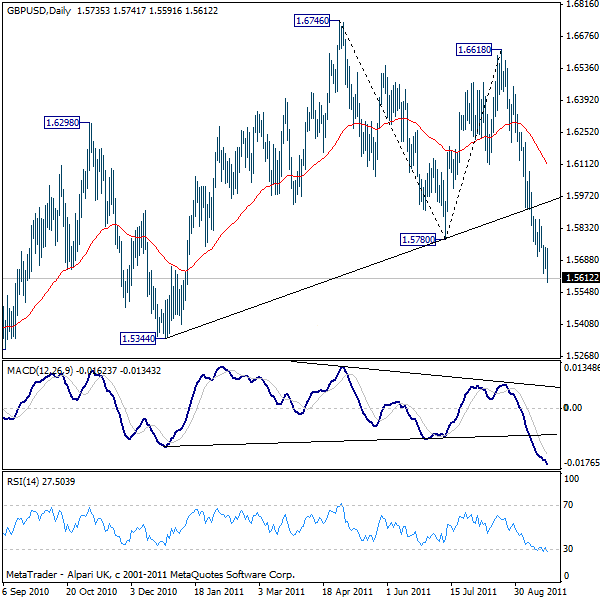
GBP/USD's fall resumes after brief consolidations and drops to as low as 1.5591 so far today. Intraday bias is back on the downside and further decline should be seen to next key medium term support at 1.5344. On the upside, above 1.5747 minor resistance will argue that a short term bottom is formed with bullish convergence condition in 4 hours MACD. In such case, lengthier consolidation would be seen before GBP/USD stages another decline.
In the bigger picture, rise from 1.4229, which is treated as the third leg of consolidation from 1.3503 (2008 low) should be finished at 1.6746 after GBP/USD completed a head and shoulder top reversal pattern (ls: 1.6298, h: 1.6746, rs: 1.6618). Fall from 1.6746 could be the fourth leg of the consolidation pattern from 1.3503 (2008 low) or resuming long term down trend from 2.1161 (2007 high). In either case, a test on 1.3503/4229 support zone should be seen. On the upside, break of 1.6618 resistance is needed to invalidate this view. Or we'll now stay cautiously bearish in GBP/USD.

USD/JPY Daily Outlook

Daily Pivots: (S1) 76.27; (P) 76.52; (R1) 76.68; 
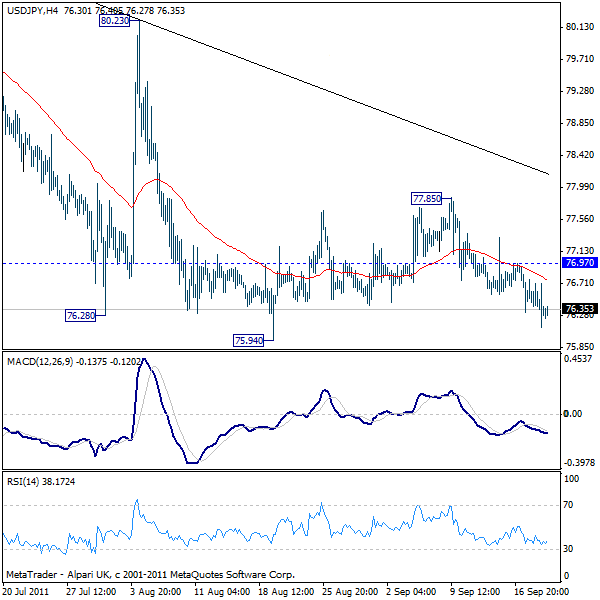
Intraday bias in USD/JPY remains on the downside and current fall is still in progress for 75.94 support. As noted before, consolidation from 75.94 should have completed at 77.85 already. Break of 75.94 will confirm resumption of whole fall from 85.51. On the upside, above 76.97 minor resistance will delay the bearish case again and turn bias neutral to extend the consolidation from 75.94.

In the bigger picture, USD/JPY is still staying well inside the falling channel that started back in 2007 at 124.13. There is no indication of trend reversal yet even though medium term downside momentum is diminishing with bullish convergence condition in weekly MACD. Such down trend is still in favor to continue to 70 psychological level. In any case, break of 80.23 resistance is first needed to indicate completion of fall from 85.51. Secondly, break of 85.51 is needed to be the first signal of medium term reversal. Otherwise, we'll stay cautiously bearish in the pair.


Economic Indicators Update

GMT Ccy Events Actual Consensus Previous Revised
22:45 NZD Current Account Balance Q2 -0.92B -0.69B -0.10B -0.09B
23:50 JPY Trade Balance Aug -0.29T -0.01T -0.13T -0.16T
0:30 AUD Westpac Leading Index M/M Jul 0.50T
0.10%
2:00 CNY Leading Indicator Jul 0.60%
1.00% 0.90%
4:30 JPY All Industry Activity Index M/M Jul 0.40% 0.50% 2.30%
8:30 GBP BoE Minutes 0--0--9 0--0--9 0--0--9
8:30 GBP Public Sector Net Borrowing (GBP) Aug 13.2B 11.4B -2.0B -5.2B
11:00 CAD CPI M/M Aug 0.30% 0.10% 0.20%
11:00 CAD CPI Y/Y Aug 3.10% 2.90% 2.70%
11:00 CAD BoC CPI Core M/M Aug 0.40% 0.20% 0.20%
11:00 CAD BoC CPI Core Y/Y Aug 1.90% 1.60% 1.60%
14:00 USD Existing Home Sales Aug
4.75M 4.67M
14:30 USD Crude Oil Inventories
-1.6M -6.7M
18:15 USD FOMC Rate Decision
0.25% 0.25%

Weekly Review and Outlook Euro Tumbled as Support Removed after ECB's Turn, More Downside ahead

Euro tumbled sharply last week as was the weakest major currency just next to the SNB intervened Swiss Franc. While sovereign debt crisis had been dragging along for some time, Euro have been receiving strong support from ECB's hike this year and expectation of of further tightening. Hence, EUR/USD stayed above 1.4 for most of the year and on every occasion of selloff due to negative news about Greece, Portugal or even Italy, the dips were relatively brief. However, ECB's turn into neutral stance last week sort of removed such strong support for the Euro. And this time, EUR/USD took out 1.4 psychological level with relative ease. Similar situation was found in in EUR/GBP, which stayed above 0.86 for most of the year but finally gave up last Friday.

ECB Trichet sounded quite dovish on the Eurozone economy in the post meeting pressing conference. The central bank revised lower growth forecasts and did not signal upside risks to inflation. The tone appeared that the central bank is ready for a rate cut should the economy deteriorate further. 
Executive Board member Jurgen Stark's resignation on Friday also surprised the markets. Stark was know to be in strong opposition to purchases of peripheral bonds. And Stark's resignation prompted some speculations to the markets that it's now easy for ECB to extend the quantitative easing program and even cut rates.

The Eurozone debt crisis would not go away easily. There were talk on Friday about a Greek default. Greece CDS hit all time high of 3238 basis points last week on concern that Greece cannot meet the terms for bailout. The CDS is implying over 90% chance of default indeed. And, further then that, there are also worries on that a Greek default will lead to default in Italy, Spain and elsewhere. Greece rejected talk of a default as "organized speculation," according to an e-mailed statement from the finance ministry. Nonetheless, Germany is believed to be preparing plans to shore up German banks in the worst case.

After release of lower than expected CPI data, SNB announced it's setting a floor of 1.2 in EUR/CHF, with immediate effect. The bank pledged to "enforce this minimum rate with the utmost determination and is prepared to buy foreign currency in unlimited quantities. In addition, the bank warned that EUR/CHF at 1.2 is still high for the economy and is deflation risks requires, the SNB will take "further measures". EUR/CHF jumped from around 1.1 to as high as 1.2190 after the announcement and was trapped between 1.20 and 1.22 since then. Recently, the Swiss Franc traded in diverged direction with Euro but the peg has now aligned the two currencies together.

Dollar was broadly higher last week on safe haven flow. Stocks stayed in range the week but are looking vulnerable to more another selloff soon. After the peg swiss franc's role as safe haven currency will recede. Yen did strengthened against most currencies except dollar but markets will be cautious on intervention threat from BoJ. Dollar, US Treasuries, UK Gilts and gold will be left as the choices in case of more risk aversion. US President Obama unveiled his USD 447b proposal to stimulate the US job markets last week but reactions was relatively mild. Fed Chairman Bernanke's speech was largely the same as the one at Jackson Hole. Fed is expected to announce new stimulus later this month but there is no hints on what will be offered. It's believed that the committe members are uncertain too and the two day FOMC meeting will involve some heated debate.

US President Obama unveiled his proposal to stimulate the US job markets last week. Obama's USD 447b job proposal mainly targets tax cut and investments. While more details will be released on September 19, the measures include a tax-cut for small businesses if they hire new workers or raise workers; a 4000 tax credit if a company hires anyone who has spent more than 6 months looking for a job and extra tax credits if they hire America's veterans; a 1-year payroll tax cut; extension of unemployment insurance and assistance on refinancing homeowners' mortgages. Obama called for an end to the 'political circus' which he believed is the main reason for S&P's downgrade.

Speaking to the Economic Club of Minnesota in Minneapolis, Fed Chairman Bernanke acknowledged that the pace of recovery has been 'much less robust' than previously anticipated' with 'the weakness of the housing sector' and 'continued financial volatility' being the two key factors resulting in the situation. Moreover, a 'substantial fiscal consolidation in the shorter term could add to the headwinds facing economic growth and hiring'. As far as inflation is concerned, the Chairman said the Fed saw 'little indication that the higher rate of inflation experienced so far this year has become ingrained in the economy'. Against this backdrop, the Fed is prepared to employ all necessary tools to 'promote a stronger economic recovery in the context of price stability'. The content of the speech was largely the same as the one at Jackson Hole.

Moderation of headline CPI to +6.2% y/y in August from +6.5% in the prior month signaled that inflation in China probably peaked in July. Yet, price levels remained elevated and it would be premature to expect China will abandon tightening or even shift to easing monetary policy. Growth of industrial production and fixed asset investment and retail sales decelerated further in August as a result of government's tightening measures. Yet, the rate of expansion remained resilient despite recent global economic turmoil. We expect to see further slowdown in economic activities in coming months but do not envisage any signs of hard landing.

Technical Highlights
The strong rally in dollar index and the break of 76.71 resistance in dollar index last week carries important technical implications. Also, note that dollar index closed above 55 weeks EMA. The overall development indicates that 72.69 is at least a medium term bottom. More importantly, the down trend from 88.7 might be finished with three wave down to 72.69 too. Outlook in the index is turned bullish now and further rise should be seen to 38.2% retracement of 88.70 to 72.69 at 78.80 in near term. Sustained break there will likely send the dollar index through 81.31 resistance in medium term to 61.8% retracement at 82.58 and above. In any case, we'll now stay cautiously bullish as long as 75.38 support holds. 
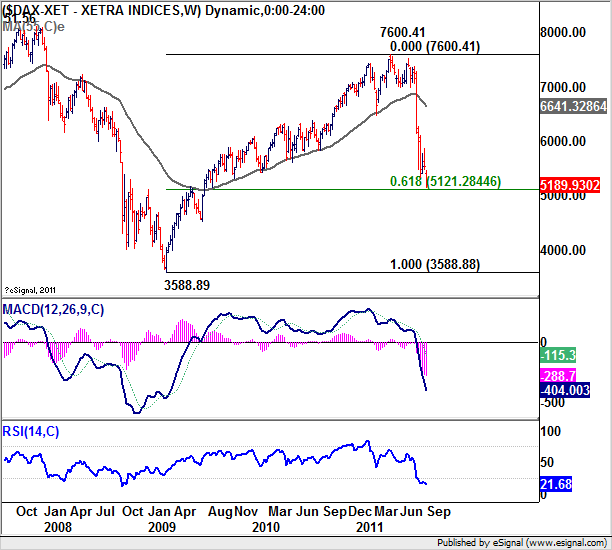
While major stock indices stayed in range last week, German DAX seemed to be leading the way again. Last week's dive to 5150 met some brief support above 61.8% retracement of 3589 to 7600 at 5121 and recovered. But there is clearly no strength in the recovery as the index weakened again on Friday to close at 5189. The index is vulnerable to more downside this week and we'd anticipate a test on 5000 psychological level ahead. 
DOW didn't break through 10604 support last week as we anticipated and turned sideway instead. Nevertheless, overall bearish outlook remains unchanged and it's just a matter of time when recent sharp decline from 12876 resumes. We'd expect more pressure on DOW this week and would favor more downside to retest 10604 this week. Decisive break there could bring accelerated selloff towards 50% retracement of 6469 to 12876 at 9672, which is close to 9614 medium term support. 
The Week Ahead
G7 issued a relatively brief statement over the weekend, noting "significant challenges to growth, fiscal deficits and sovereign debt" which is "reflected in heightened tensions in global financial markets." The group pledged to "strong and coordinated international response to these challenges." Initial focus this week will be on reaction to this rather dull statement. After that main focus will be on a number of UK data as well as US inflation data. Of course, developments in the Europe, in particular about Greece default, will be watched all the time.
  • Monday: BoJ Minutes, Japan tertiary industry index, Australia trade balance
  • Tuesday: UK RICS house price balance, CPI, trade balance, DCLG house price; US import prices, Fed budget
  • Wednesday: Swiss PPI; UK job report; Eurozone industrial production; US retail sales, PPI, business inventories; RBNZ rate decision
  • Thursday: SNB rate decision; UK retail sales; Eurozone CPI; US CPI, jobless claims, empire state manufacturing, Philly Fed survey, industrial production
  • Friday: Eurozone trade balance; US TIC capital flow, U of Michigan consumer sentiment

EUR/GBP Weekly Outlook

EUR/GBP drops sharply to as low as 0.8591 last week and the break of 0.8642 support confirms resumption of whole decline from 0.9083. Initial bias remains on the downside this week and deeper fall should be seen to 100% projection of 0.9083 to 0.8642 from 0.8884 at 0.8443 next. on the upside, above 0.8648 minor resistance will turn bias neutral and bring consolidations. But recovery should be limited by 0.8732 support turned resistance and bring fall resumption.

In the bigger picture, price actions from 0.9799 (2008) should be unfolding as a consolidation pattern in the long term up trend. The first leg is completed with three waves down to 0.8067. Second leg should also be finished at 0.9083. Fall fro 0.9083 is treated as the third leg and should now target 0.8067 first and possibly further to 61.8% projection of 0.9799 to 0.8067 from 0.9083 at 0.8013 (which is closes to 0.8 psychological level). Nevertheless, we'd expect strong support from 0.7693/8186 support zone to contain downside to finish off the consolidation. On the upside, break of 0.8884 resistance is needed to invalidate this view or we'll stay bearish now.

In the long term picture, long term up trend from 2000 low of 0.5680 shouldn't be over yet and the choppy fall from 2008 high of 0.9799 should be a correction only. We'd expect such correction to be contained by 0.7963/0.8186 support zone and bring up trend resumption. Rise from 0.5680 is still expected to extend beyond 0.9799 high eventually.

Big picture G10 Currency Charts

The charts below are for each of the G10 currencies versus an evenly weighted basket of the remainder of their G10 peers. The charts are small (as we work on updating the blog to allow links to larger graphics), but they nonetheless do cover quite a bit of ground – 2500 data points for each in fact, which hopefully gives an interesting perspective. Each of the time series starts at indexed 100 as of early February 2002. (The start point of the index changes with every refresh of the charts on  a rolling basis.)

Note that the charts were cut before the last leg of the action in the early US session after the news that Stark will resign from the ECB (rumored because of disagreements on bond buying) and on news ECB will back off on penalty rates for banks accessing emergency facilities.

USD

The US dollar has been dropping forever – note that while the dollar index crossed the 200-day moving average, the USD/G10 basket has not yet crossed this important level, though it is trading at the highest level in months and may be confirming a transition to a bullish trend after the recent basing action and loss of downside momentum.

EUR

How ironic is it that, as the EU is experiencing its worst existential crisis to date, the Euro is back close to its lowest levels in years….which are also the lowest levels since the Euro was launched amid intense skepticism over the entire idea of a single currency back in 2002.

JPY

The JPY remains resilient and relatively strong – but will likely only be so as long as rates remain absurdly low and/or the BoJ and Japanese government steal a page from the SNB’s book on the intervention front

GBP

GBP is experiencing a bit of a revival on Euro misery and as its down trend has been losing steam for a long time. Could the market be getting too complacent on further GBP weakness?

CHF

The magnitude of the run-up and the subsequent reversal is breathtaking, but leaves us, amazingly, still poised above the 200-day moving average! There’s a lot more room for franc weakness if the SNB’s intervention project succeeds.

AUD

AUD is extremely overvalued if the Asian growth story in any way derails. The focus has been intense on Europe, but many risk appetite signals are flashing around the world, which are most often associated with Aussie downside. Aussie hasn’t been garnering sufficient notice.

CAD

CAD has been a relatively low beta currency over the years relative to some of its peers. It is generally out of favor now, but could put up a fight or at least avoid broad weakness if the US economy and USD prove stronger than the market is currently expecting.

NZD

The NZD bull market has enjoyed an Indian summer, but it may fade on the potential for an Asian hiccup and if the post NZ earthquake GDP bump fades in the months ahead.

SEK

The krona is gaining favor as a safe haven from Euro turmoil. It may rally passively for a while, but historically has a hard time if its export markets are threatened.

NOK

NOK is very credible as a safe haven from a fundamental standpoint and has room to rally further, but what point does the Norges Bank begin to rattle it saber when EURNOK is already at almost decadal lows?

Reuters Sources Suggest ECB's Stark to Resign

ECB Executive Board Member Juergen Stark will step down from his post because of a conflict over the central bank's controversial bond-buying programme, two sources told Reuters on Friday. (No comment from ECB, but EUR taking it on the chin.
Read the full article here

Weaker CHF and lower volatility... SNB's Double Whammy!

What a dramatic week for the Swiss franc. Much has been written over the last few days on the Swiss National Bank's actions, pushing EURCHF spot from the 1.1200 all the way to where we are now (1.2150), firmly above the 1.2000 floor.  In our previous article, we highlighted the implied volatility price action during the CHF strengthening, and the all important interests to purchase EURCHF upside options seen prior to the move up in spot.
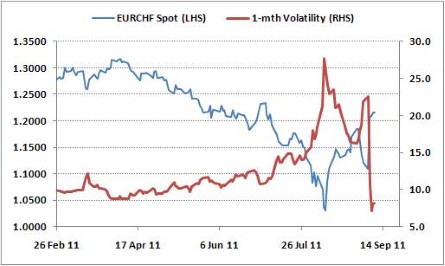
So what happened to EURCHF implied volatilities recently?  Well, movements have been as dramatic as they have been in the spot market. The below chart shows 1mth EURCHF implied volatility together with the spot price.

EUR/CHF  -  Spot and 1mth implied Volatility
(source Bloomberg)
Several points should be made:
  • EURCHF implied volatilities reached record high with spot dropping to the lows.
  • Volatilities collapsed after the SNB action. It should therefore be noted that, so far, the Central Bank’s actions have proven very successful. As per usual, central banks are not only complaining about currencies being under or overvalued, they also strongly argue against excessive volatility in financial markets. To that extent, SNB has hit home run!
  • As seen on the above chart, 1-month volatility fell from around 22% before the SNB intervention to about 8.5% at time of writing. Similar moves have been observed across the curve, with 1-year, for instance, dropping from 17% to 10.5%
  • We are seeing continued interest to sell EUR puts with strikes below 1.2000, from both end-users and interbank players. Indeed, with a supposed floor at this level, selling such options and collecting the premium is seen as a risk-free trade. A word of warning though… there is no such thing as a risk-free trade, and such strategies could prove very costly if the SNB is unable to defend this level, or, for instance, if it decides to adjust the floor level.
  • Over the last couple of days, we saw an interesting development in the option market: implied volatilities are gaining ground when spot drifts higher - rather than lower.  So far those moves in implied volatilities have been muted, but this is a large shift in sentiment from the FX options market.
  • As a result, risk-reversals have changed dramatically as well: 1month risk-reversal is now favoring the upside (0.80% middle)… those were quoted around 3.5 vols favoring downside prior to the move in spot!
  • Liquidity in the EURCHF FX options market has been extremely poor over the week, and is only slowly returning to normal.
So has the impact been limited to EURCHF implied volatilities? Certainly not! Following this week’s development, there has been a lot of talk about CHF not being the safe haven it once was (here again will we point to our previous article: CHF and Gold: unsafe havens amidst volatile option market?).  Following the CHF weakness, we noticed a lot of interest going into metals and Scandies.  Whether this is justified or not is almost irrelevant… What matters is that this shift in sentiment has triggered some very strong interest to purchase options in EURSEK, EURNOK and Gold (XAUUSD). For instance, the EURNOK implied volatility curve is currently quoted 11.25 / 12.25 after trading as high as 12.5.  in a way, some of the EURCHF volatility has been transferred to other perceived safe havens.

EURCHF and Dollar Index to soar as we head to global QE Extreme

The chart below shows why the new SNB EURCHF floor could be of extreme importance. I am just back from yet another trip to Zürich and I found people extremely bullish on CHF – with talk of corporates wanting to sell, sell, sell etc. But franc bulls need to pause a moment to consider the following few points:

  • The SNB has an ‘unlimited ability to print money’
  • The SNB is worried about deflation – hence the need to monetize
  • The bias is far too complacent on the direction for the CHF, with more than 95% on the bullish side
  • The SNB is clearly committed and feels there is no alternative and perhaps even more importantly, they have full political backing from the government.
Source: Bloomberg LLP and Strategy and Research
 
I have two strong view for the next 12 months:
1.       A much stronger US Dollar - DXY to 100 (now 75.00)
2.       A much higher EUR vs CHF - to 1.40/1.50

The scenario for much stronger US dollar:
The view on the greenback strengthening is based on a  too low consensus on US growth, better than ‘announced’ jobs and consumer spending data. Finally, the US will become competitive inside next two years on unit labor costs. Add to that the fat tail risk of HIA 2 being introduce- and the rest of the G-20 moving toward the same kind of QE measures we have seen from the US Fed – why should only the USD be punished for QE when “everyone is doing it?” (see more below)
 
The Scenario for a much higher EUR/CHF
The SNB has no alternative, Switzerland is headed full steam into “Japanisation” without extreme measures that include a major change in the “expectation curve” when we see 1.30 plus in EURCHF. Also, investors will have to cover massive losses from selling EUR calls. Finally, inside the next 12 months we will have some kind of a “resolution” on the EU debt crisis.
 
Macro themes
There are really only three ways to deal with the current situation:
  1. Accept Crisis 2.0 – deleveraging and pain, but also better for longer term restructuring – unlikely accepted by policy makers but more likely from a market perspective.
  2. Accept Japanisation – deflation, slow-growth and no structural changes.
  3. Go to QE Extreme/Maximum Intervention – betting that the ‘weather’ will improve by spending ever more money and making very gradual structural changes. The Keynesian economists/advisers are again getting upper hand as they now can claim (wrongly!) that the reason we did not get back on track is because we did too little, too late – similar to Japan. This is the route the G-20 will move to for now. I see all major nations in QE Extreme/Maximum Intervention mode by the halfway point of 2012.
 
By the way, more specifically on the current EuroZone crisis: Greece going bankrupt is not a fat fat-tail event (Black Swan), it’s the most expected outcome ever!
 
If Greece leaves the EU,  it will lead to a major “risk on” scenario as Europe will have regained the initiative, so if the Euro-zone’s next development is a break-up from the weak (Greece) then it’s good for risk – if it’s a break-out from the strong (Finland or Germany) it’s Crisis 2.0 extreme. Chances? 50/50
 
That’s it for now – I’m off to Spain and the Vuelta and some fact-finding,
 
Have a nice week-end
 
Steen

Trichet Press Conference Sees EURUSD Fibrillating around 1.40

Trichet was dovish on growth and inflation, but no new liquidity measures were announced, EURUSD tried through 1.40 initially, though we’ve got the key Obama speech on tap much later.

BoE “Decision”
The BoE’s pass on altering the rates and more importantly the asset purchase target was apparently a bigger surprise than we would have suspected, as sterling climbed steeply versus the Euro and the USD in the wake of the BoE announcement today, despite a lack of further details. Stay tuned for the minutes in two weeks and the

Euro rushes lower initially on Trichet rhetoric, but...
Trichet’s assessment of economic conditions were distinctly worse than in previous meetings, with downside risks deemed to outweigh upside risks on growth. On inflation, the rhetoric was the most dovish for some time, as Trichet said that inflation risks were no longer on the upside. This was not exactly a super-dove on display today at the press conference, however, as Mr. Trichet still describes policy as accommodative, no exactly a setup for a rate cut. As well, he stated that while the ECB stood ready to provide liquidity, it is not an issue for Euro area banks. Still, March 2012 Euribor futures jumped 7-8 ticks shortly after the press conference got away and the German 10-year yield dropped to an incredible sub-1.84% level.

Technically, a break on the close below the psychologically and technically significant 1.40 area and below the slightly higher 200-day moving average would be a bearish development, though let’s see where we stand at the end of this week. If the EURUSD remains below 1.40 beyond the US FOMC meeting later this month, EURUSD may open up a significant new downside range toward 1.30 eventually. If Obama doesn’t deliver tonight, the risk is that we remain interminably rangebound. The latter also becomes more likely if we trade above 1200 in the S&P500 in the days and weeks ahead (as a rough barometer of risk) and the bears lose their mojo.

US Data
US data was mixed, with a much smaller than expected trade balance, but a slightly worse than expected initial weekly claims data point, which stubbornly remains above 400 after showing signs of dipping a few weeks ago.

The Scandies
We noted recently that Scandies seem to have decoupled from the normal pro-risk correlation (historically much stronger for SEK, as NOK tends to be more strongly correlated with crude). After the last couple of days of action, we now need to underline the interesting behavior of the Swedish krone, which has strengthened very sharply despite a relatively dovish performance from the Riksbank this week, after which we see two-year government notes yielding almost 75 bps below the overnight rate now. For support of the idea that the market is attempting to use the Scandies as the next best safe havens after the CHF blow-up we offer the chart below. Eventually, the markets should watch out, however, as the liquidity in these currencies is a fraction of the liquidity in the CHF and the reaction pattern from the government and central banks could eventually be the same. The question is at what level and over what time frame is eventually? Norges bank in particular has experience with fighting a strong krone and both CB’s and governments will be quick to complain if we strengthen another few percent even from these levels.

Chart: EURSEK vs. German/Swedish rates
The rate picture for EURSEK has tended to more or less follow the interest rate spread of the two currencies for some time, but over the last few days, we’ve seen an interesting divergence in this trade, with widening differentials in favor of the Euro not seeing any reaction in EURSEK, which has instead fallen sharply. Part of that can be written off as a desperate search for alternatives after the franc implosion as the EU’s woes are ongoing. How long will this divergence last? Normally , the SEK is a pro-cyclical currency highly dependent on export markets. If theEuroZone economies are weakening, this would normally be considered a SEK-negative, but will the market prefer to focus on this or on Sweden’s healthy fiscal picture. 
Looking ahead
Obama is set to speak at midnight London time and 1900 New York time – normally a rather illiquid part of the trading day. But the market reaction may come despite the time of the day depending on the contents of that speech, so stay tuned. Again, the critical component is the degree to which Obama hints at a new version of the Homeland Investment Act that would allow companies to repatriate foreign profits at advantageous/no tax. It would be extraordinarily interesting if the HIA-2 hint is able to see the dollar decoupling more decidedly from its negative correlation with risk and strike out on its own path.

Economic Data Highlights
  • UK BoE Announces left interest rate and Asset Purchase Target as expected
  • EuroZone ECB left interest rate unchanged as expected
  • Canada Jul. Building Permits  out at +6.3% MoM vs. -1.5% expected
  • Canada Jul. New Housing Price Index out at +0.1% MoM vs. +0.3% expected
  • Canada Jul. International Merchandise Trade out at -0.75B vs. -1.0B expected and –1.37B in Jun.
  • Us Jul. Trade Balance out at -$44.8B vs. -$51.0B expected and vs. -$51.6B in Jun.
  • US Weekly Initial Jobless Claims out at 414k vs. 405k expected and 412k last week
  • US Weekly Continuing Claims out at 3717k vs. 3706k expected and 3747k last week
  • US Weekly Bloomberg Consumer Comfort Survey out at -49.3 vs. -49.1 last week

Upcoming Economic Calendar Highlights (all times GMT)
  • US Weekly Crude Oil and Product Inventories (1500)
  • US Fed’s Bernanke to speak (1730)
  • US Jul. Consumer Credit (1900)
  • US President Obama Speaks before Congress (2300)

Ratings and Recommendations